DORA Technical Standards Compliance: A Strategic Guide to RTS and ITS Validation

Michael Iyiola
Co-Founder, CWORT
Achieve DORA technical standards compliance with confidence. Learn to validate RTS/ITS and generate the evidence-based proof regulators demand for 2026.

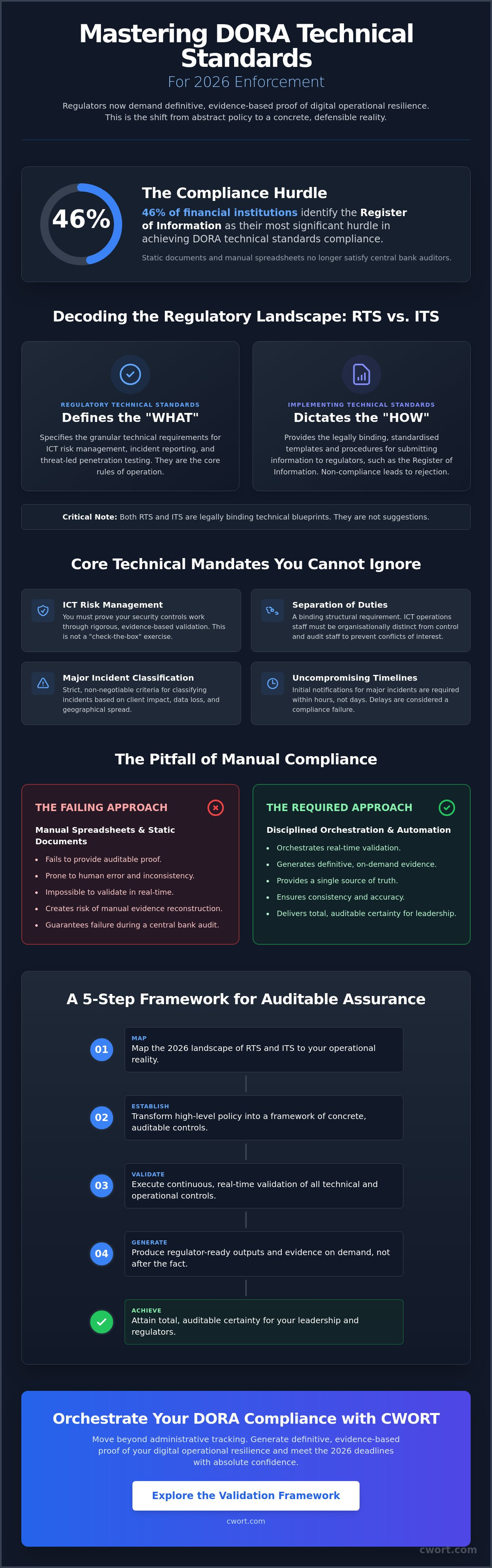
46% of financial institutions recently identified the Register of Information as their most significant hurdle whilst attempting to achieve DORA technical standards compliance. You're likely feeling the same pressure as the grace period for implementation ends and the 2026 enforcement cycle begins. It's no longer enough to maintain static policy documents or hope that manual spreadsheets will satisfy a central bank auditor. Regulators now demand definitive, evidence-based proof of your digital operational resilience. This shift from documentation to active enforcement requires a transition from abstract requirements to a concrete, defensible reality.
We understand the anxiety that stems from a lack of auditable certainty in a fragmented regulatory landscape. This guide moves you beyond simple administrative tracking and into the realm of disciplined orchestration. You'll learn how to master the complexities of Regulatory and Implementing Technical Standards by establishing a framework for total, auditable assurance. We provide a clear map of relevant standards and a systematic process for generating regulator-ready evidence, ensuring you meet the 2026 deadlines with absolute confidence.
Strategic Summary:
Map the 2026 landscape of Regulatory and Implementing Technical Standards (RTS/ITS) to move beyond static documentation and manual tracking.
Execute a 5-step strategic framework for DORA technical standards compliance that transforms high-level policy into auditable, evidence-based proof.
Recognise why manual spreadsheets fail during central bank audits and how to avoid the risks of manual evidence reconstruction.
Utilise CWORT to orchestrate real-time validation and generate regulator-ready outputs that provide total, auditable certainty for leadership.
Table of Contents
- Understanding the DORA Technical Standards Landscape in 2026
- Core RTS and ITS Requirements: ICT Risk, Incidents, and Third-Party Oversight
- The Pitfalls of Manual Compliance: Why Spreadsheets Fail the Audit
- Implementing a Strategic Validation Framework for Technical Standards
- CWORT: Orchestrating Auditable DORA Compliance and Proof
Understanding the DORA Technical Standards Landscape in 2026
The year 2026 marks a definitive shift in the regulatory environment. The Digital Operational Resilience Act (DORA) transitioned from a legislative framework to an enforced reality on 17 January 2025. Now, National Competent Authorities (NCAs) are moving beyond simple policy reviews. They're demanding proof. Achieving DORA technical standards compliance is no longer about intent; it's about evidence. You can't rely on the "grace period" anymore. Regulators expect a mature, functioning resilience framework that stands up to granular scrutiny.
The European Supervisory Authorities (ESAs), which include the EBA, EIOPA, and ESMA, drafted these mandates to eliminate any ambiguity. Whilst the five core pillars of DORA provide the high-level objectives, the technical standards offer the granular, technical enforcement mechanism. You won't satisfy an auditor by simply pointing to the regulation's primary text. You must demonstrate adherence to the specific RTS and ITS that govern your operations. This distinction is vital for leadership to understand. Pillars define the strategy; technical standards define the execution.
RTS vs ITS: What is the Practical Difference?
Technical standards are the engine room of the regulation. RTS define the "what"—the specific technical requirements for ICT risk management, incident reporting, and threat-led penetration testing. Conversely, ITS dictate the "how"—the standardised templates and procedures for submitting information, such as the Register of Information. These standards are legally binding for all financial entities and their ICT providers operating within the EU or across UK-EU borders. Failure to align with these specific templates leads to immediate submission rejection and potential fines. You must treat these as non-negotiable technical blueprints.
The Scope of Application for Financial Entities
The scope of application is intentionally broad. It encompasses over 22,000 entities, ranging from Tier 1 banks to critical third-party ICT providers. Whilst the ESAs apply a proportionality principle, this doesn't excuse smaller firms from rigorous oversight. It simply means the complexity of the validation may vary. Establishing a baseline through DORA compliance validation is the only way to determine your exact risk profile. Don't mistake a smaller scale for lesser accountability. The 2026 enforcement cycle prioritises structural integrity across the entire supply chain, meaning even niche providers must produce auditable proof of resilience.
Core RTS and ITS Requirements: ICT Risk, Incidents, and Third-Party Oversight
Achieving DORA technical standards compliance requires moving beyond high-level strategy into the granular mechanics of risk management. The RTS on ICT Risk Management Frameworks specifies the exact security policies, protocols, and tools required to protect ICT assets. Whilst smaller entities may utilise a simplified framework, the core expectation remains the same: you must prove your controls work. This is not a "check-the-box" exercise. It is a rigorous demand for operational integrity that leaves no room for administrative ambiguity.
One critical requirement often overlooked is the "Separation of Duties." DORA technical standards mandate that the individuals responsible for ICT operations must be distinct from those responsible for the control and audit of those operations. This isn't just a best practice; it's a binding structural requirement designed to prevent conflicts of interest and ensure objective oversight. If your current structure overlaps these responsibilities, you are already in breach of the technical standards regardless of your policy documentation.
The RTS on the classification of major ICT-related incidents sets strict criteria for what constitutes a "major" event. You're required to assess incidents based on client impact, data loss, and geographical spread. Reporting timelines are equally uncompromising. You must provide initial notifications within hours, not days. These DORA Core Requirements provide the technical foundation upon which all supervisory reviews are built. To see how these complex requirements can be automated into a single source of truth, explore our validation framework in action.
ICT Risk Management and Control Validation
Technical standards mandate that every control outcome is supported by verifiable evidence. You cannot simply claim a system is secure; you must bind the evidence to the specific regulatory requirement. This ensures that during the risk management lifecycle, you are ensuring compliance evidence integrity at every stage. Continuous monitoring and testing aren't optional extras. They are the primary mechanisms for validating that your ICT systems remain resilient against evolving threats.
Managing Third-Party Risk via Technical Templates
The ITS for the Register of Information is perhaps the most operationally taxing component. It requires a granular mapping of all contractual arrangements, including detailed information on subcontractors. For sectors with extensive supply chains, such as those navigating DORA compliance for insurance firms in 2026, this mapping must extend to any subcontracted service supporting critical or important functions. The technical challenge lies in moving from siloed contract lists to a unified, regulator-ready register that reflects your entire ICT supply chain.
The Pitfalls of Manual Compliance: Why Spreadsheets Fail the Audit
Many organisations ask a recurring question: "Why can't I use Jira or Excel to track DORA technical standards compliance?" The answer is simple. These tools were never designed to maintain the structural integrity required for a central bank audit. They are static trackers in a high-stakes environment that demands dynamic, real-time proof. Relying on manual spreadsheets creates a false sense of security whilst building significant "compliance debt" that only becomes visible when a regulator demands evidence of operational resilience. You aren't just tracking tasks; you're building a defensible record of truth.
Manual evidence reconstruction is a catastrophic audit risk. When you attempt to pull together disconnected emails and screenshots months after an event, you risk failing the primary test of auditable truth. Regulators view reconstruction as a lack of internal control. They don't want to see a narrative written under the pressure of an audit deadline. They want to see a system that captures validation as it happens. Contrast your current manual tracking with an orchestrated validation system. One relies on human memory and fragmented files; the other provides a definitive, unalterable record of execution. Stop hoping your spreadsheets will suffice. Start building a framework that removes the possibility of failure.
The Problem with Fragmented Evidence
Disconnected screenshots and email threads fail to prove control effectiveness because they lack context and a verifiable timeline. Regulators now demand an unbroken chain of custody for every piece of compliance evidence. Manual tools cannot guarantee DORA separation of duties enforcement, as they often allow the same user to record a task and "validate" its completion. This lack of structural discipline is an immediate red flag for any sophisticated auditor. You need a system that enforces accountability by design, ensuring that validation is independent and tamper-proof.
Moving Beyond GRC to Orchestration
Traditional GRC tools often serve as "graveyards for data" where policies go to die. They track obligations but fail to drive execution. Orchestration changes this dynamic by translating abstract requirements into validated, real-time activities. This shift toward regulatory compliance workflow automation is essential for UK enterprises aiming for true resilience. Orchestration ensures that every technical standard is met with a specific, validated action. It moves your organisation from a state of passive tracking to proactive, evidence-based control.
Implementing a Strategic Validation Framework for Technical Standards
Transitioning from static policy to operational reality requires a disciplined, multi-stage approach. You cannot achieve DORA technical standards compliance through passive observation. It requires the active decomposition of regulatory mandates into specific, validated actions. This framework moves your organisation beyond the "policy graveyard" and into a state of continuous, auditable execution. By following these steps, you establish the structural integrity necessary to satisfy both internal boards and external regulators.
Step 1 & 2: Obligation Mapping and Activity Orchestration
Decompose every RTS and ITS document into granular, assignable activities. This process transforms dense regulatory text into a linear progression of organisational actions. Every technical requirement must be bound to a specific "doer" responsible for execution and a "checker" responsible for validation. This structure enforces the separation of duties by design. It ensures that no single individual controls both the activity and its proof, creating a clear path from obligation to verified result. Mapping these dependencies early prevents the fragmentation that typically leads to audit failure.
Step 3 & 4: Evidence Binding and Real-Time Validation
Bind evidence directly to the control outcome at the moment of execution. This eliminates the need for manual reconstruction and ensures that your data remains current. Automating this process allows for the real-time validation of evidence, ensuring it meets the rigorous standards of a central bank audit. Continuous validation removes the typical "pre-audit panic" by maintaining a permanent, regulator-ready state. You don't prepare for an audit; you exist in a state of constant audit-readiness, where every control is backed by definitive, time-stamped proof.
The final stage involves Step 5: Board-Level Reporting and Continuous Improvement. Leadership requires absolute visibility into the technical compliance status of the enterprise. This reporting must be uncompromisingly objective, providing a real-time view of risk posture rather than a curated quarterly summary. Professional implementation ensures that your custom control models are mapped accurately to the DORA landscape, providing the professional maturity expected by National Competent Authorities. To see how this framework transforms your regulatory posture, request a demonstration of our validation system.
CWORT: Orchestrating Auditable DORA Compliance and Proof
Achieving sustainable DORA technical standards compliance requires a fundamental shift from administrative tracking to systematic orchestration. CWORT is the enterprise platform designed to eliminate the inherent risks of manual trackers. It replaces the fragility of spreadsheets with a robust governance engine that enforces discipline by design. Whilst manual methods fail under the pressure of regulatory scrutiny, CWORT provides the auditable certainty required to satisfy National Competent Authorities. It moves your organisation from a state of fragmented data to a single, defensible source of truth.
The platform is engineered to mirror the gravity of high-stakes regulatory environments. It enforces the separation of duties and binds evidence to outcomes automatically, ensuring that your compliance posture remains structurally sound. You don't have to worry about manual reconstruction or the validity of your audit trail. CWORT acts as the voice of reason across your entire governance landscape, providing a disciplined framework that handles the complexities of DORA alongside other critical mandates. It is the proactive system that ensures accountability is not just a policy, but an operational reality.
Regulator-Ready Proof on Demand
CWORT generates auditable proof that demonstrates control effectiveness without the need for manual intervention. This capability is vital for internal teams and consulting partners who require a unified, orchestrated system to manage complex validation cycles. By replacing Jira and Excel with a sophisticated governance engine, you eliminate the "compliance debt" that typically accumulates in disconnected tools. You gain the ability to produce board-level outputs that are accurate, objective, and immediately ready for supervisory review. It transforms the audit process from a source of anxiety into a routine demonstration of professional maturity.
Future-Proofing Your Compliance Strategy
Regulatory requirements are not static. CWORT scales to manage multiple frameworks, allowing you to manage NIS2 Compliance Orchestration and ISO 27001 Control Mapping within the same disciplined environment. This multi-framework capability ensures that your governance strategy remains cohesive and efficient as new mandates emerge. The value of SaaS orchestration lies in its ability to maintain a defensible truth for the board, regardless of the complexity of the underlying ICT supply chain. Secure your operational resilience and enquire about DORA Compliance Validation with CWORT today.
Securing Your Regulatory Future Through Auditable Certainty
The transition from implementation to active enforcement in 2026 marks a turning point for the financial sector. You've seen why manual trackers and fragmented evidence fail to meet the rigorous demands of a central bank audit. Success requires a shift from static documentation to a state of continuous, evidence-based validation. By decomposing complex RTS and ITS mandates into orchestrated activities, you move beyond administrative tracking and into the realm of definitive proof.
CWORT provides the enterprise-grade compliance validation engine necessary to achieve DORA technical standards compliance with absolute precision. Designed to manage DORA, NIS2, and ISO 27001, the platform replaces manual Jira and Excel trackers with a sophisticated governance engine that produces auditable proof by design. It's time to replace the anxiety of potential failure with the calm of structural integrity. Orchestrate your DORA compliance validation with CWORT and ensure your organisation is prepared for the scrutiny ahead. You have the framework; now execute with confidence.
Frequently Asked Questions
What are the main Regulatory Technical Standards (RTS) under DORA?
The main RTS focus on ICT risk management frameworks, the classification of major ICT-related incidents, and the oversight of third-party subcontracting. These standards provide the technical granularity required to enforce the high-level pillars of the regulation. They ensure that every financial entity maintains a consistent baseline of resilience across the European Union.
How do DORA technical standards differ from NIS2 requirements?
DORA acts as lex specialis, meaning its specific rules override the more general NIS2 requirements for the financial sector. Whilst NIS2 applies to a broad range of critical industries, DORA provides a much more prescriptive and technical set of mandates tailored to financial services. Compliance with DORA technical standards effectively satisfies the equivalent NIS2 obligations for financial organisations.
Is DORA compliance mandatory for UK financial institutions in 2026?
DORA is an EU regulation and doesn't directly apply to UK firms that lack EU operations or branches. However, any UK institution providing cross-border services into the EU or maintaining subsidiaries within the Union must comply. Most UK firms choose to align with these standards to maintain operational compatibility and satisfy the expectations of international regulators.
What happens if we fail to meet the ITS reporting templates for the register of information?
Failure to utilise the correct ITS templates leads to the immediate rejection of your submission by the National Competent Authority. This triggers a state of non-compliance, which can result in fines of up to 2% of your total annual worldwide turnover. Senior management also faces personal liability, with potential fines reaching €1 million for failing to enforce these technical reporting mandates.
Can we use our existing ISO 27001 evidence for DORA technical standards compliance?
You can utilise ISO 27001 evidence as a foundation, but it must be mapped and validated against specific DORA mandates. ISO 27001 is a voluntary framework, whereas DORA is a binding regulation with prescriptive technical outcomes. Achieving DORA technical standards compliance requires moving beyond general security controls to provide specific, auditable proof for each RTS and ITS requirement.
What is the role of the ESAs in enforcing DORA technical standards?
The European Supervisory Authorities (ESAs) draft the technical standards and maintain direct oversight of the 19 Critical ICT Third-Party Providers designated in November 2025. For other financial entities, the ESAs provide the templates and guidance that National Competent Authorities use for enforcement. They ensure that supervisory reviews remain consistent and rigorous across all member states.
How does CWORT help with the separation of duties required by DORA?
CWORT enforces the separation of duties by hard-coding distinct "doer" and "checker" roles into every compliance workflow. The platform ensures that the individual responsible for executing an ICT control cannot be the same person who validates its effectiveness. This structural discipline provides the objective, independent proof that regulators demand during a formal audit.
What is the deadline for complying with the second batch of DORA technical standards?
The second batch of technical standards applied progressively through 2025 and 2026, with the second annual submission of the Register of Information due by 31 March 2026. Missing these critical deadlines signals a failure in your DORA technical standards compliance framework. Regulators now expect mature, evidence-based submissions rather than the preliminary documentation accepted during the initial implementation phase.
Disclaimer
The content on this site is provided for general information and educational purposes only. It does not constitute legal, regulatory, financial, or professional advice. CWORT provides AI-assisted insights and workflow automation, but all compliance decisions remain the responsibility of your organisation and its management. Always seek qualified legal or regulatory guidance for decisions relating to the UK NIS Regulations, CAF, DORA, NIS2, ISO 27001, or other obligations.
Related posts
DORA Technical Standards Compliance: Moving from Regulatory Theory to Validated Execution
Struggling with DORA technical standards compliance? Move beyond spreadsheets to a validated framework that provides real-time, auditable evidence for regula...
Challenges of DORA Compliance for Financial Institutions in 2026: A Strategic Guide
Facing the challenges of DORA compliance for financial institutions? Our 2026 guide helps you move from manual tracking to automated validation for total ass...
Choosing a DORA Operational Resilience Platform: Validation vs Documentation
Move beyond spreadsheets. Discover how a DORA operational resilience platform provides validated proof, not just documentation, for total, defensible assurance.
Article by
Michael Iyiola
Co-Founder, CWORT
Michael Iyiola is a co-founder of CWORT and a Cyber and AI Security Engineer with deep experience in vulnerability management, detection engineering and operational resilience across UK critical national infrastructure, including rail, energy and financial services. At CWORT, he designs scalable, evidence-driven workflows that help teams meet modern regulatory and security demands.
Build Your Foundation of Auditable Certainty
Take control of your regulatory obligations and secure your infrastructure with CWORT.