Enterprise GRC Validation Tool: Orchestrating Regulatory Proof in 2026

Michael Iyiola
Co-Founder, CWORT
Is your GRC audit-ready? Discover how an enterprise GRC validation tool provides deterministic proof, automates reporting, and ensures DORA & NIS2 compliance.

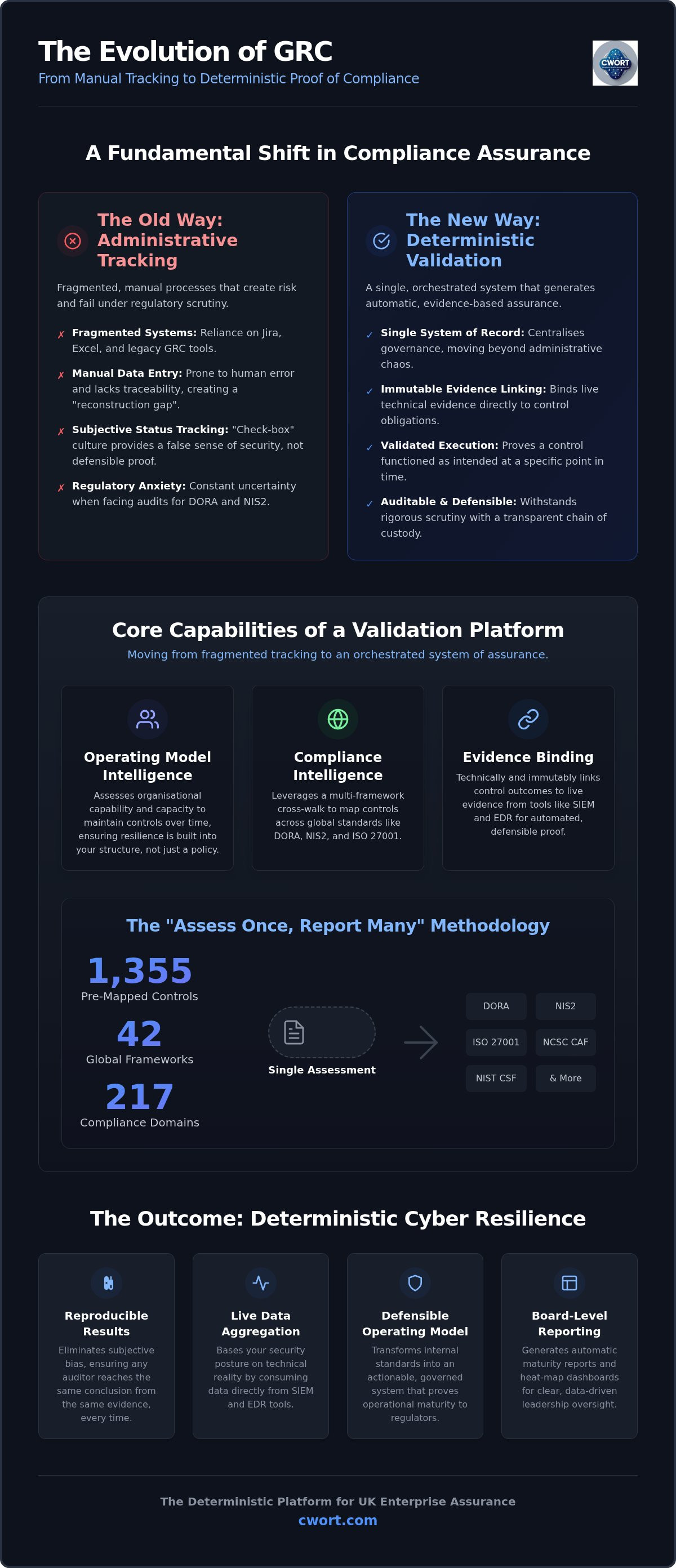
What if the difference between a successful audit and a regulatory fine isn't your security posture, but your ability to prove it exists without human intervention? Most UK leadership teams are exhausted by the fragmented reality of tracking compliance across Jira, Excel, and legacy GRC systems. It's a high-stakes environment where the anxiety of DORA and NIS2 scrutiny feels constant. You likely recognise that manual tracking is no longer sufficient to demonstrate separation of duties or evidence integrity to increasingly rigorous regulators.
It's time to shift from administrative record-keeping to definitive, evidence-based proof. Utilising a deterministic enterprise GRC validation tool moves your organisation beyond the chaos of manual updates and into a state of auditable, regulator-ready assurance. This article explores how to orchestrate a single system for compliance validation that generates automatic, board-level reporting. We'll examine the path to achieving deterministic proof of cyber resilience and operational maturity, ensuring your governance is a source of certainty rather than a cause for concern.
Key Takeaways
- Shift from passive administrative tracking to deterministic orchestration by understanding the fundamental evolution of modern validation platforms.
- Recognise why a specialised enterprise GRC validation tool is essential for providing the evidence integrity and auditable assurance that generic task managers cannot deliver.
- Leverage a "assess once, report many" methodology to map controls across 42 global frameworks, including DORA, NIS2, and ISO 27001, using a library of 1,355 pre-mapped controls.
- Implement a defensible compliance operating model by following a structured seven-step process to transform internal standards into actionable, governed systems.
- Replace manual data gathering with automatic, board-level reporting that provides deterministic proof of your organisation's operational maturity and cyber resilience.
Table of Contents
- The Evolution from GRC Management to Enterprise GRC Validation
- Core Capabilities of a High-Maturity Validation Platform
- Implementing a Defensible Compliance Operating Model
- CWORT: The Deterministic Platform for UK Enterprise Assurance
- Secure Your Regulatory Future with Deterministic Orchestration
The Evolution from GRC Management to Enterprise GRC Validation
Traditional approaches to Governance, risk, and compliance (GRC) often rely on static platforms that serve as little more than digital filing cabinets. These systems track the status of a project but fail to validate the integrity of the underlying work. An enterprise GRC validation tool represents a fundamental shift in this discipline. It functions as a deterministic orchestration engine, moving beyond administrative tracking to bind live evidence directly to control obligations. This transition is essential as 2026 marks a period of intensified enforcement for regulations like the Digital Operational Resilience Act (DORA).
Regulators no longer accept "status tracking" as proof of compliance. They demand validated execution. This means your organisation must demonstrate not just that a control exists, but that it functioned as intended at a specific point in time. Validation platforms automate this by creating an immutable link between the control requirement and the technical evidence. It replaces the "check-box" culture with a system of record that is both transparent and defensible.
Why Administrative GRC Tools Fail Under Regulatory Scrutiny
Traditional GRC platforms frequently suffer from what auditors call the "reconstruction gap". This occurs when a control is marked as compliant, yet the evidence required to prove that state is disconnected, missing, or manually entered. Manual data entry introduces significant risk, as it lacks the traceability needed for high-stakes audits. Validation tools mitigate this by enforcing separation of duties by design. They ensure that the person responsible for the control is not the same entity validating the evidence. This creates a transparent chain of custody that withstands rigorous scrutiny under NIS2 and DORA frameworks.
The Deterministic Standard for Cyber Resilience
True cyber resilience requires reproducibility. If an auditor reviews the same evidence twice, they should reach the same conclusion every time. This is the core of deterministic scoring. By eliminating subjective bias, an enterprise GRC validation tool provides a consistent measure of maturity. These systems aggregate data directly from SIEM and EDR tools, ensuring that the "truth" of your security posture is based on technical reality rather than optimistic manual updates. This level of rigor is now the minimum standard for organisations operating within the UK's critical infrastructure and financial sectors, where "almost compliant" is a synonymous with failure.
Core Capabilities of a High-Maturity Validation Platform
A high-maturity enterprise GRC validation tool is defined by three critical pillars: Operating Model Intelligence, Compliance Intelligence, and Evidence Binding. These elements move the organisation away from fragmented tracking and toward a singular orchestrated system. By integrating these pillars, leadership can finally access board-ready maturity reports and heat-map dashboards that reflect technical reality rather than administrative optimism. This visibility is powered by an integration layer that consumes data directly from existing operational registers, ensuring that governance sits above, not separate from, daily operations.
Central to this orchestration is a multi-framework cross-walk capability. UK organisations must frequently manage overlapping requirements from the NCSC Cyber Assessment Framework (CAF), NIST CSF 2.0, ISO 27001:2022, and DORA. A robust validation platform utilises a comprehensive control taxonomy library, featuring 1,355 controls across 217 domains. This allows for an "assess once, report many" strategy. You can view these framework mappings in action to see how a single assessment satisfies multiple regulatory obligations simultaneously.
Operating Model Intelligence vs. Compliance Tracking
Operating model intelligence goes beyond merely checking if a control exists. It assesses the actual capability maturity and capacity of the organisation to maintain that control over time. Design your Target Operating Model (TOM) within an enterprise GRC validation tool to evaluate whether a practice is sustainable given current staffing levels. It's useless to have a high-level security policy if the team lacks the capacity to execute it. This pillar measures the health of the process itself. It ensures resilience is built into the organisational structure rather than being a temporary state of compliance.
Binding Evidence to Control Outcomes
Evidence binding is the technical process of defensive content processing. It ensures that technical evidence is protected, indexed, and immutable. This level of rigor is a mandatory requirement for Critical National Infrastructure (CNI) providers who face intense regulatory scrutiny. The platform automatically maps technical outputs to specific control outcomes. This creates a defensible audit trail. Because the system is deterministic, identical evidence will always yield the same compliance result. Eliminate subjective bias. Provide the board with absolute certainty regarding the organisation's defensive posture.
Don't mistake task completion for regulatory compliance. Many UK organisations rely on Jira or Excel to manage their governance obligations, yet these tools are fundamentally incapable of providing the evidence integrity required in 2026. A generic task manager tracks what people say they've done. In contrast, an enterprise GRC validation tool proves what has actually occurred through technical binding. Regulators conducting DORA or NIS2 audits increasingly reject manual trackers because they lack the deterministic scoring and immutable evidence binding necessary for a defensible audit trail. Relying on a tick-box in a ticket is a liability, not a strategy. ### The Governance Deficit in Project Management Software
Project management software lacks the rigorous tenant isolation and granular role-based access controls essential for high-stakes governance. When evidence is stored within fragmented tickets, your organisation faces the "evidence drift" phenomenon. Proof becomes disconnected from the original control, making it nearly impossible to produce reproducible maturity scores. If an auditor requires a reconstruction of your security posture from a specific date, searching through historical task lists is a high-risk strategy. These tools don't enforce the separation of duties required by design. This leaves your compliance status vulnerable to subjective bias, as the person performing the task is often the same individual marking it as complete.
Moving from Fragmented Tracking to Orchestrated Truth
Orchestration represents a higher level of professional maturity. It is not simply another utility for the stack. Instead, it is a proactive system that sits above your existing operational registers to present a clear, explainable view of your defensive reality. By implementing an enterprise GRC validation tool, you replace the manual effort of evidence reconstruction with real-time, auditable assurance. This transition is powered by regulatory compliance workflow automation, which ensures that every technical action is automatically mapped to a specific regulatory outcome. This approach provides leadership with a single version of the truth. It eliminates the anxiety of potential failure by replacing fragmented spreadsheets with a disciplined, systematic path toward total assurance.
Implementing a Defensible Compliance Operating Model
Constructing a defensible model requires more than a simple checklist. It demands a structured seven-step progression that transforms abstract internal standards into a live, actionable system. By utilising an enterprise GRC validation tool, leadership can move beyond guesswork to configure precise assessment blueprints. These blueprints define the scope of the evaluation and assign specific participants, ensuring that accountability is clear and separation of duties is enforced from the outset. This systematic approach replaces fragmented workflows with a disciplined lifecycle of assessment, validation, and reassessment.
The core of this implementation lies in the calculation of maturity and confidence levels. The platform processes captured responses through a deterministic engine, meaning the result is based on objective evidence rather than subjective opinion. Once gaps are identified, the prioritisation engine ranks remediation tasks by business risk and potential value. This ensures that resources are allocated to the most critical vulnerabilities first. It's an enterprise GRC validation tool that turns raw data into a strategic roadmap, providing a clear path from current state to target maturity.
Governing Your Own Intellectual Property (BYOC)
Standard frameworks are often insufficient for organisations with unique operational requirements. High-maturity platforms allow you to "Bring Your Own Content" (BYOC), enabling you to define proprietary maturity criteria and weightings within a centralised digital model. This "Option B" approach ensures that your specific governance intellectual property is governed with the same rigor as global standards. Version control is integrated into the model catalogue, preventing the loss of historical context and ensuring that your Operating Model Maturity Assessment remains durable as your organisation evolves. You can book a demonstration of the BYOC workflow to see how your internal models can be digitised and governed.
Actionable Improvement Roadmaps
A defensible model must lead to measurable change. The system identifies specific gaps and generates actionable improvement roadmaps based on business priority. These granular component details roll up into portfolio-level visibility, allowing the board to see the health of the entire organisation at a glance. This transition from "Diagnose" to "Deliver" and finally "Demonstrate" occurs within a single environment. It eliminates the need for external reporting tools and ensures that every remediation action is tracked through to its final validation. You don't just fix problems; you prove they're solved in a way that is immediately ready for regulatory inspection.
CWORT: The Deterministic Platform for UK Enterprise Assurance
CWORT transforms abstract security functions into measurable, defensive models. It functions as a proactive enterprise GRC validation tool that replaces fragmented spreadsheets with a disciplined orchestration engine. With a library of 1,355 controls mapped across 42 global frameworks, CWORT provides the structural integrity required for complex corporate oversight. It offers first-class support for OT/ICS and critical infrastructure standards, ensuring that industrial environments are governed with the same rigor as corporate IT. Reproducibility is maintained through a suggestion-only AI advisory. This ensures that AI never alters deterministic outcomes, keeping your compliance status defensible and objective. You can request a demo to see this orchestration engine in action.
Audit-Defensible Proof for Regulators
Producing regulator-ready evidence shouldn't be a manual burden. CWORT generates board-level reports that reflect the technical reality of your controls. As of June 2026, 98.6% of active controls within the platform carry direct framework references. This level of traceability is essential for maintaining compliance evidence integrity during intensive audits. The system enforces accountability by design, ensuring that every piece of evidence is bound to a specific regulatory requirement. This eliminates the "reconstruction gap" and provides auditors with a transparent, immutable chain of custody. It replaces the anxiety of potential failure with the calm of auditable certainty.
Orchestrating UK Cyber Resilience
UK critical infrastructure providers face a unique set of challenges. CWORT simplifies this by mapping the NCSC Cyber Assessment Framework (CAF) directly to DORA and NIS2 obligations. This "assess once, report many" capability is a cornerstone of professional maturity. For organisations with bespoke requirements, professional services are available to map CWORT's deterministic engine to specific internal programmes. This ensures that your governance model is both durable and tailored to your operational reality. Stop reacting to regulatory shifts and start orchestrating your defence. Book a pilot to demonstrate the end-to-end workflow and secure your organisation's future through systematic validation.
Secure Your Regulatory Future with Deterministic Orchestration
Compliance is no longer an administrative burden to be managed. It's a technical reality to be orchestrated. Moving beyond fragmented tracking in Jira or Excel allows for absolute evidence integrity across your entire estate. By utilising a library of 1,355 controls across 217 domains, your organisation can finally achieve the "assess once, report many" standard required for modern UK governance. This shift from manual record-keeping to automated validation is the only way to maintain pace with evolving standards.
Adopting a robust enterprise GRC validation tool ensures that 98.6% of your active controls carry direct framework references. This creates the audit-defensible evidence binding necessary to withstand DORA and NIS2 scrutiny with total confidence. You have the power to replace the anxiety of regulatory failure with the calm of auditable certainty. Take control of your operational maturity today. Request a CWORT Demo to Orchestrate Your Compliance and transform your governance into a source of strategic strength. Your path to definitive, auditable assurance starts here.
Frequently Asked Questions
What is the difference between a GRC management tool and a GRC validation tool?
A GRC management tool functions as an administrative tracker for tasks and documentation, often relying on manual updates. In contrast, an enterprise GRC validation tool serves as a deterministic orchestration engine that binds live evidence to specific controls. It moves the organisation from a state of declared compliance to validated assurance. This distinction is critical for UK firms facing rigorous audits, where technical proof of control effectiveness is now the mandatory standard for regulatory submission.
Can I use my own internal maturity models within a GRC validation platform?
Yes, high-maturity platforms support "Bring Your Own Content" (BYOC) workflows. This allows organisations to digitise proprietary maturity models, weightings, and assessment criteria within a governed environment. By importing your unique intellectual property, you ensure that internal standards are subjected to the same deterministic validation as global frameworks like ISO 27001. This approach maintains a centralised digital model with full version control, ensuring your custom governance remains durable and auditable over time.
How does a validation tool help with DORA and NIS2 compliance?
Validation tools provide the evidence integrity required to meet the stringent transparency mandates of DORA and NIS2. They automate the mapping of technical outputs to regulatory requirements, ensuring that every control is backed by immutable proof. By using a library of 1,355 pre-mapped controls, organisations can demonstrate operational resilience to regulators without manual data gathering. This reduces the reconstruction gap and replaces the anxiety of potential failure with definitive, regulator-ready reporting.
Does a GRC validation tool replace my existing security tools like SIEM or EDR?
No, a validation tool doesn't replace your SIEM, EDR, or vulnerability scanners. Instead, it functions as an orchestration layer that sits above these operational registers to consume and aggregate their data. It transforms the raw technical outputs from your existing security stack into explainable, board-level maturity scores. This integration ensures that your governance reflects technical reality, providing a single version of the truth that spans across all security and IT functions.
How long does it take to implement an enterprise GRC validation tool?
Implementation timelines vary based on organisational complexity and existing maturity. However, because these platforms utilise pre-configured taxonomy libraries and automated framework cross-walks, initial assessment blueprints can often be deployed within weeks. The focus is on rapid integration with existing operational registers to begin evidence binding immediately. This streamlined approach avoids the multi-month configuration cycles associated with legacy GRC systems, delivering audit readiness in a significantly shorter timeframe.
What is deterministic scoring in governance, risk, and compliance?
Deterministic scoring is a methodology where identical evidence always yields the exact same compliance result, regardless of the assessor. It eliminates the subjective bias and optimistic reporting common in manual assessments. By applying a fixed logic to evidence validation, the enterprise GRC validation tool ensures that maturity scores are reproducible and defensible. This rigor provides the board with an uncompromisingly objective view of the organisation's defensive posture and operational maturity levels.
How does CWORT manage separation of duties in complex organisations?
CWORT enforces separation of duties through granular role-based access controls and structured assessment blueprints. By design, the platform ensures that the individuals responsible for executing a control are not the same entities responsible for validating the evidence. This professional discipline is built into the workflow orchestration, preventing conflicts of interest and ensuring the integrity of the audit trail. It establishes a transparent chain of accountability that's essential for UK critical infrastructure providers.
Is the AI advisory in CWORT capable of changing audit results?
No, the AI advisory in CWORT is strictly a suggestion-only utility. It's designed to assist users in identifying gaps or suggesting remediation actions, but it never alters the deterministic outcome of an assessment. This boundary is critical for maintaining audit defensibility. Because the final validation logic remains fixed and transparent, the reproducibility of your results is preserved. This ensures that your compliance status is always based on hard evidence rather than opaque algorithmic decisions.
Disclaimer
The content on this site is provided for general information and educational purposes only. It does not constitute legal, regulatory, financial, or professional advice. CWORT provides AI-assisted insights and workflow automation, but all compliance decisions remain the responsibility of your organisation and its management. Always seek qualified legal or regulatory guidance for decisions relating to the UK NIS Regulations, CAF, DORA, NIS2, ISO 27001, or other obligations.
Related posts
Jira for Compliance vs Orchestration: Why Task Tracking Fails Regulatory Audits
Discover why Jira fails DORA & NIS2 audits. In the debate of Jira for compliance vs orchestration, learn why task tracking isn't proof & how to automate assu...
NIS2 Audit Readiness Tool: Orchestrating Evidence-Based Compliance in 2026
Is your NIS2 compliance built on spreadsheets? Discover how a dedicated NIS2 audit readiness tool orchestrates evidence to deliver auditable proof and certai...
The Evolution of the Enterprise GRC Validation Tool: From Tracking to Orchestration in 2026
Stop chasing compliance ghosts in spreadsheets. Create a single source of truth for compliance with GRC orchestration to master NIS2, DORA, and UK audit dema...
Article by
Michael Iyiola
Co-Founder, CWORT
Michael Iyiola is a co-founder of CWORT and a Cyber and AI Security Engineer with deep experience in vulnerability management, detection engineering and operational resilience across UK critical national infrastructure, including rail, energy and financial services. At CWORT, he designs scalable, evidence-driven workflows that help teams meet modern regulatory and security demands.
Build Your Foundation of Auditable Certainty
Take control of your regulatory obligations and secure your infrastructure with CWORT.