Evidence gathering from different systems with automated extraction

Michael Iyiola
Co-Founder, CWORT
Learn how to streamline evidence gathering from different systems using responsible automation, clear control links and traceable audit-ready records for aud...

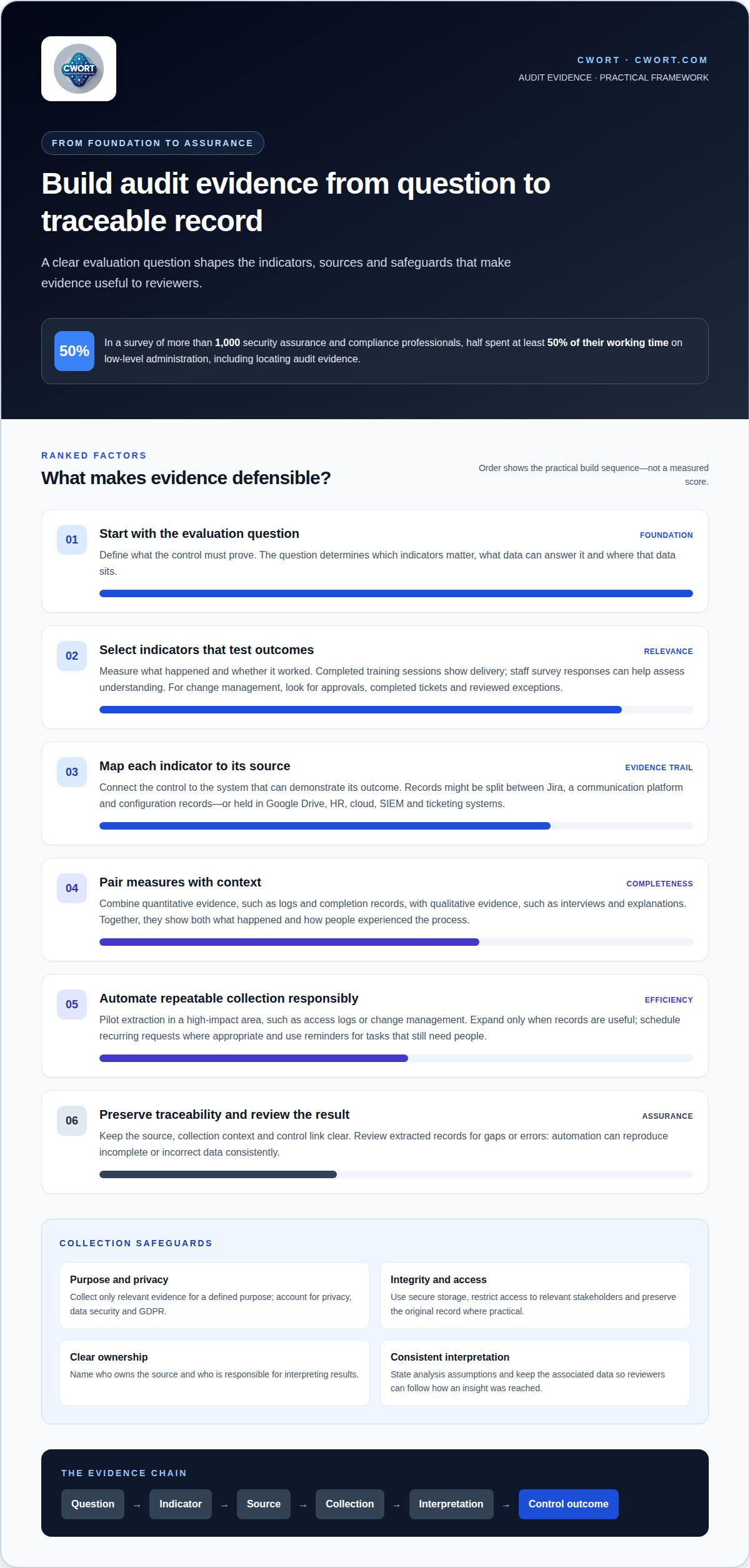
A defensible audit package is built through disciplined evidence management, not a last-minute search across disconnected systems. The practical answer to how to streamline evidence gathering from different systems is to define what each control must prove, identify the right indicators and sources, then automate extraction where it’s appropriate. Keep each item traceable to its source and the control it supports.
Evidence collection becomes difficult when relevant records are spread across operational tools, documents and people’s knowledge. Automation can reduce repetitive work, but it cannot make weak or irrelevant evidence persuasive. Pair quantitative measures, such as logs or completion records, with qualitative evidence, such as explanations of how a process works. This gives reviewers both measurable results and useful context.
This article explains how to set evaluation questions, select indicators and data sources, automate extraction responsibly, and assemble evidence packages for audit review. The aim is to turn scattered records into consistent, traceable evidence that supports clear control outcomes.
Key Takeaways
- Reduce manual searching by linking each control to the evidence and source system that can demonstrate its outcome.
- Set evaluation questions first, then choose indicators and data sources that provide relevant, verifiable answers.
- Combine quantitative measures with qualitative context to create a more complete view of how controls operate.
- Automate repeatable evidence extraction where appropriate, while preserving the security, integrity and traceability of records.
- Prepare audit-ready evidence by organising records around the controls they support, their sources and their collection details.
Table of Contents
- Why is collecting evidence such a daunting challenge?
- Setting evaluation questions, indicators and data sources
- Automating evidence extraction from source applications
- Preparing evidence packages for audits
- What are the main steps to streamline evidence gathering across different systems?
- CWORT
Why is collecting evidence such a daunting challenge?
Evidence collection becomes difficult when records are scattered, ownership is unclear and every audit requires a fresh search. Manual work can turn routine control activity into repeated administration.
Manual collection challenges
Manual evidence collection means locating, requesting and organising records without a consistent automated process. It matters because staff time shifts from assessing control outcomes to chasing files and checking whether records are complete. In a December 2020 survey of more than 1,000 security assurance and compliance professionals, half spent at least 50% of their working time on low-level administrative tasks, including locating audit evidence.
Every manual hand-off can create gaps. A control owner might provide a screenshot without a date, context or related procedure, leaving reviewers unsure what it proves. Teams may also keep copies in email, shared folders and spreadsheets. Without clear ownership and review frequency, evidence can become stale or difficult to trace to the relevant control.
Evidence across tools and teams
Evidence spread across tools and teams means information is distributed among systems, business functions and individual stakeholders. A project management tool such as Jira may show that a change was assigned and completed, while the approval discussion sits in a communication platform and the configuration record elsewhere. Auditors need a coherent account, not disconnected fragments.
Coordination becomes harder when evidence includes both records and people’s knowledge. A survey can show how staff report using a process; interviews can explain why practice differs from policy. Stakeholder accounts may add context, but they need a clear connection to the question being assessed. When responses are collected separately from control records, teams can lose context, ownership and links between claims and supporting evidence.
Streamlining through connected-system automation
Connected-system automation uses integrations to collect selected evidence from source applications, reducing repeated requests and manual uploads. For example, a control can link to documents in Google Drive, or collection can draw on HR, cloud, SIEM and ticketing systems. This can make collection more consistent when each integration has a defined purpose and owner.
Design automation around control relevance. Start with a high-impact area, such as access logs or change management, pilot the extraction, and expand only when the records are useful. Schedule recurring evidence requests weekly or monthly where appropriate, and use reminders for tasks that still require a person. Protect privacy and data security, consider GDPR implications, and preserve each record’s source and integrity. Automation gathers evidence; review determines whether it supports the control outcome.
Setting evaluation questions, indicators and data sources
Define the evaluation question before selecting evidence. It determines which indicators are relevant, what data can answer the question and where that data sits. For example, to assess whether a change-management control operates as intended, identify indicators such as approval records, completed change tickets and evidence that exceptions were reviewed.
For UK evidence gathering, account for privacy, data security and compliance with the General Data Protection Regulation (GDPR). Automated collection should use relevant data for a defined purpose, with secure storage and safeguards for data integrity.
Reduce automation risks with a robust integration strategy, limited collection of necessary evidence, and safeguards for source and integrity. Review extracted records for gaps or errors: an automated feed can reproduce incorrect or incomplete data consistently.
Plan evaluation from the start of a project and align it with the project’s impact pathway. Identify indicators, the data needed for each and its source. Name the people responsible for interpreting results, so measures are not collected without a clear question or decision in view.
Choose indicators that test outcomes, not just activity. A count of completed training sessions shows delivery; staff survey responses can help assess understanding. Pair quantitative evidence, such as completion records, with qualitative evidence, such as interview explanations. Together, they can show both what happened and how stakeholders experienced it, making findings more credible.
Local data becomes more useful when viewed alongside wider trends. Compare internal survey results across teams or track performance over time, keeping the population and collection method consistent. Social media metrics and Altmetrics can indicate online engagement and reach, but cannot establish broader outcomes by themselves. Interpret each measure according to what it can demonstrate.
Analytics can reveal patterns that individual records conceal. A dashboard, for example, may show recurring delays by process stage, while interviews explain the operational cause. State the assumptions behind each analysis and retain the associated data so reviewers can follow how an insight was reached. A clear chain from question to indicator, source and interpretation turns analysis into useful audit insight.
Secure evidence after collection. Restrict access to relevant stakeholders, preserve the original record where practical, and document its source and collection context. These controls support data integrity and help distinguish an authentic record from a later copy or interpretation.
For organisations shaping indicators around existing material, explore a structured maturity assessment as a way to clarify evidence gaps and strengthen evaluation design.
Automating evidence extraction from source applications
To streamline evidence gathering from different systems, connect controls to source applications and extract selected records for review. Compare platforms by integration coverage, document handling, workflow controls, testing capabilities and audit trails. Assess costs in light of connectors, implementation needs, user requirements and ongoing maintenance, not headline price alone.
Extraction and verification
Automated extraction retrieves evidence from connected applications; verification checks whether records meet defined criteria. For example, a control linked to Google Drive can collect relevant documents without repeated manual uploads. Integrations with HR, cloud, SIEM and ticketing systems can capture records at source. Define the evidence sought, then review exceptions, missing fields and source details before relying on an extracted record.
Automation can keep evidence aligned with frameworks such as SOC 2 and ISO 27001. It cannot establish that evidence proves a control works. A configuration record may show a setting, but an authorised reviewer must assess its relevance to the control objective. Retain its source, collection context and validation outcome so reviewers can interpret it.
Workflows and control testing
Document management and workflow automation organise records around control activities, owners and review states. A governance, risk and compliance platform can link controls to evidence, record review decisions and flag exceptions. Automated control testing can apply defined checks to extracted data, such as identifying missing approvals in change records.
Keep automated tests specific and explainable. Record the data source, criteria and result instead of presenting an unexplained pass or fail. Use human review for exceptions and evidence that needs context. To understand how to streamline evidence gathering from different systems in practice, test one control workflow end to end, including its decision record.
Automated evidence requests
Automated requests help manage evidence that still depends on people, such as attestations or explanations. Requests can recur weekly or monthly, with reminders prompting stakeholders to respond. Each request should name the control, required evidence, responsible owner and submission route. This creates a consistent record of outstanding work instead of relying on separate email chases.
Keep requests proportionate. Ask for evidence that answers a defined control question, and direct owners to an approved secure location. Track overdue responses and incomplete submissions as workflow exceptions, not proof of control failure. Pilot automation in a high-impact area, such as access logs or change management, then refine the criteria before scaling.
Integration quality determines whether automation improves evidence handling. Map each control to its source application, confirm the connection captures intended records, and test how changes affect extraction. Store automated evidence securely and protect its integrity. A structured control mapping and framework crosswalk can help clarify which evidence supports each requirement.
Preparing evidence packages for audits
An audit-ready package lets reviewers trace each control outcome to supporting evidence without reconstructing the collection process. Organise records around the audit scope and questions, not the folders or teams that produced them. A clear structure helps reviewers locate relevant evidence, understand its context and identify gaps for follow-up.
Start with a control-level index. For each control, record the evidence item, its purpose, owner and review status. Tag each record with the controls it supports, applicable frameworks, source, collection date, review frequency and retention period. These fields make it easier to identify duplicates, outdated material and unsupported controls. They also distinguish current records from older versions with similar filenames.
Use a consistent record structure, such as:
- Control reference: the specific control outcome the item supports.
- Framework mapping: each applicable framework and requirement.
- Provenance: source application, document owner and collection date.
- Review details: review frequency, reviewer and outcome.
- Retention details: the applicable retention period and record location.
Then centralise evidence in a controlled repository. One organised location lets teams reuse suitable records for similar audits instead of collecting identical evidence repeatedly. Reuse does not mean assuming an old record remains valid: confirm its period, scope and control context match the audit. A procedure document, for example, may support a control, but reviewers may also need records showing that the procedure operates.
Package evidence so its meaning remains clear outside the source application. Briefly describe what each item demonstrates, where it came from and how it relates to the control. Keep original records distinct from explanatory notes. If a screenshot supports a system setting, identify the setting and capture its context; do not present an unexplained image as conclusive proof.
Before submission, review coverage against the audit scope. Mark each control as supported, requiring clarification or lacking evidence, and record the reason. Check that links open, filenames are clear, dates match the requested period and framework mappings are consistent. This makes gaps visible early, while the accountable owner can still provide a relevant record or explanation.
Finally, preserve a traceable package version and its supporting index. Reviewers should be able to follow the path from requirement to control, evidence source and review decision. Set separate access permissions for sensitive records and retain collection details alongside the evidence. This discipline helps the package stand on its own, supports efficient audit review and makes future preparation more repeatable.
What are the main steps to streamline evidence gathering across different systems?
Build the process around controls and audit questions, then connect each evidence requirement to its owner and source. The sequence matters: automation cannot fix unclear control expectations or evidence that fails to answer the question.
- Define the control outcome. State what the evidence must demonstrate, such as an access review being completed and exceptions addressed. Identify the control owner and the review frequency, considering the risks, processes and systems involved.
- Map requirements to existing controls. Create a control library that links requirements to relevant activities and evidence. Where frameworks overlap, a unified library can support reuse of 80-90% of overlapping controls. Reuse still depends on evidence matching the requirement, scope and period under review.
- Identify the best evidence source. Link each control to the application or record that directly demonstrates its operation. For example, use a change-management ticket for approval and completion history, then add contextual material only where that record leaves a question unanswered.
- Automate repeatable collection. Pilot extraction in a high-impact area, such as access logs or change management. Define what the integration collects and how exceptions are reviewed. Expand after the pilot shows that records are relevant, complete and traceable to their source.
- Organise, validate and reuse. Centralise evidence in one repository, associate each item with its control and framework, and record its source and collection date. Review gaps before an audit, then reuse suitable records for similar upcoming audits rather than starting collection again.
Connect qualitative and quantitative evidence to the same control question. A completion record can show that an activity occurred; an explanation from its owner may clarify how an exception was handled. Together, they provide a fuller account than either type alone. Store the explanation alongside the original system record, while keeping the two distinct.
Make the workflow accountable. Assign owners for control definitions, source connections and evidence review, so automated collection does not obscure responsibility. Track incomplete records and failed extractions as exceptions to resolve. Preserve the decision and its rationale when evidence is accepted, rejected or replaced. This creates a repeatable chain from requirement to evidence and review outcome.
For organisations aligning existing content with a structured evidence process, explore a maturity assessment to identify gaps and prioritise improvements.
CWORT
CWORT helps organisations turn fragmented compliance evidence into structured, auditable control outcomes. It fits when evidence is spread across systems, teams need clear accountability, or audit preparation requires stronger links between obligations and records. The platform translates requirements into execution activities, enforces separation of duties and binds evidence to control outcomes.
Organisations can use CWORT for DORA Compliance Readiness and Assessment, UK NIS Compliance Management, NIS2 Readiness and Compliance Management, or ISO 27001 Readiness and Control Mapping. These offerings help establish a more disciplined approach to requirements, control ownership and evidence. The right starting point depends on the frameworks and evidence challenges your organisation needs to address.
To discuss how CWORT can support your evidence and compliance processes, contact CWORT.
Make your evidence process ready for what comes next
The next step in streamlining evidence gathering from different systems is to make it part of routine control management, not an activity triggered only by an audit. Start with a priority control, agree what evidence demonstrates its outcome, and assign responsibility for reviewing the record. Use the results to refine the process before extending it across other controls and teams.
When requirements or systems change, revisit evidence sources and mappings. A record that was once useful may no longer demonstrate the intended outcome. Keep accountability clear: automation can support collection and organisation, while people remain responsible for interpreting evidence and addressing gaps.
CWORT supports organisations through DORA Compliance Readiness and Assessment, UK NIS Compliance Management, and NIS2 Readiness and Compliance Management. To discuss how a structured compliance approach could fit your organisation, contact CWORT to discuss your evidence needs.
Build the process deliberately so each control is easier to evidence and review.
Frequently Asked Questions
What tools can automate evidence collection from multiple systems?
Evidence management and governance, risk and compliance platforms can coordinate collection across connected applications. Look for support for systems holding relevant records, such as HR, cloud, ticketing and security monitoring tools. Document repositories and project management platforms can also provide evidence. Assess whether a tool records provenance, supports reviewer decisions and handles exceptions, rather than judging it solely by the number of advertised integrations.
How do you integrate evidence sources using APIs and connectors?
Map each evidence requirement to its source application and the specific records needed. An API or connector can then provide a controlled route to retrieve those records and transfer relevant fields into the evidence workflow. Define permissions, ownership and failure handling before enabling extraction. Test representative records, including missing or changed fields, then compare the collected output with the original source to confirm the mapping works as intended.
How can evidence be kept secure, traceable and audit-ready?
Apply access controls so people can view or change evidence only in line with their responsibilities. Record who collected or reviewed each item, when it was handled, where it came from and which control it supports. Preserve the original record and distinguish later annotations. For example, retain a source-system export alongside a reviewer’s explanation. Set repository retention and access rules, and monitor changes to evidence and permissions.
How can organisations measure time and cost savings from evidence automation?
Establish a baseline by recording staff time spent locating, requesting, checking and reformatting evidence for a defined audit task. After implementation, measure the same activities and scope, including time spent resolving failed extractions or incomplete records. To estimate internal cost, apply the organisation’s relevant staff cost to hours saved, then subtract implementation and ongoing operating costs. Track rework separately to see whether evidence quality also changes.
What is a practical implementation plan for centralising evidence collection?
Choose a defined audit or control area and document its evidence requirements, owners and source applications. Configure access and mappings, then pilot collection with representative records. Review accuracy, missing data and exceptions with control owners before expanding the scope. Once the process works, centralise approved records with consistent metadata and assign responsibility for ongoing review. Reassess the workflow when controls, source systems or evidence requirements change.
How do evidence management platforms compare in features and cost?
Compare platforms by integration coverage, document handling, workflow controls, testing capabilities and audit trails. Assess costs based on connectors, implementation needs, user requirements and ongoing maintenance, not headline price alone.
Disclaimer
The content on this site is provided for general information and educational purposes only. It does not constitute legal, regulatory, financial, or professional advice. CWORT provides AI-assisted insights and workflow automation, but all compliance decisions remain the responsibility of your organisation and its management. Always seek qualified legal or regulatory guidance for decisions relating to the UK NIS Regulations, CAF, DORA, NIS2, ISO 27001, or other obligations.
Related posts
Enterprise Compliance Evidence Management: A 2026 Checklist for Regulated Firms
Is your firm ready for DORA & NIS2? Our 2026 checklist for enterprise compliance evidence management shows how to replace manual tracking with a defensible, ...
Compliance Evidence Management Software: Proving Regulatory Readiness in 2026
Prepare for DORA & NIS2. See how compliance evidence management software replaces chaotic audit trails with a single, defensible source of truth.
How to Demonstrate Control Effectiveness to Regulators: A Strategic Guide
Learn how to demonstrate control effectiveness to regulators with our guide. Shift from chaos to an evidence-based, audit-ready compliance programme today.
Article by
Michael Iyiola
Co-Founder, CWORT
Michael Iyiola is a co-founder of CWORT and a Cyber and AI Security Engineer with deep experience in vulnerability management, detection engineering and operational resilience across UK critical national infrastructure, including rail, energy and financial services. At CWORT, he designs scalable, evidence-driven workflows that help teams meet modern regulatory and security demands.
Build Your Foundation of Auditable Certainty
Take control of your regulatory obligations and secure your infrastructure with CWORT.