Four ways to understand and reduce human error in compliance

Michael Iyiola
Co-Founder, CWORT
Discover four ways of reducing the risk of human error in compliance, investigating near misses and improving controls, procedures and cyber risk management.

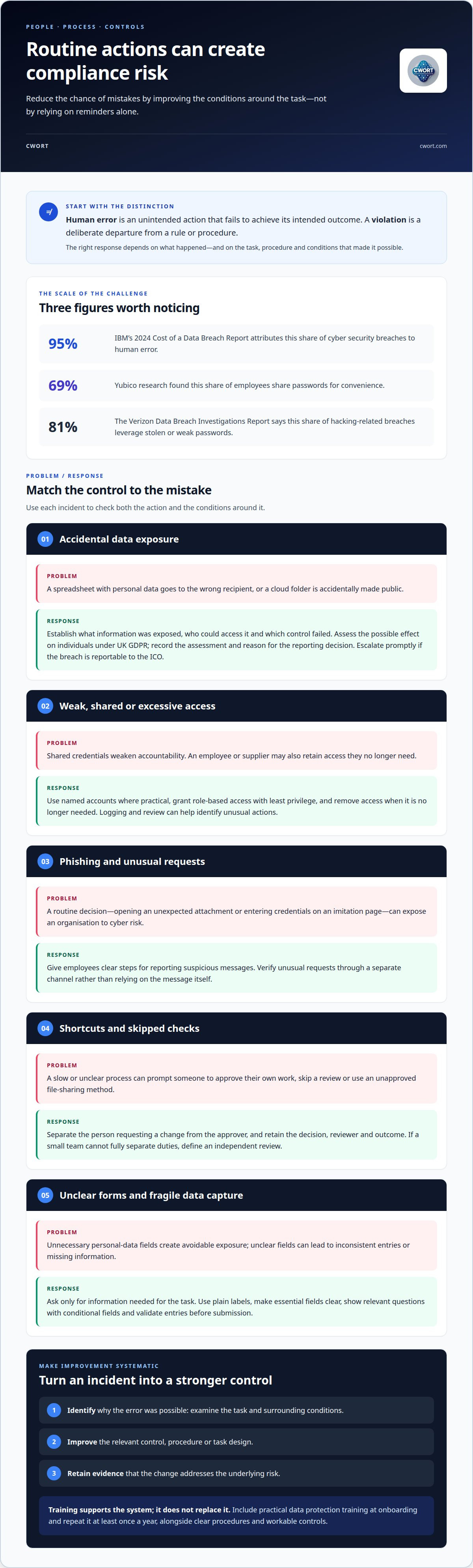
A compliance failure can start with a routine action, not a deliberate breach. Human error occurs when an action fails to achieve its intended outcome; a violation is a deliberate departure from a rule or procedure. Reducing the risk of human error in compliance means examining both the task and the conditions around it, not simply telling staff to be more careful.
Employees can make mistakes through slips, lapses, poor decisions or unsafe workarounds. These actions can expose an organisation to cyber risk when they affect access, data handling, reporting or evidence. Training matters, but it cannot compensate for unclear procedures, poorly designed tasks or controls that are difficult to follow.
This article outlines four practical ways to understand and reduce these risks. You’ll learn how to identify common employee errors, connect them to organisational cyber risk, and use incidents and near misses to strengthen compliance processes. The aim is a systematic response: identify why an error was possible, improve the control, and retain evidence that the change addresses the underlying risk.
Key Takeaways
- Distinguish unintended mistakes from deliberate departures from procedure to identify the right response.
- Recognise how accidental data exposure and misconfiguration can turn routine employee actions into cyber risk.
- Look beyond reminders and training: task design, access controls and workable procedures also shape error risk.
- Investigate incidents and near misses to uncover why an error was possible and strengthen the relevant controls.
- Use a structured compliance assessment to connect obligations, control activities and evidence of completion.
Table of Contents
- 1. What is Human Error?
- 2. Common employee errors
- 3. Human error and organisational cyber risk
- 4. Learning from incidents and near misses
- 5. What causes human error in compliance processes?
- CWORT
1. What is Human Error?
Human error occurs when a planned action fails to achieve its intended outcome. A person may select the wrong recipient, overlook a setting or misunderstand a procedure without acting intentionally. IBM’s 2024 Cost of a Data Breach Report attributes 95% of cyber security breaches to human error. That figure makes process design and effective controls central to reducing the risk of human error in compliance.
Consider a spreadsheet containing personal data sent to the wrong recipient, or a cloud folder configured for public access when it should be restricted. Both examples involve accidental data exposure, but their causes may differ: rushed data entry, unclear permissions or an unnoticed misconfiguration. Investigate the action and the conditions around it. A useful review identifies what information was exposed, who could access it and which control failed.
Under UK GDPR, assess a personal data breach for its possible effect on individuals, including whether it needs to be reported to the Information Commissioner’s Office (ICO). The decision depends on the circumstances, such as the type of data exposed and the likely consequences. Record what happened, your assessment and the reason for the reporting decision. If the breach is reportable, prompt escalation helps the organisation meet its regulatory responsibilities.
Make data capture practical. Forms that ask for unnecessary personal details create avoidable exposure, while unclear fields can prompt inconsistent entries. Use plain labels, request only information needed for the stated task, and make essential fields clear. Conditional fields can show questions relevant to the selected incident type. Before submission, validation can flag missing or incorrectly formatted information for correction.
Automation can reduce repetitive manual handling, missed fields and inconsistent records, but it brings implementation, integration and maintenance costs. Manual processes avoid some technology costs, yet consume staff time and can increase review and rework. The right balance depends on process volume, complexity and the cost of maintaining reliable controls.
Automation can enforce required fields, route reports to authorised reviewers and maintain consistent records. AI may help identify unusual entries or patterns for investigation, but it should support, not replace, accountable human review. Clear escalation rules still matter. Data protection training should also be practical: include it at onboarding and repeat it at least once a year, so staff know how to handle personal data and report accidental exposure.
2. Common employee errors
Some employee mistakes are small actions with wider consequences: reusing passwords, approving a request without checking it, or choosing the wrong access setting. Convenience can drive unsafe shortcuts. Yubico research found that 69% of employees share passwords for convenience. Shared credentials weaken accountability because a later review may not establish who performed an action or why.
Phishing and social engineering exploit routine decisions, such as opening an unexpected attachment or entering credentials on a convincing imitation page. The Verizon Data Breach Investigations Report states that 81% of hacking-related breaches leverage stolen or weak passwords. Technical controls can reduce exposure, but employees also need clear steps for reporting suspicious messages and verifying unusual requests through a separate channel.
Errors can also arise when employees work around a process that feels slow or unclear. Someone might approve their own work, skip a required review or use an unapproved file-sharing method to meet a deadline. HSE states that human failure contributes to almost all workplace accidents and exposures to substances hazardous to health. In compliance, this underlines the need to examine the conditions behind mistakes, rather than stopping at individual blame.
Layered security must account for employees and non-employees, including contractors and suppliers who receive system access. Assign each account to a named user where practical, grant access according to role, and remove it when the work no longer requires it. Role-based access and least privilege limit unnecessary access, while logging and review help identify unusual actions. A supplier account should not retain permissions simply because no one thought to remove them.
Design checks, approvals and segregation of duties around the risk of each action. Separate the person requesting a change from the person approving it, and retain a record of the decision, reviewer and outcome. If a small team makes full separation impractical, add a defined independent review rather than leaving the action unchecked.
Accountability requires clear ownership, not just a policy document. Define who reports an error, who assesses its impact and who authorises corrective action. For example, after an employee sends a report to the wrong internal recipient, a manager can record the incident, establish how it happened and assign a control change. Consistent records support analysis of recurring issues and show whether training, process design or technical controls need attention.
When repeated errors point to unclear ownership or weak control design, a structured review can identify gaps and corrective actions. Request a demonstration to explore how compliance activities and evidence can be organised.
3. Human error and organisational cyber risk
A routine action can become a cyber risk when it affects access, data or a critical system. An employee might grant excessive permissions to speed up a task, or overlook an alert during a busy handover. Risk management should connect these actions to the assets and processes they could affect. This clarifies where a single mistake could lead to wider disruption.
Distinguish unintended errors from deliberate violations before choosing controls. The Health and Safety Executive (HSE) describes human errors as unintended actions or decisions, and violations as deliberate deviations from rules or procedures. A mistyped configuration is different from bypassing an approval because it feels inconvenient. The distinction helps determine whether the response should focus on task design, practical procedures, accountability or a combination.
Map the steps that could expose systems or information. For example, trace how a user requests access, who approves it, how permissions are applied and when they are reviewed. Mark handovers, manual transfers and privileged changes for closer examination. This process analysis can reveal unclear instructions or situations where one person can initiate and complete a critical change without independent scrutiny.
Build robust controls around those points. Apply least privilege so users receive only the access their roles require. Use separate accounts for administration and routine work, and require approval for sensitive changes. Technical safeguards can restrict risky actions, while logging records who made a change and when. These measures limit the impact of mistakes and provide evidence for investigation.
HSE recommends including human failure in risk assessments by identifying possible errors, factors that affect their likelihood and relevant controls. It also favours redesigning tasks or equipment where practical. For instance, if staff repeatedly select the wrong system environment, clearer labels and a confirmation before deployment address the design problem directly. Training can explain the correct process, but it cannot prevent every slip or lapse.
Automate repeatable checks where consistent execution matters. A workflow can prevent a request from moving forward until the required approval is recorded. However, automation needs an owner: an outdated rule may reproduce the same error at scale. Assign a control owner, test the workflow after process changes and retain results showing whether the control operated as intended.
Finally, connect incidents and control evidence to ongoing risk reviews. If access reviews repeatedly find permissions that no longer match job roles, examine how staff changes are communicated to system owners. Track the cause, corrective action, owner and completion evidence. This turns individual events into organisational insights, helping leaders decide whether to revise a procedure, strengthen a technical control or redesign a critical task.
4. Learning from incidents and near misses
An incident shows where a control failed; a near miss shows where it nearly failed. Both provide evidence about how work happens in practice. A report caught before reaching an unintended recipient, for example, can expose unclear checking steps. Record near misses alongside incidents so analysis includes warning signs before harm occurs.
Begin each investigation by recording what happened, when, which process was involved and the outcome. Reconstruct the sequence of actions and conditions. Ask whether instructions were available, the system behaved as expected and the person had suitable information. The Health and Safety Executive advises identifying why individuals failed, rather than stopping at “operator error”.
A UK example highlights the need to trace information handling. In December 2024, a Lloyds Banking Group customer received a package containing detailed financial statements belonging to other clients. An investigation can examine how the statements were selected, checked, packaged and dispatched. Each step may reveal a distinct control weakness and inform a targeted corrective action.
Assess actual and potential impact. A near miss involving restricted information can expose a weakness that could affect other records. Consider the information involved, who could access it, how long it was exposed and whether the same process is used elsewhere. These factors help assess the likelihood of recurrence and prioritise the response.
Assign each corrective action an owner, a due point and evidence of completion. If a review finds that a second-person check was unclear, revise the procedure and record the approval. Then test whether employees follow the revised step during normal work. Closing an action without testing its effect can leave the original failure mechanism in place.
Make reporting straightforward. A clear process should capture what happened, preserve relevant evidence and route the report for review. A digital platform can support consistent fields, status tracking and assigned actions. Keep reporting practical: capture the event, contributing conditions, impact assessment and follow-up, rather than requiring employees to write lengthy narratives.
Review incident and near-miss trends across teams and processes. If similar failures recur after training, examine whether system design, handovers or workload contribute to the pattern. If corrective actions remain open, escalate ownership and assess the remaining exposure. This turns individual reports into evidence for strengthening controls and improving compliance.
Use each investigation to test whether the control change addresses the underlying cause. For example, after correcting a dispatch check, review later records for completion and repeat errors. Document the finding, decision, action owner and outcome. This creates a traceable basis for refining procedures and assessing whether the likelihood of the same failure has changed.
5. What causes human error in compliance processes?
Human error can begin before an employee acts. An inadequate plan can fail even when someone follows it carefully, because the procedure itself does not address the risk. By contrast, an adequate plan that an employee unintentionally fails to follow can lead to an incident. A compliance review should distinguish these causes: poor control design needs redesign, while an execution lapse may call for clearer steps, better support or changed working conditions.
Workload and stress can make it harder to retain instructions, notice exceptions or complete checks consistently. Tessian research found that 52% of respondents said they made more mistakes at work when stressed. The American Psychological Association identified too heavy a workload as a workplace stress factor for 50% of respondents. For example, an employee handling urgent requests alongside a control review may overlook a required approval or record incomplete evidence.
Unclear procedures create another failure point. A policy may require a review without naming the responsible role, the evidence to retain or the escalation route for exceptions. Employees may then make different assumptions about the same obligation. Replace broad instructions with practical steps, ownership and decision criteria. For a supplier review, specify which documents to assess, who approves exceptions and where to record the outcome.
Task design also matters. Repeatedly switching between systems, copying data by hand or completing forms with confusing fields increases the chance of slips and omissions. A staff member might enter evidence in one tool but forget to update the compliance record elsewhere. Map each handover, identify duplicated entry and automate repeatable checks where appropriate. Keep human review for decisions that require context, judgement or approval.
Skills gaps and changing requirements can leave employees relying on outdated knowledge. Training should match the task, role and current procedure, then be reinforced with accessible guidance at the point of work. Someone responsible for assessing control evidence needs different instruction from someone who reports incidents. Managers can use reviews to identify recurring mistakes and determine whether knowledge, capacity or process design is the underlying issue.
To diagnose a recurring error, compare the intended process with what employees actually do. Examine workload, instructions, tools, handovers, access and approval records, then identify the condition that made failure possible. Assign an owner to each corrective action and retain evidence of its completion. A compliance maturity assessment can help structure this analysis and prioritise process improvements.
CWORT
CWORT turns compliance obligations into structured activities, defined responsibilities and evidence linked to control outcomes. This supports a consistent approach to identifying where human error can affect compliance and showing how controls are applied. Use it when fragmented tracking makes ownership, progress or evidence difficult to follow across requirements.
CWORT offers readiness and compliance management for DORA, UK NIS and NIS2, alongside ISO 27001 readiness and control mapping. These offerings help organisations organise relevant obligations and assess how their controls align with them. They support compliance work, rather than replacing sound procedures, staff judgement or investigation of incidents.
To discuss how CWORT could support your compliance processes, contact CWORT.
Make compliance controls easier to sustain
Reducing the risk of human error in compliance depends on making sound practice part of everyday work. Start by identifying where responsibilities, control activities and evidence need clearer alignment, then set priorities that match your organisation’s risks. This gives improvement work a defined direction instead of leaving teams to address errors one at a time.
CWORT supports organisations working towards DORA, UK NIS and NIS2 compliance through readiness, assessment and compliance management. Its ISO 27001 readiness and control mapping can also help structure control activity and evidence. Consider these options when you need a more organised view of compliance obligations and how work is progressing. Contact CWORT to discuss your compliance needs and identify a practical next step. Stronger processes start with a clear view of what needs attention, and you can build that view methodically.
Frequently Asked Questions
Can employees be part of the solution?
Yes. Employees can identify where procedures clash with real work, where approvals cause delays and where unclear instructions prompt workarounds. For example, a payroll team can flag that a control requires evidence from a system they cannot access. Give staff a straightforward way to raise concerns, then record decisions and assign follow-up actions. This makes operational knowledge part of control improvement, rather than treating staff only as a source of errors.
How does building a security culture help?
A security culture makes safe actions and prompt reporting normal parts of daily work. Managers shape it by responding consistently when staff raise mistakes, near misses or confusing procedures. For example, a team leader who thanks an employee for reporting a suspicious access request encourages earlier escalation. Reinforce the message through team discussions, role-specific examples and visible follow-through. If staff report issues but see no action, their confidence in the process can weaken.
What is human risk in cyber security?
Human risk in cybersecurity is the possibility that people’s decisions, actions or working conditions contribute to unauthorised access, data loss or disruption. It includes accidental actions, such as granting access to the wrong account, and deliberate actions, such as bypassing an approval. Assess the risk in context: consider the system or information involved, the user’s responsibilities and the controls that could limit the impact.
How can organisations reduce compliance errors through training and clear procedures?
Make training specific to employees’ duties, then provide procedures they can use during the task. A procurement employee, for instance, needs clear criteria for recording supplier evidence and escalating missing documents. Use short worked examples, explain what to do when a case falls outside the usual process, and make current instructions easy to find. Review recurring errors to see whether training or procedure changes are needed.
How can compliance teams identify and measure human-error risks?
Compliance teams can combine incident records, audit findings, access reviews and control-test results to identify recurring patterns. Classify each finding by process, control, contributing condition and impact, then track repeat occurrences and overdue corrective actions. For example, recurring evidence gaps in an approval workflow may indicate unclear ownership. Trend reviews help distinguish isolated mistakes from a process weakness that needs redesign or stronger oversight.
What UK laws and regulatory guidance address compliance controls and human error?
UK GDPR and the Data Protection Act 2018 are relevant when processes handle personal data. The Health and Safety Executive’s guidance, Reducing error and influencing behaviour (HSG48), addresses human failure and workplace controls. It was published by HSE Books in 1999. Which obligations apply depends on the organisation, its activities and the information or systems involved, so compliance teams should map applicable requirements to their controls.
How do UK GDPR and the Data Protection Act 2018 affect compliance processes and error prevention?
Data protection should be built into processes that collect, use or share personal information. Organisations should define who may access records, what information a task requires and how to assess and document a suspected breach. For example, a team handling employee files can restrict access by role and record authorised disclosures. The Information Commissioner’s Office can impose fines for GDPR non-compliance, so sound processes matter.
What are examples of human-error compliance failures and lessons learned in the UK?
A practical UK example is payroll information attached to an email for the wrong external recipient. Design transfer checks around the actual risk: confirm the recipient, limit the information shared and record approval where required. If an error occurs, assess the data and potential effect, preserve the incident record and identify why the check failed. This turns a specific mistake into a targeted control improvement.
Disclaimer
The content on this site is provided for general information and educational purposes only. It does not constitute legal, regulatory, financial, or professional advice. CWORT provides AI-assisted insights and workflow automation, but all compliance decisions remain the responsibility of your organisation and its management. Always seek qualified legal or regulatory guidance for decisions relating to the UK NIS Regulations, CAF, DORA, NIS2, ISO 27001, or other obligations.
Related posts
NIS2 Compliance for Critical Infrastructure: A Strategic Guide to Evidence-Based Validation (2026)
Master NIS2 compliance for critical infrastructure. Our guide helps you move beyond manual tracking to build an auditable, evidence-based system and avoid hu...
How to Demonstrate Control Effectiveness to Regulators: A Strategic Guide
Learn how to demonstrate control effectiveness to regulators with our guide. Shift from chaos to an evidence-based, audit-ready compliance programme today.
Managing Compliance Evidence in Excel: Comparison and Strategic Risks for 2026
Is managing compliance evidence in excel a risk for 2026? Learn why spreadsheets jeopardise DORA & NIS2 validation and get a roadmap to an audit-ready system.
Article by
Michael Iyiola
Co-Founder, CWORT
Michael Iyiola is a co-founder of CWORT and a Cyber and AI Security Engineer with deep experience in vulnerability management, detection engineering and operational resilience across UK critical national infrastructure, including rail, energy and financial services. At CWORT, he designs scalable, evidence-driven workflows that help teams meet modern regulatory and security demands.
Build Your Foundation of Auditable Certainty
Take control of your regulatory obligations and secure your infrastructure with CWORT.