Head of Compliance Challenges in the UK: 2026 Guide

Michael Iyiola
Co-Founder, CWORT
Discover how to navigate key head of compliance challenges UK leaders face. Learn how to map obligations, prove ownership, and deliver clear board assurance.

33% of compliance leaders cite new regulatory requirements as their top challenge for the next two years, according to KPMG’s October 2026 research. For UK organisations, the pressure is not just keeping pace. It is proving who owns each obligation, what evidence supports compliance and where action is still needed. That is at the heart of the head of compliance challenges UK leaders face.
Responsibilities often sit across teams, frameworks and systems, while boards expect concise assurance. Evidence can be difficult to retrieve or reconcile, and competing risks and limited capacity make priorities harder to explain or audit.
This guide shows how to identify challenges with the greatest operational and governance impact, then turn complex obligations into clear ownership, risk-based priorities and reliable evidence trails. It also covers how to report compliance status and remediation credibly to boards, auditors and regulators. The central principle is straightforward: connect obligations to accountable execution and reproducible evidence, rather than relying on activity alone.
Key Takeaways
- Understand how a head of compliance’s remit varies by organisation, and why boards need clear visibility of risks and controls.
- Map only the obligations relevant to your sector, entity and activities. Frameworks and regulatory expectations are not universally interchangeable.
- The head of compliance challenges UK teams face go beyond maintaining policies. Effective assurance depends on evidence, control ownership and traceable actions.
- Use a practical sequence to assess gaps, prioritise remediation against organisational risk and business impact, assign owners and reassess progress.
- A governed compliance platform can connect frameworks, controls, evidence and remediation to support consistent validation and reporting.
Table of Contents
- Head of compliance challenges in the UK: why the role carries growing responsibility
- UK compliance challenges: managing overlapping obligations and changing expectations
- The hardest head of compliance challenges: evidence, ownership and board assurance
- How UK heads of compliance can prioritise risk and make remediation accountable
- How a governed compliance platform can address head of compliance challenges
Head of compliance challenges in the UK: why the role carries growing responsibility
A head of compliance coordinates oversight of the obligations relevant to an organisation. This means ensuring controls have owners, activity is monitored, exceptions are escalated and evidence can be reviewed. The precise remit depends on the organisation’s sector, structure and activities. The role may involve coordinating several functions, but it does not make one person the owner of every control or decision.
This distinction matters. The role involves leadership and coordination, not replacing legal advice or operational security delivery. A compliance leader helps the organisation understand and oversee its responsibilities. Subject-matter teams carry out controls, while accountable leaders make decisions within their authority.
What does a head of compliance do in a UK organisation?
A head of compliance coordinates how relevant requirements are interpreted, assigned, monitored and escalated. In practice, this means connecting each obligation to the control intended to address it, the person responsible and evidence of how that control operates. The role’s boundaries depend on the organisation and its applicable requirements, rather than a universal job description.
Search results for the title may focus on salary research or individual vacancies. Those can support career decisions, but they do not explain the operational pressures facing practitioners. This guide focuses on the leadership challenge: making compliance responsibilities workable and visible across an organisation.
Why compliance leadership is more than maintaining policies
Policies set expectations, but they do not show on their own that a control is performed consistently or that an exception has been addressed. Understanding regulatory compliance starts with meeting relevant rules and requirements. Leaders also need a credible view of how the organisation puts its approach into practice.
That view is difficult to assemble when evidence and responsibilities are spread across teams, records and systems. A policy may describe a review process, for example, while evidence of completed reviews is held elsewhere and overdue actions are tracked separately. This can leave uncertainty about whether the control is operating, who must resolve a gap and whether the issue has been escalated.
Boards need more than a policy library or a high-level status label. They need reporting that connects control performance to exceptions, accountable owners and remediation. This does not mean presenting every operational detail. It means giving leaders enough traceable information to understand where assurance is strong, where it is limited and what action is under way. This is the practical core of the head of compliance challenges UK practitioners must address: turning dispersed activity into a clear, defensible account of organisational oversight.
UK compliance challenges: managing overlapping obligations and changing expectations
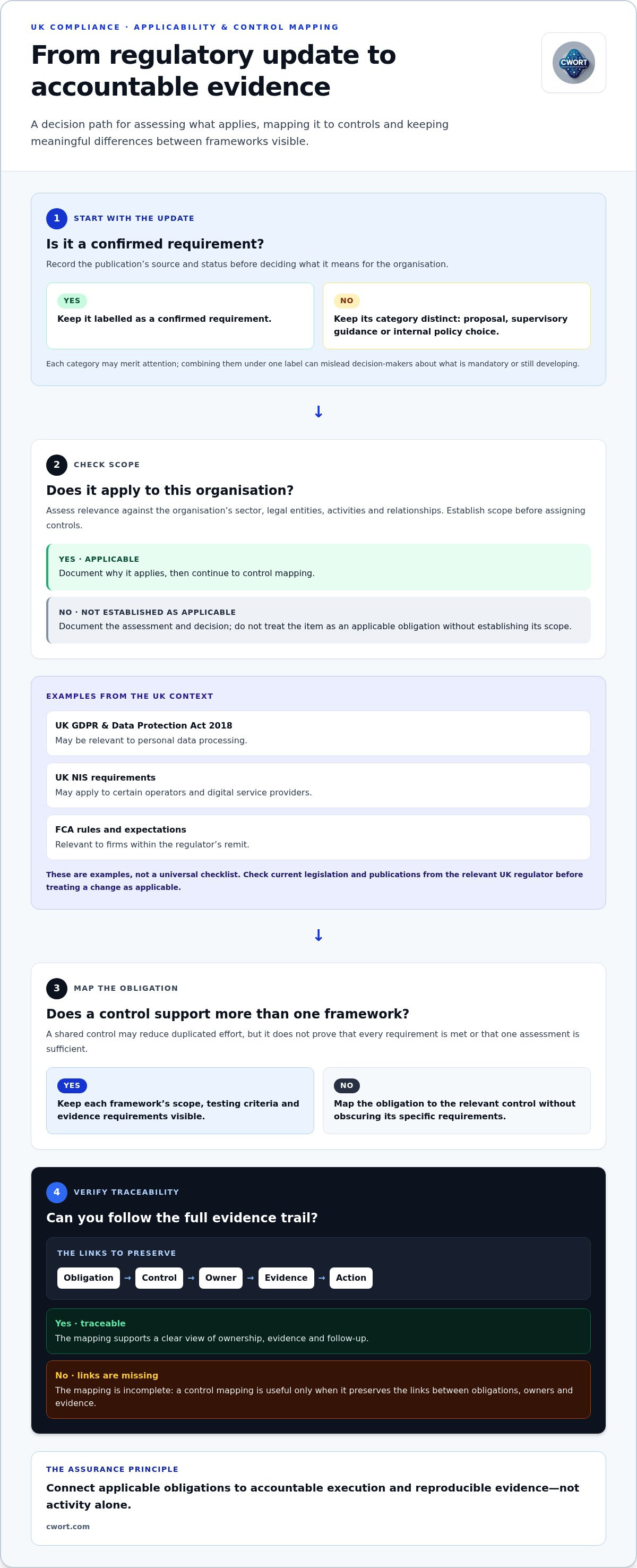
Regulatory complexity is not simply a matter of counting frameworks. Which obligations apply depends on an organisation’s sector, legal entities, activities and relationships. UK GDPR and the Data Protection Act 2018 may be relevant to personal data processing. UK NIS requirements may apply to certain operators and digital service providers. FCA rules and expectations are relevant to firms within the regulator’s remit. These are examples, not a universal checklist. Establish scope before assigning controls.
The challenge is to create a reliable view of what applies, why it applies and how the organisation addresses it. This is central to the head of compliance challenges UK practitioners face: similar control themes can appear in different frameworks, but their scope, testing criteria and evidence requirements may differ.
How can overlapping frameworks create compliance workload?
Consider access management. Several frameworks may address access, but one may require evidence of authorisation, another of periodic review and another of how exceptions are handled. Mapping each requirement separately can lead teams to repeat assessments, use inconsistent status labels and record the same remediation in disconnected trackers.
Reduce duplication without obscuring meaningful differences. Maintain a traceable mapping from each applicable obligation to the relevant control, owner, evidence and resulting action. A shared control may support more than one framework, but that does not prove it meets every requirement or that one assessment is sufficient.
A control mapping is useful only when it preserves the links between obligations, owners and evidence.
Keeping pace with UK regulatory and supervisory expectations
Regulatory monitoring should lead to an impact assessment, not just a collection of updates. For each relevant publication, record its source and status, assess whether it affects the organisation, identify the accountable owner and document the decision and follow-up. Check current legislation and publications from the relevant UK regulator before treating a change as applicable.
Keep distinct categories separate. A confirmed requirement is not the same as a proposal, supervisory guidance or an internal policy choice. Each may merit attention, but combining them under one label can mislead decision-makers about what is mandatory, what is still developing and what the organisation has chosen to do. Escalate questions requiring legal interpretation through the organisation’s appropriate governance channels. Compliance monitoring should not be presented as a substitute for that judgement.
A structured cross-framework view can help teams assess shared controls once and report against multiple relevant frameworks, while retaining each framework’s specific scope and evidence needs. To see how CWORT connects obligations, control mappings, evidence and actions, request a CWORT demonstration.
The hardest head of compliance challenges: evidence, ownership and board assurance
A complete policy library can show that expectations have been documented. It cannot, on its own, demonstrate that controls operate effectively. That requires evidence tied to a specific control outcome, with enough context to understand its source, date, status and accountable owner.
Fragmented records make this harder. Evidence may sit in spreadsheets, project tools, shared drives and operational systems, while control assessments are recorded elsewhere. Without clear provenance or ownership, a reviewer may struggle to establish whether an item is current, relevant or sufficient to support the stated outcome. The issue is not simply finding a file. It is showing why that evidence supports the conclusion.
Why fragmented evidence makes assurance difficult
Keep the relationship between a control and its evidence explicit. A governed record should connect the control, its owner, the assessment status, supporting evidence and any follow-up action. If evidence is missing, record that gap rather than presenting an incomplete record as a passed control. This helps leaders distinguish an evidence gap from a control failure, an accepted risk or remediation that is under way.
These categories have different implications. A failure indicates that the control has not achieved its intended outcome. An evidence gap means the outcome cannot be adequately substantiated. An accepted risk should have a recorded decision and accountable authority, while work in progress needs an owner and visible next steps.
How to present compliance status to the board
Board reporting should be concise, but not vague. Surface material gaps, control confidence, accountable owners and remediation progress. An overall maturity assessment can show broad capability or trends, but it is not proof that a particular control operated as intended. For more on maintaining trustworthy records, refer to your guidance on ensuring compliance evidence integrity.
Use a consistent standard for assurance:
Evidence strengthens assurance. It does not guarantee compliance or replace judgement. For leaders working through the head of compliance challenges UK organisations face, the objective is a credible, traceable account of what is known, what remains uncertain and who is acting on it.
How UK heads of compliance can prioritise risk and make remediation accountable
A gap register creates value only when it drives proportionate action. The head of compliance challenges UK practitioners face include deciding what needs attention first, making ownership explicit and showing whether remediation has improved the outcome. Use a repeatable sequence and record the reasoning behind decisions instead of relying on an unexplained priority label.
A repeatable process for turning compliance gaps into action
Start by defining the assessment boundary: the relevant obligations and criteria, controls in scope, control owners and expected evidence. Then follow a clear sequence:
- Assess the evidence: determine what it supports and where it is incomplete or out of date.
- Record the finding: describe the gap, status and rationale consistently.
- Prioritise the action: consider organisational risk, the relevance of the obligation, effort and business impact.
- Assign accountability: name an action owner, agree milestones and identify who approves or accepts decisions.
- Reassess: set a review point and check whether the action has improved the control outcome.
This is a decision framework, not a universal scoring formula. A gap affecting a critical service may warrant faster escalation than a lower-impact documentation improvement, but the rationale should be visible to operational owners and leadership.
Balancing urgent gaps with sustained compliance improvement
Separate immediate control concerns from longer-term maturity work. An urgent weakness may require prompt containment and senior oversight, while a broader capability improvement may need staged delivery. Treating both as identical “open actions” obscures urgency. Record why each item has its priority, who agreed it and what would trigger escalation or a change in approach.
Decision rights matter. The person assessing evidence should not automatically approve their own assessment or accept the associated risk. Define who performs, reviews and authorises each step, using separation of duties where appropriate. This enables challenge and gives the decision a clearer governance trail.
Revisit findings after remediation. Closing an action because a task was completed is not the same as confirming that the control now works as intended. Reassessment tests the outcome against the original criteria and preserves the rationale, evidence and decision history. For further detail on structuring these steps, see the article on regulatory compliance workflow automation.
A governed workflow can connect assessment, ownership, milestones and reassessment while keeping the basis for decisions traceable. Request a CWORT demonstration to explore how compliance actions and evidence can be organised into an accountable workflow.
How a governed compliance platform can address head of compliance challenges
A system of record stores compliance information. An orchestrated workflow connects it: relevant obligations map to controls, each control has an owner and evidence, and gaps lead to tracked actions and reassessment. This distinction matters when responsibilities span teams. A repository may hold documents, but a governed workflow helps show how they support control outcomes and what happens when assurance is incomplete.
What to look for in a compliance operating workflow
Look for traceable links between requirements, control outcomes, evidence, owners and remediation. Role-based access can help ensure people have appropriate permissions. Separation of duties supports independent review, while an immutable change history preserves an audit trail of decisions and updates. These controls strengthen governance around the workflow, but they do not replace organisational judgement.
A mapped assessment can support reporting across relevant frameworks without treating their requirements as interchangeable. Reuse evidence where it is genuinely relevant, while retaining each framework’s scope, criteria and specific evidence needs. This supports assess-once, report-many processes without overstating what a shared control demonstrates.
Where CWORT fits in a UK compliance leader’s workflow
CWORT is a compliance validation and operating-model platform that sits above existing security tools. It maps controls across frameworks and connects evidence to control outcomes for validation and reporting. Its compliance intelligence and operating-model intelligence show how obligations, controls, responsibilities and remediation relate, instead of treating framework coverage and execution as separate records.
The June 2026 taxonomy library contains 1,355 controls across 217 domains and 42 frameworks or standards. As of June 2026, 98.6% of active controls have framework references. Deterministic scoring produces reproducible results from the same evidence. AI can provide advisory suggestions, but it does not alter deterministic assessment results.
For financial-sector organisations where DORA obligations are relevant, the DORA compliance validation guide provides related context. A platform can organise mapped controls, evidence and actions, but it does not guarantee compliance or replace regulatory judgement. To explore how CWORT’s governed workflow can support your approach to the head of compliance challenges UK organisations face, request a CWORT demonstration.
Turn compliance complexity into controlled execution
The strongest response to the head of compliance challenges UK organisations face is a disciplined operating model: define what applies, connect obligations to accountable owners and prioritise remediation according to risk and business impact. Clear evidence trails help leaders explain control outcomes and what remains unresolved.
Technology can support that discipline when it connects evidence to control outcomes rather than simply storing documents. CWORT produces deterministic, reproducible assessment results from the same evidence, with separation of duties and immutable audit history supporting governed workflows. These capabilities strengthen visibility and traceability. They do not replace compliance judgement or guarantee compliance.
Take a practical next step: request a CWORT demonstration to explore how a governed workflow can support your organisation’s compliance and remediation processes. Clearer ownership and evidence make complex obligations easier to manage and explain.
Frequently Asked Questions
What are the main challenges facing a head of compliance in the UK?
The main head of compliance challenges UK teams face include identifying applicable obligations, coordinating control owners, maintaining reliable evidence, prioritising remediation and giving leaders a clear view of risk. The balance varies by sector and organisation. A practical response links each relevant requirement to accountable work and supporting evidence, rather than treating compliance as policy writing alone. This helps senior leaders understand what is working, where assurance is limited and what action is under way.
What skills does a UK head of compliance need?
A UK head of compliance needs sound regulatory judgement, risk prioritisation, clear communication and the ability to coordinate across business and operational teams. Evidence management and data literacy help them assess whether controls work in practice, not just whether documentation exists. They must also explain uncertainty accurately, escalate material issues and distinguish confirmed obligations from guidance or proposed changes. These skills support credible decisions and reporting without overstating the organisation’s position.
How can a head of compliance manage overlapping regulations?
Start by establishing which obligations apply to the organisation, recording their sources, scope and relevance. Map shared control themes where appropriate, but retain a clear link from each distinct requirement to its owner, evidence and assessment. For example, a control may support more than one framework, but that does not automatically mean it satisfies every requirement. Review mappings as obligations or organisational activities change, and keep remediation records connected to the relevant findings.
Can compliance software solve a head of compliance’s challenges?
Compliance software can organise obligations, ownership, evidence, assessments and remediation in a more traceable workflow, but it cannot replace regulatory interpretation, accountable decisions or effective controls. Define the workflow and assurance outcomes needed before adopting a platform. CWORT maps controls across frameworks and links evidence to control outcomes. Its deterministic assessments produce reproducible results from the same evidence, while AI suggestions remain advisory and do not change assessment results.
How should a head of compliance report risks to the board?
Give the board a concise view of material control gaps, evidence limitations, accepted risks and remediation progress. Identify accountable owners and explain the rationale for priorities, including how issues relate to the organisation’s obligations and objectives. Avoid relying on a single score without context: an overall maturity view is not proof of an individual control outcome. Clear reporting should support decisions and escalation, with traceable evidence available to substantiate the status presented.
What is the difference between compliance monitoring and compliance assurance?
Compliance monitoring checks activity or status over time, such as whether a scheduled control review is due. Compliance assurance evaluates whether a control is suitably designed and operates as intended, using relevant evidence and a documented assessment. Monitoring can flag an issue for investigation, but it does not automatically prove that a control is effective. Clear ownership, defined assessment criteria and evidence linked to the control outcome help make assurance more defensible.
How can compliance teams reduce manual tracking without losing auditability?
Use a governed workflow that links each requirement and control to its owner, evidence, assessment status and remediation history. Apply consistent status definitions, appropriate access controls and a change history, retaining the rationale behind decisions. Evidence drawn from existing operational tools can reduce repeated collection, provided its source and relationship to the control remain clear and reviewable. The aim is not simply fewer spreadsheets, but a traceable record of assessments, decisions and follow-up.
Disclaimer
The content on this site is provided for general information and educational purposes only. It does not constitute legal, regulatory, financial, or professional advice. CWORT provides AI-assisted insights and workflow automation, but all compliance decisions remain the responsibility of your organisation and its management. Always seek qualified legal or regulatory guidance for decisions relating to the UK NIS Regulations, CAF, DORA, NIS2, ISO 27001, or other obligations.
Related posts
Mastering the Regulatory Obligation Execution Workflow: A Guide to Auditable Certainty
Struggling with UK compliance audits? Learn to build a regulatory obligation execution workflow for auditable certainty and replace risky spreadsheets with t...
The Evolution of the Enterprise GRC Validation Tool: From Tracking to Orchestration in 2026
Stop chasing compliance ghosts in spreadsheets. Create a single source of truth for compliance with GRC orchestration to master NIS2, DORA, and UK audit dema...
DORA Obligation Mapping Tool: Orchestrating Defensible Compliance in 2026
Stop manual DORA tracking. A DORA obligation mapping tool orchestrates compliance, automates reporting, and creates a defensible audit trail for central banks.
Article by
Michael Iyiola
Co-Founder, CWORT
Michael Iyiola is a co-founder of CWORT and a Cyber and AI Security Engineer with deep experience in vulnerability management, detection engineering and operational resilience across UK critical national infrastructure, including rail, energy and financial services. At CWORT, he designs scalable, evidence-driven workflows that help teams meet modern regulatory and security demands.
Build Your Foundation of Auditable Certainty
Take control of your regulatory obligations and secure your infrastructure with CWORT.