How IT Teams Can Build Compliance Into Everyday Processes

Michael Iyiola
Co-Founder, CWORT
Learn how to reduce compliance friction for IT teams with clear control ownership, connected systems and routine evidence capture that makes audits simpler.

Audit friction grows when evidence is scattered across spreadsheets, inboxes and disconnected tools. To understand how to reduce compliance friction for IT teams, make evidence easy to access, assign clear ownership for each control, connect relevant systems and build compliance tasks into routine workflows. The result is a more consistent process, with less manual chasing when audit evidence is needed.
The solution is to improve the process, not simply add another layer of restrictions. Duplicate tools and unclear requests create avoidable work, making unofficial workarounds more tempting and potentially introducing new risks.
Clear ownership, simpler workflows and connected systems can improve evidence access and reduce duplicate effort. Turning compliance requirements into practical procedures also makes recording and validating evidence part of everyday work, rather than a separate scramble before an audit.
Key Takeaways
- Make audit evidence easier to retrieve by reducing manual searches across spreadsheets, inboxes and point tools.
- Assign clear ownership for each control so evidence requests reach the right person and access remains consistent.
- Reduce duplication by simplifying overlapping tools and giving teams a trusted destination for compliance information.
- Connect relevant systems so evidence is drawn from authoritative sources rather than repeatedly copied between disconnected workflows.
- Translate policies into practical procedures that make evidence capture part of routine work, not a separate audit task.
Table of Contents
- Effects on productivity, adoption, experience and risk
- Managing access, ownership and consistency
- Reducing overlapping tools and duplicate destinations
- Disconnected systems and technology sprawl
- Embedding compliance into processes from the start
- CWORT
Effects on productivity, adoption, experience and risk
Compliance friction consumes time when security steps interrupt routine work or evidence requests lack a clear route. It affects productivity and employee experience, and can undermine the reliability of audit evidence.
Productivity costs of cumbersome security
Cumbersome security processes add unnecessary effort to ordinary tasks, reducing the time available for delivery. Logging into three separate portals to complete one job creates repeated interruptions; small delays can accumulate across dozens of employees over a month. In CDW’s 2026 survey of more than 950 IT decision-makers, 51% primarily associated digital friction with process inefficiencies and workflow obstacles.
Friction compounds when IT, security and operational staff disagree about who owns a control or where its evidence belongs. Requests passed between teams delay validation and can result in rushed, incomplete records. Tightening restrictions without removing the underlying obstacle may push workarounds out of sight, such as sending work files to personal accounts or saving client spreadsheets to unencrypted flash drives. The security response then creates additional risk instead of addressing the cause.
Adoption and user experience
Adoption and user experience depend on whether staff can follow required security processes without avoidable barriers. If employees must repeat steps, search multiple destinations or wait for access, they may avoid the process or use an unofficial route to keep work moving. Ask employees where tasks stall to find out whether a control is unclear, poorly placed or unnecessarily duplicated.
Make the secure route practical. A password manager that fills credentials can reduce repeated login effort, while encrypted cloud folders can support controlled sharing with external partners. Policies should explain why a control exists and what staff need to do, rather than treating every mistake as misconduct. Logs can provide feedback on whether procedures work as intended, not simply serve as surveillance.
Measuring workload, audit effort and ROI
Measure workload and audit effort by tracking the time and repeated actions needed to produce usable evidence. Establish a baseline for evidence collection, including staff hours spent finding records, answering follow-up requests and correcting incomplete submissions. After process changes or automation, compare those measures alongside exception volumes and resolution time.
Compliance automation tool costs depend on factors such as licensing, user numbers, integrations and implementation scope. For a specific tool, the price depends on the case and is given after a quote request; those same factors shape the overall cost. Assess return on investment by comparing that cost with measured changes in manual effort, audit preparation time and evidence quality. Separate time saved from work merely transferred to another team. A reduction in repeated evidence requests, for instance, is more meaningful when records remain traceable and controls still operate effectively. This measurement helps teams distinguish genuine efficiency from reduced activity that weakens assurance.
Managing access, ownership and consistency
Clear access rules and control ownership reduce delays between security, IT and operational teams. They also make evidence easier to trace across internal processes and systems.
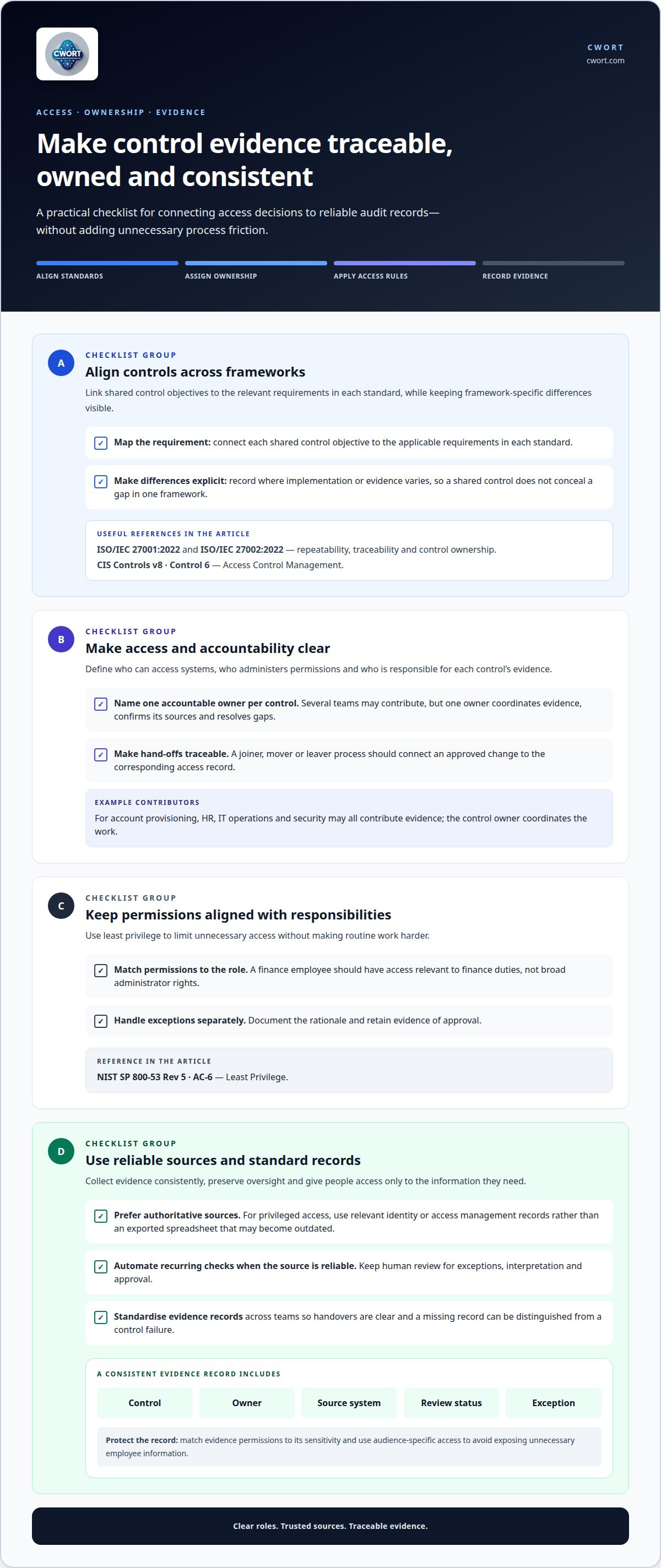
Organisations can map a control framework to multiple compliance standards by linking shared control objectives to the relevant requirements in each standard. Record where implementation or evidence differs, so a shared control does not conceal a gap in one framework.
ISO/IEC 27001:2022 and ISO/IEC 27002:2022 provide useful references for repeatability, traceability and control ownership. CIS Controls v8 identifies Control 6 as Access Control Management. Together, these references help teams define who can access systems, who administers permissions and how changes are evidenced. For example, a joiner, mover or leaver process should connect an approved change to the corresponding access record.
Apply least privilege to reduce unnecessary access without making routine work harder. NIST SP 800-53 Rev 5 control AC-6 is Least Privilege; use that principle to keep permissions aligned with each person’s responsibilities. A finance employee, for example, should receive access relevant to finance duties, not broad administrator rights. Review exceptions separately, document the rationale and retain evidence of approval.
Assign one accountable owner to each control, even when several teams contribute evidence. A control covering account provisioning might involve HR, IT operations and security. The owner coordinates contributions, confirms evidence sources and resolves gaps, rather than forwarding requests without context. This prevents audit requests from circulating between teams while each assumes another function is responsible.
Use authoritative source systems for evidence wherever possible. For a privileged-access control, for example, use relevant identity or access management records rather than an exported spreadsheet that may become outdated. Automate recurring evidence checks when the source is reliable, and reserve human review for exceptions, interpretation and approval. This keeps routine collection consistent while preserving oversight where judgement matters.
Standardise evidence records across teams. Identify the control, its owner, the source system, review status and any exception. A shared format clarifies handovers and helps distinguish a missing record from a control failure. Match evidence permissions to its sensitivity. Clear roles and audience-specific access support governance without exposing more employee information than necessary.
For organisations aligning controls across frameworks, a structured review can expose duplicate work and unmapped requirements. Explore a structured control-mapping approach to bring ownership, evidence and framework coverage into a clearer view.
Reducing overlapping tools and duplicate destinations
Overlapping workplace tools create duplicate records, competing notifications and uncertainty about where approved information belongs. A focused governance strategy reduces that burden by giving each tool a clear purpose and a trusted destination.
In CDW’s 2026 survey, 54% of more than 950 IT decision-makers said introducing new IT tools felt slower or more difficult than it should. Adding another platform can therefore increase friction unless it replaces duplication or connects existing work. Leaders should identify where teams repeat the same task, store parallel records or receive conflicting alerts before approving another tool.
GRC platforms and compliance automation tools reduce workload in different ways. A GRC platform can organise risks, controls and evidence, while automation can handle recurring collection and workflow tasks. Compare options by how well they fit existing systems, preserve evidence traceability, remove duplication and reduce manual reviews.
Reduce notification overload by separating alerts that require action from routine updates. An access exception may need an owner’s decision, while a routine status change may be recorded without messaging every stakeholder. Set notification rules for each workflow, then remove duplicate alerts from separate tools. This keeps important signals visible without encouraging employees to ignore workplace messages.
Manual reviews should focus on exceptions, judgement and validation, not repeated checks of unchanged information. Define which evidence can be collected consistently from its source system and which cases need human assessment. An unusual access change may require investigation; a routine, unchanged record may not need the same intervention. Keep the decision trail available for governance.
Shadow IT often grows when approved tools make ordinary work harder. Employees may use unofficial messaging, such as WhatsApp, to coordinate quickly, creating data, security and governance risks. Provide a well-governed channel suited to the same purpose and audience. Ask employees where approved routes fail, then address the practical barrier instead of relying only on tighter restrictions.
Consolidation needs a defined process. Map tools to the work they support, name an owner for each destination, and identify duplicate functions or records. Retire a destination only after accounting for its users, dependencies and evidence needs. If systems must remain separate, establish which is authoritative and how its records connect to the relevant workflow.
Review whether each tool still supports the workplace strategy. Track duplicate submissions, avoidable notifications, manual review queues and use of unofficial channels. These measures help leaders assess whether changes reduce effort while preserving evidence and appropriate oversight. Talking with employees can reveal friction that usage data alone misses.
Disconnected systems and technology sprawl
Compliance friction often starts with disconnected systems, duplicated records, unclear ownership and manual hand-offs. An IT team might track a control in Excel, manage remediation in Jira and store supporting evidence in separate folders. Staff must reconcile those sources before making decisions, adding operational effort and increasing the chance of inconsistent records.
Technology sprawl makes the problem harder to diagnose. Organisations can add systems without retiring older tools, leaving teams unsure which record is current. A change in an identity platform may not appear in a risk register, while an audit spreadsheet still shows an earlier position. This is more than an integration issue: every gap can prompt another manual check or evidence request.
Start by mapping the information path for one control. Identify where the relevant activity occurs, where its evidence is stored and which teams use that evidence. For example, trace a user-access change from request through approval to the system record. Note every copy, transfer and manual decision. This reveals breaks in the process without assuming that every system needs replacing.
Next, define the authoritative source for each evidence type. If an access platform records approvals, use that record as the source rather than a periodically exported spreadsheet. Connect systems only when the connection preserves useful context, such as the control reference, responsible owner and evidence date. A file transfer that loses those details moves data without improving traceability.
Implement changes to support evidence flow, not simply because a new integration is available. Prioritise repeated manual transfers and decisions that depend on information held elsewhere. Linking a remediation record to its control evidence, for instance, can help reviewers understand what changed and why. Retain human review where interpretation matters. Automate routine collection only when the source is reliable and the result can be validated.
Disconnected systems also encourage shadow processes. When approved tools do not support a hand-off, employees may use personal spreadsheets or unofficial messaging to coordinate work. These alternatives can separate evidence from its context and weaken governance. Provide a controlled route for collaboration, then improve the technical workflow that made the workaround attractive. A clear process is more useful than adding another destination.
To reduce sprawl, review each tool’s purpose, users, evidence held and dependencies before changing it. Retain systems that support necessary operational decisions; consolidate duplicate destinations where the same record is maintained twice. Document how information moves between remaining tools, who owns each connection and how failures are detected. This gives IT teams a practical basis for implementing changes without disrupting essential work.
Embedding compliance into processes from the start
Compliance is easier to execute when controls shape a workflow before launch, rather than being added after problems appear. A clear procedure shows the relevant action, who owns it and how evidence is captured as part of routine work. A practical way to reduce compliance friction for IT teams is to build requirements into the processes people already follow.
UK IT requirements may come from standards and regulatory frameworks such as ISO 27001, UK NIS, NIS2 and DORA. Which are relevant depends on the organisation’s activities and applicable scope. Treat each framework as a reason to map requirements to actual processes, not as a reason to bolt on identical steps everywhere.
UK GDPR and the Data Protection Act 2018 are relevant to IT processes involving personal data. Build privacy considerations into how a workflow handles access, information sharing and records, so teams can apply appropriate safeguards during ordinary work.
Begin where a task starts. A supplier process might identify the business owner, record the security review and preserve approval alongside the supplier record. If a required decision sits in an email thread, make the approved outcome visible in the relevant system. This reduces later reconstruction and keeps evidence connected to the activity it supports.
Translate policy into usable guidance. A policy may require authorised access; the procedure should explain how a manager requests it, who approves it and where the decision is recorded. Use plain language and instructions tailored to each role. Employees need to know what action applies to their task, not search a broad policy for an answer.
Design controls around workflow decision points. During a change review, for example, prompt the responsible person to record the risk assessment and approval before implementation. Keep evidence fields relevant and avoid requesting information already captured elsewhere. Documentation then becomes a by-product of work rather than a separate audit exercise.
Design external collaboration deliberately. A supplier onboarding process can specify the approved document-sharing channel, who may access it and how to retain the review outcome. This gives internal teams and external parties a shared route, reducing reliance on informal transfers that fragment records.
Test the procedure with the people who will use it. Ask an IT engineer to follow a change workflow and identify unclear steps, unnecessary approvals or missing guidance. Refine the process before wider adoption, then use operational logs and exception reviews to assess whether the control works as intended. Repeated exceptions may signal that the procedure needs adjustment, not simply more reminders.
To reduce compliance friction for IT teams, connect each requirement to the workflow, evidence and accountable role that address it. This helps avoid duplicate steps while keeping relevant controls part of daily operations.
CWORT
CWORT helps organisations turn compliance obligations into structured activities, linking evidence to control outcomes for auditable proof. Its governed workflow connects assessment criteria, evidence, expert judgement and accountable approvals, helping teams address fragmented tracking, unclear ownership and repeated evidence requests.
Turn to CWORT when your organisation needs to assess readiness or map controls against relevant requirements. Its offerings include DORA Compliance Readiness and Assessment, UK NIS Compliance Management, NIS2 Readiness and Compliance Management, and ISO 27001 Readiness and Control Mapping. These provide a route to clarify obligations, assess gaps and organise evidence without treating every framework as a separate tracking exercise.
Discuss how CWORT can support your compliance processes. Contact CWORT to start the conversation.
Make compliance a design decision
Build compliance into future technology and process decisions, rather than treating it as a final review gate. Before approving a new platform, service transition or workflow, establish how relevant obligations will be represented, who will own related decisions and what evidence will demonstrate that the process operates as intended.
A lasting way to reduce compliance friction for IT teams is to make good practice repeatable. Give leaders a clear view of compliance responsibilities during planning, and keep those responsibilities connected to delivery as systems and operating models change. This supports consistent execution without turning every change into a separate audit exercise.
When your organisation needs to structure its compliance approach or assess readiness against applicable frameworks, CWORT can support the work through its compliance offerings. Start with a focused discussion about your requirements, current processes and intended outcomes.
Contact CWORT to discuss compliance and identify a practical way forward for your organisation.
Frequently Asked Questions
How should security teams reduce audit friction when compliance evidence is spread across spreadsheets, inboxes, and point tools?
Define a single evidence record for each control, including its source, owner, review status and related decision. Link an approval email to the relevant change record, for example, rather than treating the email as evidence on its own. Reference the originating system and record when the evidence was collected. This makes it easier to explain how a conclusion was reached without reconstructing a trail from separate files.
How can organisations automate compliance evidence collection and reporting?
Automate repeatable collection from systems holding authoritative records, such as access logs or change records, and preserve the context that links each item to its control. Set rules for when collection runs and how exceptions are surfaced. Before relying on automated reports, have a control owner review whether the evidence supports the stated outcome. Automation can reduce copying and collation, but a report alone cannot establish that a control works.
How can compliance controls be integrated into CI/CD and IT service management workflows?
Place control prompts at existing decision points instead of creating a parallel approval route. In a CI/CD workflow, a release record could capture the relevant review, approval and supporting test result before deployment. In IT service management, a change record can retain the risk decision and authorisation. Define which changes need additional review, assign an accountable approver and link the resulting record to the release or service request.
What steps can IT teams take to simplify access reviews, change management and audit preparation?
For access reviews, group permissions by role or business function so reviewers can focus on exceptions rather than inspect every entitlement in isolation. For change management, use a consistent record connecting the request, impact assessment, approval and completion evidence. Before an audit, organise records around control outcomes and identify gaps that need explanation. This gives reviewers a coherent trail while preserving the underlying decisions and accountability.
What are the risks of over-automating compliance controls?
Over-automation can create false assurance if a workflow records completion without validating the quality or relevance of its evidence. It may also apply a routine rule to an exception that needs professional judgement, or carry inaccurate source data into reports. Keep human review for ambiguous findings, unusual changes and decisions with material consequences. Test automated rules against realistic cases, record overrides and periodically assess whether the process still reflects the control’s intent.
Disclaimer
The content on this site is provided for general information and educational purposes only. It does not constitute legal, regulatory, financial, or professional advice. CWORT provides AI-assisted insights and workflow automation, but all compliance decisions remain the responsibility of your organisation and its management. Always seek qualified legal or regulatory guidance for decisions relating to the UK NIS Regulations, CAF, DORA, NIS2, ISO 27001, or other obligations.
Related posts
UK NIS Audit Readiness Software: Orchestrating Evidence-Based Compliance in 2026
Prepare for 2026 with UK NIS audit readiness software. Ditch spreadsheets and automate compliance with NCSC CAF v4.0 to avoid £17m fines. Master your audit.
Compliance Evidence Management Software: Proving Regulatory Readiness in 2026
Prepare for DORA & NIS2. See how compliance evidence management software replaces chaotic audit trails with a single, defensible source of truth.
How to Demonstrate Control Effectiveness to Regulators: A Strategic Guide
Learn how to demonstrate control effectiveness to regulators with our guide. Shift from chaos to an evidence-based, audit-ready compliance programme today.
Article by
Michael Iyiola
Co-Founder, CWORT
Michael Iyiola is a co-founder of CWORT and a Cyber and AI Security Engineer with deep experience in vulnerability management, detection engineering and operational resilience across UK critical national infrastructure, including rail, energy and financial services. At CWORT, he designs scalable, evidence-driven workflows that help teams meet modern regulatory and security demands.
Build Your Foundation of Auditable Certainty
Take control of your regulatory obligations and secure your infrastructure with CWORT.