How to Create a Compliance Culture While Managing Resistance

Michael Iyiola
Co-Founder, CWORT
Learn how creating a culture of continuous compliance can overcome resistance with practical policies, role-based learning, safe reporting and clear accounta...

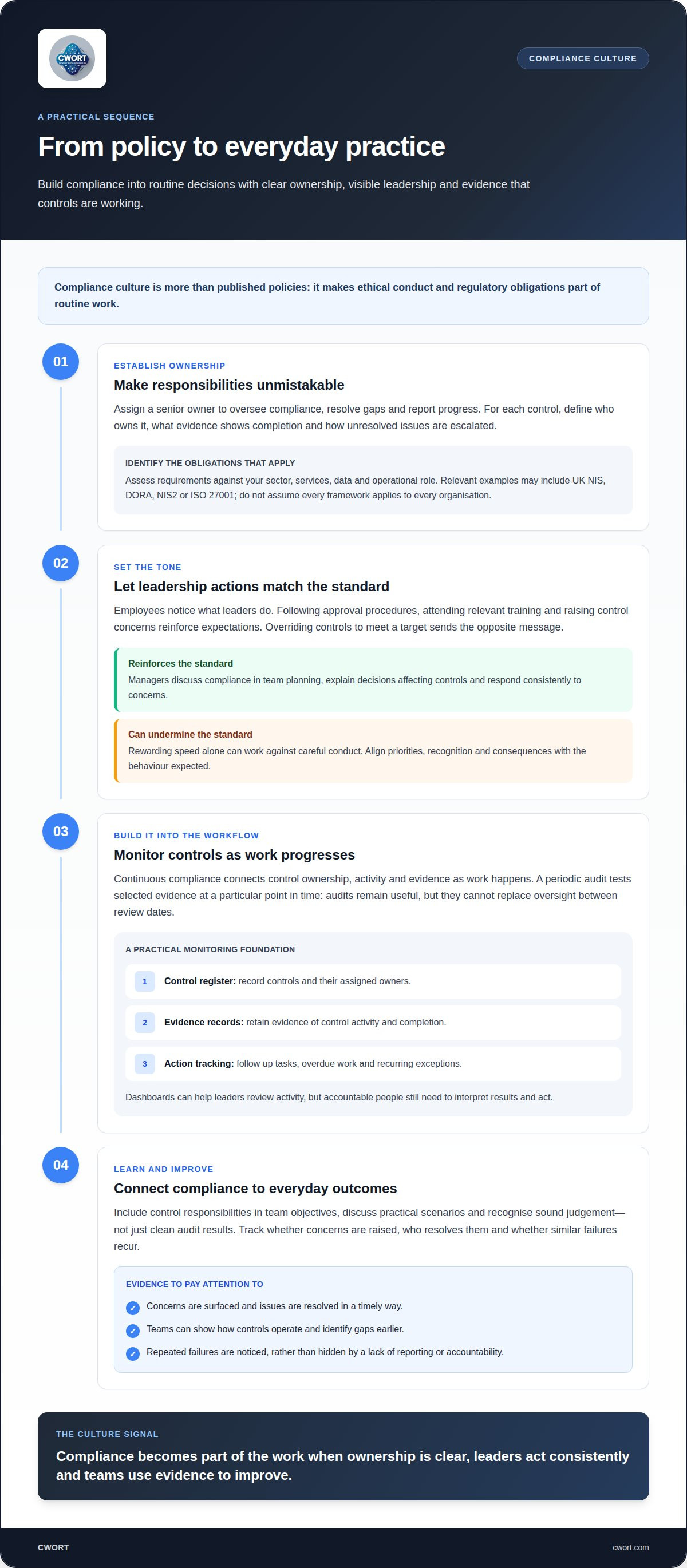
Compliance culture is not created by publishing more policies; it takes shape in everyday decisions. Creating a culture of continuous compliance means embedding ethical conduct, transparency and regulatory obligations in routine work, with leaders setting the example and clear processes making expectations practical.
That takes more than asking employees to complete training. Resistance can grow when policies feel disconnected from real work, reporting concerns feels unsafe, or teams lack time and resources to follow controls consistently. A constructive response from managers can make people more willing to raise concerns, helping surface small issues before they become harder to address.
This guide explains what compliance culture means and how to build it through clear policies, role-specific learning, open reporting and consistent accountability. It also covers working within resource limits and measuring progress through evidence such as audit findings, issue resolution and employee feedback. A practical example shows how everyday management behaviour can encourage staff to raise concerns proactively.
Key Takeaways
- Make compliance part of everyday decisions, with leaders modelling the behaviour they expect from their teams.
- Address resistance by listening to staff, making it safe to raise concerns and tailoring learning to people’s roles.
- Write policies in clear, accessible language and communicate updates when requirements or processes change.
- Measure progress through audits, staff feedback, reported issues and how effectively findings are resolved.
- Use a practical example to see how constructive management responses can encourage employees to flag concerns earlier.
Table of Contents
- What is Compliance Culture?
- Employee resistance and resource constraints
- Clear policies and procedures
- Measuring compliance culture effectiveness
- Example of a compliance culture transition
- CWORT: DORA Compliance Readiness and Assessment
What is Compliance Culture?
Compliance culture makes ethical conduct and regulatory obligations part of routine decisions, not just policy documents. Build it through leadership example, clear accountability and evidence that controls operate consistently.
-
Set leadership commitment and accountability
Assign a senior owner to oversee compliance responsibilities, resolve gaps and report progress to leadership. Define who owns each control, what evidence demonstrates completion and how unresolved issues escalate. According to International Organization for Standardization, ISO 9001 is a quality standard developed to help ensure that organisations operate safely and meet necessary regulations. Use relevant standards to inform your approach, not as a substitute for identifying your organisation’s actual obligations.
Which UK laws and regulatory requirements should organisations consider? Identify obligations by sector, services, data and operational role; do not assume every framework applies universally. Assess relevant requirements, which may include UK NIS, DORA, NIS2 or ISO 27001, against your organisation’s activities.
-
Model the expected tone at the top
Leaders should demonstrate the importance of compliance through decisions employees can observe. A director who follows approval procedures, attends relevant training and raises a control concern reinforces the stated standard. A leader who overrides controls to meet a target sends the opposite message, whatever the policy says.
Set expectations for managers as well as executives. Ask managers to discuss compliance during team planning, explain decisions that affect controls and respond consistently when people raise concerns. Review incentives and recognition, too: rewarding speed alone can undermine careful conduct. Leadership commitment is credible when actions, priorities and consequences align.
-
Distinguish continuous compliance from periodic audits
Integrate compliance checks into recurring work instead of relying only on periodic reviews. An audit tests selected evidence at a particular point in time; continuous compliance connects control ownership, activity and evidence as work progresses. Audits remain useful, but they cannot replace oversight between review dates.
Which tools and technologies support continuous compliance monitoring? Start with a structured control register, assigned owners, evidence records and a workflow for tracking actions. Dashboards can help leaders review overdue tasks and recurring exceptions. Choose tools that fit your processes and evidence needs: technology supports monitoring, but accountable people must still interpret results and act.
-
Identify the benefits and risks
Connect compliance activity to operational outcomes. Clear responsibilities reduce ambiguity, while timely evidence helps teams identify control gaps before an audit. Consistent conduct can also support organisational reputation and stakeholder trust. Creating a culture of continuous compliance means treating these outcomes as part of everyday governance, not an annual paperwork exercise.
What are the benefits of continuous compliance for organisations? It can improve visibility of obligations, support earlier issue resolution and help demonstrate how controls operate. A weak culture can leave breaches unreported, weaken accountability and expose an organisation to penalties or reputational damage. Track whether concerns are raised, who resolves them and whether similar failures recur.
How can leaders make compliance part of everyday work? Include control responsibilities in team objectives, discuss practical scenarios and respond consistently when issues emerge. Recognise sound judgement, not just clean audit results. This makes compliance visible in how work is planned, reviewed and improved.
Employee resistance and resource constraints
Resistance often points to a practical obstacle: unclear expectations, competing deadlines or concern about speaking up. Identify the barrier before choosing a response.
-
Address resistance and resource constraints
Ask employees what makes a control difficult to follow in their day-to-day work. A team, for example, may understand an approval policy but lack time to collect supporting evidence. Map each concern to its cause, such as unclear ownership, duplicated tasks or limited access to guidance. Then adjust the workflow or assign an accountable owner.
Separate deliberate disregard from process friction. A missed approval caused by an unclear handover calls for a different response from a repeated decision to bypass the same control. Review workloads alongside responsibilities, and prioritise practices that address the organisation’s most material risks. Avoid adding requirements without explaining their purpose or removing unnecessary duplication.
-
Provide ongoing education and training
Use role-specific learning rather than relying on one general presentation. A finance employee handling sensitive approvals may need different scenarios from a team member managing supplier records. Explain the relevant policies and procedures, then ask employees to apply them to realistic decisions. Scenario-based workshops make gaps in understanding easier to identify.
Reinforce learning through refresher discussions and updates when requirements or internal processes change. Include compliance learning in performance conversations so managers can address uncertainty before it affects routine work. Record completion and follow up when employees need clarification. Training should build practical judgement, not just familiarity with policy wording.
-
Assess employees’ understanding before designing a programme. Use a short survey or team discussion to find out whether people can explain their responsibilities and know where to find guidance. Ask whether they believe leaders take compliance seriously. Compare responses across teams, as shared understanding can vary between functions.
Make speaking up safe and useful. Provide clear routes for raising concerns, including an anonymous channel where appropriate, and explain how reports are handled. Thank employees who disclose mistakes; punishing people for surfacing problems can discourage future reporting. Managers should listen without defensiveness, record the issue and communicate the next action.
-
Protect time for compliance work by building checks into existing practices. For example, add a control prompt to an approval workflow instead of creating a separate task employees must remember. Ask team leads to flag conflicting priorities and recurring obstacles during routine planning. This makes resource constraints visible before they become an accepted reason for bypassing controls.
Review feedback regularly and adjust the approach as roles or risks change. If employees repeatedly misunderstand a procedure, revise its explanation and test it again with the people who use it. Where capability gaps need structured assessment or remediation, explore a compliance maturity assessment as a way to shape practical improvement actions.
Clear policies and procedures
Turn regulatory and ethical expectations into instructions employees can apply in real work. Assign ownership, define required conduct and keep each procedure accessible and current.
-
Set clear compliance expectations
Translate each obligation into a specific action, an accountable role and expected evidence. For example, a purchasing policy should identify who approves a supplier, what records support that approval and where those records belong. This makes accountability clear to employees and managers.
Explain the reason behind each expectation, including the risks it addresses and the conduct it requires. Distinguish mandatory steps from guidance, and state how staff should escalate an exception. Avoid broad phrases such as “use appropriate judgement” without examples or a route for resolving uncertainty.
Check that team objectives reinforce the same standards. If a deadline encourages staff to bypass an approval, revise the process or clarify that approval is still required. Leaders should communicate expectations consistently across departments, rather than apply different rules to similar work.
-
Develop clear policies and procedures
Build policies around the decisions employees actually make. Start with the relevant activity, identify its risks, then document the control, owner, evidence and escalation route. Keep the policy focused on expected outcomes; use a procedure to set out the sequence of actions staff must follow.
Test the draft with the people who will use it. Ask an employee to follow a procedure, such as reporting a suspected policy breach, using only the written instructions. Note where they hesitate, then clarify terms, responsibilities or handovers before approval.
Set a review trigger for changes in regulation, internal processes or identified risks. Name the policy owner and record approval, version and effective status. When an update changes expected conduct, explain what changed and what employees must do differently. This creates a traceable basis for applying policies fairly.
-
Make policies accessible
Store current policies in a central, searchable location employees can access during their work. Use plain language, descriptive titles and a clear structure, such as separate sections for responsibilities, actions and escalation. Avoid relying on old email attachments that may continue circulating after a policy changes.
Make the correct version easy to identify. Display its owner, approval status and review date, and remove or archive superseded copies. For a practical test, ask a new starter to find the procedure for a common task without help. If they cannot find it quickly, improve navigation.
Communicate updates through the channels affected employees use, then capture acknowledgement where appropriate. Managers can discuss a changed approval process during team meetings and confirm staff understand their responsibilities. Monitor questions and recurring errors; both can indicate that the wording, access or implementation needs further work.
Measuring compliance culture effectiveness
Set a baseline, choose indicators linked to your organisation’s values, then use the results to guide ongoing improvement. No single measure proves commitment or integrity; patterns across evidence, teams and reporting channels offer stronger insight.
-
Establish a baseline using audits, employee surveys, incident monitoring, breach-response assessments and training outcomes. Record current findings, reported issues and how promptly teams resolve them. For example, compare survey responses about psychological safety with actual escalation patterns. This can reveal whether employees understand expectations and feel able to raise concerns.
Break survey results down by team. Compliance culture can differ across departments, so a firm-wide average may conceal a local weakness. Ask staff whether they know where to report concerns, understand relevant controls and believe leaders take compliance seriously. Use the same questions in later surveys to assess change.
-
Choose measures that show behaviour and outcomes, not just completed administration. Track training completion, policy acknowledgements, control self-assessment pass rates, audit findings and repeat findings. Record the mean time needed to remediate audit findings and issues employees identify themselves. Each measure should have an owner, a defined evidence source and a review process.
Compare exceptions identified internally with those first detected by auditors. A higher proportion of self-identified exceptions can suggest that teams recognise and surface problems proactively. Review whether control failures are resolved at their source or merely documented. For example, repeated approval errors may indicate a process weakness despite completed training.
-
Interpret speak-up activity alongside the quality of responses. An increase in hotline or other reporting volume can indicate healthier reporting, not necessarily worsening conduct. Examine the concerns raised, their severity, escalation route and resolution. Check whether employees receive appropriate updates and whether investigations lead to corrective action.
Look for silence as well as volume. A decline in the frequency or seriousness of internally reported issues can warn of weakening speak-up behaviour. Compare reporting patterns with survey responses about psychological safety and escalation. If employees say concerns feel unsafe to raise, low reporting is not evidence of strong compliance.
-
Turn findings into a prioritised improvement plan. Assign an accountable owner to each action, define the evidence of completion and review whether the change addresses the original cause. Consider audit results, employee feedback and remediation timelines together. A faster closure rate means little if the same control findings keep recurring.
Present trends to leadership with context, not isolated figures. Use 360 feedback and performance reviews to make compliance-related behaviour visible, while avoiding incentives that reward low reporting alone. Review indicators consistently, investigate differences between teams and adjust the plan as risks change. This connects measurement to decisions, accountability and demonstrable progress.
Example of a compliance culture transition
Consider how a team handles a missed target. Its response can determine whether employees conceal small problems or raise them early. The example below shows how to turn challenge and reporting into practical evidence of cultural change.
-
Record the starting behaviour before changing the response. For example, note whether employees report small control issues, how managers react and whether actions receive follow-up. Focus the review on observable conduct, not assumptions about staff motivation. This baseline helps distinguish silence caused by fear from issues that lack a clear reporting route.
Ask employees how they would raise a concern and what they expect to happen next. Compare their answers with actual reporting and escalation patterns. If staff cannot describe the process, clarify the route before judging reporting levels. A strong compliance culture depends on accessible channels and a credible response when someone uses them.
-
Respond constructively when a target is missed. A manager should establish what happened, identify the control or process involved and agree on practical corrective action. Avoid treating the initial disclosure as proof of poor conduct. If employees see colleagues punished simply for surfacing mistakes, they may keep later issues to themselves.
Explain the response to the team while protecting confidential details. For example, share what process changed after a missed approval and who owns the follow-up. This shows that reporting leads to action, not just a record. It also turns an operational challenge into an opportunity to strengthen how work is done.
-
Make expected behaviour visible in routine team interactions. Managers can invite staff to raise emerging issues during planning meetings, then acknowledge useful disclosures without blaming the messenger. Record each concern, its owner and the next action. This creates a traceable response and shows employees what leadership commitment looks like in practice.
Review whether the process removes barriers to speaking up. Check that employees know where to report, receive appropriate updates and can escalate unresolved concerns. If a team reports fewer issues, compare that pattern with staff feedback and observed control problems. Low reporting alone does not demonstrate success or prove that risks have disappeared.
-
Track the transition through reporting patterns and follow-through. In an example of culture change, a team that responds constructively to a missed target has a noticeably higher rate of staff proactively flagging small issues within a year. Treat this as a behavioural signal, then examine whether reports receive timely investigation and corrective action.
Use the evidence to refine management practice, rather than declaring success after one positive change. Compare employee feedback with escalations, repeat issues and completed actions. Creating a strong compliance culture requires consistent responses when work goes wrong. To assess gaps and prioritise improvement, explore a compliance maturity assessment.
CWORT: DORA Compliance Readiness and Assessment
CWORT’s DORA Compliance Readiness and Assessment helps organisations translate regulatory obligations into structured compliance activities. Use it when leadership needs clearer oversight of control ownership, execution and supporting evidence, rather than fragmented tracking across separate tools.
The platform binds evidence to control outcomes and supports auditable compliance proof. This can help teams identify where readiness work requires attention and organise follow-up actions. Depending on your applicable framework, related offerings include UK NIS Compliance Management, NIS2 Readiness and Compliance Management, and ISO 27001 Readiness and Control Mapping.
To discuss how CWORT could support your compliance work, visit CWORT online.
Turn compliance intent into sustained capability
Choose one operational workflow where unclear ownership or delayed reporting creates avoidable friction. Map the decisions, evidence and handovers involved, then agree on what better practice should look like. Starting with a focused workflow gives teams a practical way to test whether expectations work in real conditions before extending changes across the organisation.
Creating a culture of continuous compliance is an ongoing leadership commitment, not a campaign with a fixed endpoint. As responsibilities and risks evolve, keep asking whether people can apply expectations, raise concerns and see issues addressed. Use those signals to decide what to strengthen next, rather than relying on policy completion alone.
If you’re ready to connect cultural goals with structured compliance work, contact CWORT to discuss your next step. Start with the challenge that matters most to your organisation, and build from there with clarity and purpose.
Frequently Asked Questions
Can culture be fixed with more training?
No. Training can clarify responsibilities, but it cannot make up for managers who ignore breaches or incentives that reward shortcuts. For example, staff may complete a conflicts-of-interest module yet still feel pressured to approve a questionable decision if targets take priority. Pair learning with visible leadership conduct, fair consequences and opportunities to discuss difficult scenarios. Check whether people apply what they learned in real decisions, not only whether they completed the course.
Can culture differ meaningfully between teams in the same firm?
Yes. A sales team facing deadline pressure may experience compliance expectations differently from an assurance team reviewing evidence. Local managers shape what gets challenged, escalated or overlooked, so one organisation-wide result can hide these differences. Compare employee feedback and reporting patterns by team, then investigate unexpected gaps. For instance, lower concern reporting in one department may call for confidential listening sessions before leaders decide whether processes or management behaviour need attention.
How do you measure its effectiveness?
Combine evidence about conduct, reporting and outcomes rather than relying on one indicator. Compare team survey responses with audit findings, recurring exceptions and the resolution of reported concerns. For example, ask whether employees feel able to challenge a decision, then check whether escalations receive documented follow-up. Track whether staff-identified issues are resolved and recur. Interpret reporting volumes carefully: more reports can reflect greater trust in speak-up channels, not necessarily more misconduct.
How long does culture change take?
Meaningful, lasting compliance culture change typically takes years rather than months. The pace depends on whether leaders change their behaviour, employees trust reporting processes and corrective actions address underlying causes. A new policy may be introduced quickly, but confidence grows through repeated experiences, such as a manager responding constructively to a disclosed error. Set near-term milestones for practical changes, then assess whether those behaviours persist as teams face new pressures and priorities.
What are some ways to create and nurture this culture?
Start with a specific behaviour to reinforce, such as challenging an approval that lacks supporting evidence. Ask managers to explain the expected response, recognise sound judgement and review whether workloads make the process workable. Invite employees to test procedures using realistic cases, then use their feedback to improve them. Keep reporting routes visible and explain how concerns progress. These practices make compliance part of operational decisions rather than a separate annual exercise.
What’s the earliest warning sign of a weakening culture?
A decline in the frequency or seriousness of issues reported internally can be an early warning sign. It deserves attention when employees still encounter control problems but fewer concerns reach managers or reporting channels. Compare reporting trends with staff feedback, audit observations and unresolved escalations. For example, a quieter hotline alongside repeated informal concerns may indicate that employees doubt reports will receive a fair response.
Why do compliance programmes fail?
Programmes can fail when senior managers do not support them, communication or training is poor, monitoring is inconsistent, or controls do not adapt to changing risks. These weaknesses reinforce one another. Unclear ownership, for example, can leave an updated procedure without an accountable team, while inconsistent follow-up signals that compliance is optional. Diagnose the failure point before adding another control. Review ownership, staff understanding, evidence and the quality of management oversight.
What does a culture of continuous compliance mean?
It means people consider relevant obligations as part of ordinary work, not only during an audit or policy review. For example, a project team might record why it accepted a supplier exception, who approved it and what follow-up is needed. The culture is continuous because decisions, evidence and learning remain connected over time. It depends on shared expectations and visible accountability, rather than treating compliance as a task owned solely by specialists.
Disclaimer
The content on this site is provided for general information and educational purposes only. It does not constitute legal, regulatory, financial, or professional advice. CWORT provides AI-assisted insights and workflow automation, but all compliance decisions remain the responsibility of your organisation and its management. Always seek qualified legal or regulatory guidance for decisions relating to the UK NIS Regulations, CAF, DORA, NIS2, ISO 27001, or other obligations.
Related posts
Streamlining Regulatory Compliance Processes: From Manual Tracking to Orchestrated Validation
Stop wasting money on manual compliance. Learn about streamlining regulatory compliance processes to reduce personal liability under DORA & NIS2 and gain aud...
The Shift to Compliance Orchestration Platforms: Beyond Enterprise GRC Automation
Struggling with DORA & NIS2? Move beyond failing GRC tools with a compliance orchestration platform for automated, auditor-ready evidence and real-time overs...
Real-Time Compliance Dashboards for Executive Decisions
See how real-time compliance dashboards for executives turn trusted data into clear risk signals, accountable actions and stronger regulatory oversight.
Article by
Michael Iyiola
Co-Founder, CWORT
Michael Iyiola is a co-founder of CWORT and a Cyber and AI Security Engineer with deep experience in vulnerability management, detection engineering and operational resilience across UK critical national infrastructure, including rail, energy and financial services. At CWORT, he designs scalable, evidence-driven workflows that help teams meet modern regulatory and security demands.
Build Your Foundation of Auditable Certainty
Take control of your regulatory obligations and secure your infrastructure with CWORT.