How to Maintain Compliance After Certification and Manage Costs

Michael Iyiola
Co-Founder, CWORT
Learn how to maintain compliance after certification with guidance on regulatory changes, product updates, documentation, audits and ongoing costs effectively.

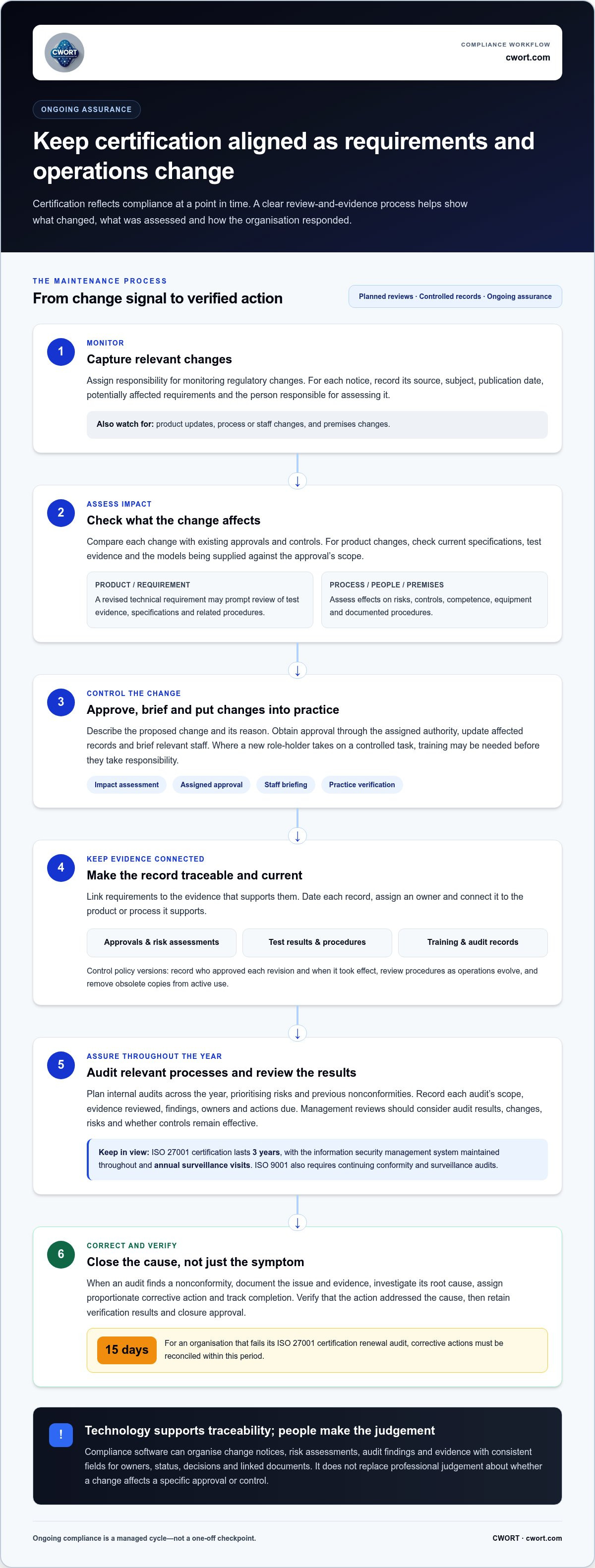
Certification is a checkpoint, not a permanent guarantee: a product can become non-compliant if requirements change or the product itself is updated. Knowing how to maintain compliance after certification means monitoring those changes and keeping the evidence behind the certification current. For ISO 27001, certification is valid for 3 years, and organisations must maintain their information security management system throughout that period, including annual surveillance visits.
It is easy to treat certification as the finish line, but how to maintain compliance after certification comes down to planned reviews, controlled documentation and ongoing assurance. If those activities slip, gaps can emerge between what was certified and how the organisation or product operates now.
This article explains how regulatory changes and product updates can affect compliance, what documentation to keep current, and how audits and maintenance work shape ongoing costs. It also outlines how to organise compliance activity across the certification cycle so evidence remains traceable and renewal preparation is controlled.
Key Takeaways
- Assign responsibility for monitoring regulatory changes, then assess how each relevant update affects existing approvals and controls.
- Review product and operational changes for compliance impact before they create gaps between certified arrangements and current practice.
- Keep technical documentation, policies and declarations aligned with how products and operations actually work.
- Identify which UK regulators and industry rules apply, and account for oversight that may continue after products reach the market.
- Map the main drivers of maintenance costs and distribute compliance work across the year to avoid a last-minute evidence scramble.
Table of Contents
- Regulatory change management and regulatory intelligence
- Can a certified product become non-compliant?
- Updating technical documentation and declarations
- Regulatory bodies and industry rules
- Certification maintenance costs
- CWORT: DORA Compliance Readiness and Assessment
Regulatory change management and regulatory intelligence
Certification reflects compliance at a particular point in time. Requirements, product designs and operating processes can change, so manufacturers need a consistent way to identify changes and assess their impact. A notice is useful only when someone determines which product, control or procedure it affects.
Build regulatory monitoring into a defined review process. Record each change’s source, subject and publication date, the requirements it may affect, and who is responsible for assessing it. Then compare the change with existing approvals and controls. For example, a revised technical requirement may prompt a review of test evidence, product specifications and related procedures before the next production decision.
Maintain records that connect requirements to evidence: applicable approvals, risk assessments, test results, controlled procedures, training records, audit findings and corrective actions. Date each item, assign an owner and link it to the product or process it supports. This makes it possible to show what was assessed, what changed and how the organisation responded.
For changes to processes, staff or premises, first describe the proposed change and its reason. Assess its effects on risks, controls, competence, equipment and documented procedures. Approve the change through the organisation’s assigned authority, update affected records, brief relevant staff, then review whether controls work in practice. ISO 9001 expects changes to be managed in a controlled and planned way.
Apply the same discipline when staff or premises change. A new role-holder may need training before taking responsibility for a controlled task. A premises move can affect equipment, storage or work instructions. Record the impact assessment, approvals, revised documents and verification results. Together, these records show how the change was managed and whether it created a compliance gap.
Plan internal audits to examine relevant processes over time, prioritising risks and previous nonconformities. Schedule audits throughout the year rather than concentrating evidence gathering before an external assessment. Record the scope, evidence reviewed, findings, owners and actions due. Management reviews should consider audit results, changes, risks and whether existing controls remain effective.
When an audit identifies a nonconformity, document the issue and supporting evidence. Investigate the root cause, assign proportionate corrective action, set an owner and track completion. Then verify that the action addressed the cause, not just the visible symptom. Retain verification results and closure approval to demonstrate both the correction and its effectiveness.
Compliance management software can bring change notices, risk assessments, audit findings and evidence into a structured record. Use consistent fields for owners, status, decisions and linked documents. Software supports traceability, but does not replace professional judgement. A reviewer still needs to determine whether a regulatory change affects a specific approval or control.
Manage policies and data through controlled versions. Record who approved each revision, when it took effect and which teams use it. Review procedures as operations evolve, and remove obsolete copies from active use. This gives auditors a clear path from current requirements to the policies, evidence and practices that demonstrate compliance.
Can a certified product become non-compliant?
Yes. A product’s compliance status can change when requirements or specifications change, so existing approvals need periodic review. Certification also involves continuing system obligations, including surveillance and renewal activities.
Ongoing certification requirements
Ongoing certification requirements are the controls and reviews an organisation must continue to meet after its certificate is issued. For ISO 27001, certification lasts 3 years, and the organisation must maintain its information security management system throughout that period. ISO 9001 certification likewise requires a quality management system that continues to meet the standard’s requirements. These obligations make certification a continuing programme, not a one-off assessment.
Review approvals whenever a product, process or applicable requirement changes. Compare each approval’s scope with current specifications, test evidence and the models being supplied. If several models share one certificate, a failed market-surveillance documentation review or test may affect more than one shipment. Record the comparison and resulting action so teams can trace why an approval still applies or what needs reassessment.
Surveillance audits and certification breaches
Surveillance audits assess whether certified management systems continue to meet their requirements between certification cycles. ISO 27001 organisations undergo annual surveillance visits; ISO 9001 surveillance audits also check continuing conformity. The schedule depends on the certification scheme, so organisations should map its review dates and recurring evidence needs into their annual plan.
A failed audit or breach requires a documented response, not simply a plan to address it later. For an organisation that fails its ISO 27001 certification renewal audit, corrective actions must be reconciled within 15 days. Record the finding, investigate its cause, assign corrective action and retain evidence of completion. Spread annual requirements across the year, rather than leaving evidence gathering until the assessment period.
Recertification preparation
Recertification preparation is the review of controls, evidence and outstanding actions before a certificate expires. For ISO 27001, begin preparing around three months before the certification expiration date. This gives the organisation time to check risk records, review audit findings, confirm control operation and resolve gaps before the renewal assessment.
For ISO 9001, recertification audits assess the quality management system’s overall effectiveness after three years. Plan backwards from the renewal date, allowing time to evaluate objectives, process performance and corrective-action effectiveness. Keep the review continuous: a late evidence drive can expose missing records, while routine checks reveal whether an approval still reflects the product or system in operation.
Where a regulated organisation needs a more structured way to track requirements, actions and evidence, explore a compliance validation approach alongside its certification programme.
Updating technical documentation and declarations
Technical documentation must reflect the product and processes currently in use, not only the version assessed for certification. A component substitution, design revision or change in manufacturing method can affect the evidence supporting an approval. Record the change, identify affected products and requirements, then assess whether existing test results and declarations still accurately describe the updated configuration.
Link each requirement to the relevant product specification and supporting evidence. Keep controlled copies of drawings, risk assessments, test reports, inspection records and approval decisions. When a document changes, record its revision, approval and effective date. This helps teams distinguish current evidence from superseded material during an audit or market-surveillance review.
Review declarations of conformity when technical changes or regulatory updates could affect the original declaration. Confirm that the named product, applicable requirements and supporting documents remain aligned. If a declaration needs revision, retain the previous version and record why the new one was issued. A clear revision history shows how the change was assessed and who is accountable for the compliance statement.
Policies and procedures need the same discipline. ISO 9001 requires organisations to maintain documented information where necessary to support effective operation and demonstrate control. Review affected documents when operations evolve or expand. For example, a revised inspection process should prompt updates to the work instruction, relevant forms and staff guidance. Withdraw obsolete copies from use so employees follow the approved procedure.
Connect regulatory monitoring with document control. Log relevant updates, review existing approvals and assess whether technical changes affect product requirements. Assign an owner to each assessment and record the outcome, including when no document revision is needed. This decision record shows that the update was considered, not overlooked.
Include preparation for market surveillance and customs checks in ongoing compliance work. Organise approval records, declarations and supporting evidence so they can be retrieved by product or model. If several models rely on shared documentation, map those relationships clearly. A change to one model can then trigger a focused review of linked records.
Use a controlled review cycle for policies, declarations and technical files. At each review, compare documents with current product specifications, operating practices and applicable requirements. Record gaps, assign corrective work and verify revised documents before release. This prevents an updated file from being approved while related instructions or evidence remain outdated.
Keep compliance data structured and accessible to those responsible for product, quality and regulatory decisions. A central register can track document owners, revision status, linked approvals and open actions. Restrict changes to authorised roles, preserve previous versions and record the rationale for decisions. These controls make it easier to reconstruct the evidence trail when an auditor reviews a product change.
Regulatory bodies and industry rules
Compliance responsibilities depend on an organisation’s sector, products and markets. In the United Kingdom, the Medicines and Healthcare products Regulatory Agency (MHRA) is a government organisation that puts regulations in place. Financial institutions must also account for industry rules associated with the Financial Conduct Authority (FCA), the Prudential Regulation Authority (PRA) and the Financial Services Compensation Scheme (FSCS). These bodies and frameworks have different roles, so organisations need to map requirements to their own activities.
Identify which rules apply to each service, product or business function. Record the relevant authority, requirement, accountable owner and supporting control in a central register. For example, a financial institution should map relevant FCA and PRA requirements to the processes and evidence that demonstrate how they are addressed. A product business should identify applicable requirements and link them to approvals, declarations and technical records.
Certification does not replace regulatory oversight. Regulators may check products at the border or after they reach customers, rather than checking every product before market entry. Maintain records that connect each product to its approval and supporting documentation, and make them retrievable for the relevant review or check.
Some schemes rely on a supplier’s declaration of conformity. Where regulators or certification bodies reduce or remove pre-market checks, manufacturers are responsible for declaring compliance. The accuracy of the declaration and its supporting evidence is therefore central. Before making or updating a declaration, compare the product’s actual design and configuration with applicable requirements and retained records.
Industry rules can change independently of product design. Assign responsibility for monitoring relevant regulatory updates, then assess each change against existing controls and documentation. Record the decision, including why a change does or does not affect a particular product or process. This creates a clear audit trail and helps teams distinguish relevant updates from information outside their scope.
Independent third-party services can audit company policies and operations to assess whether they comply with regulations. Such reviews can help identify gaps between written procedures and actual practice. The organisation must still own decisions and corrective actions: assign each finding to a responsible role, record supporting evidence and track resolution. A clear map of authorities, rules and controls helps UK organisations connect external expectations with day-to-day governance.
Certification maintenance costs
Certification costs continue after the initial assessment. For ISO 27001, budget planning should account for surveillance audits, external support and employee training. These costs arise at different points in the certification cycle, so treating them as one renewal expense can obscure what drives the annual spend.
Separate recurring obligations from work triggered by a change or finding. Recurring activities include audit preparation, staff awareness and routine evidence management. Additional effort may follow a change in scope, a control gap or corrective action. Record each activity’s purpose and owner, then compare planned work with actual effort during management review.
Audit expenditure depends on the work required to assess an organisation’s certified system. System scope, processes and available evidence all affect preparation and assessment effort. Well-maintained records can reduce avoidable rework, while scattered evidence may force teams to reconstruct decisions before an auditor can assess them. Budget for preparation as well as the audit itself.
External consulting is another potential cost. It may support readiness, interpretation of control requirements or work to address identified gaps. Define the work before allocating a budget: distinguish specialist input from tasks internal teams can complete, and link each engagement to a documented deliverable. For example, a targeted review of unresolved findings has a clearer purpose than open-ended support.
Training and awareness also need planned resources. The effort depends on the roles affected, the controls employees operate and any procedural changes. A revised access-control process, for example, may require updated staff guidance and evidence that the affected team understands its responsibilities. Track training against roles and control changes, rather than treating it as a generic annual activity.
Use a cost register to make programme spending easier to forecast. Group expenditure by certification activity, owner, planned timing and business purpose. Review it alongside audit findings and planned changes so leadership can distinguish essential maintenance from avoidable remediation caused by late preparation. Keep assumptions visible and update forecasts when scope or corrective work changes.
- Audit: include preparation, evidence collation and assessment activity.
- People: account for training and staff time spent maintaining controls.
- Change: allow for reviews or remediation prompted by new requirements or findings.
- Support: define external work by scope and deliverables.
Costs vary with certification scope, operational complexity, evidence quality and the amount of corrective work required. Compare actual effort with the forecast after each audit cycle, then adjust the next programme. To structure compliance evidence and activity around defined controls, request a compliance validation demonstration.
CWORT: DORA Compliance Readiness and Assessment
CWORT’s DORA Compliance Readiness and Assessment helps organisations structure regulatory obligations as accountable activities and connect evidence to control outcomes. It is relevant when certification maintenance involves fragmented tracking, unclear ownership or difficulty producing auditable evidence. The platform supports separation of duties and brings compliance validation into a governed workflow.
Organisations working across frameworks can also use UK NIS Compliance Management, NIS2 Readiness and Compliance Management, or ISO 27001 Readiness and Control Mapping. These offerings help align framework requirements with controls and supporting evidence, giving teams a clearer view of outstanding actions and assessment readiness. The right starting point depends on the framework and compliance challenge your organisation needs to address.
To explore how CWORT could support your compliance work, visit cwort.com.
Make ongoing compliance part of governance
Ultimately, how to maintain compliance after certification is a governance question: who owns the evidence, who validates it and how leaders act on gaps. Assign these responsibilities within oversight so compliance remains connected to operational decisions, rather than becoming a separate reporting exercise.
CWORT supports organisations that need structured compliance validation through DORA Compliance Readiness and Assessment, UK NIS Compliance Management, and NIS2 Readiness and Compliance Management. These offerings can help teams organise regulatory obligations and evidence around control outcomes. Choose the relevant framework as the starting point for a focused discussion about your organisation’s requirements.
Contact CWORT about compliance to discuss a practical next step. A clear ownership model and a dependable evidence trail put your organisation in a stronger position to manage its continuing obligations with discipline.
Frequently Asked Questions
How long does ISO 27001 certification last?
ISO 27001 certification lasts 3 years. Use the certificate’s expiry date to anchor renewal planning, and keep the certification scope visible to teams responsible for controls. For example, if a business adds a service within that scope, assess its information-security implications and retain the decision. This helps prevent a certificate being treated as evidence for activities that the organisation has not assessed.
How can an organisation maintain ISO certification?
To maintain compliance after certification, keep the management system active in daily work, not just in audit records. Give control owners clear responsibilities, retain evidence of their work and review unresolved findings. For example, when an employee changes roles, reassign their control responsibilities and update relevant access records. This links organisational changes to control ownership and helps preserve continuity.
How should organisations monitor regulatory and standard updates after certification?
Organisations looking at how to maintain compliance after certification should keep a monitored register of relevant regulators and standards, with an owner responsible for reviewing updates and recording decisions. For example, a UK organisation can track MHRA or FCA publications where those bodies’ requirements apply. Log relevant updates, assess their effect on the organisation’s scope and record why they prompted action or required no change.
What are the costs of surveillance audits and certification renewal in the UK?
There is no single cost for every UK organisation. Budget requirements depend on certification scope, system complexity, audit effort, preparation needs and unresolved corrective work. Internal staff time, training and external support can also affect total expenditure. Separate these categories in the annual forecast, then compare planned and actual work after each audit. This analysis helps explain budget changes and inform the next cycle.
What risks can lead to suspension or withdrawal of certification?
Key risks include failing to maintain the certified management system, leaving audit findings unresolved, or making significant operational changes without assessing their impact. Being unable to show that controls operate as required can also undermine an organisation’s case during a review. Track findings to verified closure, keep the certification scope accurate and escalate gaps to management. Prompt, documented action makes issues visible before they compound.
Disclaimer
The content on this site is provided for general information and educational purposes only. It does not constitute legal, regulatory, financial, or professional advice. CWORT provides AI-assisted insights and workflow automation, but all compliance decisions remain the responsibility of your organisation and its management. Always seek qualified legal or regulatory guidance for decisions relating to the UK NIS Regulations, CAF, DORA, NIS2, ISO 27001, or other obligations.
Related posts
ISO 27001 Continuous Compliance Monitoring: The 2026 Strategic Shift
Prepare for 2026. See how ISO 27001 compliance validation software replaces risky snapshot audits with a real-time, evidence-led monitoring framework.
NIS2 Audit Readiness Tool: Orchestrating Evidence-Based Compliance in 2026
Is your NIS2 compliance built on spreadsheets? Discover how a dedicated NIS2 audit readiness tool orchestrates evidence to deliver auditable proof and certai...
Four ways to understand and reduce human error in compliance
Discover four ways of reducing the risk of human error in compliance, investigating near misses and improving controls, procedures and cyber risk management.
Article by
Michael Iyiola
Co-Founder, CWORT
Michael Iyiola is a co-founder of CWORT and a Cyber and AI Security Engineer with deep experience in vulnerability management, detection engineering and operational resilience across UK critical national infrastructure, including rail, energy and financial services. At CWORT, he designs scalable, evidence-driven workflows that help teams meet modern regulatory and security demands.
Build Your Foundation of Auditable Certainty
Take control of your regulatory obligations and secure your infrastructure with CWORT.