How to Measure Control Effectiveness Continuously: A Strategic Guide for UK Enterprises

Michael Iyiola
Co-Founder, CWORT
For UK enterprises: learn how to measure control effectiveness continuously. End the audit scramble with a system for real-time, auditable proof of resilience.

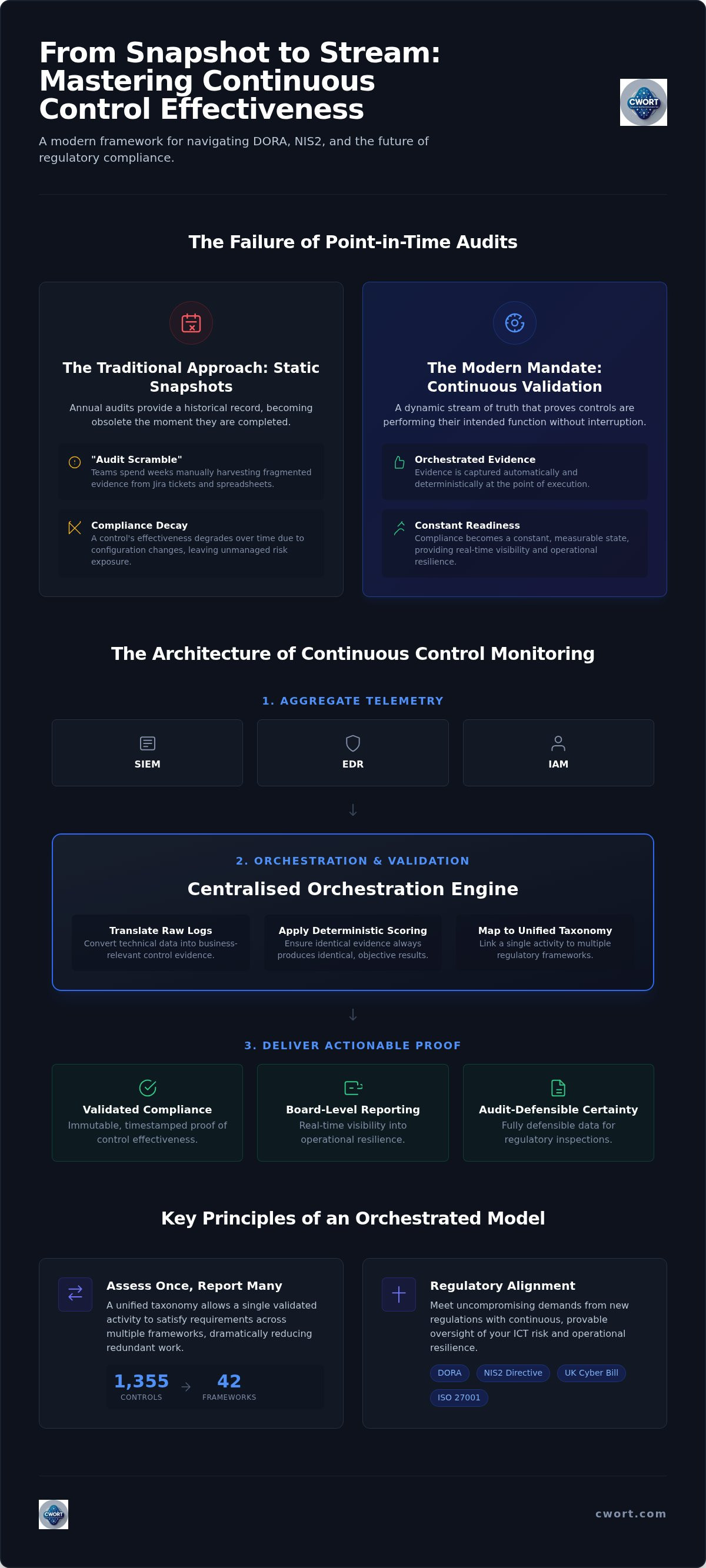
An annual audit is no longer a badge of security. It is merely a historical record of a moment that has already passed. For UK enterprises facing the stringent demands of DORA and the Cyber Security and Resilience Bill, relying on a point-in-time assessment is a strategic liability. You likely recognise the friction of the 'audit scramble', where teams spend weeks harvesting fragmented evidence from Jira tickets and spreadsheets, only to produce a subjective snapshot that is obsolete by the time it reaches the board.
This guide demonstrates how to measure control effectiveness continuously by shifting from manual tracking to a deterministic, evidence-based orchestration model. We'll move beyond the anxiety of fragmented data to establish a system where identical evidence always yields the same result. You'll learn to build a repeatable framework for control validation that satisfies regulators and provides the board with real-time visibility into operational resilience. We'll outline the precise path from administrative obligation to a state of total, auditable certainty.
Key Takeaways
- Eliminate the inefficiency of the "audit scramble" by transitioning from subjective snapshots to a system of ongoing, evidence-based validation.
- Master how to measure control effectiveness continuously by mapping regulatory obligations directly to structured execution activities within your operating model.
- Integrate telemetry from disparate security tools into a centralised orchestration layer to provide the board with definitive proof of cyber resilience.
- Utilise a deterministic scoring model to ensure your compliance data remains reproducible, objective, and fully defensible during regulatory inspections.
- Implement an "assess once, report many" framework to streamline compliance across DORA, NIS2, and ISO 27001 using a unified taxonomy of controls.
Table of Contents
- The Failure of Point-in-Time Control Testing in 2026
- The Architecture of Continuous Control Monitoring (CCM)
- Manual vs. Orchestrated Control Validation: A Performance Comparison
- A 5-Step Framework for Implementing Continuous Measurement
- CWORT: Turning Controls into Operating Model Intelligence
The Failure of Point-in-Time Control Testing in 2026
The traditional annual audit is a relic. By the time an auditor reviews a control, the operational environment has already shifted, rendering the evidence historical rather than actionable. Continuous control effectiveness is the ongoing validation that a safeguard is performing its intended function without interruption. It replaces the static snapshot with a dynamic stream of truth. In 2026, UK regulators such as the FCA, NCSC, and Ofgem have moved beyond "best effort" checklists. They now demand operational resilience, a state where an internal control is proven to work under pressure, every hour of every day.
Static assessments suffer from "Compliance Decay". A control might be effective on Monday, but a configuration change on Tuesday can render it useless by Wednesday. Without a system that understands how to measure control effectiveness continuously, organisations remain blind to these gaps for months. This delay creates unmanaged risk exposure that no amount of manual reporting can mitigate. Learning how to measure control effectiveness continuously is no longer a luxury; it's a prerequisite for survival in a high-stakes regulatory environment.
The Limitations of Manual GRC Reporting
Relying on Jira tickets and Excel spreadsheets creates fragmented, non-deterministic data silos. These tools weren't designed for validation; they were built for task management. This leads to "green-washing", where subjective self-assessments mask underlying vulnerabilities because there's no objective proof to contradict a "compliant" status. When an audit arrives, the administrative burden of manual evidence reconstruction is immense. Teams scramble to find proof that should have been captured automatically at the point of execution.
Regulatory Pressure: DORA and NIS2 Requirements
The regulatory landscape in 2026 is uncompromising. Since DORA became fully enforceable on 17 January 2025, financial entities must provide continuous oversight of ICT risk management. Similarly, the UK's Cyber Security and Resilience Bill and the EU's NIS2 directive demand "state-of-the-art" security measures. These aren't suggestions. They require audit-defensible proof that controls are active and effective. Transitioning to an orchestrated model ensures that compliance isn't a periodic hurdle but a constant, measurable state of readiness.
The Architecture of Continuous Control Monitoring (CCM)
Transitioning from abstract policy to structured execution is the foundational shift required for modern governance. An orchestration engine serves as the strategic layer above your technical stack, aggregating telemetry from point-tools such as SIEM, EDR, and IAM. This isn't merely data collection. It is the active translation of raw logs into validated proof. To understand how to measure control effectiveness continuously, you must move away from manual checklists and towards an automated, system-driven approach that enforces discipline by design.
A robust CCM architecture relies on a deterministic scoring model. In this system, identical evidence always yields identical results, ensuring that your compliance status is reproducible and objective. This eliminates the variance inherent in human interpretation. By utilising a unified taxonomy, such as the 1,355 controls in the CWORT library, you can map a single validated activity across 42 different frameworks. This "assess once, report many" capability reduces redundant work and ensures consistency across your entire operational landscape. It turns compliance from a series of disjointed projects into a single, cohesive operating model.
Binding Evidence to Control Outcomes
Integrity is the cornerstone of continuous validation. Evidence must be immutable and timestamped at the point of capture to prevent any possibility of retrospective alteration. You must link this operational data directly to specific regulatory obligations, creating a clear line of sight from a technical event to a legal requirement. Defining success criteria involves converting vague policy statements into binary, measurable outcomes. For example, a control for encryption isn't just "present"; it's effective only if the telemetry confirms the specific algorithm and key rotation frequency meet your defined standards. This level of granularity is essential for how to measure control effectiveness continuously in a complex digital environment.
Separation of Duties in Control Validation
Accountability is enforced through a strict separation of duties. The orchestration platform ensures that the teams responsible for executing a security measure are distinct from the automated system that validates its performance. This prevents the "homework marking itself" syndrome, a common failure in manual GRC environments where self-assessments often mask operational gaps. A comprehensive audit trail must record every change in control status, providing the board with a transparent record of resilience. If you want to see this architecture in action, you can request a demo of our compliance validation platform. This ensures that your evidence is not just present, but defensible under the scrutiny of a DORA or NIS2 inspection.
Manual vs. Orchestrated Control Validation: A Performance Comparison
Manual validation relies on periodic, labour-intensive sampling. This approach creates a time-to-insight measured in months, often delivering findings that are irrelevant by the time they reach leadership. Orchestrated dashboards provide validation in seconds. The cost of inaccuracy in manual systems is high. Subjective guesswork leads to unmanaged risk exposure, as humans naturally overlook gaps or provide optimistic assessments. Scalability is the final hurdle. A single compliance officer cannot manually monitor the thousands of controls required for a modern enterprise. Orchestration solves this by automating the heavy lifting. It's the only method that explains how to measure control effectiveness continuously across the entire organisation without increasing headcount. Board-level reporting also transforms. You shift from technical jargon to clear, maturity-based heat-maps that drive strategic decision-making.
The "Assess Once, Report Many" Efficiency
Efficiency in 2026 demands a unified approach. A single assessment managed through Regulatory Compliance Workflow Automation satisfies DORA, NIS2, and ISO 27001 simultaneously. This removes the redundancy of technical teams providing the same evidence to multiple auditors. Streamlining evidence collection reduces audit fatigue. It allows your engineers to focus on operational resilience rather than administrative data entry. It's the most effective way to maintain pace with an expanding digital supply chain.
Reproducibility and Audit Defensibility
Regulators are increasingly sceptical of manual trackers. They reject scores that lack a transparent, reproducible calculation method. An immutable audit history is your primary defence. It proves exactly when a control was tested and what the result was. Automated confidence scores provide a level of certainty that manual data simply cannot match. When you implement a system that knows how to measure control effectiveness continuously, you replace gut feel with defensible truth. You gain the calm of auditable certainty.
A 5-Step Framework for Implementing Continuous Measurement
Execution is the end goal of any governance strategy. You start by decomposing dense regulatory text into discrete execution activities. This eliminates the ambiguity of high-level policy and ensures every legal requirement is anchored to a specific operational task. By organising these activities into a structured taxonomy, such as CWORT’s 217 domains, you create a comprehensive map that covers every operational corner. This is the first practical step in how to measure control effectiveness continuously across a fragmented enterprise.
Data must flow without manual intervention to remain credible. Integrate your validation layer directly with your existing technical stack, including EDR, IAM, and Asset Registers. Once connected, orchestrate the validation process to enforce a strict separation of duties. Automated status roll-ups then provide a real-time view of your compliance posture. This shifts the burden from human auditors to a system that doesn't sleep, providing a level of oversight that manual sampling simply cannot match.
Refinement should be data-driven rather than reactive. Use AI-assisted advisory to spot trends or emerging gaps in your coverage before they become material risks. This identifies areas for improvement whilst maintaining the deterministic integrity of your scoring model. It ensures your operating model remains agile without sacrificing the "defensible truth" required for regulatory inspections. This disciplined approach is the only way to understand how to measure control effectiveness continuously in an evolving threat landscape.
Transitioning from Legacy GRC Tools
Legacy GRC tools often act as a graveyard for static data. To move forward, you must identify the "dead wood" in your current tracking processes, specifically those manual steps that add no value but consume significant time. Migrating these models into an orchestrated platform is essential for Ensuring Compliance Evidence Integrity. This transition replaces the hope of compliance with the proof of validation.
Setting Realistic Maturity Targets
Maturity isn't achieved overnight. Use structured assessments to design a Target Operating Model (TOM) that reflects your specific risk profile and regulatory obligations. Prioritise remediation where the gap between current and target maturity is greatest. Real-time heat-maps provide the visibility needed to track this progress, offering a far more accurate reflection of resilience than a quarterly report ever could. To see this framework in action, you can request a demo of our compliance validation platform.
CWORT: Turning Controls into Operating Model Intelligence
CWORT functions as the definitive orchestration layer that sits above your existing security and infrastructure tooling. It aggregates evidence from disparate systems to provide a unified, structural view of your compliance posture. With a comprehensive library of 1,355 pre-mapped controls, CWORT allows UK enterprises to accelerate their readiness for DORA and NIS2 by months. This pre-mapped taxonomy ensures that technical telemetry is automatically aligned with regulatory obligations. By centralising your governance logic, you finally understand how to measure control effectiveness continuously without drowning in spreadsheet silos. It transforms raw data into board-ready maturity reports and regulator-ready evidence registers, providing leadership with the auditable certainty required in high-stakes environments. For organisations with unique governance needs, the Bring Your Own Content (BYOC) capability allows you to integrate bespoke enterprise requirements into the same rigorous validation framework. This turns compliance from a burden into operating model intelligence that informs strategic resource allocation.
Deterministic Scoring for Total Certainty
The platform's deterministic scoring model sets a new standard for UK audits. It ensures that identical evidence always produces the same result, removing the subjectivity that often undermines manual assessments. This objective approach eliminates the traditional friction and hand-offs between the Diagnose, Design, Deliver, and Demonstrate phases of a compliance project. By automating the validation process, CWORT ensures that your operating model remains disciplined by design. AI is utilised as a sophisticated advisor to identify trends and gaps, but it is never the final decision-maker. This preserves the structural integrity and traceability of your audit trail, ensuring every score is defensible. This disciplined orchestration means you can demonstrate compliance to a regulator with the push of a button, replacing weeks of evidence gathering with seconds of automated reporting.
Next Steps for Strategic Resilience
Strategic resilience is built through disciplined execution rather than administrative tracking. You don't need to overhaul your entire organisation at once. Start with a governed pilot on a single sub-function to demonstrate the power of automated validation. This initial step allows you to prove how to measure control effectiveness continuously in a controlled environment before scaling across the enterprise. Shifting to a measurable operating model replaces the anxiety of potential failure with the calm of auditable certainty. It’s time to move beyond the 'audit scramble' and establish a system of definitive, evidence-based proof. By moving from manual tracking to an orchestrated system, you ensure that your resilience is not just a policy statement but a lived reality. To begin this transition, book a working session to map your CWORT programme and secure your path to total assurance.
Transitioning to a State of Total Assurance
The transition from periodic sampling to continuous validation is the only viable path for UK enterprises navigating the 2026 regulatory landscape. By replacing fragmented, manual tracking with a structured orchestration engine, you eliminate the 'audit scramble' and establish a definitive record of resilience. Mastering how to measure control effectiveness continuously transforms your security function from an administrative cost centre into a disciplined operating model. This shift ensures that your evidence is not merely present but is reproducible and defensible under the scrutiny of DORA or NIS2 inspectors.
CWORT provides the strategic layer needed to achieve this level of maturity. With 1,355 controls pre-mapped to 42 global and UK frameworks, the platform delivers deterministic results that provide total audit-defensibility. You'll reduce audit preparation time by eliminating the need for manual evidence reconstruction, allowing your teams to focus on active risk mitigation. It's time to replace the anxiety of potential failure with the calm of auditable certainty. Orchestrate your compliance validation with CWORT and lead your organisation towards a future of demonstrable operational integrity.
Frequently Asked Questions
What is the difference between control monitoring and control testing?
Control monitoring is the continuous observation of a process to detect deviations, whilst control testing is the specific validation that a control meets its objective at a given moment. Monitoring provides the raw telemetry, but testing provides the definitive verdict on effectiveness. To understand how to measure control effectiveness continuously, you must integrate both into a single orchestration layer that converts real-time monitoring data into an ongoing, automated test result.
How does continuous measurement help with DORA compliance?
Continuous measurement fulfils the DORA mandate for ongoing oversight of ICT risk management frameworks. It replaces periodic, manual reviews with a system that provides real-time assurance to the board. By using a platform pre-mapped to DORA requirements, organisations can demonstrate to regulators that their digital operational resilience is a constant state rather than a historical snapshot captured during an annual audit. This provides the audit-defensible proof regulators now expect.
Can I use Jira to measure control effectiveness continuously?
Jira is a task management tool, not a compliance validation system. Using it for control measurement creates a 'homework marking itself' scenario where execution and validation are conflated. It lacks the deterministic scoring, immutable audit trails, and strict separation of duties required for an audit-defensible governance model. True continuous measurement requires an orchestration layer that sits above task tools to aggregate telemetry and validate evidence objectively without manual intervention.
What are the key features of an audit-defensible evidence register?
An audit-defensible evidence register must feature an immutable audit history and control-by-control status tracking. Every entry should be timestamped and bound directly to a specific regulatory obligation. It must provide a transparent, reproducible link between the raw telemetry and the final effectiveness score. This ensures that when a regulator reviews your posture, every claim is backed by objective proof that cannot be retrospectively altered or manipulated.
How often should control effectiveness be reviewed in a regulated environment?
In high-stakes environments governed by NIS2 or DORA, control effectiveness should be reviewed constantly. The 'annual audit scramble' is obsolete because configuration changes can cause compliance decay in hours. Establishing a system to how to measure control effectiveness continuously ensures that gaps are identified and remediated immediately. This moves the organisation from a reactive posture to a state of permanent audit readiness, providing ongoing visibility into operational resilience.
Does continuous monitoring require replacing my existing security tools?
Continuous monitoring does not require replacing your existing security stack. Instead, an orchestration engine sits above your point-tools, such as SIEM, EDR, and IAM. It consumes telemetry from these systems to provide a unified view of your operating model. This approach leverages your current investments whilst adding the governance layer necessary to translate technical logs into defensible compliance evidence, ensuring your existing tools contribute to a wider assurance framework.
How do I handle controls that cannot be easily automated?
Controls that cannot be fully automated are managed through a governed manual workflow. This involves defining structured execution activities where owners upload timestamped evidence directly into a central platform. By applying the same deterministic scoring rules and separation of duties to manual tasks, you ensure that even non-technical controls are validated with the same level of rigour and auditability as automated ones, maintaining a consistent standard of proof.
What is deterministic scoring in compliance validation?
Deterministic scoring ensures that identical evidence always yields the same result, removing human bias from the validation process. This model is central to producing audit-defensible proof because it makes the assessment reproducible. It replaces the 'gut feel' often found in manual GRC assessments with a disciplined, mathematical approach to governance. This provides leadership with a confidence score that is objective, transparent, and capable of withstanding intense regulatory scrutiny during an inspection.
Disclaimer
The content on this site is provided for general information and educational purposes only. It does not constitute legal, regulatory, financial, or professional advice. CWORT provides AI-assisted insights and workflow automation, but all compliance decisions remain the responsibility of your organisation and its management. Always seek qualified legal or regulatory guidance for decisions relating to the UK NIS Regulations, CAF, DORA, NIS2, ISO 27001, or other obligations.
Related posts
Managing Compliance Evidence in Excel: Comparison and Strategic Risks for 2026
Is managing compliance evidence in excel a risk for 2026? Learn why spreadsheets jeopardise DORA & NIS2 validation and get a roadmap to an audit-ready system.
The Shift to Compliance Orchestration Platforms: Beyond Enterprise GRC Automation
Struggling with DORA & NIS2? Move beyond failing GRC tools with a compliance orchestration platform for automated, auditor-ready evidence and real-time overs...
CISO Guide to DORA Operational Resilience: Orchestrating Validated Compliance
Master validated compliance with our CISO guide to DORA operational resilience. Swap manual evidence gathering for an orchestrated, audit-ready security post...
Article by
Michael Iyiola
Co-Founder, CWORT
Michael Iyiola is a co-founder of CWORT and a Cyber and AI Security Engineer with deep experience in vulnerability management, detection engineering and operational resilience across UK critical national infrastructure, including rail, energy and financial services. At CWORT, he designs scalable, evidence-driven workflows that help teams meet modern regulatory and security demands.
Build Your Foundation of Auditable Certainty
Take control of your regulatory obligations and secure your infrastructure with CWORT.