How to Prepare for a UK NIS Inspection: A Practical Guide

Michael Iyiola
Co-Founder, CWORT
Discover how to prepare for a UK NIS inspection. Learn how to map scope, assemble traceable evidence, and demonstrate robust NCSC CAF compliance effectively.

Inspection readiness is demonstrated through control execution, not a last-minute evidence pack. When ownership is spread across teams and records sit in separate systems, even effective controls can be difficult to explain. Knowing how to prepare for a UK NIS inspection starts with confirming whether your organisation and relevant services are in scope, then understanding what the inspection will assess.
You need more than a folder of policies. You need traceable evidence linking applicable obligations to accountable owners, control activity and outcomes. For organisations assessed against the NCSC Cyber Assessment Framework, that means showing how security outcomes work in practice, rather than simply stating that controls exist.
This guide sets out a proportionate, evidence-led approach. You’ll learn how to confirm the inspection context and scope, map requirements to ownership and operational evidence, and identify priority gaps before scrutiny begins. It also explains how to present evidence clearly, so your organisation can demonstrate not just what it has documented, but how its controls operate.
Key Takeaways
- Learn how to prepare for a UK NIS inspection by establishing the applicable service scope and inspection context before assembling evidence.
- Build a traceable line from each applicable obligation to its control, accountable owner, execution activity and outcome.
- Assess whether evidence is current, attributable and relevant, rather than relying on documents without operational context.
- Use a defined response sequence to coordinate requests and owners, following the deadlines and formats set by the competent authority.
- See how continuous validation, evidence binding and separation of duties can support a more defensible inspection response.
Table of Contents
- How to prepare for a UK NIS inspection: establish scope before gathering evidence
- Turn UK NIS obligations into accountable controls and evidence
- Test inspection readiness: assess evidence quality, gaps and explanations
- Prepare a UK NIS inspection response plan and prioritise remediation
- How CWORT supports UK NIS inspection readiness through validation
How to prepare for a UK NIS inspection: establish scope before gathering evidence
Before searching shared drives or requesting policies, define the boundary of the exercise. Which legal entity, service and supporting systems are relevant? Which competent authority is responsible? Without clear answers, teams may collect material for services outside the inspection’s scope while overlooking evidence for the service under scrutiny.
Start with the Network and Information Systems Regulations 2018 (S.I. 2018/506), then check current legislation and the relevant authority’s guidance. Sector and service context matter: responsibility is divided between competent authorities, so you can’t identify the regulator or assessment process from the acronym alone. Search results may also confuse UK NIS with National Insurance, including National Insurance number guidance and testing material. Those relate to a different subject and don’t establish cyber-security obligations or inspection scope.
Which organisations and services may fall within UK NIS?
The Regulations cover Operators of Essential Services (OES) and relevant Digital Service Providers (RDSP). OES provide essential services in specified sectors, while RDSP categories include certain cloud computing services, online marketplaces and online search engines. The Information Commissioner’s Office (ICO) guide explains these categories and is particularly relevant to RDSPs. It isn’t a universal regulator or a definitive scope determination for every organisation.
Map your organisation’s position. Record the legal entity, service boundaries, supporting systems, any designation or formal correspondence, and the competent authority identified for the sector. A supplier to an in-scope organisation shouldn’t assume that this alone makes it an OES or RDSP. Equally, don’t conclude that a service is out of scope just because another part of the group is regulated. Check the basis for each conclusion against current legislation and authority guidance.
What does an inspection or evidence request involve?
An inspection, assessment or evidence request can vary by authority, regulated service and circumstances. The competent authority’s communication is the reference for a particular exercise: record its stated scope, requested material, deadlines and submission format. Keep that formal request distinct from broader readiness work. Preparing internal control records can support readiness, but it doesn’t expand or replace the authority’s stated requirements.
Check for changes to legislation and guidance before relying on an old scope map. The Cyber Security and Resilience Bill was introduced in November 2025. According to the position reported on 4 October 2026, it had passed the House of Commons, with the report stage in the House of Lords scheduled for 26 October. Proposed changes include bringing medium and large managed service providers and data centres into scope. These are proposals, not a basis for treating a service as already regulated. Recheck the Bill’s status and any resulting legislation at publication, then confirm how the relevant authority interprets the current position for your organisation.
That disciplined scoping is the first practical step in how to prepare for a UK NIS inspection: document what applies, why it applies and who oversees it. Once the boundary is clear, you can target evidence to the service and assessment context instead of collecting material indiscriminately.
Turn UK NIS obligations into accountable controls and evidence
Once the inspection boundary is clear, translate each applicable obligation into work that can be examined. Evidence is more than a policy, spreadsheet or screenshot. It should support a defined control outcome and be explainable in context: what activity took place, who performed or reviewed it, when it happened, which service it covered and what the result shows.
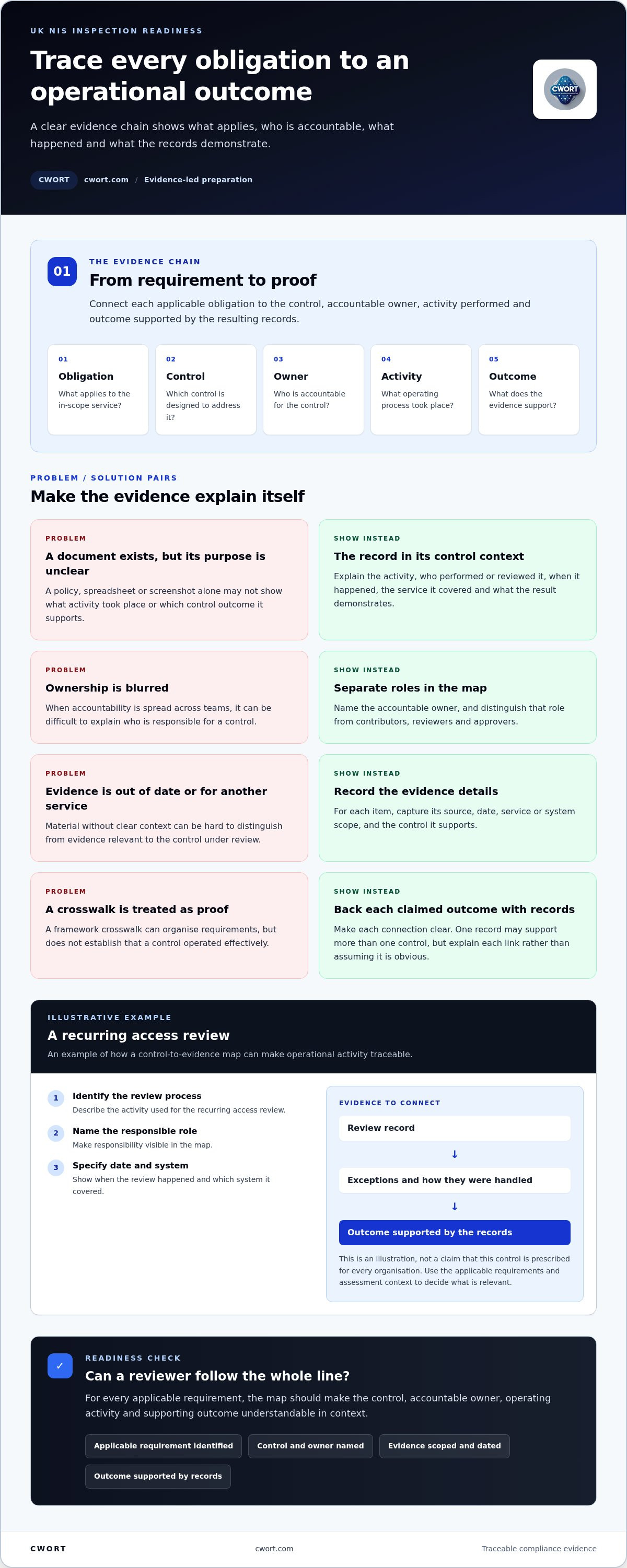
Traceable compliance evidence connects an applicable obligation to a control, its accountable owner, the activity performed and the outcome supported by the resulting records. This chain gives reviewers a route from requirement to operational proof and helps your team spot where the connection breaks.
Build a control-to-evidence map for the inspection scope
Create a working map for the in-scope service. For each applicable requirement, identify the control designed to address it, its owner, the operating process and the evidence supporting the claimed outcome. Record each item’s source, date, service or system scope, and connection to the control. This helps distinguish current, relevant evidence from material that is out of date or relates to another service.
For example, if an organisation relies on a recurring access review, the map could identify the review process, responsible role, date and system covered, review record, and how exceptions were handled. This is an illustration, not a claim that a particular control is prescribed for every organisation. Use the applicable requirements and assessment context to determine which evidence is relevant.
Check for duplicates and gaps. One record may support more than one control, but explain each connection rather than assuming it is obvious. A framework crosswalk can help organise requirements, but it doesn’t prove that a control operated effectively. The evidence must still support the stated outcome.
Make ownership and separation of duties visible
Name the accountable owner and distinguish that role from contributors, reviewers and approvers. Where responsibilities are shared, record who performs each part and how the hand-off is documented. This addresses a common weakness: a control appears on a chart, but nobody can explain who actually carries it out or challenges it.
Show separation of duties where it applies. For example, identify whether the person carrying out an activity differs from the person reviewing or approving its result, and retain evidence of those steps. The appropriate arrangement depends on the control and operating context, so record the rationale rather than assuming role labels alone demonstrate independence.
Use the NCSC Cyber Assessment Framework (CAF) as an outcome-focused assessment context where it applies. Mapping controls to CAF outcomes can structure your evidence narrative, but your organisation must still explain how its activities support those outcomes. If you’re assessing how a governed validation workflow could connect requirements, ownership and evidence, explore a UK NIS compliance validation approach.
Test inspection readiness: assess evidence quality, gaps and explanations
A full evidence folder can still leave important questions unanswered. A policy may describe the intended approach, but without records showing how it was applied, who carried it out and what resulted, it may not support a conclusion about a control’s operation. Readiness depends on evidence that is relevant to the control and understandable to someone who wasn’t involved in producing it.
Use a repeatable evidence-quality review
Review each item against its control and claimed outcome. Check that it relates to the in-scope service, can be attributed to a responsible role, is dated, is complete enough to interpret and can be traced to the activity it supports. Note limitations plainly. If a record is missing or a conclusion depends on an assumption, record a gap rather than presenting it as a confirmed result.
Evidence may exist without supporting a control conclusion; its relevance, context and traceability determine what it can substantiate.
Apply the same tests to every type of material, whether it’s a policy, approval record or technical output. A policy can show that an approach is documented; on its own, it doesn’t demonstrate that the approach was followed in a particular instance. Don’t treat a completed folder or framework crosswalk as proof of control effectiveness. Organisation and mapping make material easier to find, but the evidence must support the conclusion.
Run a proportionate internal inspection rehearsal
Select representative controls across the inspection scope. Ask each owner to explain the control’s purpose, how it operates, what evidence supports it and how exceptions are handled. Then check whether another informed colleague can follow the same trail without undocumented explanations. This can reveal weak links between records and outcomes before they affect your response.
Keep the exercise focused. Simulate a specific evidence request by asking teams to identify, validate and explain relevant records within an internal timeframe. This is a readiness test, not a replica of a competent authority’s formal process; actual requests and deadlines depend on the authority and circumstances.
Use the findings to classify evidence as supportable, incomplete or unavailable, then assign an owner and next action to each gap. This makes how to prepare for a UK NIS inspection a practical test of whether your explanations are backed by evidence, not just well-organised files.
Prepare a UK NIS inspection response plan and prioritise remediation
A clear response plan prevents a regulatory request from turning into disconnected emails, duplicate files and unreviewed explanations. Set the sequence in advance, then adapt it to the communication received. Deadlines, scope and submission formats must come from the relevant competent authority’s communication, not an assumed timetable or generic checklist.
- Receive and register the scope. Log the authority’s request, the services and controls it covers, the material requested and any stated deadline or format.
- Assign a response lead. Give one accountable person responsibility for coordination, escalation and maintaining a consistent view of progress.
- Validate each request. Break it into clear evidence requirements. Identify ambiguity or overlap and manage any clarification through the appropriate channel.
- Coordinate owners. Allocate each request to a subject-matter owner, with a reviewer checking relevance, context and completeness.
- Review and submit. Confirm that each response addresses the request, the evidence is traceable and any limitations are accurately described. Submit using the authority’s specified process.
Coordinate responses without losing evidence traceability
Maintain a request log linking each item to its scope, owner, status, source evidence and review state. Use controlled checkpoints for expert input so contributions can be attributed and checked before they enter the final response. Preserve relevant records in line with your organisation’s applicable retention and preservation arrangements. Document decisions, exceptions, clarifications and follow-up actions. This gives you a reliable record of how the response was prepared, rather than just a collection of submitted files.
Keep the response proportionate to the request. Avoid sending broad, unfiltered material that obscures the answer or introduces unrelated records. If evidence is incomplete, record the limitation and the action underway instead of presenting an assumption as a completed outcome.
Turn findings into owned, measurable remediation
Prioritise gaps based on their relationship to applicable risk, the importance of the affected control, dependencies and the accountable owner’s ability to act. Don’t invent a universal numerical score. A gap affecting a critical control or blocking another remediation may warrant earlier attention than an isolated documentation improvement. Record the rationale in your organisation’s context.
For each finding, state what is missing, which control or outcome is affected, who owns the response and what action will address it. Define a practical completion measure, such as approval of a revised process and evidence that it is operating, rather than relying on a vague “in progress” status. Reassess the evidence before describing remediation as complete. A structured workflow can improve governance and traceability, but it can’t guarantee a regulator’s conclusion.
CWORT translates obligations into controls and structured activities, binds evidence to activity states and outcomes, and supports continuous validation. It also enforces separation of duties by design. Request a CWORT demo to see how this approach can support UK NIS inspection readiness.
How CWORT supports UK NIS inspection readiness through validation
Preparation is stronger when evidence is part of governed control execution, rather than assembled from disconnected files only after a request arrives. CWORT is a compliance validation system that translates applicable obligations into controls and structured activities. It supports UK NIS and NCSC CAF, connecting requirements to assigned roles, activity checkpoints and evidence of control outcomes.
This provides a structured way to put the preparation steps into operation: work from the confirmed scope, assign responsibility, validate evidence and address gaps. CWORT is designed to prove compliance, not simply record that work has been assigned or completed. Its continuous validation state keeps execution and evidence connected as activity progresses.
From UK NIS requirements to validated execution
For an in-scope requirement, CWORT connects the relevant control with its execution activities and assigned roles. Structured checkpoints capture subject-matter expert input and delivery evidence as part of those activities. This creates a clearer trail from what the organisation needs to demonstrate to the work performed and the evidence supporting the outcome.
Accountability is explicit. CWORT enforces separation of duties by design, distinguishing responsibilities so control execution and review aren’t treated as interchangeable. Evidence is bound to activity states and control outcomes, giving reviewers context instead of leaving them to infer why a document matters. The result is a more defensible control narrative, while the underlying evidence still needs to reflect the organisation’s operations accurately.
What leaders and reviewers can see
The programme cockpit provides a live view of execution status. Leaders can see where activities stand and identify areas needing attention, rather than relying solely on periodic summaries. Because evidence is associated with activity states and outcomes, reviewers can follow how a control was addressed and what material supports the reported result.
CWORT automatically generates regulator-ready and audit-ready PDF outputs. These outputs present validated work in a structured form, but don’t replace the need to follow the competent authority’s actual scope, evidence requests, deadlines or submission instructions. Nor do they guarantee an inspection outcome. The organisation remains responsible for ensuring its evidence is accurate, relevant and complete for the request.
For teams considering how to prepare for a UK NIS inspection through a repeatable validation workflow, CWORT brings roles, checkpoints and evidence into one governed execution model. Readiness can be maintained through ongoing validation instead of relying on a last-minute collation exercise. Request a CWORT demo to see how the system supports UK NIS compliance validation.
Make inspection readiness part of operational discipline
Use this work to establish a lasting readiness rhythm, not just prepare for a single request. Set a regular point to review whether responsibilities still reflect how services operate, whether evidence remains relevant, and whether unresolved issues have clear owners. When teams make these checks part of normal governance, inspection preparation depends less on urgent, cross-organisational searches.
Decide how leadership will maintain visibility and act on findings. A consistent validation approach can turn that intention into accountable execution, so changes in services, ownership or evidence don’t quietly weaken the organisation’s ability to explain its position. Knowing how to prepare for a UK NIS inspection ultimately means building confidence in your ability to demonstrate controls when scrutiny arises, without assuming any process guarantees a particular regulatory conclusion.
Request a CWORT demo to explore how governed validation can support your UK NIS readiness.
Frequently Asked Questions
Who can carry out a UK NIS inspection?
The responsible authority depends on the organisation and service in scope; no single body oversees every organisation. The ICO’s guidance identifies the ICO as competent authority for relevant digital service providers, but that doesn’t make it the authority for all UK NIS entities. Check current official guidance for your sector and any formal communication you’ve received. This general preparation guidance isn’t legal advice or a definitive account of inspection powers.
Is UK NIS the same as NIS2?
No. UK NIS and the EU’s NIS2 are distinct regulatory frameworks, so don’t assume their scope or obligations match. This guide concerns preparation for a UK NIS inspection; it doesn’t establish whether an organisation also has NIS2 obligations. For example, a business operating across UK and EU markets may need to assess each framework separately against current authoritative guidance. A UK NIS inspection shouldn’t be treated as an automatic assessment of NIS2 compliance.
What evidence should an organisation prepare for a UK NIS inspection?
Start with the relevant authority’s request and the service it identifies. When considering how to prepare for a UK NIS inspection, tailor the response to that scope rather than building a generic pack. A request about incident handling, for example, might call for applicable procedures and records showing how a relevant event was managed. Label material with its owner, date and service context, and explain what it supports. Flag gaps clearly: evidence doesn’t prove more than its content can substantiate.
How often should an organisation conduct a UK NIS readiness review?
There’s no universal review interval to treat as a regulatory rule without a current source. Set a cadence that reflects your obligations, risks, governance and any applicable authority requirements. Revisit readiness after material changes, such as a service redesign, a change in control ownership or an incident that alters risk assumptions. Between formal reviews, keep follow-up actions visible and ensure owners reassess affected evidence instead of relying on an old review as assurance.
Can a compliance platform help prepare for a UK NIS inspection?
Yes. A platform can structure requirements, ownership, execution and evidence so control status is easier to explain. CWORT supports UK NIS and connects evidence to execution activities and control outcomes. It enforces separation of duties by design and automatically generates regulator-ready outputs. These capabilities support validation, but don’t replace accountable decisions or the authority’s specific instructions. Use the communication received to determine what must be provided and how.
What should an organisation do if it identifies a control gap before an inspection?
Record the affected control, the basis for the finding, an accountable owner and the planned remediation. Prioritise it through your organisation’s risk and governance process, then retain evidence of progress and reassess before marking it resolved. For example, distinguish a planned procedure update from an approved change that has been put into operation. If a formal request or deadline is already in place, follow its instructions and seek appropriate legal or regulatory advice where needed.
Disclaimer
The content on this site is provided for general information and educational purposes only. It does not constitute legal, regulatory, financial, or professional advice. CWORT provides AI-assisted insights and workflow automation, but all compliance decisions remain the responsibility of your organisation and its management. Always seek qualified legal or regulatory guidance for decisions relating to the UK NIS Regulations, CAF, DORA, NIS2, ISO 27001, or other obligations.
Related posts
UK NIS Audit Readiness Tool: Orchestrating Compliance for 2026
Master your 2026 audit with our guide to UK NIS compliance orchestration. Move from fragmented evidence to a single source of truth for NCSC CAF 4.0 readiness.
UK NIS Evidence Management Platform: Orchestrating Auditable Compliance in 2026
Is your NIS evidence audit-ready for 2026? A UK NIS evidence management platform orchestrates compliance, replacing risky spreadsheets to avoid £17m fines.
NCSC CAF Assessment Software: Orchestrating UK Cyber Resilience in 2026
Ditch spreadsheets. Discover how NCSC CAF assessment software helps you meet the 2026 Cyber Resilience Bill, automate reporting, and build a defensible audit...
Article by
Michael Iyiola
Co-Founder, CWORT
Michael Iyiola is a co-founder of CWORT and a Cyber and AI Security Engineer with deep experience in vulnerability management, detection engineering and operational resilience across UK critical national infrastructure, including rail, energy and financial services. At CWORT, he designs scalable, evidence-driven workflows that help teams meet modern regulatory and security demands.
Build Your Foundation of Auditable Certainty
Take control of your regulatory obligations and secure your infrastructure with CWORT.