UK NIS Audit Readiness Tool: Orchestrating Compliance for 2026

Michael Iyiola
Co-Founder, CWORT
Master your 2026 audit with our guide to UK NIS compliance orchestration. Move from fragmented evidence to a single source of truth for NCSC CAF 4.0 readiness.

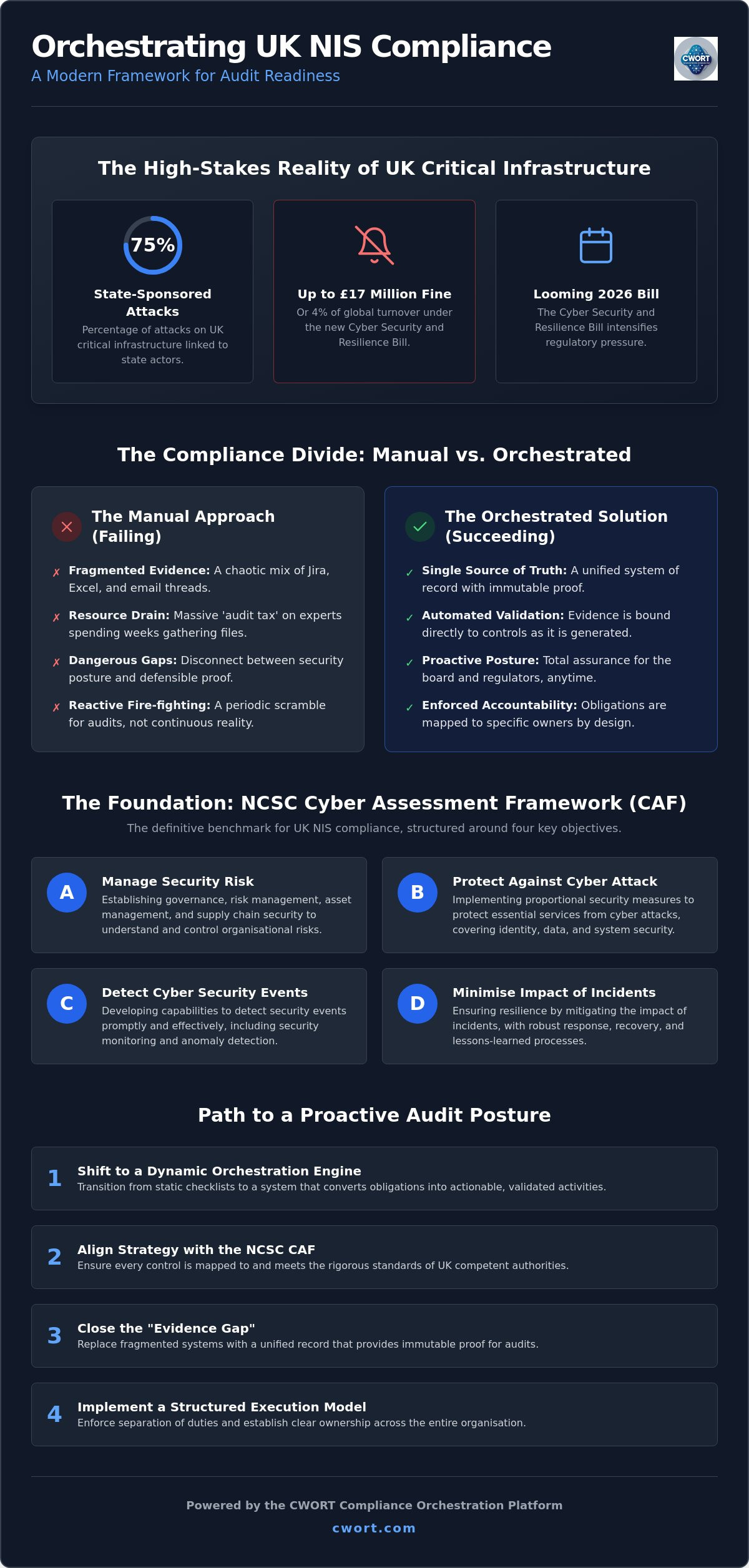
With 75% of attacks on UK critical infrastructure now linked to state actors, the margin for error in your regulatory reporting has effectively vanished. You're likely managing a fragmented mess of evidence across Jira, Excel, and legacy email threads, whilst the pressure of the 2026 Cyber Security and Resilience Bill looms. This manual approach doesn't just drain resources; it creates a dangerous gap between your actual security posture and the defensible proof required by regulators. Transitioning to a model of UK NIS compliance orchestration is no longer a luxury for the risk-averse; it's a structural necessity for any organisation serious about operational resilience.
We understand the anxiety of facing a competent authority audit when your separation of duties and control effectiveness aren't yet validated. This guide provides a clear path to move from reactive fire-fighting to a proactive, orchestrated audit posture. You'll learn how to establish a single source of truth for all UK NIS evidence and generate audit-ready outputs that satisfy both your board and the NCSC CAF 4.0 requirements. We'll examine the specific steps to automate your validation processes, ensuring your compliance is a continuous reality rather than a periodic scramble.
Key Takeaways
- Transition from static checklists to a dynamic orchestration engine that converts abstract regulatory obligations into actionable, validated activities.
- Align your resilience strategy with the NCSC Cyber Assessment Framework (CAF) to ensure every control meets the rigorous standards of UK competent authorities.
- Close the "Evidence Gap" by replacing fragmented spreadsheets and Jira tickets with a unified system of record that provides immutable proof for audits.
- Implement a structured execution model for UK NIS compliance orchestration that enforces separation of duties and clear ownership across the organisation.
- Shift from reactive manual evidence gathering to a proactive audit posture that provides total assurance to your board and regulators.
Table of Contents
- What is a UK NIS Audit Readiness Tool?
- The NCSC Cyber Assessment Framework (CAF) as the Foundation
- Why Spreadsheets and Jira Fail UK NIS Audits
- 5 Steps to Achieving UK NIS Audit Readiness
- CWORT: The Strategic UK NIS Audit Readiness Tool
What is a UK NIS Audit Readiness Tool?
A UK NIS audit readiness tool is not a passive repository for documents; it functions as a high-performance orchestration engine. It converts abstract regulatory obligations into concrete, time-bound activities that your technical teams can execute. By 2026, the era of static checklists has ended. Regulators now demand dynamic, evidence-based validation systems that prove control effectiveness in real time. This shift requires a move towards UK NIS compliance orchestration, where the system itself enforces the discipline necessary to meet stringent security standards.
Traditional Governance, Risk, and Compliance (GRC) tools are designed to track risks through manual entry, which often results in outdated or missing information. In contrast, an orchestration tool enforces accountability by design. It maps every regulatory obligation to a specific owner and binds evidence directly to the control as it is generated. This ensures that when an auditor asks for proof of a specific security measure, the evidence is already validated and ready for review. It replaces the chaos of manual evidence gathering with a structured, auditable system of record.
The Regulatory Landscape for UK NIS in 2026
The regulatory environment for Operators of Essential Services (OES) and Relevant Digital Service Providers (RDSPs) has reached a new level of maturity. Under the Cyber Security and Resilience Bill, the National Cyber Security Centre (NCSC) provides the technical framework, whilst competent authorities like the Information Commissioner’s Office (ICO) oversee enforcement. The release of CAF 4.0 in August 2025 solidified the shift towards a threat-informed, risk-based approach. Organisations must now demonstrate resilience across four high-level objectives: managing security risk, protecting against attack, detecting events, and minimising impact. Compliance is no longer a "tick-box" exercise; it is a continuous operational requirement.
Why Readiness Tools are Mandatory for Essential Services
Manual compliance processes are no longer sustainable for organisations managing critical infrastructure. The risks of failure are severe, with proposed penalties under the new Bill reaching up to £17 million or 4% of worldwide annual turnover. Beyond financial loss, the "audit tax" represents a massive drain on productivity. Technical subject matter experts often spend weeks retrieving files from disparate systems to satisfy a single audit request. An orchestration tool eliminates this burden by automating evidence collection. It provides the "Defensible Truth" that UK regulators require, ensuring that every security assertion is backed by verifiable, immutable data. This level of assurance is impossible to achieve through spreadsheets alone.
The NCSC Cyber Assessment Framework (CAF) as the Foundation
The NCSC Cyber Assessment Framework (CAF) serves as the definitive benchmark for UK NIS compliance. It moves beyond generic security advice by providing a systematic approach to assessing the resilience of essential services. Competent authorities use this framework to evaluate whether organisations have achieved specific security outcomes rather than just ticking boxes. Effective UK NIS compliance orchestration ensures that every technical action is mapped directly to the four high-level CAF objectives. These include managing security risk (Objective A), protecting against cyber attack (Objective B), detecting cyber security events (Objective C), and minimising the impact of cyber security incidents (Objective D).
Achieving a "Green" status in a CAF assessment requires more than just meeting basic requirements. Organisations must demonstrate adherence to Indicators of Good Practice (IGPs). These indicators provide a granular roadmap for excellence. An orchestration engine simplifies this process by automatically linking technical evidence to these IGPs. This allows leadership to see exactly where they stand against regulator expectations. Instead of manual data entry, the system captures proof of execution as it happens. This creates a defensible record of your security posture.
Mapping Obligations to CAF Outcomes
Translating abstract regulatory text into executable activities is a complex challenge. You must break down high-level principles into specific tasks for technical teams. A robust orchestration model supports "many-to-one" mapping. This means a single internal control, such as a multi-factor authentication policy, can simultaneously satisfy requirements for the CAF, DORA, and ISO 27001. Using specialised NCSC CAF assessment software allows you to maintain this traceability without duplicating effort. It ensures that every activity performed has a clear regulatory purpose.
Achieving Continuous Validation vs. Point-in-Time Assessment
Yearly audits are insufficient in an environment where 75% of attacks on critical infrastructure are state-linked. A point-in-time assessment only proves you were compliant on the day of the audit. True resilience requires continuous validation. An orchestration engine ensures that security controls are executed during daily operations, not just during audit season. It provides the board with real-time resilience metrics. This shifts the focus from historical reporting to current readiness. If you want to see how this works in practice, you can schedule a technical walkthrough of our validation engine. This proactive approach replaces the anxiety of potential failure with the certainty of auditable truth.
Why Spreadsheets and Jira Fail UK NIS Audits
Many organisations mistakenly believe that their existing project management tools are sufficient for regulatory scrutiny. Whilst Jira and Excel are excellent for tracking general tasks, they are fundamentally ill-equipped to handle the rigours of a formal inspection. The primary issue is the "Evidence Gap". A ticket marked "Done" in Jira represents a status, not a defensible fact. Regulators enforcing The Network and Information Systems Regulations 2018 require immutable proof of control execution, not just a record of intent. Without UK NIS compliance orchestration, your evidence remains scattered, unverified, and prone to human error.
Spreadsheets lack the necessary version control and integrity required for high-stakes governance. They are easily manipulated. They provide no robust audit trail. This fragmentation leads to profound compliance fatigue amongst technical teams. Technical SMEs find themselves buried under repetitive manual requests for data, pulling them away from critical security operations. This creates a cycle of reactive firefighting that leaves the organisation vulnerable during a competent authority visit. It's a system built on hope rather than evidence.
The Critical Problem of Separation of Duties
Auditors demand clear, unalterable proof of separation of duties. They need to see that the individual designing a security control is not the same person responsible for its validation. Spreadsheets fail this test completely. They cannot enforce workflow constraints or prevent a single user from modifying both the requirement and the associated evidence. This lack of structural integrity often results in significant negative audit findings. Implementing a system that can enforce separation of duties by design is a non-negotiable differentiator for modern resilience. It ensures that every action is independently verified before it is recorded as compliant.
The Hidden Cost of Manual Evidence Reconstruction
The financial burden of manual audit preparation is often underestimated. When an audit is announced, organisations typically enter a state of emergency. High-value engineers are diverted from their primary roles to spend weeks reconstructing timelines and hunting for evidence across emails and shared drives. The staff costs alone can reach thousands of pounds per audit cycle. This "firefighting" approach increases the risk of error and presents a fragmented, unprofessional image to regulators. Transitioning to UK NIS compliance orchestration allows you to build audit readiness into daily operations. It eliminates the need for manual reconstruction by capturing validated proof as a natural byproduct of the security workflow. This shifts the focus from administrative tracking to definitive, evidence-based proof, making it significantly easier for independent bodies like International Associates Limited to verify your regulatory standing.
5 Steps to Achieving UK NIS Audit Readiness
Moving from reactive documentation to a state of total assurance requires a disciplined, five-step methodology. This process isn't about creating more paperwork. It's about building a technical system that enforces security by design. By implementing UK NIS compliance orchestration, you replace the anxiety of manual evidence gathering with a structured, defensible reality. This approach ensures that every regulatory obligation is met with concrete, validated proof rather than mere assertions of intent.
- Step 1: Map Regulatory Obligations to a Structured Execution Model.
- Step 2: Assign Ownership and Enforce Separation of Duties.
- Step 3: Bind Immutable Evidence to Control Outcomes in Real-Time.
- Step 4: Orchestrate Continuous Monitoring and Validation.
- Step 5: Generate Regulator-Ready Proof without Manual Intervention.
Step 1 & 2: Setting the Framework and Governance
Success begins with identifying which specific CAF objectives apply to your OES or RDSP status. You must translate these high-level principles into granular, executable tasks. Accountability cannot be vague; it must be enforced. Define roles that satisfy the most stringent UK auditors by ensuring the person performing a task is not the one validating it. Utilizing regulatory compliance workflow automation simplifies this initial governance phase. It creates a rigid structure where responsibilities are clear and audit trails are generated automatically from the outset.
Step 3 & 4: The Execution Engine
The core of audit readiness lies in the technical process of "binding" evidence to control activities. When a security task is completed, the system must immediately capture the relevant screenshot, log, or report. This evidence must be timestamped and subjected to integrity checks to prevent data tampering. Focus on ensuring compliance evidence integrity to maintain long-term defensibility. This execution engine transforms compliance from a periodic scramble into a continuous operational byproduct. It ensures that your organisation is always ready for an unannounced regulator visit.
Step 5 concludes the process by removing the human element from report generation. A mature orchestration system aggregates all validated evidence into a single source of truth. It produces regulator-ready outputs for board review or formal inspections at the touch of a button. If you're ready to move beyond manual spreadsheets and secure your operational resilience, you can request a technical demonstration of our orchestration engine. This shift provides the calm of auditable certainty in a high-stakes regulatory environment.
CWORT: The Strategic UK NIS Audit Readiness Tool
CWORT functions as the definitive enterprise orchestration engine, purpose-built to navigate the high-stakes regulatory landscape of the United Kingdom. It replaces the fragmented, manual tracking methods discussed previously with a single, auditable system of record. By centralising your resilience data, the platform eliminates the "Evidence Gap" that often leads to audit failure. It provides a level of structural integrity that generic project management tools simply cannot match. This is UK NIS compliance orchestration at its most rigorous, designed to shift your organisation from administrative tracking to definitive, evidence-based proof.
The platform delivers "Audit-Ready" outputs at the click of a button. It generates board-level dashboards that translate technical security metrics into clear, strategic insights for leadership. For regulators, it produces comprehensive reports that mirror the exact requirements of the Cyber Assessment Framework (CAF). CWORT serves as a collaborative bridge, allowing internal compliance teams and external consulting partners to work within a unified environment. This ensures that every stakeholder has access to the same validated truth, facilitating seamless inspections and reducing the time spent on manual data reconciliation.
Translating Obligations into Action
CWORT removes the ambiguity from regulatory compliance by providing structured execution paths for every CAF objective. It breaks down complex requirements into manageable, time-bound tasks for your technical teams. Central to its architecture is the "Evidence Binding" feature. This mechanism ensures that every control outcome is anchored to immutable, validated proof the moment a task is completed. Beyond the NIS regulations, the platform supports a multi-framework approach. It includes comprehensive ISO 27001 control mapping, allowing you to satisfy multiple governance standards without duplicating your operational effort. It enforces discipline by design, ensuring that no obligation is overlooked.
Future-Proofing Your Compliance Strategy
The regulatory environment in 2026 requires a system that can adapt as quickly as the threat landscape. CWORT is engineered to evolve alongside the UK’s Cyber Security and Resilience Bill, ensuring your organisation remains compliant as new incident reporting deadlines and penalty structures take effect. Maintaining a "continuous audit-ready" state provides a significant strategic advantage. It replaces the seasonal panic of audit preparation with the calm of permanent readiness. This proactive posture allows your board to focus on growth, secure in the knowledge that your operational resilience is fully validated and defensible. To see how our validation engine can transform your regulatory posture, book a CWORT demonstration to see the orchestration engine in action. Secure your organisation's future with the certainty of auditable truth.
Secure Your Operational Resilience for the 2026 Mandate
Manual evidence gathering is a structural liability in an environment where 75% of attacks on critical infrastructure are state-linked. As we've established, spreadsheets and Jira tickets lack the integrity to satisfy NCSC CAF 4.0 requirements or provide the defensible truth required by UK competent authorities. Implementing a robust system of UK NIS compliance orchestration is the only way to replace administrative anxiety with auditable certainty. By binding immutable evidence to control outcomes in real time, you ensure that your organisation remains in a state of permanent readiness rather than periodic panic.
True resilience is a holistic endeavour that spans both digital systems and physical preparedness. For organisations whose technical teams must operate in the field or maintain remote infrastructure, having the right survival and outdoor equipment is just as critical as having the right software; providers like Wood To Water Outdoors specialise in the high-quality gear necessary to support operational readiness in any environment.
Lapace Services UK Ltd brings deep UK-based expertise to help you navigate these high-stakes regulatory shifts. Our CWORT platform provides regulator-ready outputs designed specifically for UK NIS and DORA, replacing manual spreadsheets with automated, evidence-based validation. Orchestrate your UK NIS audit readiness with CWORT today and gain total assurance over your compliance posture. You have the opportunity to lead your organisation from reactive firefighting to a position of strategic control. Establish your single source of truth now and face your next audit with absolute confidence.
Frequently Asked Questions
What is the Cyber Assessment Framework (CAF) and why is it used for UK NIS audits?
The CAF is a structured tool developed by the NCSC to help organisations achieve a high level of cyber resilience. It provides a systematic set of 14 security principles and Indicators of Good Practice (IGPs) that UK competent authorities use to assess compliance. Regulators rely on this framework because it moves beyond static checklists, focusing instead on measurable security outcomes that prove an organisation can manage risks and minimise incident impact.
How does a UK NIS audit readiness tool differ from a standard GRC platform?
Standard GRC platforms function as passive repositories for manual status updates, whereas a readiness tool acts as an active execution engine. It enforces UK NIS compliance orchestration by binding technical evidence directly to regulatory obligations as they occur. This transition from administrative tracking to real-time validation ensures that your audit trail is a byproduct of daily operations, providing a level of defensible truth that manual GRC systems cannot provide.
Can CWORT help with both UK NIS and NIS2 compliance simultaneously?
Yes, the platform is designed to manage multiple regulatory frameworks within a single environment. By using a "many-to-one" control mapping strategy, CWORT allows you to satisfy the requirements of the UK NIS regulations and the EU NIS2 Directive through shared activities. This approach eliminates duplicated effort and ensures that your global resilience strategy remains coherent and efficient across different jurisdictions.
What kind of evidence do UK regulators expect during a NIS audit?
Regulators require immutable, timestamped proof that your security controls are functioning as intended. This evidence typically includes system logs, configuration reports, and incident notification records that demonstrate continuous adherence to CAF principles. They look for a clear audit trail that proves the "Defensible Truth" of your security posture, rather than relying on verbal assertions or unverified documentation gathered at the last minute.
How does the tool enforce separation of duties during compliance activities?
CWORT enforces accountability through automated workflow constraints that are hard-coded into the system. It ensures that the individual responsible for performing a security task is technically barred from being the one who validates its completion. This rigid structure satisfies the strict requirements for independent verification demanded by UK auditors, preventing the conflict of interest often found in manual, spreadsheet-based processes.
Is it possible to migrate our existing Excel-based compliance trackers into CWORT?
Yes, you can transition your existing data into our structured orchestration model to improve oversight. The migration process involves mapping your current controls to the specific objectives of the NCSC CAF within the platform. This converts your static spreadsheet rows into dynamic, auditable activities, allowing you to begin capturing validated evidence without losing the historical context of your previous compliance efforts.
How does CWORT help generate board-level reports for cyber resilience?
The platform aggregates granular technical data into high-level strategic dashboards designed for executive review. It translates complex UK NIS compliance orchestration metrics into clear indicators of organisational readiness and risk. This allows the board to see exactly where the organisation stands against the 2026 mandate, replacing technical jargon with actionable insights that support informed decision-making at the highest level.
Can external auditors be given access to the CWORT platform for a smoother review?
Yes, CWORT provides secure, read-only access specifically designed for external auditors and competent authorities. This feature allows them to inspect validated evidence and audit trails directly within the system of record. By providing a single source of truth, you eliminate the need for cumbersome manual file transfers and significantly accelerate the inspection process, fostering a more transparent relationship with your regulator.
Disclaimer
The content on this site is provided for general information and educational purposes only. It does not constitute legal, regulatory, financial, or professional advice. CWORT provides AI-assisted insights and workflow automation, but all compliance decisions remain the responsibility of your organisation and its management. Always seek qualified legal or regulatory guidance for decisions relating to the UK NIS Regulations, CAF, DORA, NIS2, ISO 27001, or other obligations.
Related posts
NIS2 Audit Readiness Tool: Orchestrating Evidence-Based Validation for 2026
Ditch spreadsheets for the 2026 audit. A NIS2 audit readiness tool provides orchestrated, evidence-based validation for total compliance certainty.
Reducing Audit Preparation Time and Costs: A Strategic Guide for UK Enterprises
Tired of costly audit seasons? Our guide for UK enterprises shows you how to stop the manual scramble, reducing audit preparation time and costs with automat...
Regulatory Compliance Workflow Automation for UK Enterprise: A Strategic Guide
Ditch spreadsheets for DORA & NIS2. Our guide to regulatory compliance workflow automation delivers auditable certainty and board-level assurance for UK ente...
Article by
Michael Iyiola
Co-Founder, CWORT
Michael Iyiola is a co-founder of CWORT and a Cyber and AI Security Engineer with deep experience in vulnerability management, detection engineering and operational resilience across UK critical national infrastructure, including rail, energy and financial services. At CWORT, he designs scalable, evidence-driven workflows that help teams meet modern regulatory and security demands.
Build Your Foundation of Auditable Certainty
Take control of your regulatory obligations and secure your infrastructure with CWORT.