ISO 27001 audit preparation tool: how to choose and use one in 2026

Michael Iyiola
Co-Founder, CWORT
Find the right ISO 27001 audit preparation tool in 2026. Learn how to map control outcomes, organise evidence, and streamline compliance readiness effectively.

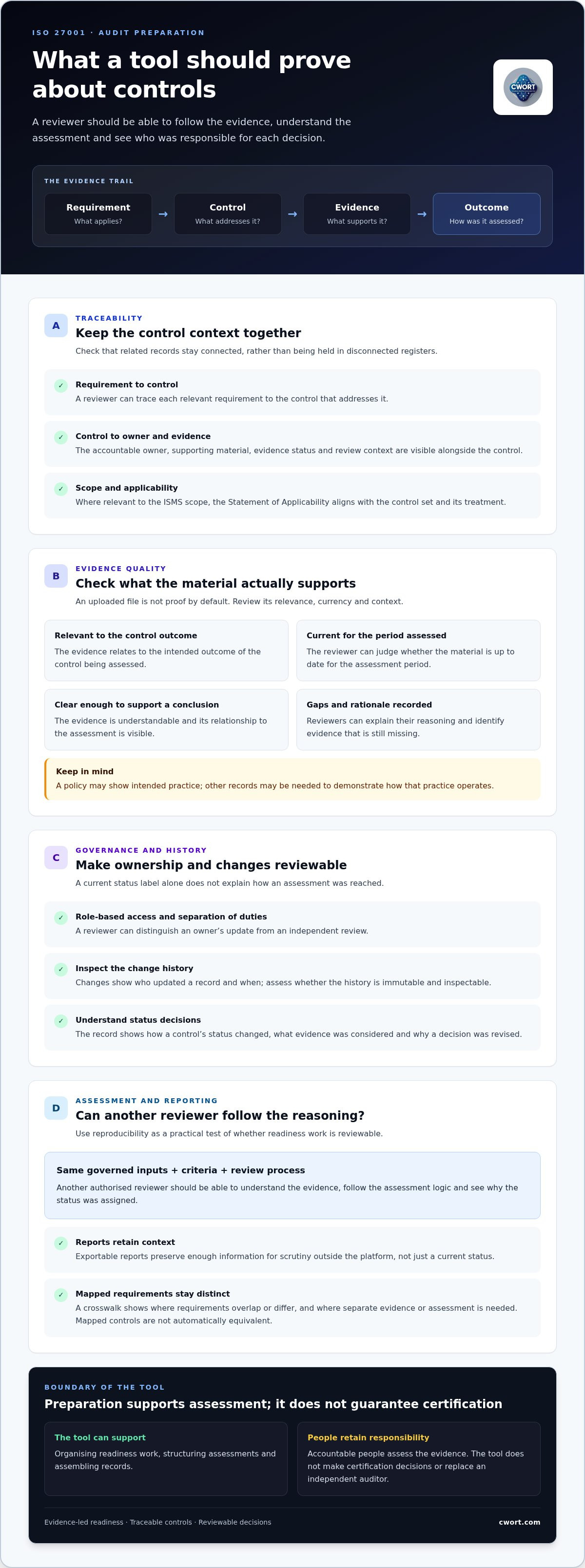
What should an ISO 27001 audit preparation tool show when an auditor asks how a control works? A collection of files isn’t enough. You need to trace relevant evidence to the control outcome, see who owns and reviewed it, and understand how the assessment was reached.
When evidence is scattered across spreadsheets, shared drives and operational tools, it can be difficult to tell what’s current, who’s responsible or which gaps need attention. That uncertainty may surface late, when remediation needs careful planning. A disciplined process replaces last-minute evidence gathering with traceable, reviewable work.
This guide explains how to assess tools against practical, auditable criteria and use them to organise evidence, assign control owners and manage remediation. You’ll learn how to create a reproducible view of readiness without mistaking a tool for a guarantee of certification. We’ll also explain how CWORT maps requirements to governed activities and links evidence to control outcomes, working above existing security tools rather than replacing them.
Key Takeaways
- Choose an ISO 27001 audit preparation tool that links evidence to control outcomes, rather than one that only stores files or tracks tasks.
- Assess traceability, ownership, separation of duties and review history to make readiness work reproducible.
- Compare spreadsheets, project trackers and compliance platforms against the same practical criteria before deciding how to manage preparation.
- Use a controlled workflow that starts with ISMS scope and applicable requirements, then moves through evidence review, gap prioritisation and readiness reporting.
- Keep preparation distinct from certification: a tool can organise and evidence readiness, but it can’t guarantee certification or prove control effectiveness on its own.
Table of Contents
- Why an ISO 27001 audit preparation tool must do more than track tasks
- What an ISO 27001 audit preparation tool should prove about controls
- ISO 27001 audit preparation tool comparison: spreadsheets, trackers and platforms
- How to prepare for an ISO 27001 audit with a controlled workflow
- How CWORT supports evidence-led ISO 27001 audit preparation
Why an ISO 27001 audit preparation tool must do more than track tasks
A task marked “complete” shows that someone updated a record. It doesn’t show whether a control is suitably designed, consistently applied or supported by current evidence. An effective ISO 27001 audit preparation tool organises readiness work around requirements and controls, so responsibility, evidence and review status can be seen together.
Preparation support isn’t certification. A platform can help an organisation structure its assessment and assemble records, but it doesn’t make certification decisions or replace an independent auditor. A completed workflow alone also doesn’t prove that a control operates effectively. That assessment depends on how the control works in practice and the evidence available to support a conclusion.
Evidence collection gathers material; evidence-backed assurance connects relevant, reviewed material to a control outcome and explains the basis for that conclusion.
What does an ISO 27001 audit preparation tool do?
An audit preparation tool can map applicable requirements to controls, assign control owners, capture or reference supporting evidence, record review status and track remediation. A control-level evidence register brings these details into one view: the control’s intended outcome, its accountable owner, the material supporting its assessment, when it was reviewed and whether further action is open.
That structure makes follow-up more specific. If a policy changes, for example, the owner can see which control assessment relies on it and whether the evidence needs review. The software supports the process; accountable people still assess the evidence, and auditors retain their independent role. For an overview of the standard and certification process, see the ISO/IEC 27001 Wikipedia article.
Why spreadsheets and shared folders lose audit context
Spreadsheets and shared folders can work for a contained preparation exercise, particularly when a small team can govern updates consistently. The risk isn’t the format alone. As records spread across files and operational systems, it can become harder to keep the control, owner, evidence, review decision and change history connected.
This raises practical questions: Is this the current policy? Who reviewed it? Does the status reflect the latest evidence? Teams may need to reconcile answers manually, while version confusion can obscure the basis for a readiness claim. These are governance risks, not inevitable spreadsheet failures. Set conventions for naming, access, review and change control, then assess whether they remain workable as requirements and contributors grow.
Whether preparation sits in a governed platform or a carefully controlled register, preserve the relationship between each control and its supporting records. ISO 27001 readiness and control mapping can structure that relationship above existing operational tools. The goal is a reviewable account of readiness, not a task list that looks complete while leaving the underlying controls unexamined.
What an ISO 27001 audit preparation tool should prove about controls
Evaluate more than convenience. A capable ISO 27001 audit preparation tool should let a reviewer trace each relevant requirement to the control addressing it, the accountable owner, the evidence considered and the decision reached. It should preserve who changed a record and when, support separation of duties, and produce reports that can be reviewed outside the platform.
The presence of evidence doesn’t make it sufficient. Check whether it’s relevant to the control outcome, current for the period being assessed and clear enough to support the conclusion. A policy may show intended practice; other records may be needed to demonstrate how that practice operates. The tool should help reviewers record their rationale and identify evidence gaps, rather than treating an uploaded file as proof by default.
A reproducible assessment reaches consistent results from the same governed inputs, criteria and review process. Use this as a practical test: can another authorised reviewer understand the evidence, follow the assessment logic and see why the status was assigned?
Can the tool link requirements, controls, owners and evidence?
Check that records preserve these relationships instead of keeping each item in a disconnected register. Evidence should show which control it supports, its status and its review context, including who assessed it and when. Where relevant to the organisation’s ISMS scope, the Statement of Applicability should also align with the control set and its treatment. Clear links make gaps and dependencies easier to investigate.
Control mapping can reduce duplicated assessment work across frameworks, but mapped controls aren’t automatically equivalent. A useful crosswalk shows where requirements overlap, where they differ and where separate evidence or assessment is needed. Keep the rationale visible, and don’t assume one control outcome satisfies every mapped requirement.
Does it preserve governance and a reviewable history?
Assess role-based access, separation of duties and whether changes leave an immutable, inspectable history. A reviewer should be able to distinguish an owner’s update from an independent review and understand how a control’s status changed, what evidence was considered and why a decision was revised. Exportable reports should retain enough context for scrutiny, not just display a current status label.
Keep advisory features separate from assessment outcomes. AI may suggest evidence or highlight a potential issue, but those suggestions shouldn’t be presented as deterministic results. Outcomes should remain tied to governed criteria and reviewed inputs, with human judgement recorded where it applies.
Make tool evaluation concrete by testing whether a sample control can be traced, reviewed and reassessed without losing its history. CWORT supports governed control mapping and evidence-linked assessment above existing operational tools. Explore how its assessment workflow works to see how these principles can be applied.
ISO 27001 audit preparation tool comparison: spreadsheets, trackers and platforms
Choose an approach that fits the scale of your ISMS and the governance your evidence needs. A spreadsheet may be manageable for a limited, stable scope. A project tracker can coordinate actions across teams. A governed compliance-validation platform is designed to connect requirements, controls, evidence and assessment decisions in a structured workflow.
When can spreadsheets or project trackers be sufficient?
For a small, stable scope, a controlled spreadsheet and folder structure may provide enough visibility if access, naming, ownership and review conventions are applied consistently. A tracker can coordinate deadlines and remediation tasks. Look for repeated manual reconciliation, unclear control ownership, conflicting file versions or missing change history. These indicate that governance effort is increasing, not that spreadsheets are inherently unsuitable.
When does a governed compliance platform add value?
A platform can formalise control workflows, link evidence to assessment outcomes and present status consistently. Cross-framework mapping may reduce duplicated assessment work, provided the distinct requirements and evidence context remain visible. Evidence can also be aggregated from existing security and operational tools, so those systems remain in place. The value is stronger orchestration, not simply another place to store documents.
Compare approaches using a representative control. Trace its requirement, owner, evidence, review decision and status history, then check whether another reviewer can follow the same record and produce a consistent view. This practical test reveals the trade-off between lightweight administration and governed repeatability. CWORT provides compliance validation and control mapping above existing tools. Request a demonstration of its evidence-led workflow to assess how it fits your preparation process.
How to prepare for an ISO 27001 audit with a controlled workflow
Make preparation a sequence of governed decisions, not a rush to collect documents. Start with the organisation’s ISMS scope and applicable requirements. Connect those requirements to controls, define evidence expectations, review what’s available and record gaps with clear ownership. A consistent workflow helps teams explain both their readiness and how they reached that view.
Establish scope, owners and evidence expectations
Confirm which parts of the organisation, services, systems and locations fall within the ISMS scope, then identify the relevant controls and accountable owners. Assign review responsibilities separately where needed, and agree what evidence would help demonstrate each control in its operating context. Set review dates and escalation routes in line with your governance arrangements, rather than assuming there’s a universal audit timetable.
- Confirm scope and requirements. Record the approved ISMS scope and the requirements that apply to it. Use these as explicit inputs for preparation, so teams don’t assess controls outside scope or overlook relevant obligations.
- Map requirements to controls. Record the rationale connecting each applicable requirement to the control intended to address it. A structured ISO 27001 control mapping approach makes those relationships easier to review while keeping differences between requirements visible.
- Assign ownership and define evidence. Name the accountable owner and review role for each control. Specify what kind of material would support assessment, how it will be referenced and when it should be reviewed.
- Review evidence and assess controls. Check each record for relevance, currency, provenance and a clear connection to the control outcome. Record the reviewer’s rationale, not just a status label.
- Classify gaps and prioritise remediation. Separate missing or weak evidence from control-design issues and concerns about operating effectiveness. For each action, record an owner, status and prioritisation rationale to help direct effort.
- Report readiness with context. Summarise assessed controls, open gaps, remediation progress and review dates. Make the basis of the assessment visible, distinguishing unresolved issues from controls supported by reviewed evidence.
Review evidence, prioritise gaps and report readiness
Make the remediation register specific. An evidence gap may require a record to be located or updated. A design issue may mean reconsidering the control approach. An operating-effectiveness concern may call for further review of how the control works in practice. Preserve traceability by retaining links to source material and the context for decisions. Avoid presenting a single readiness score without supporting detail.
An ISO 27001 audit preparation tool can coordinate these steps, but accountable owners must validate the inputs and decisions. To see how CWORT supports governed control mapping and evidence-led readiness work, request a demonstration.
How CWORT supports evidence-led ISO 27001 audit preparation
CWORT is a compliance validation and orchestration platform that works above existing security and operational tools. It doesn’t replace those systems or perform their operational work. Instead, it provides a governed structure for connecting ISO 27001 requirements and controls with evidence, accountable owners, assessment status and review history. This gives teams a clearer route from source material to a documented readiness view.
For organisations comparing an ISO 27001 audit preparation tool, the distinction matters. A repository collects files; an evidence-led workflow records why material is relevant, which control outcome it supports and how the assessment was reached. Teams can use the resulting view to identify open actions and prepare reporting, without treating a platform status as a certification decision or a guarantee of audit success.
From control mapping to defensible assurance
CWORT’s ISO 27001 readiness and control-mapping capabilities translate obligations into governed activities. Evidence can be linked to control outcomes, while ownership and status provide context for assessment and follow-up. The platform supports deterministic results, with assessment outcomes governed by defined inputs and criteria rather than changed by advisory suggestions.
Governance features support separation of duties and an immutable audit history. Teams can distinguish responsibility for maintaining a control from review activity, then inspect the history of changes and decisions. This strengthens traceability: an authorised reviewer can follow the assessment record and see how its status developed, rather than relying on an unexplained current label.
AI advisory can offer suggestions, but it doesn’t alter deterministic results. This keeps recommendations distinct from governed assessment outcomes. CWORT can also aggregate evidence from existing operational tools, allowing teams to use established sources while managing control mapping and review through a structured layer above them.
As of June 2026, CWORT’s control taxonomy library contained 1,355 controls across 217 domains and 42 frameworks or standards. At that same snapshot, 98.6% of active controls carried framework references. These figures describe the library at that point in time. Organisations still need to determine which requirements and controls apply to their own ISMS scope.
See the workflow against a real programme
A focused working session can map the platform’s workflow to your programme. Review scope and control mapping, examine how existing evidence sources relate to control outcomes, and consider how ownership, review and reporting would fit your process. The aim is to assess practical alignment, not assume every organisation should work in the same way.
An optional pilot on a real sub-function can demonstrate the workflow end to end, from mapped control and evidence through assessment history and readiness reporting. Request a CWORT demo to explore how evidence-led preparation could fit your audit-readiness needs. CWORT supports structured readiness work; certification and audit outcomes remain outside the platform’s control.
Make your next readiness decision evidence-led
Test whether your current preparation process gives decision-makers a reliable basis for action. Choose a representative part of your ISMS and see how easily your team can trace a control assessment to its evidence, ownership and review history. If the process depends on manual reconciliation or undocumented judgement, address that before audit pressure makes it harder to manage.
The right ISO 27001 audit preparation tool should fit how your organisation governs controls and evidence, not simply add another task list. A practical discussion can help you assess how a structured workflow aligns with your scope, existing tools and readiness priorities.
Request a CWORT demo to explore the workflow against your programme and identify a sensible next step. Build readiness through clear evidence and accountable review, one control at a time.
Frequently Asked Questions
Can an ISO 27001 audit preparation tool guarantee certification?
No. An ISO 27001 audit preparation tool can help organise readiness activity, but it can’t guarantee certification. Certification depends on the organisation’s ISMS and the outcome of an independent audit. For example, a dashboard showing every task as complete doesn’t establish that staff follow a procedure or that a control achieves its intended purpose. Accountable teams must operate controls, review relevant evidence and address findings; the tool supports that work and its traceability.
What evidence should an ISO 27001 audit preparation tool manage?
Select evidence according to the applicable requirement, control and organisational context, rather than assembling material from a universal checklist. A tool should show who owns each item, which control it relates to, its review status and the history of its assessment. Depending on the control, useful records may demonstrate its design or how it operates in practice. A stored document alone doesn’t establish that it’s current, relevant or sufficient.
Is a spreadsheet enough to prepare for an ISO 27001 audit?
It can be, when the preparation scope is small and stable and the team consistently manages access, ownership, versioning and review. For example, a limited register with a named maintainer and controlled evidence links may remain practical. As scope or participation grows, manual reconciliation can take more effort and make changes harder to follow. Assess how well your current process maintains context and accountability, rather than labelling spreadsheets automatically sufficient or non-compliant.
How does an audit preparation tool differ from an internal audit tool?
An audit preparation tool coordinates readiness across the ISMS, while internal audit software may focus on planning, recording and following up audit activity. The functions can overlap, so define the specific workflow your organisation needs. For example, preparation might organise evidence for control owners, while an internal auditor evaluates evidence independently. Neither type of software replaces management review or an external certification audit.
Can one ISO 27001 audit preparation tool support multiple frameworks?
Some platforms map controls or evidence across frameworks, helping teams reuse relevant assessment work instead of gathering the same material repeatedly. For instance, a shared access-control record may inform more than one framework assessment, but each mapping still needs its own rationale and context. CWORT supports cross-framework control mapping. Organisations must still establish which requirements apply to their scope and whether the evidence meets each distinct expectation.
What should we check before selecting an ISO 27001 audit preparation tool?
Test whether the tool preserves the relationships between requirements, controls, owners and supporting records, and whether reviewers can follow status changes over time. Check that access and review responsibilities fit your governance model, and that reports explain assessment status rather than offer an unexplained score. A demonstration using a representative process can reveal practical friction, such as whether existing evidence sources can be incorporated without disrupting their operational use.
How often should audit evidence be reviewed in an ISO 27001 tool?
There’s no single review frequency that suits every control or evidence item. Set expectations in line with the control’s purpose, relevant risk, operational changes and your governance arrangements. A procedure affected by a significant process change may need attention sooner than a stable record. Make the owner, review date and latest status visible, so teams can identify material that may need reassessment instead of relying on an arbitrary universal timetable.
Disclaimer
The content on this site is provided for general information and educational purposes only. It does not constitute legal, regulatory, financial, or professional advice. CWORT provides AI-assisted insights and workflow automation, but all compliance decisions remain the responsibility of your organisation and its management. Always seek qualified legal or regulatory guidance for decisions relating to the UK NIS Regulations, CAF, DORA, NIS2, ISO 27001, or other obligations.
Related posts
How to Streamline ISO 27001 Internal Audits with Orchestration Software in 2026
Learn how ISO 27001 internal audit software replaces spreadsheet chaos with automated orchestration for a flawless, defensible compliance posture.
Streamlining Regulatory Compliance Processes: From Manual Tracking to Orchestrated Validation
Stop wasting money on manual compliance. Learn about streamlining regulatory compliance processes to reduce personal liability under DORA & NIS2 and gain aud...
ISO 27001 Control Effectiveness Proof: Moving Beyond Static Certification to Defensible Validation
Move beyond static ISO 27001 certification. Discover how an ISO 27001 compliance validation tool delivers continuous, defensible proof for UK regulators.
Article by
Michael Iyiola
Co-Founder, CWORT
Michael Iyiola is a co-founder of CWORT and a Cyber and AI Security Engineer with deep experience in vulnerability management, detection engineering and operational resilience across UK critical national infrastructure, including rail, energy and financial services. At CWORT, he designs scalable, evidence-driven workflows that help teams meet modern regulatory and security demands.
Build Your Foundation of Auditable Certainty
Take control of your regulatory obligations and secure your infrastructure with CWORT.