ISO 27001 Control Mapping Software: Orchestrating Evidence-Based Compliance in 2026

Michael Iyiola
Co-Founder, CWORT
Ditch spreadsheets. Discover how ISO 27001 control mapping software orchestrates evidence-based compliance for a defensible, audit-ready posture in 2026.

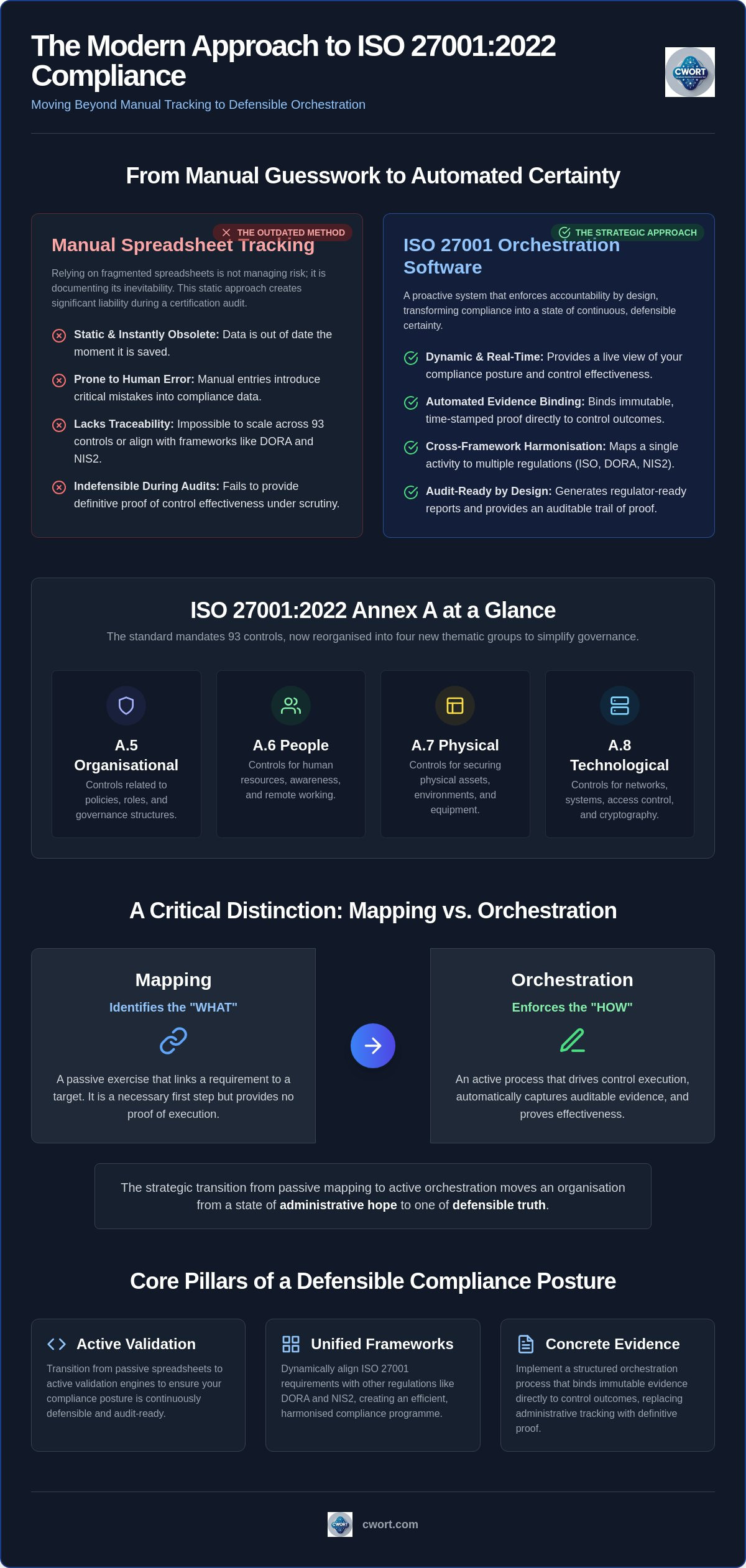
Your ISO 27001:2022 compliance posture is only as defensible as the evidence you can produce under immediate scrutiny. If you're still relying on fragmented spreadsheets to track the 93 controls mandated by the current standard, you aren't managing risk; you're merely documenting its inevitability. With the transition deadline for the 2013 version now firmly in the past, organisations must move beyond administrative tracking. Implementing a sophisticated ISO 27001 control mapping software is the only way to replace manual guesswork with a disciplined, orchestration-led approach to governance and structural integrity.
We recognise the exhaustion of spreadsheet fatigue and the anxiety that stems from a lack of real-time visibility into control effectiveness. You need more than a passive directory. You require a proactive system that enforces accountability by design. Discover how to move beyond passive tracking and use orchestration software to validate ISO 27001 controls with auditable evidence. This guide previews the transition to a single source of truth, where automated evidence binding and regulator-ready reporting transform compliance from a seasonal burden into a state of continuous, defensible certainty for the board.
Key Takeaways
- Transition from passive spreadsheets to active validation engines to ensure your compliance posture remains defensible and audit-ready in 2026.
- Leverage ISO 27001 control mapping software to dynamically align requirements with DORA and NIS2, creating a unified and efficient regulatory framework.
- Organise the 93 Annex A controls into the four new thematic groups to simplify governance and clarify accountability across the entire organisation.
- Implement a structured orchestration process that binds concrete evidence directly to control outcomes, replacing administrative tracking with definitive proof.
- Enforce a strict separation of duties and generate sophisticated board-level reports that provide real-time visibility into your information security posture.
Table of Contents
- What is ISO 27001 Control Mapping Software and Why is it Essential?
- The Core Features of Modern Control Mapping Solutions
- ISO 27001:2022 Annex A: Mapping the New Control Categories
- How to Implement ISO 27001 Mapping Software: A 4-Step Guide
- CWORT: The Orchestration Engine for ISO 27001 Validation
What is ISO 27001 Control Mapping Software and Why is it Essential?
ISO 27001 control mapping software is a specialised digital architecture designed to align the 93 controls of ISO/IEC 27001:2022 with your daily operational activities. It serves as the connective tissue between high-level policy and granular execution. By 2026, the shift from manual trackers to automated validation engines has become a survival requirement for enterprise security teams. UK regulators have heightened their expectations, moving past the mere existence of a policy to demand definitive proof of control effectiveness. If you can't demonstrate that a control is active and producing the intended outcome, it doesn't exist in the eyes of an auditor.
Mapping provides the structural integrity needed to maintain a live, dynamic Statement of Applicability (SoA). This document must reflect your actual risk posture rather than a frozen moment in time. Without a centralised system, the SoA becomes a historical artefact rather than a management tool. Effective software ensures that every change in your infrastructure or threat landscape is immediately reflected in your compliance status, providing a level of agility that manual processes cannot match.
The Failure of Manual Spreadsheet Mapping
Excel-based trackers are fundamentally static. They become obsolete the moment the "Save" button is clicked. These manual systems are prone to version control errors and broken file links, which create significant liability during a certification audit. When you're managing 93 distinct controls across the four new thematic groups, a spreadsheet cannot scale. It fails to provide the traceability required when aligning with overlapping frameworks like NIS2 or DORA. Relying on manual entries introduces human error into your compliance data, leaving you vulnerable to regulator scrutiny and potential fines.
Mapping vs Orchestration: A Strategic Distinction
Mapping identifies the "what"; it links a requirement to a target. However, mapping alone is a passive exercise. Strategic leaders are moving towards orchestration, which enforces the "how." Advanced ISO 27001 control mapping software doesn't just record that a control should happen; it drives the execution and automatically captures the resulting evidence. This transition moves your organisation from a state of administrative hope to one of defensible truth. It provides the board with a transparent, auditable trail of proof that satisfies even the most rigorous regulatory standards. Using a platform like CWORT allows you to bridge the gap between abstract obligations and concrete, auditable reality.
The Core Features of Modern Control Mapping Solutions
Modern compliance demands more than just a digital filing cabinet. It requires a system that actively validates security posture through execution. Forbes explains the business case for ISO 27001 certification as a fundamental driver for trust and operational resilience. However, achieving this trust in 2026 requires ISO 27001 control mapping software that functions as an orchestration engine. These systems replace passive lists with active workflows, ensuring that every control is not only documented but also executed and verified in real-time.
Cross-Framework Mapping and Harmonisation
Audit fatigue is the inevitable byproduct of fragmented compliance efforts. Organisations often find themselves validating the same security activity multiple times for different regulators. Modern solutions solve this by mapping a single operational task to multiple obligations, such as ISO 27001, DORA, and NIS2. For UK-based firms, aligning these controls with the NCSC CAF or UK NIS requirements creates a streamlined programme. This harmonisation ensures that a single evidence repository serves all enterprise audits. It reduces the administrative burden and eliminates the redundancy of repeating the same checks for different frameworks.
Automated Evidence Binding and Integrity
Evidence binding is the digital glue between a requirement and its validated execution. In a high-stakes audit, an unverified claim is worthless. Modern ISO 27001 control mapping software automatically binds immutable, time-stamped proof to specific control outcomes. This process involves linking Jira tickets, system logs, or configuration snapshots directly to the Annex A requirement they satisfy. By automating this connection, you eliminate the risk of missing or manipulated data. Auditors can trace a requirement to its execution with total certainty, providing a level of structural integrity that manual systems cannot replicate.
This requirement for verifiable proof extends to the transmission of sensitive information. For example, using byNow - Bezpieczna platforma wymiany dokumentów i wysyłki dokumentów ensures that document delivery is recorded with the same degree of immutable proof, providing a secure, digital alternative to traditional registered mail that satisfies modern auditing requirements for information transfer.
Reporting and Separation of Duties
Board-level oversight demands clarity, not complexity. Real-time compliance dashboards translate technical status into strategic insight, allowing leadership to monitor control effectiveness at a glance. Equally critical is the enforcement of role-based access controls. These ensure a strict separation of duties, a requirement often scrutinised by UK regulators. By defining who can perform an action versus who can validate it, the software enforces discipline by design. It replaces the anxiety of potential failure with the calm of auditable certainty. To see how this orchestration functions in a live environment, you might request a demonstration of our validation platform.
ISO 27001:2022 Annex A: Mapping the New Control Categories
The transition to the ISO 27001:2022 update consolidated the previous 114 controls into 93, structured across four distinct thematic groups: Organisational, People, Physical, and Technological. This refinement requires ISO 27001 control mapping software that can handle not just the controls themselves, but the complex "Attributes" associated with them. These attributes, covering control types and cybersecurity concepts, allow for more granular filtering and sophisticated reporting. According to the official page for the ISO 27001 standard, this structure is designed to reflect modern security challenges. In 2026, audits have evolved to prioritise automated validation, particularly for technological controls, ensuring that compliance remains a continuous state rather than a point-in-time snapshot.
Organisational and People Controls
Mapping "People" controls often presents a significant challenge because they rely on human behaviour and procedural adherence. Advanced mapping software translates abstract policies, such as remote working and BYOD, into active monitoring activities. Instead of merely presenting a signed policy document, you must prove "Information Security Awareness" through validated training workflows and completion records. Orchestration platforms like CWORT enforce a strict separation of duties amongst administrative and operational staff by design. This ensures that no single individual has end-to-end control over a critical process, a key requirement for satisfying UK regulatory scrutiny under NIS2 and DORA.
Technological and Physical Controls
Technological controls now demand the highest level of automated proof to satisfy modern auditors. Mapping access rights and identity management is no longer a manual task; it requires direct integration with your directory services to provide real-time validation. For software development, you must prove "Secure Coding" and "Change Management" by binding evidence directly from CI/CD pipeline logs to the relevant Annex A controls. Physical security mapping is equally rigorous. It requires linking periodic maintenance logs and facility access records to the physical control categories. This creates a high-integrity audit trail that demonstrates your organisation is not just compliant on paper but secure in practice. By automating these connections, you eliminate the risk of missing evidence and ensure your compliance posture is always defensible.
How to Implement ISO 27001 Mapping Software: A 4-Step Guide
Implementing ISO 27001 control mapping software is not a mere administrative task; it's a strategic transition from passive documentation to active operational validation. Success requires a disciplined, step-by-step approach that ensures every regulatory obligation is translated into a concrete, auditable activity. By following a structured implementation framework, you replace the chaos of manual trackers with a resilient system of defensible truth. This process enforces accountability by design, ensuring that every control is backed by immutable proof.
Phase 1: Scoping and Obligation Mapping
Define your scope with clinical precision. You must determine which of the 93 Annex A controls apply to your specific business context, whilst simultaneously identifying overlapping requirements from DORA and NIS2. Use your software to import existing policies to see where your current posture fails to meet the 2022 standard. This gap analysis serves as your baseline for improvement. Utilising a dedicated ISO 27001 Control Mapping Tool allows you to harmonise these disparate obligations into a single, unified framework from day one, ensuring no requirement is overlooked.
Phase 2: Execution and Validation
Translate abstract requirements into actionable tasks. Assign specific control activities to Subject Matter Experts (SMEs) across the organisation. This move from "Policy" to "Practice" is where many organisations fail. You must ensure that evidence is captured at the exact moment of execution. If a control is performed but not recorded, it remains invisible to auditors. Implementing Regulatory Compliance Workflow Automation ensures that every task generates a time-stamped, immutable record of success. This replaces the anxiety of manual evidence collection with the certainty of automated validation.
Phase 3: Orchestration and Monitoring
Enforce discipline through automated workflows. Orchestration engines drive the "how" of compliance by setting mandatory evidence collection requirements for every task. This removes the burden of manual follow-ups and reduces the risk of human error. Continuous monitoring provides real-time visibility into your control effectiveness, allowing you to address failures before they escalate into audit non-conformities. It transforms compliance from a seasonal burden into a continuous, business-as-usual activity that supports operational resilience.
Phase 4: Audit Readiness and Reporting
Generate regulator-ready reports at the touch of a button. Your software should consolidate all validated evidence into a transparent dashboard for the board and external auditors. This state of perpetual readiness replaces the traditional "audit season" panic with a calm, evidence-based certainty. You can now present a single source of truth that satisfies the most rigorous scrutiny. To see how this structured approach can transform your security posture, book a demonstration of our compliance platform.
CWORT: The Orchestration Engine for ISO 27001 Validation
Whilst many GRC tools act as passive repositories, CWORT functions as a proactive system that enforces discipline and accountability by design. As a specialised ISO 27001 control mapping software, it moves beyond the limitations of administrative tracking to provide definitive, evidence-based proof of compliance. It replaces the fragmented nature of manual oversight with a rigorous orchestration engine that translates abstract obligations into structured, auditable activities. This ensures that your security posture is not just a policy on paper but a defensible reality in practice.
Enforcing a strict separation of duties is a cornerstone of UK regulatory standards, yet most organisations struggle to prove this during an audit. CWORT solves this by hard-coding these requirements into the workflow. It ensures that the individual executing a control is never the same person validating its effectiveness. This creates a high-integrity environment where collusion is prevented and accountability is absolute. By generating board-level reports that demonstrate actual control effectiveness rather than simple completion status, leadership can manage risk with uncompromising objectivity.
Replacing 'Compliance Theatre' with Defensible Proof
Jira is frequently misapplied as a compliance tool, yet it remains fundamentally insufficient for proving regulatory adherence to an auditor. It lacks the structural integrity to bind immutable evidence to specific outcomes or to enforce the precise activities required for ISO 27001. CWORT replaces these fragmented tools and manual Excel trackers with a single orchestrated workflow. By utilising a UK-based platform, enterprises gain the additional advantage of native alignment with NIS2 and DORA frameworks. This ensures that proof of execution meets local regulator expectations and provides a level of traceability that generic project management software cannot replicate.
Next Steps: Achieving Continuous Audit Readiness
The path to continuous audit readiness begins with transitioning your existing ISMS into the CWORT orchestration engine. This shift reduces the cost and time associated with annual ISO 27001 certification cycles by eliminating the need for seasonal manual reconstruction of evidence. Instead of a frantic scramble before an audit, you maintain a state of perpetual readiness through automated validation. Every control activity produces a time-stamped record, creating a seamless path toward a successful conclusion. To see how your organisation can achieve auditable certainty and structural integrity, you should Experience CWORT's Compliance Validation Platform.
Securing Your Defensible Truth with Orchestration
The transition from passive documentation to active orchestration is no longer a strategic choice; it's a regulatory necessity for the modern enterprise. By moving beyond the limitations of static trackers and embracing a system that enforces discipline by design, you replace audit anxiety with the calm of auditable certainty. Implementing a high-integrity ISO 27001 control mapping software allows you to harmonise your obligations across ISO, DORA, and NIS2, creating a single, resilient source of truth.
CWORT provides the structural integrity required to move beyond compliance theatre. Our platform translates abstract obligations into structured execution, binds immutable evidence directly to outcomes, and enforces a strict separation of duties. This systematic approach ensures your organisation remains audit-ready whilst providing the board with transparent, evidence-based reporting. Stop managing trackers and start orchestrating your security posture. Request a CWORT Demo to Orchestrate Your ISO 27001 Compliance and secure a state of continuous, defensible readiness for your organisation.
Frequently Asked Questions
What is the difference between GRC software and control mapping software?
GRC software serves as a broad umbrella for governance, risk, and compliance, often acting as a passive repository for policies. In contrast, ISO 27001 control mapping software is a specialised engine designed to align specific regulatory requirements with granular operational activities. It focuses on the execution and validation of controls rather than mere administrative tracking, providing a more disciplined approach to governance.
Can I map ISO 27001 controls to other frameworks like DORA or NIS2?
Yes, modern orchestration engines allow you to map a single operational activity to multiple regulatory obligations simultaneously. This harmonisation ensures that evidence collected for one ISO 27001 control also satisfies requirements for DORA or NIS2. It eliminates redundant efforts and reduces audit fatigue by creating a unified, enterprise-wide compliance posture that satisfies various regulators from a single source of truth.
How does software help with the ISO 27001:2022 update?
Software automates the transition from the previous 114 controls to the 93 controls mandated by the 2022 update. It organises these requirements into the four new thematic groups: Organisational, People, Physical, and Technological. This ensures your Statement of Applicability remains accurate and reflects current standards without the risk of manual error or the need for total reconstruction of your ISMS.
Is it possible to automate evidence collection for ISO 27001 audits?
Automated evidence collection is a fundamental feature of advanced ISO 27001 control mapping software. By integrating directly with system logs, CI/CD pipelines, and directory services, the platform captures immutable proof at the exact moment of execution. This process replaces the anxiety of manual evidence gathering with the certainty of time-stamped, auditable records that are always ready for regulator scrutiny.
Why is separation of duties important in ISO 27001 mapping?
Separation of duties is a critical control that prevents any single individual from having end-to-end authority over a sensitive process. In the context of mapping, it ensures that the person responsible for executing a control is not the same person who validates its effectiveness. This structural discipline reduces the risk of fraud and is a requirement frequently examined by UK auditors during high-stakes assessments.
How often should I update my ISO 27001 control mapping?
Control mapping must be a continuous process rather than a seasonal administrative task. You should update your mapping in real-time as your infrastructure, threat landscape, or internal policies change. Orchestration platforms facilitate this by providing live visibility into your compliance status, ensuring your security posture is always a defensible reflection of your current operational reality.
Can I use Jira for ISO 27001 control mapping and evidence?
Jira is a project management utility and lacks the structural integrity required for formal compliance validation. It cannot enforce a strict separation of duties or bind immutable evidence directly to control outcomes in a way that satisfies a rigorous audit. Relying on Jira often leads to "compliance theatre," where tasks are tracked but definitive proof of effectiveness is absent.
What are the benefits of a UK-based compliance platform for NIS2?
A UK-based platform provides native alignment with local regulatory expectations and the NCSC CAF framework. It ensures that your reporting structures and data handling practices mirror the specific requirements of UK law and NIS2 implementation. This localised expertise simplifies the mapping process for organisations operating within the UK's critical national infrastructure by providing a system designed for their specific regulatory environment.
Disclaimer
The content on this site is provided for general information and educational purposes only. It does not constitute legal, regulatory, financial, or professional advice. CWORT provides AI-assisted insights and workflow automation, but all compliance decisions remain the responsibility of your organisation and its management. Always seek qualified legal or regulatory guidance for decisions relating to the UK NIS Regulations, CAF, DORA, NIS2, ISO 27001, or other obligations.
Related posts
ISO 27001 Control Mapping Tool: A Strategic Guide for UK Enterprises in 2026
Prepare for 2026 UK cyber laws. Discover the essential ISO 27001 control mapping tool to replace risky spreadsheets and automate your audit evidence.
Reducing Audit Preparation Time and Costs: A Strategic Guide for UK Enterprises
Tired of costly audit seasons? Our guide for UK enterprises shows you how to stop the manual scramble, reducing audit preparation time and costs with automat...
GRC Platform vs Compliance Validation Tool: Choosing the Right Architecture for 2026
GRC platform vs compliance validation tool: Is your GRC ready for 2026? Learn how automated validation provides the defensible proof needed for DORA & NIS2.
Article by
Michael Iyiola
Co-Founder, CWORT
Michael Iyiola is a co-founder of CWORT and a Cyber and AI Security Engineer with deep experience in vulnerability management, detection engineering and operational resilience across UK critical national infrastructure, including rail, energy and financial services. At CWORT, he designs scalable, evidence-driven workflows that help teams meet modern regulatory and security demands.
Build Your Foundation of Auditable Certainty
Take control of your regulatory obligations and secure your infrastructure with CWORT.