NCSC CAF Assessment Tool: Orchestrating UK Cyber Resilience in 2026

Michael Iyiola
Co-Founder, CWORT
Ditch spreadsheets for CAF v4.0. Our guide shows how an NCSC CAF assessment tool automates evidence to ensure audit-defensibility for UK regulators in 2026.

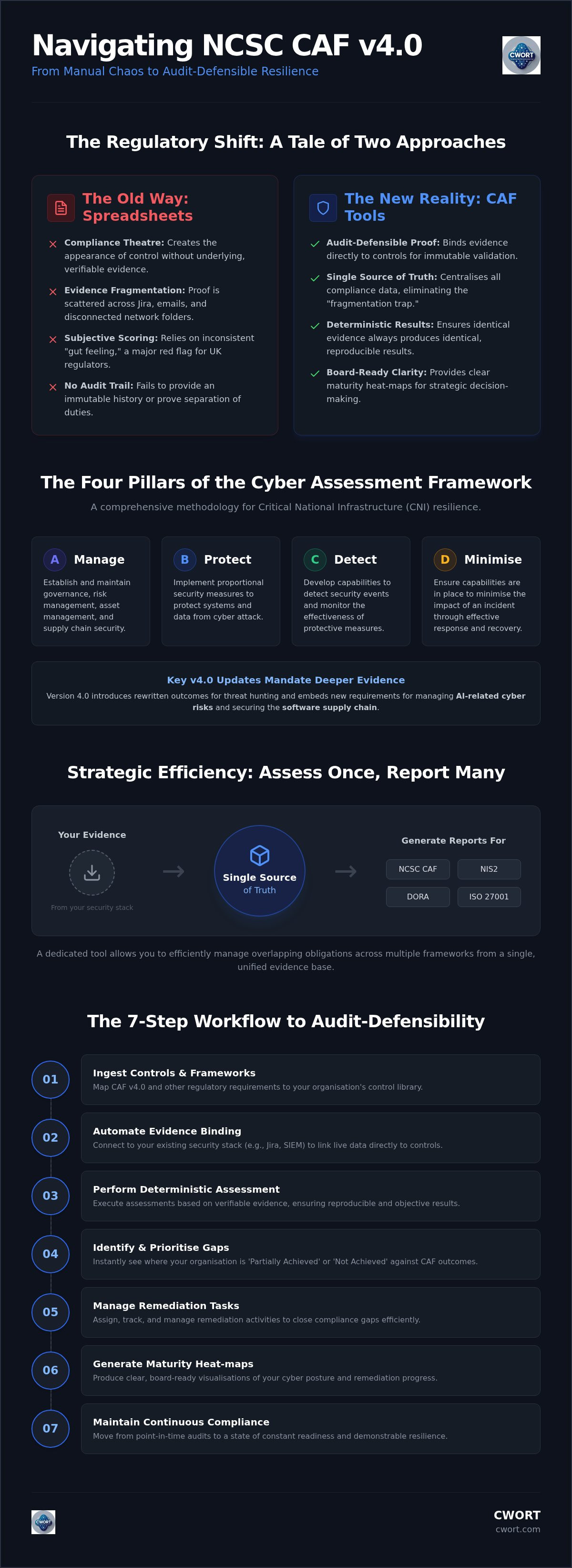
If your cyber resilience strategy still relies on the manual manipulation of Excel spreadsheets, you aren't managing risk; you're merely documenting your eventual failure. You likely feel the mounting pressure of CAF v4.0 and the looming Cyber Security and Resilience Bill, yet your evidence remains scattered across Jira tickets and disconnected emails. Adopting a dedicated NCSC CAF assessment tool is no longer a luxury for the organised; it's a regulatory necessity for any UK entity serious about audit-defensibility in 2026.
Discover how to transition from chaotic manual tracking to a deterministic, board-ready operating model that satisfies even the most rigorous UK regulators. We'll examine the process of automating evidence binding to control outcomes, ensuring your compliance data is both reproducible and transparent. This guide provides the blueprint for establishing a single source of truth, moving your organisation from the anxiety of potential failure to the calm of auditable certainty with sophisticated maturity heat-maps.
Key Takeaways
- Identify the four core objectives of CAF v4.0 and why they require a shift from reactive security to proactive, demonstrable resilience.
- Recognise the risks of "compliance theatre" inherent in manual spreadsheets and why UK regulators now demand reproducible, evidence-based proof.
- Utilise a deterministic NCSC CAF assessment tool to automate evidence binding from your existing security stack; this ensures identical evidence always yields identical results.
- Adopt an "assess once, report many" strategy to efficiently manage overlapping obligations across NIS2, DORA, and ISO 27001 frameworks.
- Transition to board-ready maturity heat-maps that provide a clear, defensible narrative of your organisation's current cyber posture and remediation progress.
Table of Contents
- Navigating the NCSC Cyber Assessment Framework (CAF) v4.0
- Why Traditional Spreadsheets Fail the CAF Assessment Scrutiny
- Strategic Advantages of a Dedicated NCSC CAF Assessment Tool
- Executing a Deterministic CAF Assessment: A 7-Step Workflow
- CWORT: The Audit-Defensible Platform for CAF Maturity
Navigating the NCSC Cyber Assessment Framework (CAF) v4.0
The Cyber Assessment Framework (CAF) represents the definitive benchmark for Critical National Infrastructure (CNI) resilience in the United Kingdom. Published by the NCSC, version 4.0 introduces a rigorous shift in how organisations must validate their security posture. It isn't just a checklist; it's a comprehensive methodology structured around four pillars: managing security risk, protecting against cyber attack, detecting cyber security events, and minimising the impact of incidents. Deploying a sophisticated NCSC CAF assessment tool is the only viable way to map these complex requirements to real-world evidence whilst avoiding administrative collapse.
Version 4.0, released in August 2025, specifically targets emerging threats that previous iterations overlooked. It introduces rewritten outcomes for threat hunting and understanding threat actors. Most notably, it embeds requirements for managing AI-related cyber risks and securing the software supply chain. These updates demand a more granular level of evidence than ever before. You can't satisfy these outcomes with vague policy statements; you need deterministic proof that controls are active and effective across your entire digital estate.
Who is the CAF for in 2026?
Traditionally, the CAF served core CNI sectors like energy, water, transport, and health. By 2026, the scope has expanded significantly. Government departments now operate under the GovAssure scheme, which mandates CAF-aligned assessments. Crucially, the framework now captures supply chain partners providing essential services to regulated entities. If you're part of the digital backbone of a regulated organisation, your resilience is no longer your private concern; it's a matter of national security that requires a structured, tool-based approach to validation.
The Shift from Guidance to Regulation
The era of voluntary alignment is over. The Cyber Security and Resilience Bill, scheduled for its House of Lords Committee Stage on 1 September 2026, transforms the CAF from helpful guidance into a statutory obligation. Regulators like Ofgem and the NCSC are moving away from surface-level reviews toward deep-dive audits. They're looking for deterministic proof. This shift demands a transition from "good enough" security to an audit-defensible posture. Using a dedicated NCSC CAF assessment tool ensures that your maturity claims are backed by immutable evidence, replacing subjective guesswork with objective truth and board-ready clarity.
Why Traditional Spreadsheets Fail the CAF Assessment Scrutiny
Many organisations still rely on the basic Excel templates provided for initial orientation. Whilst these templates help you understand the framework's structure, they're wholly inadequate for formal regulatory audits under the upcoming Cyber Security and Resilience Bill. Relying on manual entry creates a high risk of "compliance theatre", where the appearance of control exists without the underlying evidence. Regulators are increasingly rejecting these manual trackers because they lack the structural integrity required for a high-stakes NIS audit.
Evidence is frequently trapped in a "fragmentation trap". It's scattered amongst Jira tickets, archived emails, and shared network folders. Without a dedicated NCSC CAF assessment tool, connecting these disparate data points to specific CAF outcomes is an administrative nightmare. This lack of cohesion makes it impossible to provide a real-time view of resilience, leaving your organisation vulnerable during a snap inspection. You can't defend a maturity claim if you can't find the proof in under five minutes.
The Problem with Subjective Scoring
Manual assessments are inherently biased. They rely on the "gut feeling" of individual department heads, leading to inconsistent results across the enterprise. One manager might rate a control as "Achieved" whilst another, using the same evidence, might rate it as "Partially Achieved". This non-deterministic approach is a significant red flag for auditors. Managing 1,355 controls within the NCSC Cyber Assessment Framework (CAF) Collection requires a systematic approach that subjective spreadsheets simply cannot provide. You need a platform that ensures identical evidence always yields the same result.
Evidence Integrity and the Audit Trail
Regulatory compliance demands an immutable history of every assessment. Spreadsheets fail to offer a robust audit trail or prove a clear "separation of duties" between those performing the work and those validating it. You need a system that binds evidence directly to control outcomes in a way that's tamper-proof. You should prioritise ensuring compliance evidence integrity to avoid the pitfalls of version control errors and accidental data deletion. A professional NCSC CAF assessment tool provides this level of rigour by design, ensuring that every score is defensible and every change is logged.
Moving beyond the limitations of manual tracking is the only way to achieve true audit readiness. To see how a deterministic approach can transform your resilience posture, request a platform demonstration today.
Strategic Advantages of a Dedicated NCSC CAF Assessment Tool
Adopting a purpose-built NCSC CAF assessment tool transforms compliance from a static administrative burden into a dynamic strategic asset. The primary advantage lies in the "Assess Once, Report Many" efficiency. By centralising your control data, you eliminate the redundant effort of answering the same security questions for different stakeholders. This systematic approach ensures that a single piece of evidence, once validated, can satisfy requirements across multiple regulatory domains simultaneously.
Strategic leadership requires clarity, not a deluge of raw data. A dedicated platform provides board-ready maturity heat-maps that translate technical control statuses into a clear narrative of risk and resilience. These visualisations allow senior executives to identify resource gaps and prioritise investments based on objective data rather than subjective estimates. This shift to a deterministic assurance system means that your maturity scoring is predictable, reproducible, and entirely dependent on the evidence provided, rather than the interpretation of the assessor.
Orchestration Above Point Tools
A sophisticated assessment platform doesn't replace your existing security stack; it orchestrates it. It sits as an authoritative layer above your SIEM, EDR, and IAM tools, aggregating telemetry to provide a unified view of your security posture. For organisations in the energy or water sectors, this includes integrating data from OT and ICS monitoring systems. This orchestration ensures that every active control is mapped directly to the relevant CAF outcomes, providing a continuous pulse on your organisation's defensive health whilst maintaining a clear line of sight for auditors.
Multi-Framework Cross-walks
The regulatory landscape for UK enterprises is increasingly crowded, often requiring simultaneous alignment with the CAF, DORA, and ISO 27001. A professional NCSC CAF assessment tool utilises automated cross-walks to map these frameworks together. This functionality drastically reduces the administrative load on your risk and security teams by identifying overlapping requirements. If your organisation also operates within the EU, you should consider how a NIS2 compliance platform UK can further streamline your international obligations. By leveraging these cross-walks, you ensure that your resilience strategy remains cohesive and defensible across every jurisdiction in which you operate.
Executing a Deterministic CAF Assessment: A 7-Step Workflow
Operationalising the framework requires more than an occasional review; it demands a disciplined, repeatable workflow. A professional NCSC CAF assessment tool enables this by replacing ad-hoc enquiries with a structured digital journey. The process begins with importing the latest CAF v4.0 model to configure your assessment blueprint. This ensures your baseline is aligned with the most recent NCSC expectations regarding AI risk and supply chain security. Once the blueprint is active, you must assign clear scope, owners, and participants across the enterprise. Accountability is the foundation of any defensible assessment; without it, ownership of risk remains dangerously vague.
The execution phase focuses on capturing responses and binding evidence directly to specific control outcomes. This is where you move from abstract policy to concrete reality. Finally, the system calculates maturity and confidence levels using deterministic rules. By applying a fixed scoring logic, you ensure that identical evidence always yields identical results. This eliminates the variability of human judgment and provides a stable, reproducible metric for your cyber resilience.
Evidence Binding and Validation
The transition from self-assertion to evidence-backed validation is the most critical hurdle in audit readiness. Relying on a team's word that a control is "achieved" is no longer sufficient for regulators. You must bind immutable proof, such as system logs or configuration exports, directly to the assessment outcome. A robust NCSC CAF assessment tool enforces a strict separation of duties. This ensures that the individuals performing the security activities are not the same ones validating the results. This structural integrity prevents the "marking your own homework" syndrome that often undermines internal audits. Defensive content processing further protects this evidence, ensuring it remains tamper-proof throughout the assessment lifecycle.
Gap Analysis and Prioritisation
A completed assessment is only valuable if it drives meaningful change. Use the output to perform a granular gap analysis, identifying resilience deficits based on risk, implementation effort, and business value. This allows you to generate actionable improvement roadmaps that speak the language of the board. Instead of presenting a list of technical failures, you present a strategic plan for maturity growth. Tracking remediation progress within a single, governed environment ensures that identified gaps are actually closed. This continuous loop of assessment and improvement transforms your resilience from a static snapshot into a living operating model. To begin orchestrating your own deterministic workflow, book a demonstration of the platform today.
CWORT: The Audit-Defensible Platform for CAF Maturity
CWORT stands as the definitive enterprise compliance validation platform for UK Critical National Infrastructure. It translates the abstract obligations of the framework into a series of structured, manageable activities. Whilst other tools focus on administrative tracking, CWORT functions as a rigorous orchestrator of truth. Its core strength lies in a deterministic scoring engine. This means that identical evidence always yields identical results, providing the consistency that regulators now demand. It removes the variability of human error and ensures that your maturity claims are backed by immutable proof.
True resilience requires more than technical achievement. CWORT introduces a critical distinction between capability and capacity. It asks a fundamental question: can your team actually sustain these controls over time? This view allows leadership to identify where a programme might be technically compliant but operationally fragile. By modelling these constraints, you can address resource gaps before they lead to a regulatory breach. The platform also includes a sophisticated AI advisory. This system provides intelligent suggestions for control alignment and evidence mapping without altering the final outcomes, acting as a force multiplier for your risk team whilst the deterministic engine remains the ultimate arbiter of truth.
Built for Senior Leadership and Regulators
Senior leaders don't need raw data; they need auditable certainty. CWORT generates board-ready maturity reports that speak the language of business risk and strategic impact. These reports provide a clear, defensible narrative for Ofgem and NCSC inspections, replacing the panic of an audit with the calm of readiness. By using this NCSC CAF assessment tool, you replace manual hand-offs and fragmented communication with an end-to-end resilience lifecycle. Every stakeholder, from the technical engineer to the Chief Information Security Officer, operates within a single, governed environment where accountability is designed into the workflow.
Ready for the Future of UK Compliance
The regulatory landscape in 2026 is too volatile for snapshot assessments. CWORT provides continuous operating model intelligence, ensuring your assurance is recurring rather than reactive. If your organisation requires bespoke maturity models, the platform's support for "Bring Your Own Content" (BYOC) allows you to integrate internal standards alongside the CAF. This flexibility ensures you're prepared for whatever legislative updates follow the Cyber Security and Resilience Bill. Don't leave your compliance to chance or outdated spreadsheets. Book a demo to see CWORT in action and secure your organisation's audit-defensible future.
Securing Your Audit-Defensible Future in 2026
The transition from manual spreadsheets to a deterministic operating model is no longer a strategic choice; it's a regulatory mandate. Organisations across the UK's Critical National Infrastructure must move beyond subjective "gut feeling" assessments to achieve true resilience. By adopting a dedicated NCSC CAF assessment tool, you replace fragmented data with a single source of truth. This shift ensures that your maturity claims are backed by immutable evidence, providing the auditable certainty required by Ofgem and the NCSC. It's about transforming compliance from an annual burden into a continuous, defensible reality.
CWORT provides the rigorous orchestration needed to manage 1,355 controls across 42 frameworks. Its deterministic scoring engine guarantees that identical evidence yields identical results, eliminating the variability that often plagues manual audits. You don't have to face the complexities of CAF v4.0 alone. Take control of your compliance lifecycle and replace regulatory anxiety with the confidence of total assurance. Request a CWORT Demo to Orchestrate Your CAF Assessment and build a resilient, audit-ready future for your organisation today.
Frequently Asked Questions
What is the latest version of the NCSC CAF?
The current version is CAF v4.0, published by the NCSC in August 2025. This update is significant as it introduces rewritten outcomes for threat hunting and specific requirements for managing AI-related cyber risks. Organisations must transition from v3.2 to this more rigorous standard to satisfy modern regulatory expectations. It's essential to use an updated NCSC CAF assessment tool to capture these new requirements accurately and ensure your resilience posture reflects the 2026 landscape.
Is an NCSC CAF assessment mandatory for UK businesses?
Mandatory requirements depend on your sector and the services you provide. It's currently compulsory for Critical National Infrastructure (CNI) sectors, including energy, water, and health, as well as government organisations under the GovAssure scheme. The Cyber Security and Resilience Bill will soon expand these obligations to managed service providers and cloud platforms. Failure to comply can result in fines of up to £17 million for serious breaches, making audit-readiness a critical priority for 2026.
How does a CAF assessment tool differ from a standard GRC platform?
Standard GRC platforms often act as passive repositories for policy documents and manual checklists. In contrast, a dedicated NCSC CAF assessment tool functions as an active orchestrator of security data. It uses a deterministic scoring engine to ensure that identical evidence always yields the same result, removing the subjectivity common in general tools. This approach specifically maps technical telemetry to the 1,355 controls required for high-stakes CNI environments, providing a level of rigour that standard platforms cannot match.
Can I map my NCSC CAF assessment to ISO 27001 or DORA?
Yes, you can map these frameworks automatically to reduce administrative duplication. Modern platforms allow for "assess once, report many" efficiencies by identifying overlapping requirements between the CAF, ISO 27001:2022, and DORA. This cross-framework mapping ensures your evidence supports multiple regulatory obligations simultaneously. It's a vital strategy for UK firms with EU operations that must navigate NIS2 requirements whilst maintaining their primary CAF-based resilience posture. This systematic approach ensures total coverage without doubling the workload.
How long does a full NCSC CAF assessment take to complete?
The duration depends on your organisation's size and current maturity. Manual, spreadsheet-based assessments often take several months due to fragmented data and subjective scoring disputes amongst departments. Using an automated NCSC CAF assessment tool can significantly reduce this timeline by streamlining evidence collection and validation. Most UK enterprises can complete a comprehensive baseline assessment within a few weeks when using a platform that orchestrates data directly from existing security tools like SIEM and EDR.
What evidence is required for a CAF audit?
Auditors require deterministic proof that controls are active and effective. This includes technical evidence such as system logs, configuration exports, and network diagrams, alongside formal policies and incident response records. You must also prove a clear separation of duties between those executing security tasks and those validating the results. Vague assertions of compliance are no longer accepted; regulators demand immutable, timestamped proof that your resilience measures are functioning exactly as described in your assessment.
How does the Cyber Security and Resilience Bill affect CAF reporting?
The Bill places the CAF on a statutory footing, transforming it from guidance into a legal requirement for a broader range of entities. It introduces stricter incident reporting timelines and higher penalties for non-compliance, reaching a maximum of £17 million. This shift means your reporting must be audit-defensible and reproducible. Regulators will have increased powers to conduct deep-dive inspections, making manual, non-deterministic tracking a significant liability for senior leadership and board-level accountability.
Can CWORT handle OT and ICS environments for energy operators?
CWORT is specifically designed to handle the complexities of Operational Technology (OT) and Industrial Control Systems (ICS). It aggregates telemetry from specialised OT monitoring tools to provide a unified view of your entire digital and physical estate. This is critical for energy and water operators who must manage risks across both IT and OT environments. The platform ensures that controls in physical infrastructure are mapped directly to CAF outcomes, providing a comprehensive resilience narrative for regulators.
Disclaimer
The content on this site is provided for general information and educational purposes only. It does not constitute legal, regulatory, financial, or professional advice. CWORT provides AI-assisted insights and workflow automation, but all compliance decisions remain the responsibility of your organisation and its management. Always seek qualified legal or regulatory guidance for decisions relating to the UK NIS Regulations, CAF, DORA, NIS2, ISO 27001, or other obligations.
Related posts
UK NIS Evidence Management Platform: Orchestrating Auditable Compliance in 2026
Is your NIS evidence audit-ready for 2026? A UK NIS evidence management platform orchestrates compliance, replacing risky spreadsheets to avoid £17m fines.
NCSC CAF Assessment Software: Orchestrating UK Cyber Resilience in 2026
Ditch spreadsheets. Discover how NCSC CAF assessment software helps you meet the 2026 Cyber Resilience Bill, automate reporting, and build a defensible audit...
UK NIS Audit Readiness Tool: Orchestrating Compliance for 2026
Master your 2026 audit with our guide to UK NIS compliance orchestration. Move from fragmented evidence to a single source of truth for NCSC CAF 4.0 readiness.
Article by
Michael Iyiola
Co-Founder, CWORT
Michael Iyiola is a co-founder of CWORT and a Cyber and AI Security Engineer with deep experience in vulnerability management, detection engineering and operational resilience across UK critical national infrastructure, including rail, energy and financial services. At CWORT, he designs scalable, evidence-driven workflows that help teams meet modern regulatory and security demands.
Build Your Foundation of Auditable Certainty
Take control of your regulatory obligations and secure your infrastructure with CWORT.