NCSC CAF principles for cyber security and managing risk

Michael Iyiola
Co-Founder, CWORT
Explore the NCSC CAF principles for cyber security: how its four objectives assess resilience, manage risk and guide practical improvements for UK services.

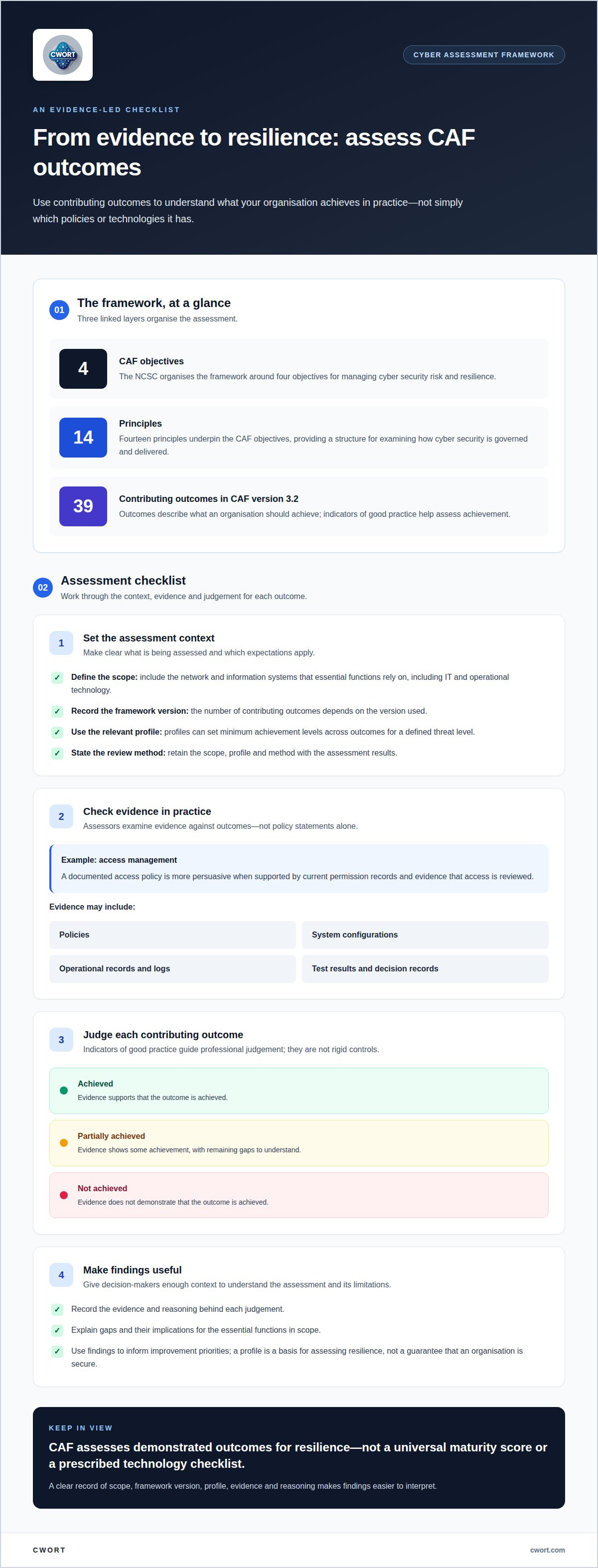
A checklist alone cannot demonstrate cyber resilience. The NCSC CAF principles for cyber security are 14 principles organised around 4 objectives, according to the National Cyber Security Centre (NCSC). Together, they give organisations a framework for assessing how well they manage cyber security risks and protect the essential functions their services depend on.
It’s understandable to look for a fixed set of controls or technologies to meet. The Cyber Assessment Framework (CAF) instead focuses on outcomes: it helps assess whether an organisation’s security measures support resilience, rather than prescribing a single technical solution. Used well, it gives leaders a structured way to understand strengths, identify gaps and direct improvement.
This article explains what the CAF is, how its objectives and contributing outcomes work, and how the framework relates to essential services, regulated organisations and critical national infrastructure (CNI) in the UK. It also explains how risk management connects the principles, so you can understand what an assessment should establish and how its findings can inform practical improvements to cyber resilience.
Key Takeaways
- Use contributing outcomes to assess whether cyber resilience is evidenced in practice, not just documented in policy.
- Connect governance, protection, monitoring and recovery so security activity supports the organisation’s essential functions.
- Prioritise assessment findings by their impact on critical services, then translate the highest risks into owned remediation actions.
- Align the assessment with the relevant sector profile and the systems that support essential services or critical national infrastructure.
- A CWORT NCSC CAF Maturity Assessment can help turn identified gaps into a structured view of maturity and improvement priorities.
Table of Contents
- What is the Cyber Assessment Framework?
- Contributing outcomes and indicators of good practice
- CAF objectives and cyber resilience
- Managing security risk
- CAF alignment for essential services and CNI
- CWORT: NCSC CAF Maturity Assessment
What is the Cyber Assessment Framework?
The Cyber Assessment Framework (CAF) helps organisations assess cyber security and resilience through evidence of outcomes, rather than a prescribed set of technologies. The National Cyber Security Centre (NCSC) organises it around 4 objectives for managing cyber security risk and resilience.
Purpose and scope of the framework
The CAF provides a structure for assessing whether an organisation’s arrangements support the security and resilience of its essential functions. Its scope includes the network and information systems those functions rely on, including operational technology as well as information technology.
This matters when disruption to a service could have operational, economic or societal consequences. The framework supports organisations in identifying strengths and exposures, then directing improvement towards the systems and functions where failure would matter most. It was developed to support implementation of the UK Network and Information Systems Regulations 2018, and is also used more widely across critical national infrastructure and other settings where operational resilience is essential.
In UK rail, CAF assessment sits within the sector’s NIS context. The Department for Transport is the Competent Authority for the NIS Regulations in the rail sector, so organisations need to understand the relevant sector expectations and define their assessment scope accordingly.
CAF principles and contributing outcomes
The NCSC CAF principles for cyber security describe the practices and outcomes that together support effective resilience. The National Cyber Security Centre states that 14 principles underpin the CAF objectives, while CAF version 3.2 contains 39 contributing outcomes.
Principles give assessors a structured way to examine how cyber security is governed and delivered. Contributing outcomes make those principles assessable by describing what an organisation should achieve. Indicators of good practice help assessors judge whether an outcome is achieved, partially achieved or not achieved. They guide assessment rather than operate as rigid requirements. The number of outcomes depends on the framework version, so assessment records should state which version was used.
For an organisation, this structure makes an assessment more meaningful than a list of controls. It connects evidence, such as policies, system configurations and operational records, to outcomes that support essential functions. The result is a clearer view of where current measures meet expectations and where further work is needed.
CAF maturity and achievement levels
The CAF assesses achievement by reviewing evidence against contributing outcomes, rather than awarding a single universal maturity score. Assessment judgements consider whether each outcome is achieved, partially achieved or not achieved.
Profiles can set minimum achievement levels across contributing outcomes for a defined threat level. This helps an organisation compare its current position with the resilience expected by its relevant profile. The assessment should also consider its scope, the quality of evidence and the reasoning behind each judgement, so decision-makers can understand what the findings represent.
That distinction matters: a profile is a basis for assessing resilience, not a guarantee that an organisation is secure. A useful assessment records gaps and their implications, then supports improvement priorities. It turns maturity from a broad label into a defensible account of demonstrated outcomes and remaining work.
CAF comparisons and official resources
CAF, Cyber Essentials and ISO 27001 serve different assessment purposes. Cyber Essentials focuses on a defined set of baseline cyber security measures, ISO 27001 provides a management-system framework, and CAF assesses outcomes related to cyber resilience and essential functions. One does not automatically replace the others.
For official guidance, start with the NCSC’s published CAF materials, which explain the objectives, principles and indicators of good practice. Use the framework version and any sector-specific profile relevant to the assessment. Sector oversight bodies may provide additional context. This helps organisations interpret outcomes consistently and avoid treating the CAF as a generic checklist.
Keep the assessment scope, framework version, profile and review method clear in recorded results. This gives leaders and assurance stakeholders the context they need to interpret findings, understand limitations and track improvement priorities.
Contributing outcomes and indicators of good practice
Contributing outcomes describe what an organisation needs to achieve for cyber security and resilience. Indicators of good practice help assess whether each outcome is achieved, partially achieved or not achieved. They guide professional judgement; they are not a rigid set of controls that every network must implement in the same way.
Assessors examine evidence against each outcome, rather than relying on policy statements alone. For example, a documented access policy is more persuasive when supported by current permission records and evidence that access is reviewed. Logs, configurations, test results and decision records can show how measures operate across systems that support essential services.
This evidence-led approach supports assessment of control effectiveness and identification of gaps. An assessor can distinguish a control that exists on paper from one that works as intended. Where an outcome is only partially achieved, the assessment should identify the weakness and its relevance to essential functions. This gives leaders a clearer basis for prioritising corrective work instead of treating every gap as equally urgent.
CAF objectives connect outcomes to the broader tasks of managing risk, protecting systems, detecting threats and responding effectively. Cyber security controls should be assessed in context: a measure is useful when it reduces exposure or supports continuity for the function it protects. For example, an access restriction should prevent users from reaching systems or information beyond their authorised role.
Identity and access control evidence can include assigned permissions, approval records and logs showing access activity. Assessors can compare these records with the organisation’s roles and operational needs, then identify excessive or outdated access. The aim is not to collect documents for their own sake. It is to establish whether access measures work consistently and limit opportunities for unauthorised activity.
For UK rail, Control Period 7 runs from April 2024 to March 2029. Funding and upgrade decisions made during this period can affect the technology and dependencies supporting rail services. CAF does not prescribe a particular upgrade or allocate funding. Instead, assessment can help organisations examine how changes affect security outcomes, identify new risks and retain evidence that safeguards remain effective as systems evolve.
Link each gap to its affected function, supporting evidence and a responsible improvement action. This creates a usable record for leadership and assurance, while keeping remediation focused on exposures that matter to service continuity. A structured review of CAF evidence can help clarify how outcomes, controls and improvement actions connect.
CAF objectives and cyber resilience
The CAF links governance, protective measures and incident handling to the continued operation of essential functions. Its objectives provide a structure for examining resilience across an organisation and its critical systems.
The four CAF objectives
Each objective focuses on a distinct part of cyber resilience, from directing security to learning after disruption. Together, they help organisations assess whether their approach covers risks before, during and after an adverse cyber event.
- Objective A covers governance, risk management, asset management and supply chain management.
- Objective B addresses protection against cyber-attacks through six principles.
- Objective C covers cyber security monitoring and proactive discovery of security events through two principles.
- Objective D addresses response and recovery planning, alongside lessons learned, through two principles.
This structure directs attention beyond technical infrastructure. For example, a critical service depends on clear accountability, known assets, effective protection, monitoring and plans for restoring operations. A weakness in one area can undermine the others, even when individual controls appear sound.
Objectives, principles and cyber resilience
The objectives group related principles, while each principle guides the assessment of practices that contribute to resilience. This relationship helps organisations connect leadership decisions with the security measures that protect essential functions.
Cyber resilience means maintaining the correct operation of essential functions during adverse cyber events. The CAF therefore centres on service outcomes, not simply on whether security tools are present. For example, monitoring matters because it supports detection; response and recovery arrangements matter because they help an organisation manage disruption and restore functions.
The objectives also connect organisational responsibility with technical evidence. The CAF groups its objectives into two self-assessments: one for the organisation and one for its critical systems. This distinction lets an assessment consider governance and management at organisational level, then examine whether protections and processes operate across systems that support important services.
For national cyber security, this service-centred view is significant. Resilience depends on infrastructure and the people responsible for it, not solely on individual devices. An organisation can use the objectives to trace how decisions, safeguards and response arrangements support a particular function. This makes weaknesses easier to explain in operational terms, such as a monitoring gap that limits the visibility needed to detect an event.
The objectives are connected, but they are not interchangeable. Governance in Objective A establishes direction and accountability; protection in Objective B reduces exposure; Objectives C and D address detection, response and learning. Assessing these relationships helps show whether measures work together to achieve resilience, rather than producing isolated evidence for separate controls.
Managing security risk
CAF Objective A puts governance, risk management, asset management and supply chain management at the centre of security decisions. It asks organisations to connect cyber risk with the essential functions supported by their network and information systems. This helps leaders judge exposure by its operational consequences, not merely by the number of technical weaknesses recorded.
Risk management starts with understanding what must keep working and what could disrupt it. Identify the essential function, the systems and data that support it, and the threats that could affect them. Relevant data may include operational information, network traffic and system configurations, as well as information that could give an attacker insight or advantage. This inventory gives decisions a defined operational context.
CAF Principle A2, Risk Management, provides a basis for examining how risks are identified, assessed and managed. Assessors can trace each significant risk to its affected function, existing measures and accountable owner. For example, if a legacy system supports a critical operational process, the assessment should record its exposure and how that exposure affects service continuity. The risk record should support prioritisation, not simply list concerns.
Prioritise gaps by the risk they pose to essential functions. Then assign remediation owners and target dates, and involve the internal or external stakeholders needed to deliver improvements. A risk with direct consequences for a critical service may need earlier attention than a weakness with limited operational impact. This makes the reasoning behind remediation priorities visible to management and supports review as systems or threats change.
Passenger-facing rail operations show why impact matters. A cyber event affecting network and information systems could disrupt services passengers rely on, so an assessment should consider operational dependencies alongside information security. Ask how disruption could affect the essential function, what measures limit that exposure, and whether response arrangements support continued operation. This treats passenger impact as an operational consequence to assess, not as a separate technical control.
Risk decisions also need to account for authorised access and system design. Systems should remove functionality that could permit access beyond what has been authorised. Assessors can examine permissions, configurations and operational data to understand whether controls match the function’s needs. In a connected environment, supply chain management matters too: third-party dependencies can contribute to service exposure and should be included in the risk picture.
After assessment, translate the highest-priority gaps into a remediation plan with named owners, target dates and supporting evidence. Revisit decisions when changes affect assets, suppliers or essential functions. This gives government-facing assurance and organisational leadership a traceable account of how cyber risk is managed, what remains exposed and how planned actions support resilience.
CAF alignment for essential services and CNI
The CAF focuses on network and information systems supporting essential functions or critical services. Disruption to these systems could have significant operational, economic or societal consequences. This makes the framework relevant to organisations delivering essential services and operators within the UK’s critical national infrastructure (CNI).
The NCSC developed the CAF to support reliable, secure systems behind essential functions. Its use extends across sectors regulated under the Network and Information Systems (NIS) Regulations, wider CNI, government and other environments where operational resilience is essential. However, the CAF itself is not a law. Organisations subject to cyber regulation should establish whether their regulator expects a particular profile or assessment approach.
Start by defining the essential function and the network, information, suppliers and technology it depends on. For a water service, this could mean examining the systems and operational data needed to maintain treatment and distribution. The assessment then considers how a cyber threat could affect those dependencies, which outcomes the organisation achieves and where resilience needs improvement.
Profiles help make an assessment relevant to sector context and threat. They set target or minimum achievement levels across contributing outcomes and are agreed at sector level by the recognised cyber-oversight body. A profile can provide a structured baseline, but it does not remove the need to understand the organisation’s own scope, dependencies and operational priorities. Sector-specific guidance should shape the assessment before work begins.
CAF version 4.0 adds guidance on securely developing and maintaining software used in essential services. It also strengthens coverage of security monitoring and threat hunting, and broadens treatment of cyber security risks from AI. These areas matter where service delivery depends on software changes, rapid identification of suspicious activity or systems using AI. The relevant assessment should connect each issue to the essential function it could affect.
Use the findings to identify strengths and exposures, prioritise improvements and establish ongoing monitoring. Record the framework version and profile, assessment scope, review method, assumptions and limitations. This context helps regulators and senior decision-makers interpret results accurately, rather than treating a profile as a universal certificate or guarantee of resilience.
For organisations with several critical services, the assessment scope should make clear which functions and systems are included. A shared network may support multiple services, while a supplier or software component may create dependencies across the organisation. Mapping these relationships helps prevent gaps between service boundaries and technical assessment boundaries.
Build a defensible view of how essential services align with CAF outcomes by arranging a CAF alignment discussion.
CWORT: NCSC CAF Maturity Assessment
CWORT’s NCSC CAF Maturity Assessment helps organisations turn framework outcomes into a structured view of maturity, evidence and improvement priorities. It is useful when an internal assessment has identified gaps, leaders need a clearer account of current achievement, or an organisation is preparing for assurance activity.
CWORT is an enterprise compliance validation platform that organises obligations into execution activities and links evidence to control outcomes. This supports traceability between an assessment finding, its evidence and the action planned to address it. Organisations managing broader cyber risk can also use a Cyber Resilience Assessment; UK NIS Compliance Management supports work on UK NIS requirements.
For a discussion about applying the assessment to your organisation, contact CWORT.
Turn CAF findings into sustained progress
Use the NCSC CAF principles for cyber security as a basis for continuing governance, not a one-off assessment. As services, suppliers and technology change, keep ownership of improvement actions clear and maintain evidence that reflects how controls operate in practice. This gives leadership a stronger foundation for reviewing priorities and directing resources as the organisation’s risk picture develops.
CWORT can support this work through its NCSC CAF Maturity Assessment. Where CAF planning connects with other compliance needs, its offerings also include DORA Compliance Readiness and Assessment, UK NIS Compliance Management and NIS2 Readiness and Compliance Management. The right starting point is the requirement or assessment outcome your organisation needs to address.
Contact CWORT to discuss your needs and identify a practical next step for your assessment. Clear priorities make sustained resilience more achievable.
Frequently Asked Questions
Final word: why should organisations use the CAF?
Organisations should use the CAF to make cyber resilience easier to assess, explain and improve. Its outcome-based approach helps leadership connect security decisions with the services they protect. For example, an assessment can show whether a weakness in a supplier relationship could affect an essential function. The value lies in applying findings to decisions and improvement priorities, not simply recording a framework score.
How is a CAF assessment carried out?
A CAF assessment defines its scope and relevant profile, then evaluates evidence against contributing outcomes. Evidence may include policies, system configurations, logs, test results and decision records. Assessors use judgement to decide whether outcomes are achieved, partially achieved or not achieved; indicators of good practice guide that evaluation. Findings identify strengths and gaps, informing improvement actions and subsequent reviews.
What changed in CAF v4.0?
CAF version 4.0 adds guidance on secure development and maintenance of software used in essential services. It also strengthens coverage of security monitoring and threat hunting, and expands consideration of cyber security risks from AI. These changes help organisations assess areas where technology and threats are evolving. Use the version and profile relevant to the assessment, and make that basis clear when communicating results.
What happens if an organisation doesn’t align with CAF?
There is no automatic penalty simply for not aligning with the CAF, because the framework itself is not a law. However, an organisation subject to cyber regulation may still need to meet requirements assessed using the CAF. The practical implications depend on the applicable regulatory and sector context. A gap can also leave decision-makers without clear evidence of how risks to essential services are being managed.
What is the NCSC CAF?
The NCSC CAF is an outcomes-based framework for assessing cyber security and resilience. It helps an organisation examine whether its arrangements support the services and functions it needs to maintain. It does not prescribe a single technology stack or provide a certificate. Its purpose is to structure assessment and improvement, with judgements based on evidence and the context of the organisation’s essential functions.
Who is the CAF for?
The CAF is relevant to organisations responsible for essential services, critical national infrastructure, government functions and other operations where cyber disruption could have serious consequences. It can also support organisations in sectors that use a CAF profile for assurance. A profile gives the assessment a defined context, while the organisation’s scope should reflect the services, systems and dependencies that matter to its operations.
Who needs to comply with the CAF?
The CAF is not a standalone legal requirement that every UK organisation must follow. Organisations subject to the Network and Information Systems Regulations may be assessed against it, depending on their sector’s regulatory arrangements. Other organisations may use it voluntarily or as part of sector assurance. The key distinction is between using the CAF as an assessment framework and meeting the legal duties imposed by applicable regulations.
Why is the government mandating CAF alignment?
The premise needs qualification: the UK government does not impose CAF alignment as a universal legal duty. The NCSC developed the framework to support cyber resilience assessment, including in regulated sectors. Regulators and recognised sector bodies determine how it is applied within their oversight arrangements. Organisations should therefore understand the requirements that apply to their sector and the profile used to assess them.
Disclaimer
The content on this site is provided for general information and educational purposes only. It does not constitute legal, regulatory, financial, or professional advice. CWORT provides AI-assisted insights and workflow automation, but all compliance decisions remain the responsibility of your organisation and its management. Always seek qualified legal or regulatory guidance for decisions relating to the UK NIS Regulations, CAF, DORA, NIS2, ISO 27001, or other obligations.
Related posts
UK NIS Evidence Management Platform: Orchestrating Auditable Compliance in 2026
Is your NIS evidence audit-ready for 2026? A UK NIS evidence management platform orchestrates compliance, replacing risky spreadsheets to avoid £17m fines.
NCSC CAF Assessment Software: Orchestrating UK Cyber Resilience in 2026
Ditch spreadsheets. Discover how NCSC CAF assessment software helps you meet the 2026 Cyber Resilience Bill, automate reporting, and build a defensible audit...
Four ways to understand and reduce human error in compliance
Discover four ways of reducing the risk of human error in compliance, investigating near misses and improving controls, procedures and cyber risk management.
Article by
Michael Iyiola
Co-Founder, CWORT
Michael Iyiola is a co-founder of CWORT and a Cyber and AI Security Engineer with deep experience in vulnerability management, detection engineering and operational resilience across UK critical national infrastructure, including rail, energy and financial services. At CWORT, he designs scalable, evidence-driven workflows that help teams meet modern regulatory and security demands.
Build Your Foundation of Auditable Certainty
Take control of your regulatory obligations and secure your infrastructure with CWORT.