NCSC Cyber Assessment Framework: UK Resilience Guide

Michael Iyiola
Co-Founder, CWORT
Our NCSC Cyber Assessment Framework explained guide helps you master v4.0. Ditch spreadsheets for a clear roadmap to achieve compliance and auditable resilie...

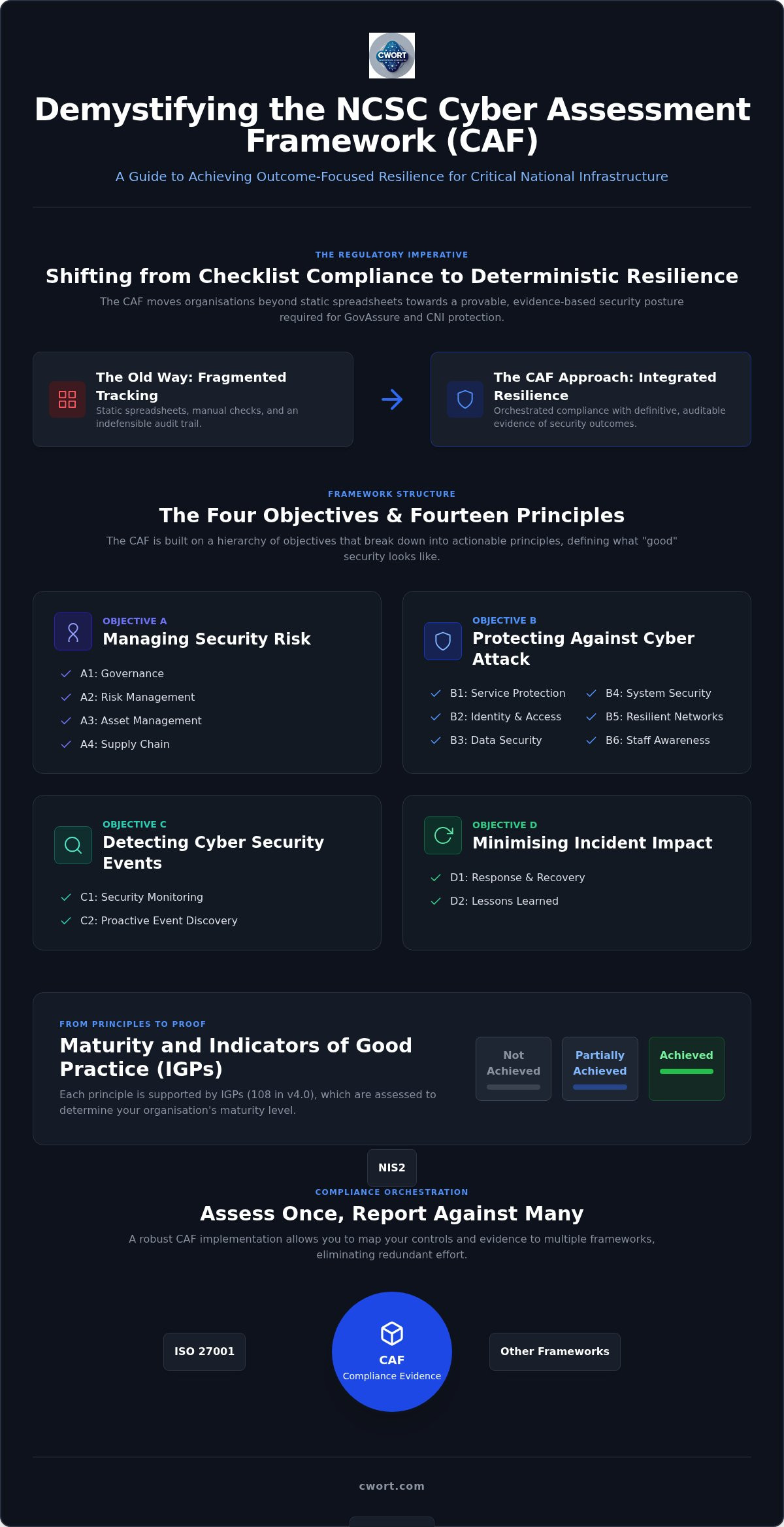
Your fragmented Excel spreadsheets aren't a security strategy; they're a liability that will crumble under the first sign of a formal regulatory audit. Relying on manual tracking for critical national infrastructure is no longer defensible in an era of sophisticated threat actors and rigorous GovAssure scrutiny. This NCSC Cyber Assessment Framework explained guide moves beyond the surface level to address the 14 principles and the 108 new Indicators of Good Practice introduced in version 4.0. You likely feel overwhelmed by the volume of requirements, yet you recognise that static checklists can't produce the definitive, evidence-based proof that boards now demand.
Mastering these complexities requires a shift from administrative box-ticking to a deterministic resilience model. We'll provide a clear roadmap for achieving "Achieved" status whilst ensuring your efforts remain reproducible and auditable. You'll learn how to orchestrate your compliance activities to map CAF outcomes directly to other frameworks like ISO 27001 or NIS2. This article breaks down the updated v4.0 structure, explores the new focus on secure software development, and delivers a systematic approach to transitioning from obligation to absolute assurance.
Key Takeaways
- Understand why the shift from passive vulnerability management to outcome-focused resilience is a regulatory necessity, with the NCSC Cyber Assessment Framework explained as your foundational blueprint.
- Master the 14 principles and the latest Indicators of Good Practice to move your organisational posture toward a defensible "Achieved" maturity rating.
- Execute a systematic roadmap for defining scope and conducting gap analyses to replace fragmented tracking with definitive, auditable evidence.
- Orchestrate your compliance activities to eliminate manual spreadsheets, allowing you to assess controls once and report against multiple standards like NIS2 and ISO 27001.
- Align your security strategy with the v4.0 updates to ensure your governance structures account for proactive threat hunting and secure software development.
Table of Contents
- Understanding the NCSC Cyber Assessment Framework (CAF)
- The Four Objectives and Fourteen Principles of the CAF
- Navigating Indicators of Good Practice (IGPs) and Maturity Levels
- Implementing the CAF: From Assessment to Continuous Resilience
- Beyond Spreadsheets: Orchestrating CAF Compliance with CWORT
Understanding the NCSC Cyber Assessment Framework (CAF)
The NCSC Cyber Assessment Framework (CAF) represents a fundamental departure from traditional security audits. It's an outcome-focused tool designed to ensure the resilience of the UK's most critical systems. Unlike standard vulnerability management, which often prioritises patching over purpose, the CAF focuses on the continuity of essential services during and after a cyber event. This Cyber Assessment Framework (CAF) provides a systematic approach for Operators of Essential Services (OES) and Digital Service Providers (DSPs) to demonstrate their security posture to competent authorities. Having the NCSC Cyber Assessment Framework explained in terms of resilience rather than just compliance is vital for organisations managing Critical National Infrastructure (CNI).
The Evolution of UK Cyber Governance
The framework acts as the technical cornerstone of the UK Government Cyber Security Strategy 2022-2030. Developed by the NCSC and GCHQ, it sets a rigorous standard for national resilience. By 2026, the landscape has reached a critical turning point; government departments now use the CAF as the foundation for the GovAssure scheme. This transition highlights a shift where manual, fragmented validation is no longer sufficient. Organisations must now move toward automated compliance validation to maintain an audit-defensible position against increasingly sophisticated threat actors who target the core of UK infrastructure.
Outcome-Based Security vs. Checklist Compliance
Traditional standards like ISO 27001 focus on broad management systems, whilst Cyber Essentials addresses basic technical hygiene. The CAF is distinct. It demands specific security outcomes but allows organisations the flexibility to determine how they achieve them. This philosophy moves away from prescriptive, "one-size-fits-all" checklists that often fail to account for unique operational risks. By focusing on outcomes, the framework provides a more accurate reflection of operational maturity through several key advantages:
- Operational Flexibility: You can tailor security controls to your specific business context and technical environment.
- Evidence-Based Maturity: The focus remains on the effectiveness of a control in practice rather than its mere existence on a registry.
- Strategic Accountability: It provides leadership with a transparent, objective view of actual resilience levels across the organisation.
Shifting to an outcome-based model ensures that security isn't just a static administrative record. It becomes an active, defensible operational state that prioritises the protection of vital services over simple box-ticking exercises.
The Four Objectives and Fourteen Principles of the CAF
The framework operates through a hierarchical structure designed to provide total visibility across an organisation's digital estate. At its core, the NCSC Cyber Assessment Framework explained simply, consists of four high-level objectives. These objectives break down into 14 principles that define what "good" looks like for critical infrastructure. Rather than focusing on specific technologies, these principles describe required outcomes, ensuring that your security posture remains robust regardless of your specific tech stack.
Objective A and B: Building the Foundation
Objective A focuses on managing cyber security risk, with Principle A1 (Governance) acting as the non-negotiable cornerstone. Without a clear governance structure that links board-level accountability to technical execution, your resilience strategy will inevitably fail under scrutiny. Objective B then translates these governance requirements into technical reality. Principles such as B2 (Identity and Access Control) are vital in modern, perimeter-less architectures. You must ensure that your technical protection measures are directly informed by the risks identified in Objective A, creating a closed loop of validation. Following the NCSC's CAF principles ensures that your identity management isn't just a list of users, but a dynamic system of least-privilege enforcement.
Objective C and D: Ensuring Operational Resilience
Objective C (Detecting Cyber Security Events) is frequently the area where organisations fail their audits. Many teams possess the tools for monitoring but lack the purposeful, structured threat hunting required by CAF v4.0. You must move beyond passive logging to active anomaly detection that can identify hostile tactics in real-time. Objective D (Minimising Impact) then addresses what happens when an event occurs. This goes beyond simple backups; it requires you to prove the reproducibility of your recovery processes. Your incident response must be integrated with board-level reporting to ensure that recovery isn't just a technical success, but a business one that preserves the continuity of essential services.
Cross-Walking CAF to NIS2 and DORA
For multi-regulated enterprises, the overlap between these principles and European mandates is significant. The CAF's focus on supply chain security and incident reporting aligns closely with both NIS2 and DORA Compliance Validation requirements. Adopting an "assess once, report many" strategy allows you to map CAF outcomes to these frameworks, reducing the administrative burden of redundant audits. By orchestrating your controls through a single taxonomy, you turn compliance from a fragmented chore into a streamlined, deterministic process. If you're struggling to map these overlapping obligations, you can explore how to automate your framework cross-walking to ensure every control carries the necessary references for any auditor.
Navigating Indicators of Good Practice (IGPs) and Maturity Levels
Indicators of Good Practice (IGPs) are the technical engine of the framework. They move the assessment from abstract principles to measurable reality. In the context of the NCSC Cyber Assessment Framework explained, these indicators provide the precise benchmarks used to determine maturity across three states: Not Achieved, Partially Achieved, and Achieved. Relying on subjective scoring is a critical error that leaves your organisation vulnerable. To survive a 2026 audit, you must replace internal "gut feelings" with an immutable trail of validation that proves your operational state.
The IGP Assessment Model
IGPs are categorised into "Basic" and "Advanced" levels. This distinction is vital for strategic prioritisation. Achieving a principle is often binary; if you fail to meet even a single Basic IGP, the entire principle is marked as "Not Achieved". This rigour prevents organisations from masking systemic weaknesses with high performance in secondary areas. You must implement a system for evidence protection to ensure that once a control is validated, the proof remains tamper-proof. It's not enough to claim a control exists; you must prove its execution through deterministic, reproducible data. Missing a single indicator can derail your entire resilience posture, so total coverage is non-negotiable.
GovAssure and the Cyber Assurance Model
Launched in April 2023, the GovAssure scheme has redefined how government departments approach the CAF. It enforces a shift from self-assessment to independent validation, known as a Stage 3 assessment. This "Cyber Assurance Model" requires departments to provide granular evidence to third-party assessors to verify their claims. Referencing the Official NCSC Cyber Assessment Framework Guidance is the first step in aligning with this standard. For enterprises, the lesson is clear: your internal assessments must mirror the rigour of an external audit to avoid catastrophic failure during formal reviews. Self-certification is a relic of the past; independent validation is the new baseline for trust.
As the NCSC Cyber Assessment Framework explained in version 4.0 becomes the definitive standard, the volume of assessment data points has increased significantly. Managing the 108 new IGPs manually in fragmented Excel sheets isn't just inefficient; it's dangerous. You need an orchestration layer that aggregates evidence automatically, ensuring that every "Achieved" status is backed by a reproducible data set. This approach removes the anxiety of regulatory scrutiny and replaces it with the calm of auditable certainty. It’s the only way to maintain a state of total assurance in 2026.
Implementing the CAF: From Assessment to Continuous Resilience
Execution of the framework requires a disciplined, multi-stage workflow that moves beyond simple discovery into active orchestration. Transitioning to a defensible posture involves five critical steps. First, define your scope by identifying the critical systems and data that support your essential services. Second, conduct a rigorous gap analysis against the 14 principles. Third, design a Target Operating Model (TOM) that specifically addresses remediation needs. Fourth, bind immutable evidence to your controls to prove their effectiveness. Finally, establish continuous monitoring and reassessment cycles to ensure your resilience doesn't degrade over time. Having the NCSC Cyber Assessment Framework explained as a lifecycle rather than a one-off project is essential for long-term security.
The Diagnostic Phase: Identifying Maturity Gaps
Initial assessments often reveal a fragmented landscape of security controls. You must use heat-map dashboards to visualise your security posture, allowing leadership to identify areas of "Not Achieved" status at a glance. Prioritise remediation based on business risk and the level of effort required to reach the next maturity tier. Manual spreadsheets fail during this diagnostic phase because they lack version control, real-time updates, and the structural integrity required for a complex audit. A static document cannot track the remediation progress of hundreds of Indicators of Good Practice across a multi-year strategy. You need a centralised system that enforces accountability and provides a single version of the truth.
Evidence Orchestration: Proving Compliance
The most significant challenge in any CAF audit is proving that your controls actually work in practice. You must move away from "point-in-time" evidence collection toward a model of continuous orchestration. This involves aggregating data from your existing SIEM, EDR, and IAM tools into a unified view. By binding this technical data directly to CAF outcomes, you create a deterministic record of compliance. This process must also ensure a strict separation of duties, where the individuals responsible for operating a control are not the same individuals validating its effectiveness. This structural discipline ensures that your maturity reports are both objective and audit-defensible.
Managing this volume of evidence requires an orchestration layer that sits above your security stack. This layer translates technical telemetry into the language of governance, ensuring that every claim of "Achieved" status is backed by reproducible proof. If you are still relying on manual evidence collection, you are leaving your organisation exposed to regulatory failure. You can request a demo of our CAF maturity assessment platform to see how to automate your evidence binding and move toward a state of total assurance.
Beyond Spreadsheets: Orchestrating CAF Compliance with CWORT
Manual tracking in spreadsheets is a strategic liability that prioritises administrative activity over actual security validation. CWORT serves as the definitive orchestration engine that replaces fragmented Jira tickets and static Excel files with a disciplined execution layer. It translates the complexities of the NCSC Cyber Assessment Framework explained throughout this guide into a series of structured, actionable activities. By sitting above your existing security stack, the platform aggregates technical telemetry to produce board-ready maturity reports and audit-defensible evidence registers. This NCSC CAF Assessment Software ensures that your resilience posture is a matter of documented, verifiable fact rather than administrative optimism.
Deterministic Scoring and Reproducible Results
Compliance must be objective to survive regulatory scrutiny. CWORT employs a deterministic scoring model where identical evidence sets always yield the same maturity result, eliminating the variability inherent in human-led assessments. Whilst the platform utilises AI advisory capabilities to suggest specific remediation improvements, these suggestions never interfere with the underlying integrity of the scoring logic. This transparency builds profound confidence with regulators. You provide them with a clear, auditable data trail that survives the most rigorous GovAssure Stage 3 validation. Every maturity claim is backed by a reproducible data set, ensuring your organisation remains beyond reproach during formal reviews.
The "Assess Once, Report Many" Advantage
Multi-regulated organisations often struggle with the burden of redundant audits. CWORT eliminates this inefficiency through its library of 1,355 controls, which map to 42 different frameworks as of June 2026. You can assess a single control and automatically generate compliance reports for the CAF, NIS2, and ISO 27001 simultaneously. This "assess once, report many" capability ensures that 98.6% of your active controls carry direct framework references, creating a unified compliance architecture. This systematic approach reduces the cost of compliance whilst increasing the accuracy of your risk reporting. To transition your organisation from manual tracking to definitive, auditable proof, book a pilot to see CWORT in action.
Securing Your Defensible Resilience Model
The transition from administrative tracking to operational resilience is no longer optional for UK organisations. This NCSC Cyber Assessment Framework explained guide highlights that success in 2026 requires more than just meeting a baseline; it demands a deterministic, audit-defensible model that survives intense regulatory scrutiny. You've seen how the shift toward outcome-based security and the rigour of GovAssure necessitates an orchestration layer that binds technical evidence directly to the 14 principles.
Relying on fragmented spreadsheets is a liability. By leveraging CWORT, you gain access to a library where 98.6% of active controls carry direct framework references, allowing you to assess once and report across multiple standards. Our platform delivers board-ready maturity reporting and deterministic assurance that replaces guesswork with auditable truth. It's the most effective way to ensure your organisation remains resilient. You can now master your CAF compliance with CWORT’s orchestration platform to ensure your digital future is secure. Take the first step toward total assurance today.
Frequently Asked Questions
What is the NCSC Cyber Assessment Framework (CAF)?
The NCSC Cyber Assessment Framework (CAF) is a high-level tool designed to assess the cyber resilience of organisations managing essential services. Developed by the NCSC and GCHQ, it provides a systematic approach to protecting the UK's critical national infrastructure. Unlike traditional checklists, it focuses on measurable security outcomes across four key objectives. This NCSC Cyber Assessment Framework explained simply helps leaders understand their operational maturity whilst ensuring they meet the rigorous standards required for national security.
Is the NCSC CAF mandatory for all UK businesses?
No, the CAF is not mandatory for every business in the UK. It is primarily required for Operators of Essential Services (OES) and Digital Service Providers (DSPs) under the UK NIS regulations. Additionally, government departments must use it as part of the GovAssure scheme. Whilst not compulsory for the broader private sector, many organisations adopt it as a "gold standard" for resilience to align with best practices in critical infrastructure protection in 2026.
How does the CAF differ from ISO 27001?
Whilst ISO 27001 focuses on establishing an Information Security Management System (ISMS), the CAF is specifically designed for the resilience of critical services. ISO 27001 is a global standard for general security management, whereas the CAF is outcome-focused and tailored to the UK's regulatory landscape. The CAF requires more granular, evidence-based proof of operational effectiveness, making it a more rigorous tool for organisations that cannot afford even a single point of failure within their infrastructure.
What are the 14 principles of the NCSC CAF?
The 14 principles are organised into four objectives: managing risk, technical protection, detection, and incident response. These principles cover areas such as governance, asset management, identity and access control, and security monitoring. Every principle describes a desired security outcome rather than a specific technical configuration. This flexibility allows you to apply the framework across diverse technical environments whilst maintaining a consistent and auditable standard of resilience across your entire digital estate and critical service components.
What is the GovAssure cyber assurance model?
GovAssure is the UK government’s cyber assurance model for critical systems, launched in April 2023. It utilises the CAF as its foundational assessment tool but introduces a more rigorous validation process. Departments must move beyond self-assessment to undergo independent Stage 3 reviews. This model ensures that security claims are backed by deterministic evidence. It represents a significant shift toward transparency, requiring organisations to prove their maturity through a reproducible, audit-defensible governance system that stands up to external scrutiny.
How do I achieve "Achieved" status in a CAF assessment?
Achieving "Achieved" status requires you to meet all relevant Indicators of Good Practice (IGPs) for a specific principle. The assessment is often binary; failing a single Basic IGP can prevent you from reaching the "Achieved" tier. You must provide immutable, deterministic evidence that your controls are functioning as intended. Using an orchestration platform ensures your results are reproducible, replacing subjective internal scores with a defensible record that regulators and auditors can verify with total confidence during formal reviews.
Can I use the CAF for NIS2 compliance?
Yes, you can use the CAF to support your NIS2 compliance efforts. There is a significant overlap between the NCSC's principles and the requirements of the EU's NIS2 directive, particularly regarding supply chain security and incident reporting. By having the NCSC Cyber Assessment Framework explained in the context of global standards, you can adopt an "assess once, report many" strategy. This approach allows you to map your CAF outcomes directly to NIS2, reducing administrative redundancy for multi-regulated enterprises.
What tools can help with NCSC CAF assessments?
Modern orchestration platforms like CWORT are essential for managing complex CAF assessments. These tools replace fragmented Excel spreadsheets with a governed digital workflow that binds technical evidence directly to control outcomes. CWORT utilises a library of 1,355 controls to automate the mapping process across 42 different frameworks as of June 2026. This ensures your maturity reports are board-ready and your evidence registers are audit-defensible, providing a single, explainable view of your organisation’s resilience and regulatory compliance status.
Disclaimer
The content on this site is provided for general information and educational purposes only. It does not constitute legal, regulatory, financial, or professional advice. CWORT provides AI-assisted insights and workflow automation, but all compliance decisions remain the responsibility of your organisation and its management. Always seek qualified legal or regulatory guidance for decisions relating to the UK NIS Regulations, CAF, DORA, NIS2, ISO 27001, or other obligations.
Related posts
UK NIS Evidence Management Platform: Orchestrating Auditable Compliance in 2026
Is your NIS evidence audit-ready for 2026? A UK NIS evidence management platform orchestrates compliance, replacing risky spreadsheets to avoid £17m fines.
NIS2 Compliance for Critical Infrastructure: A Strategic Guide to Evidence-Based Validation (2026)
Master NIS2 compliance for critical infrastructure. Our guide helps you move beyond manual tracking to build an auditable, evidence-based system and avoid hu...
Auditable Compliance Proof Software: A Strategic Guide to Regulatory Validation in 2026
Stop documenting history and start managing risk. Our guide to defensible compliance evidence software prepares your organisation for tough 2026 regulatory a...
Article by
Michael Iyiola
Co-Founder, CWORT
Michael Iyiola is a co-founder of CWORT and a Cyber and AI Security Engineer with deep experience in vulnerability management, detection engineering and operational resilience across UK critical national infrastructure, including rail, energy and financial services. At CWORT, he designs scalable, evidence-driven workflows that help teams meet modern regulatory and security demands.
Build Your Foundation of Auditable Certainty
Take control of your regulatory obligations and secure your infrastructure with CWORT.