NIS2 compliance for data centres UK: who is in scope and which controls matter

Michael Iyiola
Co-Founder, CWORT
NIS2 compliance for data centres UK depends on EU services, not location alone. Learn controls, reporting duties and how proposed UK rules may affect operators.

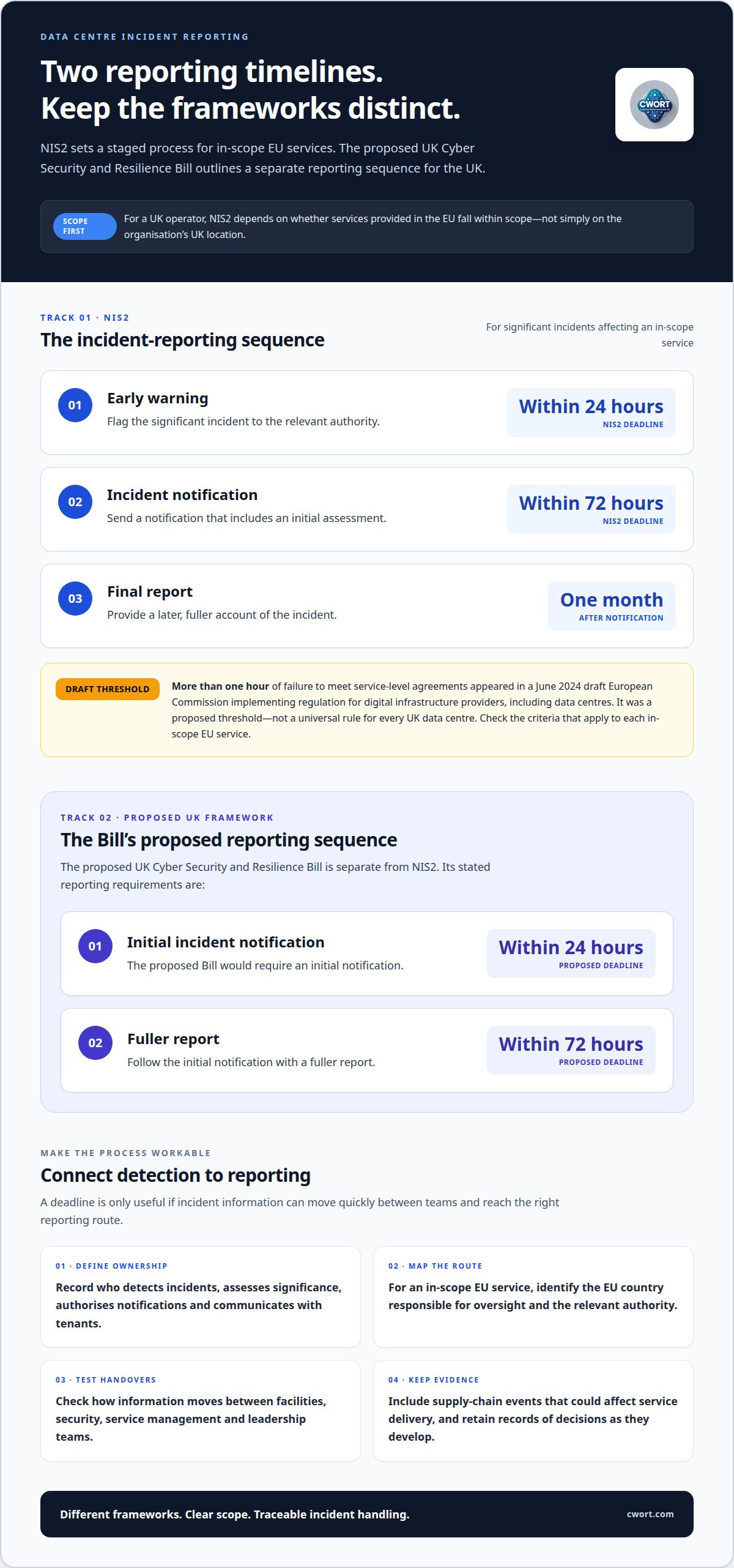
UK-only data centre operators aren’t automatically subject to NIS2: the directive applies to UK organisations when they provide in-scope services in the EU. NIS2 compliance for data centres in the UK therefore depends on where services are provided and which activities fall within scope. Separately, the proposed UK Cyber Security and Resilience Bill would bring data centres into the UK cybersecurity regime.
That distinction matters. Treating NIS2 as a blanket UK requirement can misdirect compliance planning, while overlooking EU operations or proposed UK changes can leave material obligations unaddressed. The key is to separate current EU requirements from the direction of UK regulation.
This article explains when NIS2 may apply to a UK operator, the security and incident-reporting controls it requires, and how the proposed UK framework could affect data centres. You’ll also see how to turn those requirements into mapped controls and auditable evidence, so leadership can assess exposure and plan compliance on a defensible basis.
Key Takeaways
- Establish whether your EU service activities bring the organisation within NIS2 scope; UK location alone does not settle the question.
- Understand the incident-reporting sequence, from an early warning to an initial assessment and final report.
- Assess how the proposed UK Cyber Security and Resilience Bill could extend cybersecurity requirements to data centre operators.
- Map risk management, supply-chain security, encryption, access controls and vulnerability management to accountable controls and evidence.
- Use the relevant size criteria and service type to inform your scope assessment, then consider structured readiness and compliance management to organise the work.
Table of Contents
- What Are the Key NIS2 Security Requirements?
- UK data centres and the proposed Cyber Security and Resilience Bill
- Security controls including encryption and access controls
- Company size and turnover thresholds
- Data centres entering the UK NIS regulatory framework
- CWORT: NIS2 Readiness and Compliance Management
What Are the Key NIS2 Security Requirements?
NIS2 requires in-scope organisations to manage cybersecurity risks, oversee security measures and report significant incidents. For a UK operator serving EU customers, the practical test is whether its services fall within the directive’s scope.
Significant incident thresholds
A significant incident is one that meets the applicable reporting criteria for the affected service. A June 2024 draft European Commission implementing regulation set out proposed detailed requirements for digital infrastructure providers, including data centres.
Draft thresholds included failure to meet service-level agreements for more than one hour. This was a proposed threshold, not a universal rule for every UK data centre. Operators need to understand the criteria relevant to each in-scope EU service, then connect service-level events to incident assessment and reporting. An outage affecting one tenant may also have wider service implications, so assess the incident’s overall impact.
Incident reporting deadlines
NIS2 incident reporting follows a staged timetable: an early warning within 24 hours, an incident notification with an initial assessment within 72 hours, and a final report one month after the notification.
These deadlines make escalation arrangements operationally important. Staff need a defined route from detection to assessment and notification, with incident details and decisions recorded as they develop. Organisations subject to NIS2 must report significant cyber incidents to the relevant authorities. A late or incomplete handover between technical teams and reporting leads can compromise that process.
Reporting involves more than sending a single notice. An early warning flags a significant incident, a notification adds an initial assessment, and a final report provides a later account. Data centre operators must be ready to notify competent authorities about significant incidents affecting their services. They may also need to inform relevant tenants, particularly when an incident affects customer services or requires customer action.
For a UK data centre serving EU customers, preparation starts with identifying the in-scope services and the EU country responsible for oversight. NIS2 requires notification to the relevant authorities in the EU country where the operator has its main establishment. Map operational escalation to that reporting route, and establish how tenant communications relate to regulatory notifications.
Security governance also carries management responsibilities. Under NIS2, senior management bodies must approve and oversee cybersecurity risk-management measures, and their members must undertake training. Connect incident reporting to those controls: management needs oversight of how incidents are assessed, escalated and recorded, not simply a policy document.
Prepare by documenting who detects incidents, who assesses their significance, who authorises notifications, and who communicates with tenants. Test how information moves between facilities, security, service management, and leadership teams. Include supply-chain events that could affect service delivery, and retain evidence of decisions. This creates a traceable response process suited to the relevant sector and the services supplied to EU customers.
UK data centres and the proposed Cyber Security and Resilience Bill
The UK Cyber Security and Resilience Bill would bring data centres into the UK cybersecurity regime, extending attention beyond existing NIS coverage. Operators should distinguish this proposed UK framework from NIS2, which applies to in-scope services provided in the EU.
For a UK data centre, risk-management measures should address cyber threats, supply-chain exposure and operational disruption. The UK Government, legislation.gov.uk states that relevant digital service providers must identify and take appropriate and proportionate measures to manage security risks.
Cybersecurity risk and supply chains
Cybersecurity risk management involves identifying threats to digital infrastructure and applying proportionate measures to reduce their impact. It matters because an operator’s security depends on more than its own systems.
For example, a supplier disruption could affect power, connectivity, software, or facilities that support data centre services. Map dependencies, identify how supplier incidents could affect service delivery, and connect those risks to controls and response plans. The proposed UK framework focuses on cyberattacks, physical attacks, insider threats, human error, and extreme weather. Each can disrupt continuity in a different way.
Operational resilience and incident response
Operational resilience is the ability to maintain or restore important services when disruption occurs. For data centre operators, it connects cyber risk management with practical response arrangements and the continuity of digital infrastructure.
The proposed Bill would increase reporting requirements and require an initial incident notification within 24 hours, followed by a fuller report within 72 hours. Those proposed deadlines make clear escalation routes and reliable incident records important. Operators should align detection, technical assessment, leadership decisions and external communications, so information can move promptly when an incident affects a service.
The Bill was introduced on 12 November 2025 to reform and add to the Network and Information Systems Regulations 2018. It was not yet law as of 23 September 2026. Its proposed scope would bring data centres into the UK cybersecurity regime, alongside stricter standards for operators of essential services and penalties for non-compliance. Treat these provisions as proposed requirements, rather than current duties created by the Bill.
For data centre operators, the proposed approach connects cyber security with physical resilience and operational controls. A cyberattack may require technical containment; extreme weather may demand a facility-level response; human error may require both service recovery and a review of access or operating procedures. The regulatory direction therefore concerns the resilience of data infrastructure, not cyber controls in isolation.
Translate this direction into a governance view: identify critical services, link each to relevant operational and supplier dependencies, and assign owners for risk treatment and incident response. Keep evidence of decisions, control operation, and recovery activity together. This helps leadership assess whether measures address the threats facing each service, rather than relying on a policy statement alone.
UK operators serving EU customers still need to assess NIS2 separately, since the directive and the proposed UK framework are distinct regulatory routes. A structured cyber resilience assessment can help surface gaps across supply-chain dependencies, response arrangements and service continuity, then organise the evidence needed for oversight.
Security controls including encryption and access controls
For organisations in scope, NIS2 security measures extend beyond incident response to risk management, supply-chain security, encryption and vulnerability management. Operators need controls that protect the services they provide and evidence showing how those controls work.
Security controls can include encryption technology and multi-factor authentication. Treat these as safeguards within a wider control framework, not isolated technical settings. For example, map where tenant information moves between infrastructure components, identify where encryption applies, and define who manages access to encryption keys. Multi-factor authentication should form part of access arrangements for administrative systems and sensitive operational functions.
Access control should reflect each role’s operational needs. Separate routine user permissions from privileged administration, record approvals for elevated access, and remove access when responsibilities change. As a practical test, trace a facilities engineer’s access from approval through use and review. Keep the access record alongside the control owner, relevant system, and review evidence. This makes accountability visible rather than relying on a general statement that access is restricted.
Risk management must also cover vulnerabilities and suppliers. Connect vulnerability findings to the systems and services they affect, then record how remediation decisions are prioritised and tracked. A telecoms provider may support connectivity between a data centre and its tenants. Document that dependency, the service impact of disruption, and the security responsibilities agreed with the supplier. This gives a usable view of supply-chain exposure instead of treating each provider as an isolated contract.
UK infrastructure resilience has a related reference point. The National Cyber Security Centre designed the Cyber Assessment Framework for critical national infrastructure organisations, and the framework covers four key areas. A data centre assessing its UK resilience can use a structured framework view to organise governance and control evidence. That does not make NIS2 and the UK framework interchangeable; record which requirement each control addresses.
Crown services and national-security functions need careful scope assessment. Do not assume a service is exempt simply because it supports a Crown customer or sensitive function. Identify the service, accountable organisation, data flows, and applicable legal basis before excluding any control from the assessment. Document the rationale, clearly distinguishing an established exemption from an operational decision about risk.
For telecoms and other providers, align supplier oversight with the service they enable. Identify the dependency, relevant security measures, and evidence available for assessment. Then map each control to its owner, operating process, and supporting record. This makes gaps easier to distinguish: a missing encryption control requires a different response from unclear supplier accountability or excessive user access.
Company size and turnover thresholds
For UK operators, NIS2 compliance for data centres UK companies operate depends partly on organisational size and service type. Data centre capacity thresholds also feature in UK regulatory discussions, but they are separate from NIS2’s EU company-size tests.
NIS2 generally covers medium-sized organisations in listed sectors if they have at least 50 employees, or annual turnover or balance sheet total of at least EUR 10 million, subject to exceptions. These are alternative tests: an organisation may meet the threshold through employee numbers or financial size. A UK subsidiary providing EU services should therefore assess its own position and relevant group relationships.
For essential entities in high-criticality sectors, the general size threshold is 250 or more employees or EUR 50 million or more in turnover. Neither figure makes every organisation automatically in scope. Sector, service and applicable exceptions matter too. Equally, being below a general threshold does not settle every case, because NIS2 includes specific entity categories and exceptions.
Turnover and balance sheet total are distinct measures. An organisation may meet the EUR 10 million balance-sheet test even when its turnover is lower. Group structures can also make scope assessments more complex: consider the entity providing the service, its relationship with other organisations and the relevant financial and employee measures. Record the reporting period and entity boundaries used, so the rationale can be followed later.
Rated IT load is a separate UK data centre measure. One stated threshold places UK data centres with a rated IT load of at least 1 MW in scope for regulation; another identifies UK enterprise data centres at 10 MW or more. Neither figure replaces NIS2’s employee and financial tests. Capacity concerns the facility, while the EU criteria classify organisations using size measures.
Assess NIS2 compliance for data centres UK operators manage against both dimensions, without treating them as interchangeable. Identify the service and the legal entity providing it, then assess the relevant employee, turnover and balance-sheet figures against NIS2 criteria and exceptions. Separately, establish the facility’s rated IT load against the relevant UK framework. This helps prevent a capacity threshold being mistaken for proof of EU scope.
Keep the assessment linked to operational responsibilities. Record the entity, service, applicable framework and figures relied upon. That gives decision-makers a traceable basis for considering network and information security, continuity planning and incident response. For NIS2 compliance for data centres UK organisations operate, distinguish EU organisational thresholds from UK facility measures before assigning controls or reporting responsibilities.
Data centres entering the UK NIS regulatory framework
The UK applies the Network and Information Systems Regulations 2018, rather than implementing NIS2 as domestic law. For data centre operators, UK NIS scope depends on the services provided and any formal designation.
Scope of the UK NIS Regulations
The UK NIS Regulations apply to relevant operators of essential services and relevant digital service providers. Data centre operators are not directly covered unless they provide cloud computing services, which may include cloud hosting.
Regulatory scope depends on the services an operator provides and its status, so capacity alone should not be treated as decisive. The distinction matters: a facility’s capacity alone should not be confused with the separate test based on the services an operator provides. Record the service, operator and applicable designation when assessing scope.
The UK government designated data centres as critical national infrastructure in 2024. That designation recognises their importance to essential services, but does not itself mean that every operator has the same status under the UK NIS Regulations. Operators should distinguish critical national infrastructure status from formal designation as an Operator of Essential Services.
For an operator designated as an Operator of Essential Services, Ofcom is the operational regulator. The operator must notify Ofcom within 3 months of being designated. That notification requirement makes designation a key governance event: assign responsibility for tracking it, and retain the decision and subsequent notification record.
Regulatory inspections and enforcement
Regulatory inspection and enforcement assess whether an in-scope operator meets its applicable obligations. In practice, operators need to evidence how they manage risks to network and information systems.
Failure to comply with UK NIS Regulations could result in a financial penalty of up to £17 million. The regime’s relevance depends on the operator’s services and designation, so scope records, assessments and control evidence should relate to the correct entity and service.
Prepare evidence for the systems and services that support the regulated activity. Connect threat assessments to the controls that address those threats, identify control owners, and retain records showing how decisions were made. This gives Ofcom a coherent view of how the operator implements its obligations, rather than a collection of disconnected policies.
Separate UK and EU obligations in governance records. A UK operator may fall under UK NIS because it provides cloud services or has an applicable designation, while its EU activities may raise a distinct NIS2 assessment. Track each framework against the relevant entity, service, regulator and evidence. This avoids treating one framework’s assessment as proof of compliance with another.
For an operator assessing its UK NIS position, a structured review can connect scope, assessments and evidence to accountable owners. Request a demonstration of compliance management to explore how that work can be organised.
CWORT: NIS2 Readiness and Compliance Management
CWORT provides NIS2 Readiness and Compliance Management to help data centre operators organise requirements, control activities and supporting evidence. Turn to it when scope has been assessed and the next challenge is coordinating implementation, ownership and auditable proof across teams.
CWORT is an enterprise compliance validation platform that translates regulatory obligations into structured execution activities, enforces separation of duties, and binds evidence to control outcomes. It helps replace fragmented tracking with a traceable view of progress, decisions, and outstanding actions.
Where organisations manage overlapping frameworks, relevant offerings also include UK NIS Compliance Management and ISO 27001 Readiness and Control Mapping. Contact CWORT to discuss how its compliance management approach could support your data centre’s readiness work.
Turn regulatory clarity into accountable action
Make the next step a governance decision, not another disconnected tracking exercise. Assign ownership for scope decisions, control evidence and changes in service delivery, then ensure leadership can see how those responsibilities connect. For organisations operating across borders, NIS2 compliance for data centres in the UK depends on maintaining a clear view of the obligations attached to each service.
CWORT supports NIS2 Readiness and Compliance Management, UK NIS Compliance Management and DORA Compliance Readiness and Assessment. These offerings help organisations structure compliance work around requirements, activities and evidence, creating a more coherent basis for oversight.
Start a focused discussion about your data centre’s regulatory readiness and the work needed to make controls auditable. Contact CWORT about data centre security and take the next step towards a structured, evidence-led compliance approach.
Frequently Asked Questions
Does NIS2 apply in the UK?
NIS2 is EU law, so it does not automatically apply to organisations operating only in the UK. A UK organisation providing in-scope services in the EU may be covered. For example, a UK operator serving EU customers should assess the service, the organisation responsible for it and the relevant EU regulatory arrangements, rather than relying solely on its UK location.
How Does NIS2 Affect UK Organisations?
NIS2 can affect UK organisations that provide in-scope services in the EU. Those organisations may need to assess their EU-facing activities separately from their UK operations, including which legal entity provides each service. If a UK digital service provider has no EU establishment, it must appoint a representative in an EU member state where it offers services. The relevant country’s regulatory requirements then matter to its compliance planning.
What Is the NIS2 Directive?
The NIS2 Directive is an EU law that establishes a common cybersecurity framework across 18 critical sectors. It came into force in January 2023, and EU Member States had until 17 October 2024 to transpose it into national law. It sets requirements for covered organisations, including risk management and reporting significant incidents. Its rules apply through each member state’s national legislation.
Who Must Comply with NIS2?
NIS2 generally covers medium-sized and large organisations in designated sectors, subject to exceptions and specific entity categories. The medium-sized threshold includes at least 50 employees or annual turnover or balance sheet total of at least EUR 10 million. For essential entities in high-criticality sectors, the general threshold is 250 or more employees or EUR 50 million or more in turnover. Sector and service type also matter.
How does NIS2 differ from NIS?
NIS2 is the EU’s successor directive to NIS, with a broader sectoral reach and updated cybersecurity requirements. The UK, however, continues to apply the Network and Information Systems Regulations 2018 rather than transposing NIS2 as domestic law. A UK operator may therefore need to consider two distinct regimes if its activities include both UK services and in-scope services in the EU.
How does NIS2 relate to ISO 27001?
NIS2 is a legal directive, while ISO 27001 is a standard for information security management. An organisation’s ISO 27001 work can help organise security controls and evidence, but certification alone does not establish that every NIS2 obligation has been met. Map relevant controls to the applicable NIS2 requirements, identify gaps and retain evidence against each obligation for a clear assessment.
What does NIS2 mean for the UK?
For the UK, NIS2 mainly matters to organisations providing covered services in the EU; it is not the UK’s domestic NIS law. UK operators must also consider the separate UK regime and the proposed Cyber Security and Resilience Bill. A practical scope assessment should distinguish EU service obligations from UK requirements, then assign accountable owners and records to each regulatory framework.
Does NIS2 apply to data centres in the UK after Brexit?
Brexit did not make a UK data centre automatically subject to NIS2. The directive may apply where a UK operator provides in-scope services in the EU, with requirements determined by the relevant EU arrangements. For UK-only operations, the domestic framework is the Network and Information Systems Regulations 2018, alongside proposed UK reforms. Assess each service and operating entity separately to establish the applicable route.
Disclaimer
The content on this site is provided for general information and educational purposes only. It does not constitute legal, regulatory, financial, or professional advice. CWORT provides AI-assisted insights and workflow automation, but all compliance decisions remain the responsibility of your organisation and its management. Always seek qualified legal or regulatory guidance for decisions relating to the UK NIS Regulations, CAF, DORA, NIS2, ISO 27001, or other obligations.
Related posts
NIS2 Compliance for Critical Infrastructure: A Strategic Guide to Evidence-Based Validation (2026)
Master NIS2 compliance for critical infrastructure. Our guide helps you move beyond manual tracking to build an auditable, evidence-based system and avoid hu...
NIS2 Implementation Software Europe: Beyond Checklists to Orchestrated Validation
Facing a NIS2 audit? Our guide to NIS2 implementation software Europe shows how to move beyond checklists to build a defensible, unified system of proof.
The Evolution of the Enterprise GRC Validation Tool: From Tracking to Orchestration in 2026
Stop chasing compliance ghosts in spreadsheets. Create a single source of truth for compliance with GRC orchestration to master NIS2, DORA, and UK audit dema...
Article by
Michael Iyiola
Co-Founder, CWORT
Michael Iyiola is a co-founder of CWORT and a Cyber and AI Security Engineer with deep experience in vulnerability management, detection engineering and operational resilience across UK critical national infrastructure, including rail, energy and financial services. At CWORT, he designs scalable, evidence-driven workflows that help teams meet modern regulatory and security demands.
Build Your Foundation of Auditable Certainty
Take control of your regulatory obligations and secure your infrastructure with CWORT.