NIS2 Compliance Orchestration Platform: Transforming Regulatory Obligations into Defensible Evidence

Michael Iyiola
Co-Founder, CWORT
Struggling with NIS2? A NIS2 compliance orchestration platform transforms obligations into defensible evidence, protecting your board from personal liability.

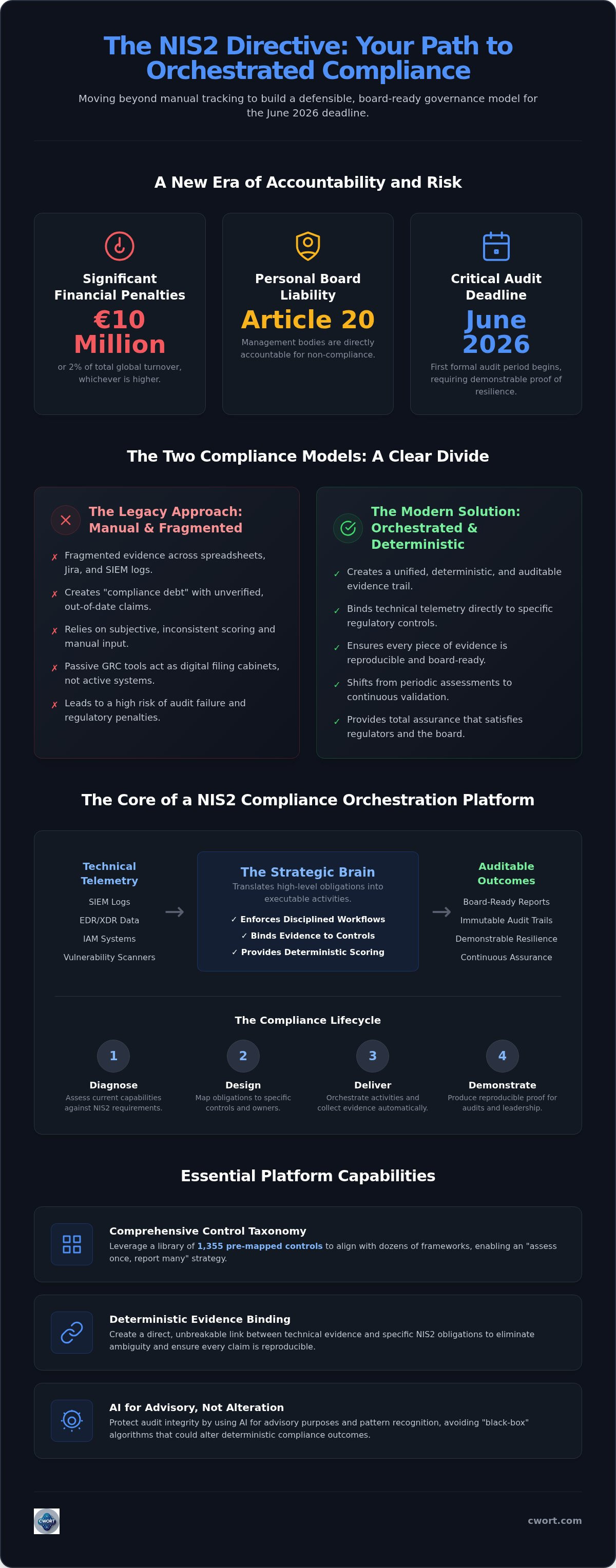
What if your personal liability as a board member rested on a spreadsheet that hasn't been updated in three weeks? Under Article 20 of the NIS2 Directive, this isn't a hypothetical scenario; it's a legal reality that requires a robust NIS2 compliance orchestration platform to ensure absolute accountability. You likely feel the weight of fragmented evidence scattered across Jira, SIEM logs, and manual checklists, whilst the June 2026 audit deadline approaches. Managing these high-stakes obligations through disconnected tools is no longer a viable strategy for essential entities facing fines of up to €10 million.
This article demonstrates how to replace the fragility of manual tracking with a deterministic, reproducible system for evidence. We'll explore how to bridge the gap between technical telemetry from SIEM or EDR tools and high-level regulatory controls. You'll learn to transform abstract obligations into a defensible operating model that provides the auditable certainty required to protect both the organisation and its leadership. By moving beyond simple checklists, you can establish a state of total assurance that satisfies regulators and the board alike.
Key Takeaways
- Eliminate the "compliance debt" created by spreadsheets and Jira by adopting a structured system that translates NIS2 obligations into executable activities.
- Implement a NIS2 compliance orchestration platform to create a deterministic link between technical telemetry from SIEM/EDR tools and specific regulatory controls.
- Distinguish between simple automation and true orchestration to ensure that every piece of evidence is reproducible and board-ready for the first formal audit.
- Utilise a comprehensive taxonomy of 1,355 controls to map existing capabilities against dozens of frameworks, enabling an "assess once, report many" strategy.
- Protect audit integrity by prioritising platforms that use AI for advisory purposes rather than allowing black-box algorithms to alter deterministic compliance outcomes.
Table of Contents
- The NIS2 Challenge: Why Manual Compliance Models Fail in 2026
- What is a NIS2 Compliance Orchestration Platform?
- Orchestration vs. Automation: Why Deterministic Evidence Binding Matters
- Implementing a Defensible NIS2 Governance Framework
- CWORT: The Strategic Platform for NIS2 Orchestration
The NIS2 Challenge: Why Manual Compliance Models Fail in 2026
The NIS2 Directive has fundamentally altered the risk profile for UK and EU enterprises. It isn't just an update; it's a structural reset. The scope has expanded to 18 critical sectors, and the stakes have escalated from administrative oversight to potential fines of €10 million or 2% of global turnover. By the first formal audit deadline on 30 June 2026, organisations must prove resilience across an "all-hazards" landscape. Relying on legacy methods to meet these requirements is a strategy built on sand.
Manual models fail because they depend on fragmented tracking. Spreadsheets and Jira tickets create "compliance debt", which is a backlog of unverified claims that lack the structural integrity required for a rigorous audit. When SIEM data and technical telemetry from EDR tools don't share a common taxonomy with regulatory controls, your evidence becomes anecdotal. A NIS2 compliance orchestration platform solves this by binding technical reality directly to specific obligations. This ensures that every entry in your audit trail is deterministic and reproducible, rather than a hopeful estimate from a busy analyst.
Board members now face personal liability under Article 20. Stating that the team is "working on it" won't suffice when regulators demand reproducible proof. Leadership needs board-ready evidence that demonstrates proactive governance. Without a system that enforces discipline, the gap between technical execution and regulatory obligation remains unbridgeable.
The Limitations of Legacy GRC Tools
Traditional GRC systems often function as passive digital filing cabinets. They store static policies but fail to orchestrate the day-to-day activities required to sustain them. These tools lack direct traceability between high-level obligations and granular technical evidence, which leads to inconsistent maturity scoring. When assessments rely on subjective manual input, the risk of human error or "optimistic reporting" increases. A modern NIS2 compliance orchestration platform moves beyond this by enforcing discipline and accountability by design, turning passive records into active, defensible proof.
Regulatory Scrutiny in the UK Landscape
UK regulators, including the NCSC and sector-specific bodies like Ofgem, are moving toward more rigorous oversight. They expect organisations to demonstrate maturity against the Cyber Assessment Framework (CAF) with immutable audit trails. Manual systems can't provide the level of validation needed to prove complex requirements like supply chain risk management or "separation of duties". These must be enforced by the underlying system architecture, not just documented in a policy. By the June 2026 audit window, the ability to show a structured, evidence-based operating model will be the difference between compliance and significant financial penalties.
What is a NIS2 Compliance Orchestration Platform?
A NIS2 compliance orchestration platform acts as the strategic brain of your regulatory programme. Whilst point-tools like EDR, IAM, and vulnerability scanners provide technical telemetry, they cannot interpret the official NIS2 Directive policy. Orchestration translates high-level obligations into specific execution activities. It sits above your existing security stack, integrating Operating Model Intelligence to assess whether your organisation has the capability and capacity to meet its duties. It identifies where resource gaps exist before they become compliance failures. By shifting from periodic assessments to continuous validation, it ensures that control effectiveness is a lived reality rather than a static snapshot.
Obligation Translation and Execution
This process involves dissecting complex NIS2 articles into actionable, assigned tasks across the enterprise. The platform enforces a rigorous "Diagnose, Design, Deliver, Demonstrate" lifecycle, ensuring no requirement is left to chance. Compliance orchestration is the systematic binding of evidence to regulatory outcomes. It replaces the ambiguity of manual tracking with a disciplined workflow that holds every stakeholder accountable for their specific contribution to the organisation's resilience.
The Deterministic Scoring Model
Audit-defensibility relies on reproducibility. Unlike legacy GRC tools that use "weighted averages" or subjective "best guesses" from analysts, a deterministic model ensures that identical evidence always yields the same compliance status. This level of precision is vital for senior executives who must sign off on regulatory submissions. If an auditor can't replicate your results, your assurance is void. Orchestration provides a disciplined environment where every score is validated against hard data, removing the anxiety of human bias from the reporting process.
Multi-Framework Cross-Walking
Efficiency is paramount for organisations managed under multiple regulatory regimes. CWORT's library of 1,355 controls allows for an "assess once, report many" philosophy. A single assessment can simultaneously satisfy NIS2, ISO 27001, and the NCSC CAF by mapping evidence across framework cross-walks. This reduces the administrative burden on technical teams and ensures consistency in your governance posture. For UK enterprises operating in critical sectors, this systematic approach provides a clear path from regulatory obligation to defensible truth. To see how this structured approach can transform your audit readiness, you might explore a platform demonstration.
Orchestration vs. Automation: Why Deterministic Evidence Binding Matters
Many organisations mistake "automation" for "compliance". Automated alerts from a SIEM or vulnerability scanner show that a tool is working, but they don't prove a control is effective. A NIS2 compliance orchestration platform goes further by implementing governed evidence binding. This process ensures that technical data isn't just collected but is systematically mapped to a specific regulatory obligation. It creates a "defensible truth" that survives auditor scrutiny because the relationship between the data and the requirement is immutable and transparent.
The ISACA analysis of NIS2 highlights that harmonising practices across complex environments requires more than just reactive scripts. Unlike generic AI GRC tools that might use black-box algorithms to "predict" compliance status, CWORT’s AI advisory remains purely supportive. It never alters deterministic outcomes. This ensures that your compliance posture is based on reproducible evidence, not a probabilistic guess that could fail during a high-stakes investigation. Separation of duties is enforced within the orchestration workflow itself, ensuring that the person implementing a control isn't the same person validating its success. This structural discipline is mandatory for board-level accountability, as it removes the possibility of internal collusion or unintentional bias in maturity reporting.
Evidence Integrity and Protection
Building a NIS2 compliance orchestration platform requires an immutable evidence register. CWORT consumes telemetry directly from SIEM platforms and asset registers, eliminating the risks associated with manual data entry. This direct integration prevents evidence tampering and ensures that the data used for reporting is an accurate reflection of the technical environment. To satisfy stringent UK audit standards, the platform employs defensive content processing. This rigorous approach verifies the source and integrity of every data point before it's bound to a control, providing a level of assurance that manual trackers simply can't match. This systematic ingestion ensures that your audit trail remains unbroken, even as technical environments evolve.
Capability vs. Capacity: The Orchestration Differentiator
A critical failure in legacy compliance models is ignoring operational reality. Capability refers to whether a practice exists, such as having an incident response plan. Capacity, however, measures whether the organisation has the skills and resource coverage to sustain that practice during a crisis. A control is only truly effective if it's operationally sustainable. CWORT provides a heat-map view of both maturity and capacity, allowing leadership to see where they might be "compliant" on paper but vulnerable in practice. This distinction is what separates a tick-box exercise from genuine cyber resilience, ensuring the board understands the true state of the organisation's defensive posture.
Implementing a Defensible NIS2 Governance Framework
Transitioning from fragmented manual tracking to a NIS2 compliance orchestration platform requires a disciplined, step-by-step execution. This process moves beyond simple deployment, establishing a rigorous operating model that enforces accountability by design. To achieve audit-defensibility, organisations must follow a linear progression from identifying obligations to producing reproducible evidence.
- Step 1: Map obligations and controls. Utilise a comprehensive taxonomy library of 1,355 controls to identify specific gaps across 217 domains. This ensures that 98.6% of active controls carry precise framework references.
- Step 2: Design the Target Operating Model (TOM). Define remediation workflows and assign clear accountability. This structure ensures that every stakeholder understands their role in maintaining the organisation's resilience.
- Step 3: Integrate operational tools. Connect EDR, IAM, and OT monitoring systems to the orchestration layer. This allows the platform to sit above existing tools, capturing technical telemetry as governed evidence.
- Step 4: Execute governed assessments. Perform validations that enforce a strict separation of duties. This creates an immutable audit trail that prevents internal bias or tampering.
- Step 5: Generate reporting. Produce board-ready maturity reports and regulator-ready evidence registers. These outputs provide a "defensible truth" that satisfies both internal leadership and external auditors.
The BYOC (Bring Your Own Content) Advantage
Enterprises often possess proprietary maturity models that reflect their unique operational risks. A sophisticated NIS2 compliance orchestration platform allows you to import this proprietary content into a governed digital workflow. You can retain your organisational IP whilst leveraging CWORT’s orchestration engine to enforce discipline. For long-term durability, the "Option B" governed reusable model service ensures that your custom controls remain aligned with evolving regulatory standards without requiring manual reconstruction.
Engagement and Onboarding
The shift from spreadsheets to an orchestrated environment begins with a short working session to map the platform to your specific programmes. We recommend a pilot phase that focuses on validating sub-functions to demonstrate end-to-end workflow success. This pragmatic approach allows teams to see immediate value whilst building the momentum needed for enterprise-wide adoption. By replacing disconnected Jira tickets with a single orchestrated environment, you eliminate the "compliance debt" that plagues manual systems.
Board and Regulator Reporting
Leadership requires more than just a list of completed tasks; they need an "explainable" view of the organisation's security posture. CWORT produces audit-ready outputs that translate technical data into strategic insights for the board. These dashboards provide a real-time view of maturity and capacity, ensuring that personal liability risks are managed proactively. You can learn more about regulatory compliance workflow automation to see how these reports are generated. To understand how this structured approach secures your regulatory standing, request a platform demonstration today.
CWORT: The Strategic Platform for NIS2 Orchestration
CWORT provides the definitive framework for organisations requiring an audit-defensible NIS2 compliance orchestration platform. By consolidating Operating Model and Compliance Intelligence into a single governed environment, it eliminates the ambiguity of fragmented tracking. The platform's power lies in its taxonomy of 1,355 controls across 217 domains, where 98.6% of active controls carry precise framework references as of June 2026. This level of technical depth allows UK critical national infrastructure providers to move beyond administrative checklists and establish a deterministic, reproducible scoring model. The "Diagnose to Demonstrate" lifecycle ensures that every obligation is identified, designed into the operating model, delivered through technical execution, and demonstrated through immutable evidence. This systematic progression replaces the anxiety of potential failure with the calm of auditable certainty.
Tailored for UK Critical Infrastructure
CWORT provides first-class support for the complex OT and ICS standards that govern national resilience, including IEC 62443 and NIST SP 800-82. This specific focus enables seamless reporting to regulators such as Ofgem and the NCSC, ensuring that organisations meet the rigorous expectations of the Cyber Assessment Framework. You can explore our NCSC CAF assessment software to understand how we bridge the gap between industrial operations and regulatory oversight. By enforcing discipline across both IT and OT environments, CWORT creates a unified view of risk that manual systems cannot replicate. Trust is built through transparency; CWORT provides the granular traceability that auditors demand when assessing the security of essential services.
Future-Proofing Compliance for 2026 and Beyond
The regulatory landscape isn't static; it's an evolving set of challenges that includes the EU AI Act and emerging supply chain mandates. CWORT's architecture is designed for scalability, allowing enterprises to integrate new obligations into their existing workflows without disrupting established processes. Continuous operating-model intelligence provides the long-term visibility needed to sustain transformation rather than just surviving an audit cycle. This proactive stance ensures that your governance remains a strategic asset rather than an administrative burden. As supervision phases intensify across the EU and UK, the ability to rapidly adapt to new requirements becomes a competitive necessity. To secure your organisation's regulatory future and move beyond the fragility of manual tracking, book a pilot to see CWORT in action.
Securing Audit-Defensible Resilience for 2026
The transition from manual tracking to a NIS2 compliance orchestration platform is no longer a matter of administrative preference; it's a strategic necessity for board-level protection. You've seen how fragmented spreadsheets create compliance debt whilst deterministic evidence binding offers a path to auditable truth. By bridging the gap between technical telemetry and regulatory obligations, you can replace the anxiety of personal liability with the certainty of reproducible proof.
CWORT provides the structural integrity required to meet the June 2026 deadline. With a library of 1,355 controls and 98.6% framework reference accuracy, you can generate board-ready maturity reports instantly. This systematic approach ensures that your governance remains robust, transparent, and resilient against both internal scrutiny and external audits. Every obligation is transformed into a validated activity, ensuring that your resilience is a lived reality rather than a static policy.
Don't leave your regulatory standing to chance. Experience deterministic NIS2 orchestration with CWORT and transform your compliance obligations into a defensible competitive advantage. You have the tools to lead your organisation toward total assurance and lasting cyber resilience.
Frequently Asked Questions
What is the difference between NIS2 automation and orchestration?
Automation refers to reactive, script-based tasks that reduce manual labour for specific technical events. Orchestration is a governed, end-to-end digital environment that translates regulatory obligations into executable activities whilst binding evidence to outcomes. A NIS2 compliance orchestration platform ensures that every automated alert is contextualised within a broader governance framework. This distinction is vital for audit-readiness, as orchestration provides the structural discipline and traceability that simple automation lacks.
How does NIS2 impact UK critical national infrastructure (CNI) in 2026?
UK CNI providers must complete their first formal compliance audit by 30 June 2026. Whilst the UK has its own NIS regulations, the NIS2 Directive influences the security standards expected by regulators like Ofgem and the NCSC. Entities in critical sectors like energy and water must demonstrate maturity against the Cyber Assessment Framework (CAF). Failure to prove resilience through immutable audit trails can lead to significant operational scrutiny and financial penalties.
Can I use Jira or Excel for NIS2 compliance validation?
Whilst Jira and Excel are useful for administrative tracking, they're insufficient for regulatory validation. These tools create compliance debt because they lack deterministic evidence binding and immutable audit trails. They can't enforce a strict separation of duties or provide the reproducible proof required by auditors. Managing complex NIS2 obligations through disconnected spreadsheets often leads to fragmented data and a high risk of human error during high-stakes regulatory assessments.
Who is held personally accountable for NIS2 non-compliance?
Article 20 of the NIS2 Directive holds management bodies personally accountable for cybersecurity failures within their organisations. This means board members and senior executives can be held liable if the entity fails to implement adequate risk-management measures. Regulators now demand that leadership takes an active role in approving cybersecurity strategies and overseeing their implementation. A NIS2 compliance orchestration platform provides the explainable evidence needed to protect leadership from personal legal exposure.
What is deterministic compliance scoring and why is it audit-defensible?
Deterministic scoring is a model where identical evidence always yields the same compliance status, removing subjective best guesses from the process. It's audit-defensible because it ensures reproducibility; an auditor can follow the same logic to reach the same conclusion. This contrasts with legacy GRC tools that rely on weighted averages or analyst opinions. By using hard data from technical telemetry, deterministic models provide a defensible truth that survives rigorous external scrutiny.
How does CWORT handle "separation of duties" under NIS2?
CWORT enforces separation of duties by design within its orchestration workflow. It ensures that the individual responsible for implementing a technical control isn't the same person who validates its effectiveness. This structural discipline prevents internal bias and ensures that maturity scoring remains objective. By hard-coding these governance requirements into the platform, CWORT provides an immutable record of accountability that satisfies the stringent transparency requirements of modern regulatory audits.
Can CWORT map NIS2 controls to other frameworks like ISO 27001 or CAF?
Yes, CWORT utilises a comprehensive taxonomy of 1,355 controls to enable multi-framework cross-walking. This "assess once, report many" capability allows organisations to map a single piece of evidence across NIS2, ISO 27001, and the NCSC CAF simultaneously. With 98.6% of active controls carrying precise framework references, the platform significantly reduces the administrative burden on technical teams. This ensures consistency in governance posture across multiple regulatory regimes and international standards.
What are the penalties for failing a NIS2 audit in the UK?
Penalties for non-compliance are severe, with fines for essential entities reaching up to €10 million or 2% of total global annual turnover. Beyond financial sanctions, regulators can impose binding instructions, peer reviews, and temporary bans on management functions. In the UK, failure to meet NIS requirements can lead to enforcement notices and significant reputational damage. Proactive orchestration is the only way to mitigate these risks and ensure long-term operational sustainability.
Disclaimer
The content on this site is provided for general information and educational purposes only. It does not constitute legal, regulatory, financial, or professional advice. CWORT provides AI-assisted insights and workflow automation, but all compliance decisions remain the responsibility of your organisation and its management. Always seek qualified legal or regulatory guidance for decisions relating to the UK NIS Regulations, CAF, DORA, NIS2, ISO 27001, or other obligations.
Related posts
NIS2 Audit Readiness Tool: Orchestrating Evidence-Based Validation for 2026
Ditch spreadsheets for the 2026 audit. A NIS2 audit readiness tool provides orchestrated, evidence-based validation for total compliance certainty.
Enterprise Compliance Evidence Management: A 2026 Checklist for Regulated Firms
Is your firm ready for DORA & NIS2? Our 2026 checklist for enterprise compliance evidence management shows how to replace manual tracking with a defensible, ...
NIS2 Audit Readiness Tool: Orchestrating Evidence-Based Compliance in 2026
Is your NIS2 compliance built on spreadsheets? Discover how a dedicated NIS2 audit readiness tool orchestrates evidence to deliver auditable proof and certai...
Article by
Michael Iyiola
Co-Founder, CWORT
Michael Iyiola is a co-founder of CWORT and a Cyber and AI Security Engineer with deep experience in vulnerability management, detection engineering and operational resilience across UK critical national infrastructure, including rail, energy and financial services. At CWORT, he designs scalable, evidence-driven workflows that help teams meet modern regulatory and security demands.
Build Your Foundation of Auditable Certainty
Take control of your regulatory obligations and secure your infrastructure with CWORT.