NIS2 Regulatory Reporting Platform: Orchestrating Audit-Ready Evidence in 2026

Michael Iyiola
Co-Founder, CWORT
Ditch spreadsheets for NIS2. Our guide shows how a NIS2 regulatory reporting platform provides audit-ready evidence and protects leadership from personal lia...

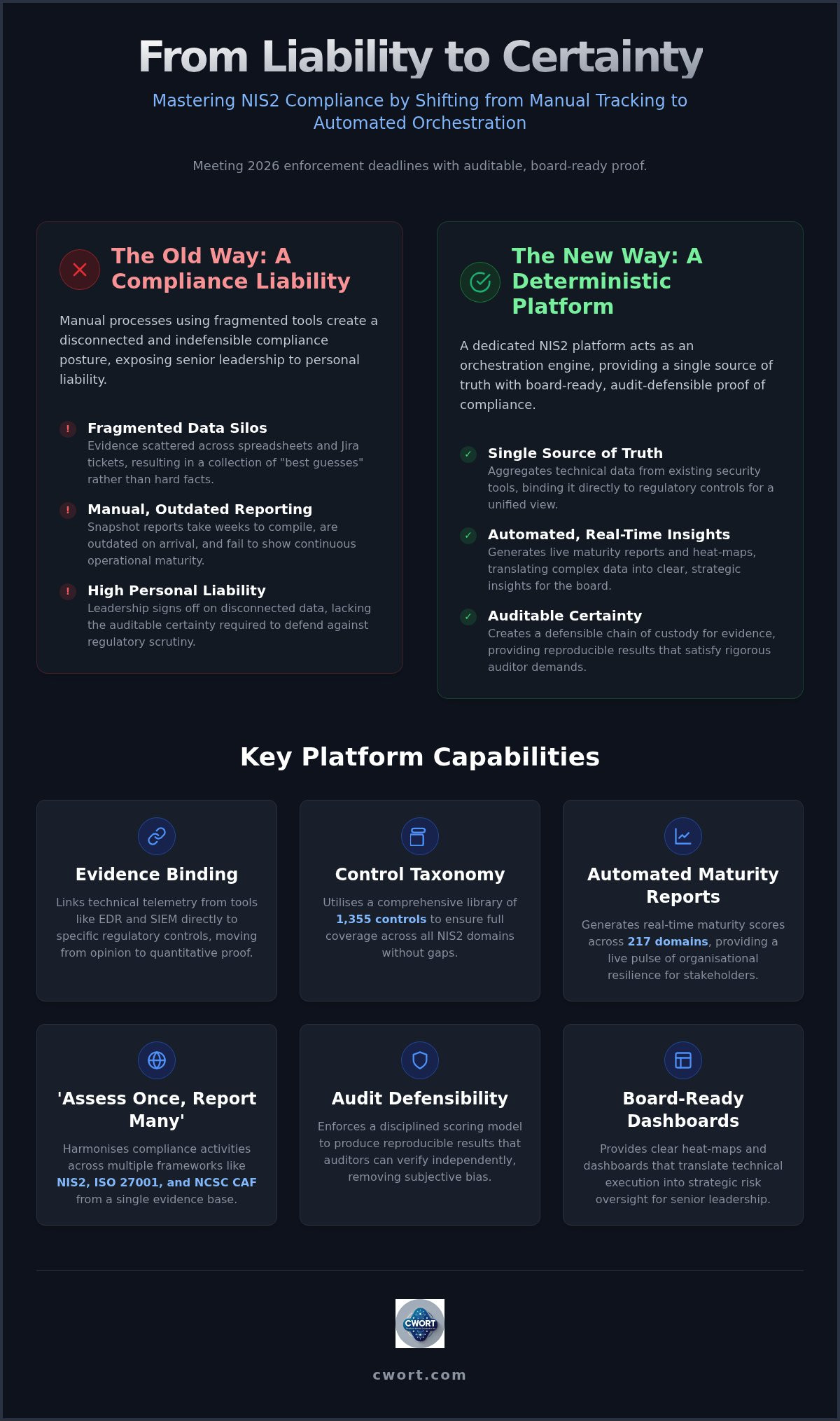
Your spreadsheet is no longer a shield; it's a liability. As the 2026 enforcement deadlines for national implementations like the Dutch Cybersecurity Act take hold, the anxiety amongst senior leadership regarding personal liability has reached a fever pitch. You've likely spent months trying to map fragmented evidence across Jira tickets and Excel sheets, only to find that your compliance posture remains a collection of "best guesses" rather than hard facts. Implementing a dedicated NIS2 regulatory reporting platform is the only way to bridge the gap between administrative tracking and auditable certainty.
You need a system that enforces discipline by design. This article demonstrates how to move beyond manual processes to a deterministic system that provides board-ready, audit-defensible proof of compliance. We'll explore the transition from fragmented data to a single source of truth, the automation of maturity reports, and the methods for generating results that even the most rigorous auditors cannot challenge.
Key Takeaways
- Shift from passive GRC repositories to active orchestration engines that enforce structural integrity and accountability across the organisation.
- Learn how a NIS2 regulatory reporting platform sits above existing security tools to aggregate and bind technical evidence directly to regulatory controls.
- Adopt an "assess once, report many" strategy to harmonise compliance activities across NIS2, ISO 27001, and the NCSC CAF.
- Replace manual administrative tracking with deterministic results that provide senior leadership with auditable certainty and protection against personal liability.
- Generate automated maturity reports and heat-maps that translate complex technical data into clear, board-ready strategic insights without manual reconstruction.
Table of Contents
- The Evolution of NIS2 Compliance: Why Static Reporting No Longer Suffices
- Key Capabilities of a Modern NIS2 Regulatory Reporting Platform
- Beyond GRC: Transitioning from Manual Tracking to Automated Orchestration
- The "Assess Once, Report Many" Strategy: Mapping NIS2 to CAF and ISO 27001
- Achieving Board-Ready Transparency and Audit-Defensibility
The Evolution of NIS2 Compliance: Why Static Reporting No Longer Suffices
Compliance is no longer a static event. The NIS2 Directive has fundamentally altered the expectations of national regulators, moving the goalposts from periodic documentation to continuous validation. For UK-based enterprises with EU operations, the strategic urgency is absolute. With the Dutch Cybersecurity Act (CBW) coming into effect on 15 August 2026, and Germany's registration deadlines already passed, the window for "best effort" reporting has closed. A NIS2 regulatory reporting platform serves as the essential system of record, moving beyond mere administrative tracking to provide a deterministic validation of cyber resilience.
Traditional GRC tools and spreadsheets fail because they lack structural integrity. They're designed for documentation, not orchestration. In a high-stakes audit, a regulator doesn't just want to see a policy; they want to see the execution history that proves the policy is active. Shifting to a deterministic model means that evidence is no longer a narrative written by a manager. It's a verified output that links directly to a library of 1,355 controls, ensuring that compliance is a reflection of reality rather than an optimistic snapshot.
The Limitations of Manual Compliance Trackers
Jira tickets and Excel workbooks are where audit readiness goes to die. These tools create fragmented compliance debt because they can't maintain the complex relationships between 42 different frameworks and standards. When a regulator demands proof of control effectiveness, manual reconstruction takes weeks of forensic data gathering. This lag time is a red flag to auditors. Snapshot reporting fails to capture the continuous operational maturity required in 2026. It leaves leadership exposed to personal liability because they're signing off on data that is inherently disconnected and potentially outdated.
The Regulator Perspective: What Auditors Actually Seek in 2026
Modern auditors demand reproducible results. If two different people review the same evidence, they must arrive at the same score. A NIS2 regulatory reporting platform enforces this through a disciplined scoring model that removes subjective bias. Regulators also look for a clear separation of duties within the reporting workflow to prevent "marking your own homework." Boards can't rely on a static PDF that was relevant three months ago. They require real-time dashboards and heat-maps that translate technical execution into strategic risk oversight. This level of transparency is only possible when your reporting sits above your technical stack, orchestrating evidence into a single, defensible truth.
Key Capabilities of a Modern NIS2 Regulatory Reporting Platform
Orchestrate your response to the official NIS2 Directive policy by moving beyond passive documentation. A modern NIS2 regulatory reporting platform functions as the central nervous system for compliance validation, translating abstract legal obligations into structured execution activities. It does not merely record that a task was completed; it validates the integrity of the process itself. By automating the roll-up of maturity scores across 217 domains and sub-functions, the platform provides a real-time pulse of organisational resilience that manual processes cannot replicate.
Success in 2026 requires a system that sits above your existing security stack, aggregating technical data into a single, defensible truth. This orchestration ensures that every control is mapped, every piece of evidence is bound, and every stakeholder is held accountable through strict governance. To see how this orchestration works in practice, you can request a platform demonstration tailored to your specific framework requirements.
Evidence Binding and Control Taxonomy
Utilise a comprehensive library of 1,355 controls to ensure every NIS2 domain is covered without gaps. Evidence binding is the process of linking technical data from tools like EDR or SIEM directly to specific regulatory requirements. This transition from qualitative "opinions" to quantitative, data-driven validation is critical for audit-defensibility. Instead of a manager stating that "antivirus is deployed," the platform provides the bound telemetry that proves the control is active and effective across the entire estate. This creates a chain of custody for evidence that auditors can verify independently.
Capability and Capacity Assessment
Measure the sustainability of your security programme by assessing both capability and capacity. It's not enough to have a control in place; you must prove the organisation has the resources to maintain it under pressure. CWORT ensures that 98.6% of active controls carry framework references as of June 2026, providing a level of structural integrity that Excel-based trackers lack. Use heat-map dashboards to visualise resilience gaps across different business units. This allows leadership to identify potential audit failures before they manifest, shifting the focus from reactive remediation to proactive governance.
Deterministic vs. Subjective Reporting
Eliminate the variability of human judgement in your compliance assessments. In high-stakes regulatory environments, reproducibility is the standard. The same evidence must lead to the same score, regardless of who performs the evaluation. A NIS2 regulatory reporting platform enforces this discipline by design, using a deterministic scoring model that removes subjective bias. Combined with robust role-based access control (RBAC), the platform ensures that only authorised personnel can validate evidence, maintaining a strict separation of duties that satisfies both internal risk committees and external regulators.
Beyond GRC: Transitioning from Manual Tracking to Automated Orchestration
Stop treating compliance as a documentation task. Traditional GRC repositories are passive filing cabinets; they wait for you to upload a file and offer no validation of the data within. An active NIS2 regulatory reporting platform operates as an orchestration engine that drives execution. It sits above your technical stack, pulling telemetry from tools like EDR and SIEM to aggregate evidence into a single, defensible truth. This is the essence of Operating Model Intelligence. You aren't merely tracking administrative tasks; you're designing and enforcing a target resilience state. To understand the underlying mechanics of this shift, explore our detailed breakdown of Regulatory Compliance Workflow Automation.
Replacing Fragmented Workflows
Fragmented workflows are the primary cause of compliance failure. When risk teams, compliance officers, and technical delivery teams operate in silos, "compliance debt" accumulates rapidly. Orchestration eliminates these hand-offs by creating a single governed digital environment. It establishes a common language for maturity across the entire enterprise, ensuring that a "level 3" maturity score means the same thing to a technician as it does to a board member. You don't have to argue over whether a control is "done" because the platform provides the bound evidence that proves it's effective. This structural integrity replaces the anxiety of manual tracking with the calm of auditable certainty.
The Seven-Step Assessment Process
Achieving "always-on" readiness requires a disciplined, step-by-step progression that mirrors a professional workflow. The NIS2 regulatory reporting platform enforces this rhythm through a structured seven-step assessment process. It begins by defining the operating model and scope, then moves through mapping controls and executing assessment activities. The platform then calculates deterministic maturity and confidence scores based on the bound evidence.
- Define the model and framework scope.
- Map controls across NIS2, ISO 27001, or CAF.
- Execute assessment and gather technical evidence.
- Calculate maturity using a reproducible scoring model.
- Validate confidence levels for each domain.
- Prioritise remediation based on business risk and implementation effort.
- Continuous reassessment to maintain a state of total assurance.
This process moves the organisation away from the panic of annual audits. By prioritising remediation based on actual risk rather than guesswork, you ensure that resources are focused where they provide the most resilience. It's a transition from reactive snapshots to a state of continuous, data-driven validation.
The "Assess Once, Report Many" Strategy: Mapping NIS2 to CAF and ISO 27001
Efficiency in compliance is no longer a luxury; it's a structural necessity for enterprises operating in a fragmented regulatory landscape. Organisations are currently drowning in overlapping requirements from EU authorities, the NCSC, and sectoral bodies like Ofgem. A NIS2 regulatory reporting platform facilitates a shift from redundant manual work to a streamlined "Assess Once, Report Many" model. By utilising a centralised control taxonomy, you eliminate the friction of duplicate data entry and ensure that a single assessment activity satisfies multiple framework obligations. To understand how this resilience lens applies to the British market, examine our guide on the NIS2 Compliance Platform UK.
The core of this strategy lies in the structural integrity of your control library. Managing 1,355 controls across 42 different frameworks is impossible without automated orchestration. When you centralise your taxonomy, you create a unified language of risk that spans the entire enterprise. This doesn't just reduce administrative overhead; it enforces a level of consistency that is essential for defending your posture during a multi-regulator audit. You can request a platform demo to see these framework cross-walks in action.
Framework Cross-Walking in Practice
Mapping a single technical control to multiple regulatory obligations simultaneously is the primary driver of compliance ROI. Industry data indicates that maintaining ISO 27001:2022 certification can facilitate between 60% and 80% of the technical requirements for the NIS2 Directive. Intelligent mapping allows you to capitalise on this overlap. When you validate a control for ISO 27001, the platform automatically updates the corresponding maturity scores for NIS2 and the Cyber Assessment Framework (CAF). This approach reduces the overall compliance burden by up to 60% whilst ensuring that reporting remains consistent across different business units and jurisdictions. It prevents the data "drift" that occurs when compliance teams manage frameworks in separate, disconnected silos.
Supporting Critical National Infrastructure
Critical National Infrastructure (CNI) requires a higher level of evidence integrity than standard commercial environments. In OT and ICS settings, reporting must align with specialised standards such as IEC 62443 or NIST SP 800-82. CWORT supports these granular requirements by providing direct cross-walks to the NCSC CAF and E-CAF for UK energy networks. This level of orchestration ensures that 98.6% of active controls carry framework references, providing a deterministic audit trail that satisfies the most rigorous sectoral regulators. You don't have to choose between general NIS2 compliance and specific CNI requirements; the platform sits above your technical stack to harmonise both into a single, defensible truth.
Achieving Board-Ready Transparency and Audit-Defensibility
Secure your stance before the regulator arrives. Senior leadership is no longer insulated from the consequences of poor cyber governance; the personal liability provisions within the directive have made audit-defensibility a boardroom priority. A NIS2 regulatory reporting platform provides the necessary structural integrity by generating regulator-ready outputs that lack the "narrative padding" typical of manual GRC entries. It replaces subjective status updates with deterministic evidence validation, ensuring that your compliance posture is a reflection of operational reality rather than an optimistic forecast.
Eliminate the friction of manual reconstruction. Auditors in 2026 demand proof of evidence protection and a clear separation of duties within the reporting workflow. They seek to verify that the person assessing a control is not the same individual responsible for its technical delivery. CWORT enforces this discipline by design, providing an immutable audit trail for every compliance change and securing a single source of truth that auditors cannot challenge.
Board-Level Reporting Requirements
Translate complex technical gaps into business-priority remediation plans. Risk committees don't need to understand the granular telemetry of an EDR alert; they need to understand how that alert contributes to the organisation's overall maturity score. Provide a reproducible view of resilience for non-technical stakeholders through automated heat-maps and maturity reports. These visualisations allow the board to identify exactly where resilience gaps exist and how they correlate to specific business risks. This level of transparency replaces anxiety with a sense of control, turning compliance from a burden into a strategic advantage.
Preparing for the 2026 Regulatory Scrutiny
Don't wait for the first mandatory audit to discover your evidence is fragmented. Enterprise leaders should adopt a governed approach to resilience rather than attempting a rapid, unverified conversion of existing spreadsheets. Moving from a chaotic "Option A" of manual data gathering to the "Option B" of governed reusable models is the only way to ensure long-term sustainability. Start with a controlled pilot to map your existing controls against the 1,355 entries in the taxonomy library. This proactive orchestration allows you to secure a "defensible truth" months before national deadlines like the Dutch Cybersecurity Act become enforceable. By the time the regulator asks for proof, your evidence will already be bound, validated, and ready for inspection.
Enforcing Structural Integrity in a Post-NIS2 Landscape
The era of "best effort" compliance has ended; the transition to a deterministic operating model is now a prerequisite for organisational survival. By moving beyond fragmented spreadsheets to a dedicated NIS2 regulatory reporting platform, you replace administrative anxiety with auditable certainty. Centralising your control taxonomy allows for an "assess once, report many" strategy that reduces the compliance burden whilst ensuring total board-level transparency.
CWORT provides the structural rigour required by UK critical national infrastructure, offering a library of 1,355 controls where 98.6% of active controls carry direct framework references. This level of traceability ensures that your evidence is not just a narrative, but a validated reality that auditors cannot challenge. You've already built the foundation of your security stack; it's time to orchestrate it into a defensible truth.
Orchestrate your NIS2 compliance with CWORT’s audit-defensible platform and secure your professional standing before the 2026 deadlines arrive.
Frequently Asked Questions
What is a NIS2 regulatory reporting platform?
Implementing a NIS2 regulatory reporting platform provides an enterprise system of record that translates legal obligations into specific execution activities. Unlike manual trackers, this platform orchestrates evidence gathering to provide defensible proof of compliance. It sits above existing security tools to aggregate technical telemetry, ensuring that every control is mapped to a verified outcome. This structural approach replaces administrative guesswork with a disciplined, auditable truth.
How does automated reporting differ from a standard GRC tool?
Automated reporting differs from standard GRC tools by serving as an active orchestration engine rather than a passive repository. A modern NIS2 regulatory reporting platform binds technical evidence directly to controls, removing the need for manual reconstruction during audits. Whilst GRC tools focus on tracking tasks, an orchestration platform validates the integrity of the operating model through continuous, data-driven assessment. This ensures that maturity scores reflect operational reality.
Can I map my existing ISO 27001 controls to NIS2 requirements?
Yes, the platform utilises a centralised control taxonomy to facilitate multi-framework cross-walking. Since ISO 27001:2022 can satisfy between 60% and 80% of technical NIS2 requirements, the system allows you to assess a control once and report it across multiple frameworks. This reduces redundant work by ensuring that 98.6% of active controls carry framework references, providing consistency across different jurisdictions and business units.
Does the platform integrate with my existing security tools like SIEM or EDR?
Integration with your existing stack is seamless as the platform is designed to sit above your tools like SIEM or EDR without replacing them. It pulls telemetry to bind evidence to specific regulatory obligations. This integration ensures that maturity scores are based on real-time execution rather than periodic manual updates. It creates a unified digital environment where technical delivery is directly linked to governance and accountability.
What is deterministic scoring in compliance reporting?
Deterministic scoring is a reproducible model where the same evidence always leads to the same maturity score, regardless of who performs the assessment. This removes the subjective bias found in traditional qualitative reporting. By enforcing this discipline, the platform provides a result that auditors can verify independently. It ensures that your compliance posture is based on structural integrity and hard facts rather than optimistic manager opinions.
How does the platform handle "Bring Your Own Content" (BYOC) for custom maturity models?
Support for custom requirements is provided through "Bring Your Own Content" (BYOC) to accommodate unique organisational standards. You can import custom controls and map them against the existing library of 1,355 controls. This flexibility ensures that whilst you benefit from standardised frameworks, you can still maintain the granularity required for complex operating models. It allows for a tailored resilience strategy that remains fully auditable and structurally sound.
Is the AI advisory in the platform auditable?
The AI advisory is a support mechanism that assists with mapping and remediation suggestions without ever altering deterministic results. Every action taken or suggestion accepted is recorded within an immutable audit trail. This ensures that whilst AI improves efficiency, the final validation always rests on verified evidence. It maintains a strict separation of duties and protects the integrity of the audit-defensible proof required by regulators in 2026.
Disclaimer
The content on this site is provided for general information and educational purposes only. It does not constitute legal, regulatory, financial, or professional advice. CWORT provides AI-assisted insights and workflow automation, but all compliance decisions remain the responsibility of your organisation and its management. Always seek qualified legal or regulatory guidance for decisions relating to the UK NIS Regulations, CAF, DORA, NIS2, ISO 27001, or other obligations.
Related posts
NIS2 Audit Readiness Tool: Orchestrating Evidence-Based Compliance in 2026
Is your NIS2 compliance built on spreadsheets? Discover how a dedicated NIS2 audit readiness tool orchestrates evidence to deliver auditable proof and certai...
NIS2 Audit Readiness Tool: Orchestrating Evidence-Based Validation for 2026
Ditch spreadsheets for the 2026 audit. A NIS2 audit readiness tool provides orchestrated, evidence-based validation for total compliance certainty.
Jira for Compliance vs Orchestration: Why Task Tracking Fails Regulatory Audits
Discover why Jira fails DORA & NIS2 audits. In the debate of Jira for compliance vs orchestration, learn why task tracking isn't proof & how to automate assu...
Article by
Michael Iyiola
Co-Founder, CWORT
Michael Iyiola is a co-founder of CWORT and a Cyber and AI Security Engineer with deep experience in vulnerability management, detection engineering and operational resilience across UK critical national infrastructure, including rail, energy and financial services. At CWORT, he designs scalable, evidence-driven workflows that help teams meet modern regulatory and security demands.
Build Your Foundation of Auditable Certainty
Take control of your regulatory obligations and secure your infrastructure with CWORT.