Preventing Compliance Gaps in Critical Infrastructure: A Strategic Guide to Orchestrated Governance

Michael Iyiola
Co-Founder, CWORT
Stop relying on spreadsheets. Learn how to move to orchestrated governance for preventing compliance gaps in critical infrastructure. Get your DORA & NIS2 au...
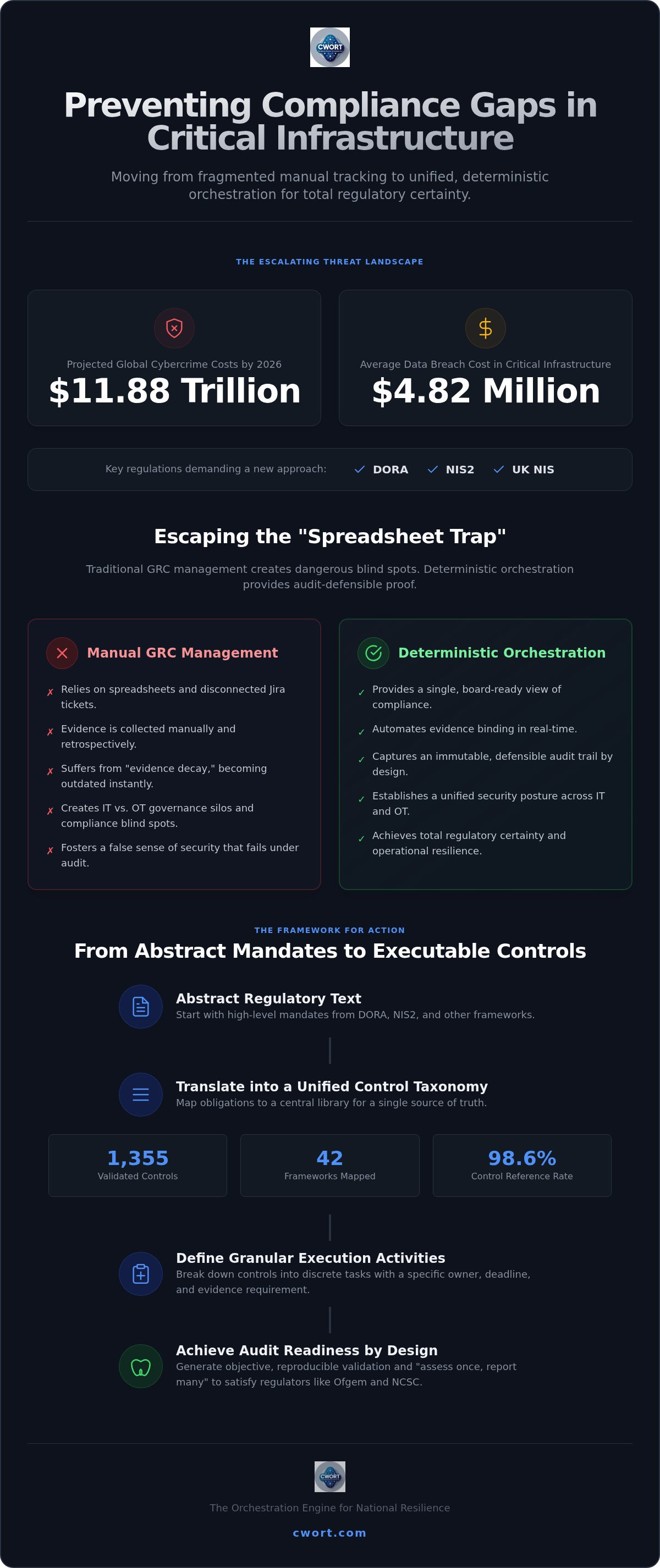
With global cybercrime costs projected to reach $11.88 trillion in 2026, the margin for error in securing national assets has effectively vanished. For most leaders, the challenge of preventing compliance gaps in critical infrastructure isn't a lack of effort; it's a failure of fragmented systems that rely on manual reconstruction and hope. You likely recognise that spreadsheets and disconnected Jira tickets are no longer sufficient to satisfy the rigorous demands of NCSC or Ofgem. These manual methods create dangerous blind spots that only become visible when an auditor arrives or a system fails.
This strategic guide shows you how to eliminate those vulnerabilities by moving from administrative tracking to deterministic orchestration. You'll discover how to build a single, board-ready view of compliance for DORA, NIS2, and UK NIS that stands up to the most intense scrutiny. We'll explore the transition to automated evidence binding, ensuring your OT and ICS environments are fully visible and your audit trails are defensible by design. By the end of this article, you'll have a clear roadmap to reduce manual workloads whilst achieving total regulatory certainty and operational resilience.
Key Takeaways
- Understand why the disconnect between IT and OT environments creates systemic blind spots and how to establish a unified security posture across the entire organisation.
- Discover why traditional GRC management fails and how deterministic orchestration provides the immutable evidence required for audit-defensible compliance.
- Learn to translate abstract regulatory text into structured execution activities using a centralised taxonomy of 1,355 validated controls.
- Master a 7-step framework for preventing compliance gaps in critical infrastructure, ensuring every obligation is mapped to a specific owner and action.
- Generate board-ready maturity reports that satisfy regulators like Ofgem and NCSC whilst significantly reducing the manual workload for compliance teams.
Table of Contents
- Why Compliance Gaps Persist in Critical Infrastructure
- Mapping Regulatory Obligations to Execution Activities
- Moving Beyond Spreadsheets: Orchestration vs Management
- A 7-Step Framework for Preventing Compliance Failures
- CWORT: The Orchestration Engine for National Resilience
Why Compliance Gaps Persist in Critical Infrastructure
Compliance gaps represent the critical discrepancy between abstract regulatory obligations and verifiable operational evidence. In the high-stakes environment of what critical infrastructure is, these gaps are not merely administrative errors; they are structural vulnerabilities. For organisations managing power grids, water systems, or financial networks, the average cost of a data breach has reached $4.82 million according to 2026 industry reports. This financial risk is compounded by a shifting regulatory landscape where the period of grace for manual compliance has ended.
The urgency is no longer theoretical. With DORA fully enforceable and NIS2 requirements expanding across the UK and EU in 2026, many firms are falling into the "spreadsheet trap". They maintain an illusion of control through manual tracking whilst hiding systemic risks. Relying on human memory or point-in-time snapshots creates a false sense of security that collapses during an audit. Preventing compliance gaps in critical infrastructure requires moving beyond these static documents toward a model of continuous, deterministic validation.
The Fragility of Manual Evidence Collection
Manual processes are inherently fragile. When evidence is fragmented across Jira tickets and Excel sheets, it suffers from "evidence decay". Information becomes outdated the moment it's recorded. Auditors today demand real-time proof, yet many teams still spend weeks on retrospective evidence reconstruction. This frantic activity is a symptom of a failed process. Without a system to enforce "separation of duties" and capture immutable audit trails, accountability remains a theoretical concept rather than a defensible reality. Relying on SMEs to manually gather data isn't just inefficient; it's a primary driver of preventing compliance gaps in critical infrastructure from being addressed effectively.
Siloed Governance: The IT vs OT Divide
The most dangerous gaps exist at the intersection of corporate IT and Operational Technology (OT). Traditional Governance, Risk, and Compliance (GRC) tools were designed for the office, not the plant floor. They often fail to ingest technical evidence from Industrial Control Systems (ICS), leaving a significant portion of the estate unmonitored. This creates "compliance silos" where different teams apply different frameworks to the same physical assets. Senior leadership needs a single, explainable view of maturity that bridges this divide. Without it, the board remains blind to the actual resilience of their most critical operations, making it impossible to prove compliance to regulators like Ofgem or the NCSC.
Mapping Regulatory Obligations to Execution Activities
Bridge the divide between regulatory theory and operational practice. High-level mandates like DORA's ICT risk management or NIS2's supply chain security are often too abstract for engineering teams to implement without guidance. Preventing compliance gaps in critical infrastructure requires a rigorous translation process that turns these mandates into discrete, assignable tasks. By adopting a continuous compliance framework, organisations move away from subjective interpretation toward a system of absolute accountability.
Translating DORA and NIS2 into Actionable Workflows
Break down complex regulations into granular execution activities. Every obligation must be mapped to a specific owner, a clear deadline, and a predefined evidence requirement. This process, known as obligation execution, ensures that no requirement is left to chance. Central to this approach is the use of a unified control taxonomy. CWORT utilises a library of 1,355 controls mapped across 42 frameworks to provide a single point of truth, with 98.6% of active controls carrying direct framework references. Deterministic scoring is a system where identical evidence always yields the same compliance result. This removes human bias from the equation, replacing it with objective, reproducible validation.
Establishing Audit Readiness by Design
Consolidate your efforts by mapping controls to 217 distinct domains. This comprehensive coverage ensures that every aspect of the enterprise, from the data centre to the plant floor, is accounted for. The "assess once, report many" strategy allows multi-regulated firms to satisfy DORA, NIS2, and ISO 27001 requirements simultaneously without duplicating effort. It's a method that transforms compliance from a seasonal burden into a constant state of readiness. Utilising an ISO 27001 control mapping tool can accelerate this framework synergy, ensuring that technical controls are aligned with governance standards.
By configuring assessment blueprints that align with NCSC CAF requirements, you build audit readiness into your daily operations. Preventing compliance gaps in critical infrastructure is only possible when your governance model reflects the reality of your technical estate. If you're ready to see how this looks in practice, you can request a platform demonstration.
Moving Beyond Spreadsheets: Orchestration vs Management
Distinguish between passive oversight and active enforcement. Traditional GRC management is a record-keeping exercise that documents history whilst leaving the future to chance. In contrast, compliance orchestration is a proactive engine that enforces discipline and accountability by design. This shift is fundamental to preventing compliance gaps in critical infrastructure. Whilst management tools track what you hope is happening, orchestration validates what is actually occurring through deterministic proof.
A true orchestration engine acts as the single source of truth, sitting above your existing security point-tools to aggregate evidence and enforce standards. It moves beyond a binary pass or fail view to assess both Capability and Capacity. It isn't enough to prove a control works today; you must demonstrate the organisational capacity to sustain that control under the pressure of a 2026 regulatory environment. This ensures that resilience is built into the operating model rather than treated as a periodic checklist.
Why GRC Tools and Jira Fail Critical Infrastructure
Generic task management tools like Jira are built for velocity, not for governance. They suffer from a hand-off problem where critical context is lost between platforms, creating fragmented data silos that are impossible to reconcile during an audit. These tools lack immutable audit trails and the strict separation of duties required by NCSC and Ofgem. Producing board-ready reports from these sources requires weeks of manual effort, an inefficiency that masks systemic risks until they result in a failure. Without direct evidence binding, you're left with a collection of tasks rather than a defensible compliance model.
The Power of "Assess Once, Report Many"
Eliminate redundant work through framework cross-walking. For critical infrastructure organisations bound by UK NIS, NIS2, and ISO 27001, the manual duplication of effort is a significant operational drain. CWORT solves this by mapping 1,355 controls across 42 frameworks, allowing you to validate a control once and report its status against multiple regulatory requirements simultaneously. This efficiency is a core component of Regulatory Compliance Workflow Automation, ensuring your team focuses on remediation rather than administration.
By automating these workflows, you ensure that preventing compliance gaps in critical infrastructure becomes a repeatable, scalable process. This approach provides the clarity and certainty that senior leadership demands, moving the organisation from a state of anxiety to one of auditable control.
A 7-Step Framework for Preventing Compliance Failures
Execute a disciplined approach to preventing compliance gaps in critical infrastructure. Whilst competitors often suggest general risk assessments, CWORT enforces a rigorous 7-step process designed for the complexities of combined IT and OT environments. This framework moves beyond the periodic snapshot to create a state of permanent, auditable readiness. It replaces subjective "gut feel" with deterministic validation, ensuring that every regulatory obligation is met with concrete evidence.
The process begins with Model Definition, where the specific regulatory scope is established. This is followed by Step 2, configuring Assessment Blueprints that translate high-level requirements into technical benchmarks. In Step 3, Ownership is assigned across the enterprise, ensuring every asset has a designated guardian. Step 4 triggers automated Evidence Capture from your existing security stack, whilst Step 5 applies Deterministic Scoring to calculate maturity. Step 6 prioritises gaps based on business risk, and Step 7 tracks remediation until every vulnerability is closed with verifiable proof.
Binding Evidence to Control Outcomes
Prevent compliance drift by binding technical evidence directly to regulatory controls. Ingesting data from SIEM, EDR, and OT monitoring systems allows for the real-time validation of control effectiveness. This technical binding ensures that a control doesn't just exist on paper; it is functioning as intended in the live environment. Evidence protection ensures the integrity of the audit trail for regulator scrutiny, making it impossible for data to be altered or falsified retrospectively. For a deeper look at these mechanisms, consult our guide on Ensuring Compliance Evidence Integrity.
Enforcing Separation of Duties and Accountability
Establish governance integrity through rigorous access controls. Utilising role-based and attribute-based access (RBAC and ABAC) ensures that those who execute a control are not the same individuals who validate it. This separation of duties is a non-negotiable requirement for auditors at NCSC and Ofgem. Every action is recorded in an immutable audit history, providing definitive proof of who performed a task and when it was completed. This level of traceability replaces the anxiety of potential failure with the calm of auditable certainty. Preventing compliance gaps in critical infrastructure requires this level of systemic discipline to withstand the pressure of modern regulatory cycles.
To see how this framework can be applied to your specific operational environment, request a platform demonstration today.
CWORT: The Orchestration Engine for National Resilience
CWORT transforms fragmented security activities into a cohesive, audit-defensible operating model. It provides the structural integrity required for preventing compliance gaps in critical infrastructure by replacing administrative guesswork with technical validation. The platform includes an AI Advisory feature designed to assist compliance teams whilst maintaining the strict reproducibility of results. Crucially, this AI remains advisory only and never alters the deterministic scoring that auditors require for definitive proof. This ensures that every maturity score is both explainable and reproducible, regardless of the complexity of the underlying IT or OT environment.
By turning cyber-security functions into measurable activities, CWORT enforces a level of discipline that manual systems cannot match. It bridges the gap between high-level governance and granular execution, ensuring that every control is mapped to a specific regulatory obligation. This systematic approach allows leadership to move beyond mere administrative tracking to definitive, evidence-based proof of resilience.
Board-Ready Reporting for Regulators
Eliminate the weeks of effort usually required for manual audit reconstruction. Generate regulator-ready outputs instantly, providing a single, explainable view of maturity that satisfies Ofgem, NCSC, and central bank requirements. Heat-map dashboards allow senior leadership to visualise resilience gaps across the enterprise in real-time, enabling rapid, data-driven decision-making. This visibility is essential for maintaining stakeholder confidence and ensuring that remediation resources are directed where they are most needed. For organisations specifically focused on the Cyber Assessment Framework, our NCSC CAF Assessment Software provides a direct path to maturity.
Future-Proofing Critical Infrastructure Compliance
Adapt to an evolving threat landscape with continuous operating-model intelligence. CWORT’s "Bring Your Own Content" (BYOC) capability allows you to integrate custom maturity models and internal standards alongside the 42 pre-mapped frameworks. This flexibility ensures your governance remains relevant as new risks emerge and regulations evolve. Preventing compliance gaps in critical infrastructure is not a one-time project; it's a permanent state of operational discipline. Move from the anxiety of potential failure to the calm of auditable certainty by shifting to an orchestrated model. Explore the CWORT platform for your organisation to secure your regulatory future and enhance national resilience.
Establishing Deterministic Certainty for National Resilience
The period for manual oversight in high-stakes regulatory environments has ended. You've seen how preventing compliance gaps in critical infrastructure requires a fundamental shift from passive management to active orchestration. By moving beyond spreadsheets and fragmented task trackers, you establish an immutable audit trail that satisfies the most rigorous scrutiny from NCSC and Ofgem. This systemic discipline replaces the anxiety of potential failure with the calm of auditable certainty.
CWORT provides the engine for this transition. It offers 1,355 controls mapped across 42 frameworks, designed specifically for the complexities of UK Critical National Infrastructure. Our deterministic scoring removes subjectivity, replacing it with defensible, evidence-based truth that your board and regulators can rely upon. This approach ensures that your ICT and OT environments are not just compliant on paper, but resilient in practice.
This transition to an orchestrated model is a strategic imperative for national security. Secure your operational future by moving from administrative guesswork to definitive validation. Orchestrate your compliance validation with CWORT to achieve total regulatory assurance. Your path to a single, explainable view of compliance begins with a structured, evidence-led framework.
Frequently Asked Questions
How does CWORT prevent compliance gaps in OT and ICS environments?
CWORT integrates directly with OT and ICS monitoring tools to aggregate technical evidence from industrial control systems. It bridges the divide between corporate IT and the plant floor by applying a unified control taxonomy across all assets. This ensures that technical controls in physical environments are validated against requirements like IEC 62443, eliminating the blind spots that occur when these systems are managed in silos.
Can CWORT map evidence to multiple frameworks like DORA and NIS2 simultaneously?
Yes, the platform utilises a "report many" capability that maps a single piece of evidence to every relevant framework in your scope. With 1,355 controls in the taxonomy library, CWORT automatically identifies where requirements overlap across DORA, NIS2, and ISO 27001. This approach is essential for preventing compliance gaps in critical infrastructure by ensuring that one assessment validates your posture against multiple national standards.
What is the difference between compliance management and compliance orchestration?
Compliance management is a passive record-keeping exercise that relies on manual tracking, whilst orchestration is a proactive engine that enforces discipline by design. Management tools document history, but orchestration validates what is happening through real-time evidence binding. Orchestration replaces fragmented workflows with a deterministic system, ensuring that every control is not just documented but technically validated and sustained through automated governance.
How does the platform handle separation of duties for regulatory audits?
CWORT enforces separation of duties through rigorous role-based and attribute-based access controls. The system ensures that the individuals responsible for executing a control cannot be the same people who validate the evidence. This governance integrity is backed by an immutable audit history that records every change and validation. Such structural discipline is a mandatory requirement for satisfying regulators like the NCSC during a formal audit.
Is CWORT suitable for organisations already using Jira for task tracking?
CWORT sits above existing tools like Jira to provide the governance layer that task trackers lack. Whilst Jira manages the velocity of work, it cannot provide the immutable audit trails or deterministic scoring required for regulatory assurance. CWORT consumes data from these platforms to bind it to specific controls, turning fragmented tasks into a cohesive, audit-defensible operating model that stands up to regulator scrutiny.
How does deterministic scoring improve audit-defensibility compared to manual assessments?
Deterministic scoring ensures that identical evidence always yields the same compliance result, removing the subjectivity inherent in manual assessments. This reproducibility is vital for preventing compliance gaps in critical infrastructure as it provides a consistent benchmark for maturity. Auditors value this approach because it replaces human bias with an explainable, rule-based system that remains accurate across different assessment cycles and diverse teams.
Can we import our own custom maturity models into the CWORT platform?
The platform's Bring Your Own Content capability allows organisations to import proprietary maturity models into a governed digital workflow. You can define your own criteria, weighting, and evidence requirements whilst leveraging CWORT's underlying governance engine. This ensures that your unique internal standards benefit from the same level of version control, tenant isolation, and immutable audit history as pre-mapped international frameworks.
How does CWORT support board-level reporting for UK regulators like Ofgem?
CWORT generates board-ready maturity reports and heat-map dashboards that translate technical data into strategic insights. These outputs are designed specifically for senior leadership and risk committees who must demonstrate cyber resilience to bodies like Ofgem. The platform provides a single, explainable view of maturity, showing exactly where gaps exist and how remediation efforts are being prioritised to meet national security standards.
Disclaimer
The content on this site is provided for general information and educational purposes only. It does not constitute legal, regulatory, financial, or professional advice. CWORT provides AI-assisted insights and workflow automation, but all compliance decisions remain the responsibility of your organisation and its management. Always seek qualified legal or regulatory guidance for decisions relating to the UK NIS Regulations, CAF, DORA, NIS2, ISO 27001, or other obligations.
Related posts
Ensuring Compliance Evidence Integrity: A Strategic Guide for UK Enterprises in 2026
Master ensuring compliance evidence integrity for 2026. Our UK guide helps you move from risky spreadsheets to an audit-ready system for DORA & NIS2.
Streamlining Regulatory Compliance Processes: From Manual Tracking to Orchestrated Validation
Stop wasting money on manual compliance. Learn about streamlining regulatory compliance processes to reduce personal liability under DORA & NIS2 and gain aud...
Managing Compliance Evidence in Excel: Comparison and Strategic Risks for 2026
Is managing compliance evidence in excel a risk for 2026? Learn why spreadsheets jeopardise DORA & NIS2 validation and get a roadmap to an audit-ready system.
Article by
Michael Iyiola
Co-Founder, CWORT
Michael Iyiola is a co-founder of CWORT and a Cyber and AI Security Engineer with deep experience in vulnerability management, detection engineering and operational resilience across UK critical national infrastructure, including rail, energy and financial services. At CWORT, he designs scalable, evidence-driven workflows that help teams meet modern regulatory and security demands.
Build Your Foundation of Auditable Certainty
Take control of your regulatory obligations and secure your infrastructure with CWORT.