Reducing Reliance on Compliance Consultants: An Enterprise Guide to In-House Assurance

Michael Iyiola
Co-Founder, CWORT
Discover how reducing reliance on compliance consultants empowers enterprises to build continuous, in-house assurance and cut costly advisory retainers today.

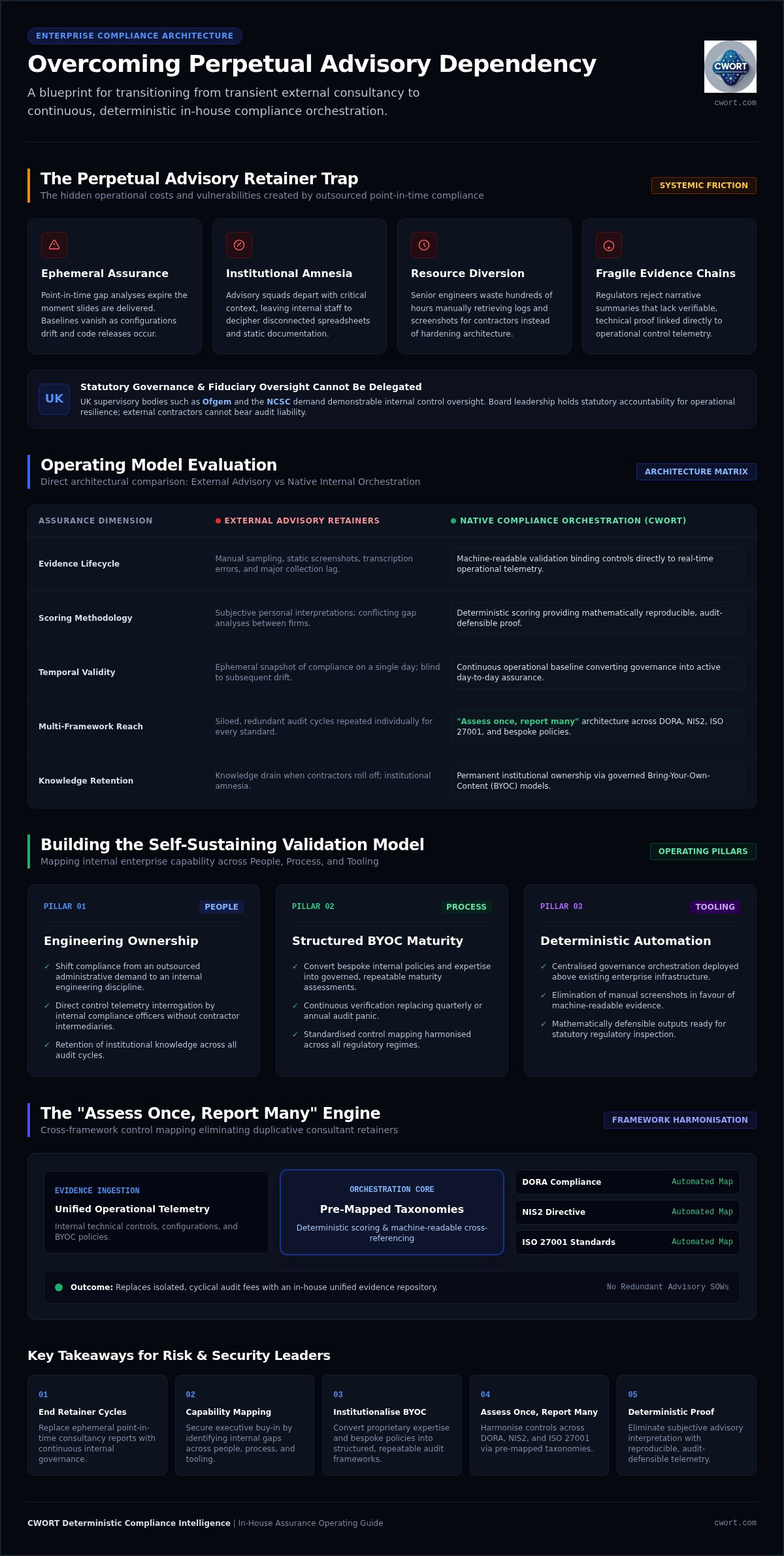
Enterprise reliance on advisory firms isn't caused by a lack of internal expertise; it's the inevitable outcome of fragmented operational evidence. For risk and security leaders, reducing reliance on compliance consultants often feels impossible when each audit cycle triggers another round of subjective gap analyses. You watch substantial budgets vanish into advisory retainers, only for external teams to depart whilst leaving behind unmaintainable spreadsheets, static slide decks, and an acute knowledge drain. When regulators subsequently reject narrative-heavy summaries that lack direct links to technical controls, your internal staff are left holding the operational risk.
It doesn't have to work this way. You can replace recurrent advisory retainers with deterministic, audit-defensible internal compliance orchestration that anchors taxonomies, evidence, and maturity models firmly under your own institutional ownership. This guide details how to build a unified in-house assurance model, allowing your enterprise to demonstrate continuous, mathematically reproducible control effectiveness across multiple frameworks without fielding permanent advisory squads.
Key Takeaways
- Break the cycle of perpetual advisory retainers by replacing ephemeral point-in-time reports with continuous, in-house governance models.
- Achieve successful executive buy-in for reducing reliance on compliance consultants by mapping internal capability gaps across people, process, and tooling.
- Convert bespoke institutional expertise and internal policies into governed, repeatable audits using structured Bring Your Own Content maturity assessments.
- Establish an "assess once, report many" architecture across standards such as DORA, NIS2, and ISO 27001 using pre-mapped control taxonomies.
- Eliminate subjective advisory interpretations through deterministic scoring that produces reproducible, audit-defensible proof directly from operational evidence.
Table of Contents
- The Hidden Operational Costs of Perpetual Consultant Dependency
- Evaluating Internal Control Capabilities Against External Advisory Models
- How to Build a Self-Sustaining Compliance Validation Operating Model
- Institutionalising Governance with Bring-Your-Own-Content Maturity Frameworks
- Transitioning to Deterministic Compliance Intelligence with CWORT
The Hidden Operational Costs of Perpetual Consultant Dependency
Point-in-time consultancy assessments expire the moment the advisory team delivers its final presentation. Organisations fall into a predictable cycle: retain an external firm, conduct a months-long audit readiness exercise, receive a heavily caveated slide deck, and file it away. By the next quarter, system configurations drift, code releases introduce architectural changes, and the baseline disappears. When enterprises fail to institutionalise internal control frameworks, they mistake static documentation for active assurance, leaving internal leaders incapable of verifying their true security posture.
This dynamic creates severe operational drag across the business:
- Institutional amnesia: Advisory teams take their contextual understanding with them when they roll off the engagement, abandoning internal teams to decipher disconnected spreadsheets.
- Resource diversion: Senior engineers spend hundreds of hours manually retrieving access logs and screenshots for contractors instead of hardening systems or improving operational resilience.
- Fragile evidence chains: Regulators increasingly penalise firms that present narrative assertions unsupported by verifiable, technical proof.
Strategic risk leaders recognise that reducing reliance on compliance consultants isn't merely a cost-cutting initiative. It's a foundational operational necessity.
The Perpetual Retainer Trap: Ephemeral Assurance vs Durable Capability
Cyclical advisory spend buys transient reassurance rather than lasting operational capability. External gap analyses provide a subjective snapshot of compliance on a single Tuesday, yet infrastructure operates continuously. When you outsource validation, you surrender engineering ownership. Internal teams treat governance as an external administrative demand rather than an engineering discipline, deepening dependency on the next advisory statement of work.
The Risk of Delegating Governance and Accountability
UK supervisory bodies such as Ofgem and the NCSC require demonstrable, internal governance oversight. Board leadership holds statutory accountability for operational resilience under UK legislation; this fiduciary duty cannot be transferred to a third party. When competent authorities conduct unannounced audits or demand evidence trails, external contractors rarely sit in the room. If your internal compliance officers cannot interrogate control telemetry directly, your organisation cannot satisfy regulatory scrutiny. True defensibility demands internal ownership of the entire evidence lifecycle.
Evaluating Internal Control Capabilities Against External Advisory Models
Most enterprises assume their only choices are fielding continuous advisory squads or battling unmanageable spreadsheets. This false dichotomy costs organisations millions in recurring fees while yielding inconsistent assurance. External consultants rely on manual interviews, personal interpretations, and subjective scoring. When two different advisory partners review the same technical estate, they routinely produce conflicting gap analyses. This variability crumbles during statutory audits, where regulatory bodies expect deterministic proof rather than narrative opinion.
A durable assurance model shifts focus from outsourced personnel to internal system capabilities. Industry guidance on building an effective compliance program establishes that self-sustaining governance requires clear operational accountability, reproducible evaluation, and centralised control data. When your teams run validation internally, compliance evolves from a seasonal interruption into an ongoing operational baseline.
Comparing the Core Operating Models: Advisory vs Native Orchestration
Manual advisory models suffer from critical friction points. Consultants collect evidence through manual sampling, introducing transcription errors, version confusion, and significant lag. Modern enterprise platforms resolve this by centralising governance above your existing infrastructure. Deploying regulatory compliance workflow automation transforms verification from human interrogation into systematic validation, binding controls directly to machine-readable evidence for undeniable audit defensibility.
- Delivery speed: Traditional engagements take months to compile retrospective reports, whereas automated orchestration surfaces control gaps continuously.
- Evidence integrity: Subjective consultant interviews introduce human bias; software-driven validation relies on direct, immutable evidence links.
- Cost durability: Retainer models reset spending to zero every fiscal cycle, whilst internal platforms create permanent operational intellectual property.
Determining When External Advisory Still Provides Legitimate Value
Successfully reducing reliance on compliance consultants does not require completely abandoning external advisory partners. Highly specialised firms provide genuine strategic value during major corporate restructuring, initial target operating model architecture, or when establishing precedent-setting legal boundaries. Crucially, software platforms provide control validation and audit readiness rather than formal legal advice.
Organisations must enforce strict exit criteria for advisory engagements to prevent unmanaged scope creep. Retain third-party experts strictly to define high-level strategic frameworks or interpret novel statutory mandates. The moment work shifts toward ongoing evidence gathering, control testing, or recurring gap remediation, hand execution directly to your internal teams. If your enterprise seeks to benchmark current internal governance against industry standards, explore how CWORT operationalises continuous assurance to safeguard internal ownership.
How to Build a Self-Sustaining Compliance Validation Operating Model
Transitioning away from advisory retainers requires an operational system rather than another policy document. Enterprises struggle with reducing reliance on compliance consultants because their technical controls remain detached from regulatory taxonomies. By establishing a four-stage operating blueprint, organisations can anchor compliance assurance directly within their internal engineering workflows.
This self-sustaining validation model progresses methodically from discovery to continuous execution:
- Diagnose baseline operational maturity: Audit internal talent, existing workflows, resource capacity, and tooling coverage to pinpoint where compliance tracking breaks down.
- Design target control models: Establish standardized control taxonomies pre-mapped to international standards to eliminate redundant assessments.
- Deliver automated evidence collection: Pull operational data directly from identity management, endpoint protection, and security telemetry platforms.
- Demonstrate continuous assurance: Generate mathematically reproducible, board-ready risk registers backed by deterministic evidence rather than subjective narrative reports.
Step 1 & 2: Baseline Diagnosis and Control Model Design
Start by inventorying existing systems. Modern IT stacks already capture extensive telemetry; the problem is that this data sits in isolated silos across IAM, cloud infrastructure, and SIEM tooling. Internal teams must map these operational feeds against required mandates such as ISO 27001:2022, DORA, and NIS2. Adopting a structured ISO 27001 control mapping tool enables teams to create framework crosswalks instantly. This approach establishes a unified "assess once, report many" control baseline, eliminating the need to pay advisory squads for repetitive gap identification across overlapping frameworks.
Step 3 & 4: Continuous Evidence Binding and Defensible Demonstration
Replace manual screenshot gathering with direct evidence binding. When technical telemetry links directly to specific control requirements, assurance shifts from a periodic scramble to an automated reality. Implement strict separation of duties: control operators manage infrastructure, while assurance personnel review validation results independently. Following rigorous principles for ensuring compliance evidence integrity guarantees that audit records remain immutable, verifiable, and regulator-ready. This approach delivers deterministic proof that satisfies supervisory authorities, firmly cementing your internal capability and reducing reliance on compliance consultants across every audit cycle.
Institutionalising Governance with Bring-Your-Own-Content Maturity Frameworks
Advisory firms deliberately protect their assessment methodologies behind bespoke intellectual property walls. When an engagement concludes, the client receives high-level maturity scores, but the underlying evaluation criteria, weighting calculations, and scoring rubrics remain locked in the consultancy's proprietary vault. This artificial dependency forces enterprises to re-engage external teams every time internal structures evolve or supervisory bodies request clarification.
Breaking this cycle requires digitising your internal expertise. A structured Bring Your Own Content (BYOC) approach ingests custom operating policies, internal service benchmarks, and sector-specific obligations directly into an enterprise platform. By encoding internal operational models into repeatable digital assessments, security leaders protect institutional knowledge. You transform static, consultant-owned documents into dynamic, organisationally owned digital assets that run across secure, tenant-isolated environments with granular role-based access.
Executing the Seven-Step Maturity Assessment Lifecycle
Modern internal assurance replaces ad-hoc consultant interviews with a governed, seven-step assessment process: define targets, configure controls, assign owners, capture evidence, calculate posture, prioritise gaps, and reassess continuously. Mathematical scoring algorithms weight risk severity against implementation effort, replacing arbitrary consultant impressions with auditable fact. Organisations using structured NCSC CAF assessment software can benchmark their operational resilience against national cybersecurity frameworks natively, running assessments on demand without paying for repeated external scoping sessions.
Multi-Framework Cross-Walking: Harmonising Overlapping Obligations
Regulatory proliferation places immense strain on engineering teams. Operating separate compliance streams for UK NIS, DORA, and ISO 27001 results in duplicative interviews, overlapping control requests, and advisory fatigue. A unified orchestration model solves this through automated framework cross-walking, where a single verified operational control satisfies multiple statutory regimes simultaneously.
Enterprises managing multinational mandates rely on a NIS2 compliance platform UK to harmonise cross-border expectations with local UK guidelines under an "assess once, report many" methodology. This eliminates fragmented reporting streams and drives significant operational efficiency. For leaders committed to reducing reliance on compliance consultants, institutionalising cross-framework validation is the definitive path to durable, audit-defensible autonomy.
Ready to anchor institutional knowledge within your own operational environment? Book a guided demonstration with CWORT to see how our BYOC maturity framework automates internal control validation.
Transitioning to Deterministic Compliance Intelligence with CWORT
Modern compliance failure rarely stems from missing security tools; it happens because technical signals remain disconnected from regulatory language. CWORT resolves this structural divide by sitting directly above existing infrastructure, including SIEM, EDR, and IAM solutions. The platform ingests telemetry to establish an audit-defensible orchestration layer. Rather than guessing whether a technical configuration satisfies an auditor, enterprise teams rely on an active taxonomy of 1,355 controls across 217 domains linked to 42 international standards. Because 98.6% of active controls carry established regulatory references, gaps are surfaced automatically without requiring external scoping engagements.
Subjective consultant reviews inevitably produce inconsistent results depending on who leads the audit. CWORT replaces this ambiguity with deterministic scoring. Identical evidence inputs produce identical, mathematically reproducible validation outcomes every time. When leadership presents control status to boards or supervisory authorities, they present verifiable proof backed by empirical telemetry rather than consultant sentiment. For organisations targeting structured paths for reducing reliance on compliance consultants, deterministic validation provides the foundational certainty required to maintain compliance internally.
Unified Operating Model and Compliance Intelligence
Traditional governance separates daily operational reality from committee oversight. CWORT bridges this gap by unifying operating model maturity with live compliance intelligence, simultaneously assessing internal technical capability and resourcing capacity. This ensures control expectations reflect realistic delivery constraints rather than theoretical policy ideals. Advisory AI delivers contextual remediation recommendations directly to engineers, accelerating resolution without altering underlying scoring criteria. Critical infrastructure operators and regulated entities benefit from dedicated workflows, mirroring how financial institutions execute DORA compliance validation to meet stringent ICT operational resilience obligations autonomously.
Achieving Audit Autonomy: Practical Next Steps
Enterprise autonomy begins with deliberate, phased execution. Rather than attempting a disruptive, enterprise-wide overhaul, select a single critical domain, such as identity governance or access control, to run an initial validation pilot. This focused exercise proves automated evidence capture in practice, systematically dismantling the assumption that external contractors are essential for routine control testing.
Accelerate your transition by establishing clear operational milestones:
- Phase out discovery workshops: Replace multi-week consultant interviews with automated evidence binding against pre-mapped controls.
- Publish continuous heat-maps: Provide executive leadership and audit committees with real-time, mathematically derived compliance dashboards.
- Embed internal ownership: Partner directly with CWORT platform specialists to map legacy audit records and internal policies into governed BYOC assessment engines.
Permanent audit readiness requires owning your data, evidence pipelines, and control taxonomies. Moving beyond advisory retainers establishes lasting institutional capability across every regulatory cycle.
Take Command of Your Enterprise Assurance Architecture
Static advisory retainers can no longer keep pace with expanding regulatory enforcement. Achieving lasting operational control requires shifting away from transient advisory snapshots toward permanent in-house orchestration. By embedding your institutional expertise into a native BYOC engine and deploying a pre-mapped taxonomy of 1,355 controls across 217 domains linked to 42 international standards, your teams transform reactive evidence gathering into continuous, auditable proof.
True defensibility rests on mathematical certainty. Deterministic scoring eliminates subjective interpretation, ensuring your operational telemetry yields identical, audit-defensible validation every single time. Structurally reducing reliance on compliance consultants doesn't just eliminate recurrent advisory spend; it establishes total internal sovereignty over your compliance data, builds enduring resilience, and aligns engineering reality directly with executive oversight.
Explore how CWORT orchestrates internal compliance autonomy and take definitive command of your enterprise validation lifecycle today.
Frequently Asked Questions
Can an enterprise legally replace compliance consultants without facing regulatory penalties?
Yes, enterprises can legally replace compliance consultants because regulatory statutes mandate operational control and accountability, not advisory retainers. Authorities like the PRA, FCA, and Ofgem inspect internal control effectiveness and institutional oversight. Statutory duties rest entirely with board leadership. Using an internal platform to manage and prove compliance satisfies regulatory mandates directly, ensuring your organisation maintains defensibility without relying on third-party advisory firms.
How does automated compliance validation satisfy supervisory bodies like Ofgem or the FCA?
Regulators require verifiable, traceable proof rather than retrospective opinion. Automated platforms bind technical telemetry from systems like SIEM, EDR, and IAM directly to regulatory control clauses. Instead of subjective slide decks, supervisory bodies receive tamper-proof audit trails linking operational evidence straight to compliance assertions. This deterministic proof eliminates ambiguity during formal audits, proving continuous control enforcement to competent authorities directly.
What is the difference between subjective consultant scoring and deterministic validation?
Subjective consultant scoring relies on personal interpretation, leading to variable audit outcomes between different assessors. Deterministic validation uses fixed mathematical algorithms where identical operational evidence always produces identical compliance results. By eliminating human variance, deterministic scoring establishes reproducible proof. This distinction is critical when reducing reliance on compliance consultants, as it replaces speculative narrative claims with audit-defensible facts that external auditors cannot dismiss.
How much internal resource is required to manage an in-house compliance orchestration platform?
Operating an in-house orchestration platform typically requires a fraction of the internal hours previously spent managing external consultancy teams. Instead of diverting senior engineers to manually extract screenshots and attend multi-week discovery interviews, an orchestration layer pulls telemetry directly through system connectors. A small, focused internal team can oversee the entire assurance lifecycle, shifting their focus from repetitive administrative tasks to strategic remediation and continuous control maintenance.
Can proprietary or bespoke organisational maturity models be imported into a digital platform?
Yes, platforms featuring Bring Your Own Content (BYOC) engines allow organisations to digitise proprietary frameworks directly. Enterprises can import custom evaluation criteria, bespoke weighting logic, and internal operational baselines without losing their unique methodology. The system applies automated scoring, role-based governance, and immutable audit logging to your proprietary models. This ensures you retain full ownership of internal intellectual property rather than leasing it back from advisory contractors.
What happens when new regulatory standards or amendments are published?
Pre-mapped control taxonomies absorb new regulatory mandates through automated framework cross-walking without disrupting existing workflows. When new regimes or updates emerge, platform libraries map revised clauses against existing operational controls. If your organisation already satisfies a control under ISO 27001 or UK NIS, that evidence automatically maps across to the new requirement. This "assess once, report many" structure accelerates readiness whilst substantially reducing reliance on compliance consultants for repetitive scoping engagements.
How do we prevent internal teams from approving their own compliance controls?
Native governance controls enforce strict separation of duties and role-based access permissions. System architecture isolates control operators who manage infrastructure from internal assurance personnel who review and validate control effectiveness. Every action, status change, and piece of evidence is logged within an immutable audit trail. This structural independence prevents conflicts of interest, establishing an auditable governance environment that satisfies both internal audit committees and external regulatory bodies.
Disclaimer
The content on this site is provided for general information and educational purposes only. It does not constitute legal, regulatory, financial, or professional advice. CWORT provides AI-assisted insights and workflow automation, but all compliance decisions remain the responsibility of your organisation and its management. Always seek qualified legal or regulatory guidance for decisions relating to the UK NIS Regulations, CAF, DORA, NIS2, ISO 27001, or other obligations.
Related posts
Streamlining Regulatory Compliance Processes: From Manual Tracking to Orchestrated Validation
Stop wasting money on manual compliance. Learn about streamlining regulatory compliance processes to reduce personal liability under DORA & NIS2 and gain aud...
The Shift to Compliance Orchestration Platforms: Beyond Enterprise GRC Automation
Struggling with DORA & NIS2? Move beyond failing GRC tools with a compliance orchestration platform for automated, auditor-ready evidence and real-time overs...
Reducing Audit Preparation Time and Costs: A Strategic Guide for UK Enterprises
Tired of costly audit seasons? Our guide for UK enterprises shows you how to stop the manual scramble, reducing audit preparation time and costs with automat...
Article by
Michael Iyiola
Co-Founder, CWORT
Michael Iyiola is a co-founder of CWORT and a Cyber and AI Security Engineer with deep experience in vulnerability management, detection engineering and operational resilience across UK critical national infrastructure, including rail, energy and financial services. At CWORT, he designs scalable, evidence-driven workflows that help teams meet modern regulatory and security demands.
Build Your Foundation of Auditable Certainty
Take control of your regulatory obligations and secure your infrastructure with CWORT.