Regulatory Obligation Mapping Tool: Orchestrating Audit-Defensible Compliance in 2026

Michael Iyiola
Co-Founder, CWORT
Master 2026 compliance. A regulatory obligation mapping tool transforms static mandates into an audit-ready execution model for DORA, NIS2, and UK NIS.

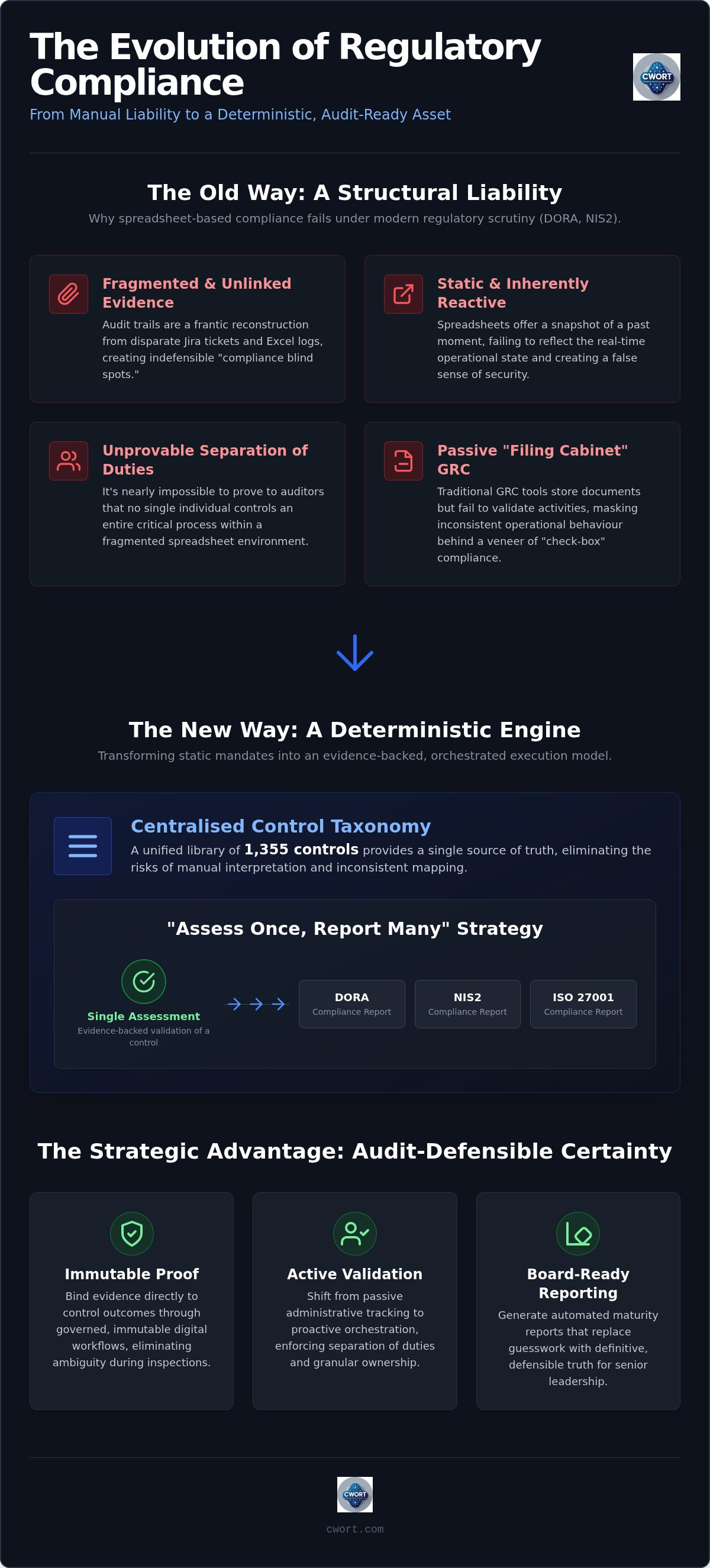
Your current spreadsheet-based compliance framework isn't a strategic asset; it's a structural liability that will crumble during the first hour of a DORA or NIS2 inspection. Without a robust regulatory obligation mapping tool, proving separation of duties to sceptical auditors becomes a manual, error-prone ordeal. You likely recognise that the reconstruction of audit trails from fragmented Jira tickets is a reactive race your team is destined to lose. This cycle of administrative anxiety lacks the rigour required for the high-stakes regulatory environment of 2026.
This article demonstrates how to transform static mandates into a deterministic, evidence-backed execution model. You'll learn how to replace fragile manual processes with a single source of truth that binds immutable evidence directly to specific control outcomes for ISO 27001 and UK NIS. We'll preview the shift from passive tracking to proactive orchestration, ensuring your organisation maintains a state of constant audit-readiness. We'll also explore how to generate automated, board-ready maturity reporting that replaces guesswork with definitive, defensible truth.
Key Takeaways
- Transition from static spreadsheets to a deterministic regulatory obligation mapping tool to eliminate the structural risks inherent in manual compliance tracking.
- Leverage a centralised taxonomy of 1,355 controls to implement an "assess once, report many" strategy that satisfies DORA, NIS2, and ISO 27001 requirements simultaneously.
- Shift from passive administrative tracking to active validation by enforcing rigorous separation of duties through governed, immutable digital workflows.
- Establish an audit-defensible execution blueprint by integrating proprietary maturity models and assigning granular ownership across specific control domains.
Table of Contents
- Beyond Spreadsheets: Why Manual Regulatory Mapping Fails in 2026
- The Architecture of a Modern Regulatory Obligation Mapping Tool
- Strategic Orchestration: Moving from Passive Tracking to Active Validation
- Implementing an Audit-Defensible Execution Blueprint
- CWORT: The Deterministic Engine for Multi-Framework Regulatory Mapping
Beyond Spreadsheets: Why Manual Regulatory Mapping Fails in 2026
Your reliance on manual spreadsheets for compliance tracking is a structural vulnerability that invites regulatory failure. In the high-velocity environment of 2026, the fragility of manual cross-referencing becomes a catalyst for catastrophic control gaps. Spreadsheets are inherently static; they offer a snapshot of a moment that has already passed, failing to reflect the real-time operational state of your organisation. This creates a dangerous false sense of security for boards who believe they're protected whilst the underlying data decays. Achieving robust regulatory compliance requires more than just a list of rules; it demands a deterministic link between mandate and evidence that manual methods cannot sustain.
The financial and operational cost of manual audit reconstruction is staggering. When DORA or NIS2 inspectors demand proof of resilience, teams often spend weeks frantically mining Jira tickets and Excel logs to piece together a coherent narrative. This reactive scramble isn't just inefficient; it's indefensible. Fragmented data across disparate tools leads to "compliance blind spots" where obligations are missed or incorrectly interpreted. To survive modern scrutiny, firms must pivot to a sophisticated regulatory obligation mapping tool that replaces fragile links with immutable, evidence-backed workflows.
The Limitations of Traditional GRC Tools
Stop treating your GRC platform as a mere filing cabinet. Traditional GRC tools act as passive repositories, storing documents without ever validating the activities they describe. This "check-box" approach to compliance creates a veneer of order whilst masking inconsistent operational behaviours. Because these systems rely on manual updates, they fail to enforce discipline or accountability by design. Without an active engine to drive validation, your compliance posture remains a matter of interpretation rather than a matter of fact. Transitioning to a proactive model ensures that every regulatory requirement is met with a concrete, auditable action.
The Rising Stakes of Regulatory Scrutiny
Leadership liability has shifted from a theoretical risk to a practical reality. Under 2026 standards, senior executives face increased personal accountability for resilience failures, making real-time visibility into control maturity a non-negotiable requirement. Auditors now focus heavily on the "separation of duties," a principle that is nearly impossible to prove within a fragmented spreadsheet environment. You must demonstrate that no single individual controls the entire lifecycle of a critical process. Implementing a regulatory obligation mapping tool provides the structural integrity needed to enforce these boundaries, replacing administrative anxiety with the calm of auditable certainty.
The Architecture of a Modern Regulatory Obligation Mapping Tool
A modern regulatory obligation mapping tool isn't a passive document; it's a deterministic engine designed for rigorous execution. It translates the opaque, often contradictory language of legal mandates into structured, executable activities that teams can actually perform. By employing a centralised control taxonomy, such as CWORT’s library of 1,355 controls, organisations move beyond the hazards of manual interpretation by using sophisticated validation platforms. This structural rigour ensures that every obligation is matched with a specific, validated action. It isn't enough to simply understand the rule. You must orchestrate the response through a system that enforces accountability and provides a clear path from mandate to maturity.
Binding evidence directly to control outcomes is the only way to achieve immutable proof during an inspection. When an auditor asks for validation, your system shouldn't just point to a high-level policy; it should present the specific output of a governed workflow. This approach aligns perfectly with the NIST Cybersecurity Framework, which emphasises the need for repeatable, risk-based processes. By codifying these links, you eliminate the ambiguity that plagues manual efforts. Organisations that request a platform demonstration see how this architectural precision transforms their compliance posture from a reactive burden into a strategic advantage.
Deterministic Scoring and Reproducibility
Compliance shouldn't depend on the individual performing the assessment. Deterministic scoring ensures that identical evidence always yields the same result, removing subjective "gut-feel" from your risk reporting. This level of reproducibility is essential for building trust with regulators. When your scoring models are transparent and consistent, your audit-defensibility increases. You're no longer presenting an opinion; you're presenting a mathematical certainty that stands up to scrutiny. This system ensures that every assessment is repeatable, providing a reliable benchmark for long-term maturity.
The Multi-Framework Cross-Walk
Efficiency in 2026 demands an "assess once, report many" methodology to manage the sheer volume of global requirements. A sophisticated regulatory obligation mapping tool allows you to link 217 domains to 42 international standards, including UK NIS and ISO 27001, without duplicating effort or wasting resource. Currently, 98.6% of active controls in the CWORT taxonomy carry framework references, enabling rapid mapping across diverse regulatory landscapes. This cross-walk capability ensures that a single operational activity satisfies multiple regulatory demands simultaneously. It streamlines the reporting process whilst maintaining a rigorous, evidence-backed posture that satisfies even the most demanding inspectors.
Strategic Orchestration: Moving from Passive Tracking to Active Validation
Mapping regulatory requirements is a futile exercise if it remains a static list. To satisfy auditors in 2026, you must prove that mapping drives operational behaviour. An advanced regulatory obligation mapping tool functions as an orchestrated compliance engine, replacing manual hand-offs with governed digital workflows. This system enforces a rigorous separation of duties by design, ensuring that validation is independent and objective. It sits strategically above your existing technical stack, consolidating data from SIEM, EDR, and IAM platforms into a unified assurance view. You aren't just tracking a task; you're orchestrating a defensible reality that point tools cannot provide in isolation. By centralising these inputs, you create a cohesive narrative of resilience that stands up to the most intense regulatory scrutiny.
The Execution Gap in Compliance
Knowing a rule exists is entirely different from proving its execution. Many organisations fail because they cannot bridge the gap between identifying a risk and delivering a verified control. CWORT addresses this by translating "Diagnose" into "Design" and finally "Deliver". This structured progression ensures that remediation tracking isn't just a list of open tickets, but a disciplined journey toward verified maturity. Closing the loop between a gap and its fix requires more than a simple notification; it requires a system that tracks the entire lifecycle of a control. This ensures that every remediation action is documented, validated, and ready for inspection at a moment's notice.
Board-Level Visibility and Maturity Reporting
Boards require more than lists of technical debt; they need explainable, strategic insight into the organisation's risk posture. Strategic orchestration allows you to generate board-ready heat maps derived from granular technical evidence. This shifts the executive conversation from abstract risks to measurable compliance maturity. Senior leadership gains a single, clear view of the organisation's resilience, backed by immutable data rather than subjective assessment. This transparency is vital for meeting UK NIS and DORA standards, providing the certainty required to sign off on regulatory filings with absolute confidence. It replaces the anxiety of potential failure with the calm of auditable certainty.
Implementing an Audit-Defensible Execution Blueprint
Execution is the differentiator between a compliant organisation and one that merely hopes it is. Implementing a robust regulatory obligation mapping tool allows for the seamless import of proprietary maturity models, often referred to as Bring Your Own Content (BYOC). This capability ensures your unique operational context isn't lost in a generic framework. Assign clear ownership and accountability for specific control domains to eliminate the ambiguity that lead to oversight. The system then automates the roll-up of evidence from operational sub-functions, ensuring every data point validates control effectiveness against the regulatory baseline. This creates a deterministic path from abstract requirement to verified reality.
Validation must be rigorous and evidence-backed to survive 2026 inspections. By binding specific control outcomes to your operational activities, you move beyond the "checkbox" mentality that fails under scrutiny. This blueprint doesn't just track tasks; it orchestrates a defensible state of being. Every participant in the compliance programme understands their role, their deadlines, and the specific evidence required to satisfy the mandate. This level of structural integrity is essential for organisations managing critical national infrastructure or high-stakes financial services.
The Seven-Step Assessment Process
A disciplined approach to maturity begins with a structured seven-step assessment. First, configure the assessment blueprint and assign specific participants to ensure absolute accountability. Capture evidence and calculate maturity using confidence scores that reflect reality rather than optimism. Finally, identify gaps and prioritise improvements based on business risk. This methodology ensures that every effort is directed toward the most critical vulnerabilities. It closes the loop between diagnosis and delivery, providing a clear audit trail for every decision made during the assessment lifecycle.
Protecting the Integrity of Evidence
Auditors demand a chain of custody for every piece of data you present. Protecting the integrity of evidence requires immutable audit trails for every change, ensuring that no record is altered without a traceable history. Utilise tenant isolation and attribute-based access controls to restrict visibility and maintain strict confidentiality across the organisation. Defensive content processing adds another layer of security, ensuring that evidence protection is built into the core of your compliance operations. This ensures that when the regulator arrives, your evidence is beyond reproach and fully verifiable.
Actionable Roadmaps for Remediation
Remediation must be strategic rather than reactive. Rank your actions by effort, risk, and expected value to ensure maximum impact for every hour of resource spent. This enables you to track progress toward a Target Operating Model (TOM) with clinical precision. You can request a demo to see the prioritisation engine in action and discover how to transform fragmented tasks into a coherent, audit-ready roadmap. By focusing on high-value remediation, you accelerate your journey toward total compliance maturity whilst reducing the administrative burden on your technical teams.
CWORT: The Deterministic Engine for Multi-Framework Regulatory Mapping
CWORT isn't just another platform; it's the strategic choice for organisations managing critical national infrastructure. It functions by consolidating Operating Model Intelligence with Compliance Intelligence, ensuring that regulatory requirements aren't just understood but fully operationalised. By using this sophisticated regulatory obligation mapping tool, you can seamlessly map DORA, NIS2, and UK NIS within a single, unified environment. It eliminates the friction of managing multiple frameworks by providing a deterministic engine that translates abstract rules into concrete activities. Consultancies and large enterprises can also productise their own proprietary models, ensuring that unique intellectual property is converted into a scalable, repeatable assurance process. This capability ensures that your specific organisational knowledge becomes a permanent part of your compliance architecture.
Unifying the Compliance Landscape
Stop struggling with disconnected systems that provide only partial visibility. CWORT sits strategically above your existing security tooling, aggregating proof from diverse technical layers to create a cohesive narrative of compliance. It eliminates the need for fragmented, legacy GRC tools that often act as data silos rather than active engines of validation. By centralising your evidence, you ensure that every control is backed by immutable proof that auditors can trust. This level of integration is essential for modern resilience. You'll find that having one source of truth reduces the administrative burden on technical teams whilst providing leadership with absolute certainty. For deeper insights, read more about DORA compliance validation strategies.
Future-Proofing for 2026 and Beyond
Regulatory requirements are evolving at a pace that manual systems cannot match. CWORT is designed to adapt, offering the flexibility to incorporate new standards like the EU AI Act whilst maintaining the integrity of your existing frameworks. The platform leverages AI advisory capabilities that assist with complex mapping without altering the deterministic outcomes required for audit-defensibility. This ensures that your compliance posture remains objective and reproducible. By maintaining a durable model catalogue, you create a foundation for recurring assurance that survives leadership changes and technical migrations. This long-term structural integrity is what separates market leaders from those merely reacting to the next audit cycle. It provides a permanent, auditable history that proves your organisation's commitment to continuous improvement and resilience.
Achieving Deterministic Compliance Maturity
The transition from manual, spreadsheet-driven tracking to a sophisticated regulatory obligation mapping tool is no longer optional; it's a requirement for survival in 2026. You've seen how fragmented data and static mapping create structural liabilities that fail under regulatory scrutiny. By leveraging a centralised taxonomy of 1,355 controls organised into 217 domains, your organisation can finally bind audit-defensible evidence to every specific control outcome. This deterministic approach ensures your readiness for DORA, NIS2, and UK NIS is a matter of verifiable fact rather than administrative hope. It replaces the anxiety of potential failure with the calm of auditable certainty. You now have the blueprint to transform abstract mandates into an orchestrated execution model that satisfies the most demanding inspectors. Don't let your compliance posture remain a liability. Request a CWORT demo to see how we orchestrate audit-defensible compliance and secure your organisation's operational resilience today. Your path to definitive, evidence-based proof starts here.
Frequently Asked Questions
What is a regulatory obligation mapping tool?
A regulatory obligation mapping tool is a deterministic engine that translates abstract legal requirements into executable activities. It replaces manual cross-referencing with a structured framework that binds evidence to specific control outcomes. By using such a tool, organisations ensure that every mandate is matched with a validated operational action. This creates a defensible audit trail that satisfies regulators in high-stakes environments like finance and critical national infrastructure.
How does regulatory mapping support DORA compliance?
It provides the structural integrity needed to prove operational resilience under the Digital Operational Resilience Act. The tool maps DORA mandates to a centralised taxonomy of controls, ensuring that every ICT risk requirement is met with a verified activity. It enforces separation of duties and generates board-ready reports that demonstrate maturity. This replaces the anxiety of potential failure with the calm of auditable certainty during DORA inspections.
Can I use a regulatory mapping tool for ISO 27001?
Yes, it is essential for managing the complex control requirements of ISO 27001. A regulatory obligation mapping tool allows you to map specific Annex A controls to your unique operational workflows. It ensures that evidence capture is automated and consistent across the organisation. This methodology eliminates the subjective assessments common in manual audits, providing a reproducible scoring model that auditors trust for certification and maintenance.
How does CWORT handle "Bring Your Own Content" (BYOC)?
CWORT allows consultancies and enterprises to import their proprietary maturity models and bespoke frameworks seamlessly. This ensures that unique intellectual property is productised into a scalable, repeatable assurance process. Users can configure assessment blueprints that reflect their specific organisational context whilst still leveraging CWORT’s underlying deterministic engine. This flexibility ensures that custom requirements are treated with the same rigour as standard international frameworks.
Is Jira suitable for regulatory obligation mapping?
Jira is a task management tool, not a compliance engine; it lacks the deterministic logic required for audit-defensibility. Whilst Jira tracks activity, it cannot provide the immutable proof or multi-framework cross-walking needed for complex regulations. Relying on Jira often leads to fragmented audit trails and significant control gaps. CWORT sits above tools like Jira to aggregate evidence and provide a unified, governed view of compliance maturity.
What are the benefits of deterministic compliance scoring?
Deterministic scoring ensures that identical evidence always yields the same compliance result, removing subjective bias from risk reporting. This reproducibility is vital for building credibility with boards and regulators. It allows leadership to move from technical debt conversations to definitive compliance maturity assessments. By using a regulatory obligation mapping tool with this capability, you establish a reliable benchmark that remains consistent across different assessors and timeframes.
How does orchestration differ from traditional GRC software?
Traditional GRC software acts as a passive repository for documents, whilst orchestration is a proactive system that enforces discipline by design. Orchestration drives operational behaviour through governed digital workflows that bind evidence directly to control outcomes. It replaces manual hand-offs with an automated compliance engine that sits above your technical stack. This ensures that compliance isn't just recorded; it is executed and validated in real-time.
What is the "assess once, report many" methodology?
This methodology involves performing a single operational assessment that satisfies multiple regulatory standards simultaneously. By mapping a centralised control taxonomy to frameworks like UK NIS, NIS2, and ISO 27001, organisations eliminate redundant data collection. It streamlines the reporting process whilst maintaining a rigorous, evidence-backed posture. This approach maximises resource efficiency and ensures that a single validated action provides proof of compliance across the entire regulatory landscape.
Disclaimer
The content on this site is provided for general information and educational purposes only. It does not constitute legal, regulatory, financial, or professional advice. CWORT provides AI-assisted insights and workflow automation, but all compliance decisions remain the responsibility of your organisation and its management. Always seek qualified legal or regulatory guidance for decisions relating to the UK NIS Regulations, CAF, DORA, NIS2, ISO 27001, or other obligations.
Related posts
Streamlining Regulatory Compliance Processes: From Manual Tracking to Orchestrated Validation
Stop wasting money on manual compliance. Learn about streamlining regulatory compliance processes to reduce personal liability under DORA & NIS2 and gain aud...
Regulatory Compliance Workflow Automation for UK Enterprise: A Strategic Guide
Ditch spreadsheets for DORA & NIS2. Our guide to regulatory compliance workflow automation delivers auditable certainty and board-level assurance for UK ente...
GRC Platform vs Compliance Validation Tool: Choosing the Right Architecture for 2026
GRC platform vs compliance validation tool: Is your GRC ready for 2026? Learn how automated validation provides the defensible proof needed for DORA & NIS2.
Article by
Michael Iyiola
Co-Founder, CWORT
Michael Iyiola is a co-founder of CWORT and a Cyber and AI Security Engineer with deep experience in vulnerability management, detection engineering and operational resilience across UK critical national infrastructure, including rail, energy and financial services. At CWORT, he designs scalable, evidence-driven workflows that help teams meet modern regulatory and security demands.
Build Your Foundation of Auditable Certainty
Take control of your regulatory obligations and secure your infrastructure with CWORT.