Streamlining IT Audits for Internal Auditors: 2026 Guide

Michael Iyiola
Co-Founder, CWORT
Stop chasing evidence. Our guide on streamlining IT audits for internal auditors provides a roadmap to automated, defensible proof for DORA, NIS2 & ISO 27001.

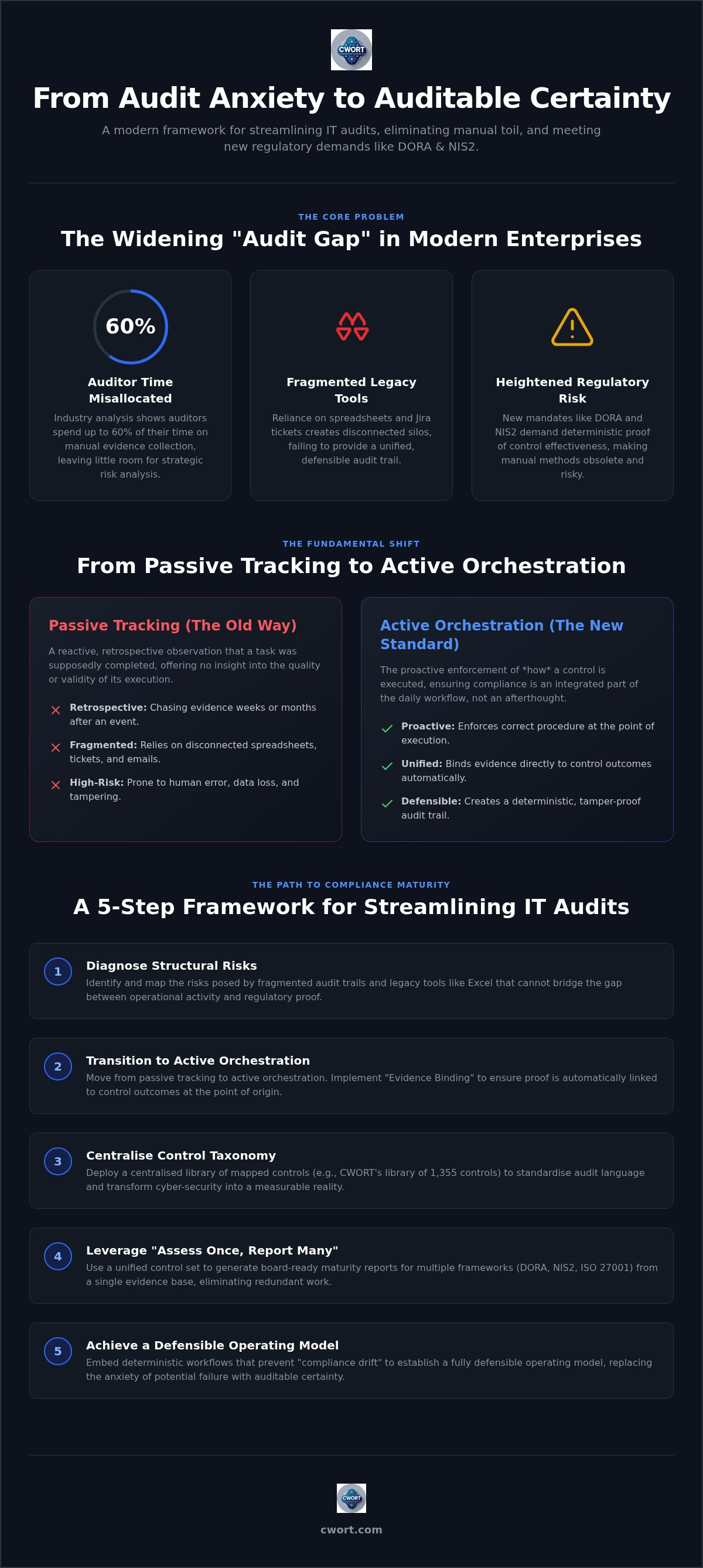
Why are you still manually reconstructing audit trails in an era of automated regulatory enforcement? If your internal audit process relies on chasing evidence across disconnected silos, you aren't just wasting time; you're operating with a structural blind spot that modern regulations like DORA and NIS2 will inevitably expose. You recognise that streamlining IT audits for internal auditors is no longer about incremental speed, but about establishing a deterministic system that enforces discipline by design. It's a common frustration to feel trapped in a cycle of evidence fragmentation that leaves even the most diligent teams feeling exposed.
This guide provides a definitive roadmap for transforming these fragmented workflows into a unified, orchestrated environment. You'll learn how to move beyond mere administrative tracking to deliver audit-defensible proof for ISO 27001 and other high-stakes frameworks. We will examine how to implement an "assess once, report many" capability that replaces manual toil with automated, board-ready maturity reports. By the end of this article, you'll understand how to replace the anxiety of potential regulatory failure with the calm of auditable certainty.
Key Takeaways
- Identify the structural risks of fragmented audit trails and why legacy tools like Excel fail to bridge the gap between operational activity and regulatory proof.
- Transition from passive tracking to active orchestration to ensure that evidence is bound to control outcomes at the point of origin.
- Master a structured 5-step framework for streamlining IT audits for internal auditors, moving from initial diagnosis to a fully defensible operating model.
- Leverage the "assess once, report many" capability to generate board-ready maturity reports for DORA, NIS2, and ISO 27001 with absolute certainty.
- Explore how a centralised taxonomy of mapped controls can transform cyber-security from an abstract requirement into a measurable, orchestrated reality.
Table of Contents
- The Audit Burden in 2026: Why Traditional IT Auditing is Failing
- Orchestration vs. Tracking: The New Standard for Streamlining IT Audits
- Moving Beyond Spreadsheets: A Comparison of Audit Management Approaches
- The 5-Step Framework for Streamlining IT Audits
- CWORT: The Audit-Defensible Operating Model
The Audit Burden in 2026: Why Traditional IT Auditing is Failing
Traditional methods are buckling under the weight of modern regulatory expectations. The "Audit Gap" represents a critical failure in governance, marking the disconnect between daily operational activities and the definitive proof required during an Information technology audit. Relying on fragmented tracking in Jira tickets or Excel spreadsheets creates significant regulatory risk amongst UK enterprises. These tools weren't designed for validation; they were built for task management. They lack the structural integrity to support complex control mapping across multiple business units. Consequently, streamlining IT audits for internal auditors requires a shift from periodic, point-in-time checks to continuous compliance validation. Industry observations indicate that auditors frequently spend 60% of their time on evidence collection. This misallocation of resources leaves little room for strategic risk analysis.
The Cost of Manual Evidence Reconstruction
Manual evidence collection remains a friction-heavy process that drains organisational resources. It forces auditors into a cycle of "chasing" Subject Matter Experts (SMEs) for screenshots, logs, and system reports weeks or months after the relevant event has occurred. This retrospective approach introduces severe risks of human error and data loss. It's particularly problematic when mapping manual evidence to overlapping frameworks like ISO 27001. Relying on manual filing systems makes ensuring compliance evidence integrity an uphill battle. If you can't prove that evidence hasn't been tampered with after the fact, your audit trail isn't defensible. By streamlining IT audits for internal auditors through automated orchestration, firms can eliminate these manual bottlenecks and ensure every piece of proof is captured at the source.
Regulatory Scrutiny: DORA and NIS2 Requirements
The Digital Operational Resilience Act (DORA) and NIS2 have fundamentally heightened the evidentiary stakes for UK and EU organisations. Regulators no longer accept vague assertions or qualitative "best efforts" regarding security. They demand deterministic, reproducible proof of control effectiveness. For DORA ICT risk management, you must demonstrate that controls functioned correctly at every required interval across the entire supply chain. This shift places immense pressure on internal audit teams to provide board-level visibility into compliance maturity. Boards now require objective, real-time data to meet their fiduciary duties and avoid personal liability. In this landscape, a "point-in-time" audit is a relic of the past. Continuous validation is the only way to satisfy modern regulatory scrutiny whilst maintaining operational pace.
Orchestration vs. Tracking: The New Standard for Streamlining IT Audits
Stop merely tracking tasks. Tracking is a passive observation that a job was supposedly finished; it provides no insight into the quality or validity of the execution. Orchestration, by contrast, is the proactive enforcement of how a control is executed. For leadership teams focused on streamlining IT audits for internal auditors, this distinction is the difference between a failed inspection and a defensible posture. Orchestration ensures that compliance is not a retrospective activity but a fundamental part of the daily workflow.
This shift enables the concept of "Evidence Binding." This process links proof directly to control outcomes at the precise moment of execution, eliminating the frantic retrospective hunt for logs or screenshots. By utilising a centralised Control Taxonomy Library, such as the one maintained by CWORT with 1,355 mapped controls, organisations can standardise their audit language across all departments. This ensures that a "pass" in one business unit matches the criteria in every other unit. This systematic approach is essential for enhancing efficiency with technology in audits, allowing for an "Assess Once, Report Many" capability. When you validate a control once, you can map it across DORA, NIS2, and ISO 27001 simultaneously, drastically reducing redundant labour.
Building Deterministic Compliance Workflows
Deterministic workflows prevent "compliance drift" by ensuring that required tasks cannot be bypassed or ignored. The system enforces a strict separation of duties by design, ensuring the individual performing a task is never the one validating it. CWORT functions as a superior layer that sits above existing security tooling like SIEM, EDR, and vulnerability scanners. It doesn't replace these tools; it aggregates their outputs and orchestrates the human actions required to turn raw data into audit-ready evidence. You can see this orchestration in action to understand how it transforms abstract requirements into a concrete, defensible reality.
The Role of AI in Audit Streamlining
AI serves an advisory role within this framework, acting as a sophisticated guide rather than a final arbiter. To maintain audit-defensible results, AI must never alter deterministic outcomes or scoring. Its primary value lies in suggesting control mappings and identifying potential gaps in evidence before an auditor discovers them. This ensures that streamlining IT audits for internal auditors remains grounded in objective, reproducible reality. Even with AI assistance, the audit trail must remain immutable. Every suggestion and action is logged, providing a clear, unalterable history of how compliance was achieved and maintained across the organisation.
Moving Beyond Spreadsheets: A Comparison of Audit Management Approaches
Internal audit departments often find themselves choosing between three distinct maturity levels: legacy spreadsheets, generic ticketing systems like Jira, or purpose-built compliance orchestration engines. Whilst spreadsheets are familiar and Jira is ubiquitous in technical teams, neither was engineered to meet the rigorous validation standards of 2026. Streamlining IT audits for internal auditors is impossible when your data is trapped in disconnected files or buried in development backlogs. You need a system that doesn't just record activity but enforces the integrity of the audit trail itself.
The "Single Source of Truth" is a frequent casualty of these fragmented approaches. In a spreadsheet-driven environment, version control is non-existent, and data integrity is compromised the moment a file is shared. Jira, whilst better for task visibility, fails the compliance test because it lacks inherent control-to-evidence binding. It cannot natively map a single operational action to multiple regulatory requirements, such as DORA and NIS2, without significant manual intervention. This creates an "audit gap" where the proof of compliance is separated from the execution of the task, leaving auditors to bridge the divide through manual labour.
Why Jira is Not a Compliance Orchestration Tool
Jira is a development tool, not a governance platform. It lacks the structural taxonomy required to manage complex framework cross-walks. When you attempt to use it for audit management, you're forced to build custom workflows that are fragile and difficult to maintain. There's no deterministic link between a ticket closure and a validated control outcome. For a more detailed look at how to move beyond basic task tracking, review our guide on Regulatory Compliance Workflow Automation. Without orchestration, you're merely tracking progress, not proving compliance.
The Spreadsheet Trap in UK Enterprise
Managing over 1,355 controls across multiple business units via Excel is a recipe for regulatory failure. Spreadsheets are inherently prone to human error and lack the immutable audit history that modern regulators demand. UK enterprises still caught in the spreadsheet trap face significant scalability issues and increasing scrutiny from authorities who now view manual logs with deep scepticism. Streamlining IT audits for internal auditors requires moving toward a deterministic model where evidence is captured automatically. This transition allows you to produce regulator-ready outputs and board-level maturity reports without the need for weeks of manual formatting and data reconciliation.
The 5-Step Framework for Streamlining IT Audits
Implementing a structured, deterministic framework is the only way to escape the cycle of manual evidence collection. By adopting a linear progression from diagnosis to reassessment, you transform a chaotic series of manual checks into a disciplined, orchestrated workflow that satisfies the most demanding regulators. This systematic approach ensures that every control is accounted for and every piece of evidence is defensible.
- Step 1: Diagnose — Begin by assessing your current capability maturity. You must identify specific compliance gaps against frameworks like DORA or NIS2 to understand exactly where your organisation remains exposed.
- Step 2: Design — Translate abstract regulatory obligations into specific execution activities. This step ensures that every requirement in the taxonomy is mapped to a concrete action with a designated owner.
- Step 3: Deliver — Execute remediation and monitor delivery status in real-time. This provides leadership with an immediate view of progress, replacing the uncertainty of manual spreadsheets with objective data.
- Step 4: Demonstrate — Generate board-ready maturity reports and evidence registers. This is the point where operational activity is converted into definitive proof for external auditors.
- Step 5: Reassess — Compliance is not a destination. Use continuous monitoring to maintain an audit-ready state, ensuring that your controls evolve alongside emerging threats and regulatory updates.
Adopting this framework is essential for streamlining IT audits for internal auditors who are currently overwhelmed by fragmented data. It shifts the focus from administrative tracking to high-value risk analysis.
Automating the Evidence Register
Creating a robust assurance evidence register is the cornerstone of a modern audit strategy. This register must provide real-time status tracking for every active control across the enterprise. To maintain the integrity of this data, the system must enforce strict tenant isolation and role-based access. These security measures ensure that evidence remains protected and that the separation of duties is absolute. You can leverage ISO 27001 control mapping tools to automate this process, binding proof directly to framework requirements without the risk of human error or tampering.
Generating Regulator-Ready Outputs
Regulators and boards require distinct levels of reporting. Whilst an auditor needs granular, technical logs, a board requires high-level heat-map dashboards that highlight strategic maturity and residual risk. A deterministic platform allows you to produce both outputs from the same single source of truth. This capability ensures you always have an immutable audit history ready for external regulatory scrutiny, providing total assurance that your controls are functioning as intended. To see how this framework can transform your compliance posture, request a demo of the CWORT platform today.
CWORT: The Audit-Defensible Operating Model
Cyber-security is often managed as a set of disconnected technical tasks. CWORT fundamentally changes this by turning security into a measurable, orchestrated operating model. For leadership teams focused on streamlining IT audits for internal auditors, CWORT provides the structural integrity required to move from subjective assessment to definitive proof. With a 98.6% framework reference rate across active controls, the platform offers a level of traceability that builds immediate trust with regulators. It ensures that every action taken is explicitly linked to a regulatory requirement, removing the ambiguity that typically plagues traditional audit environments.
Flexibility is a core component of this model. The "Bring Your Own Content" (BYOC) capability allows organisations to ingest their unique maturity models and proprietary control sets. This ensures that the platform adapts to your specific governance needs rather than forcing you into a rigid, one-size-fits-all framework. To accelerate your transition, professional services are available to provide rapid document-to-assessment conversion. This service ensures that your existing policies and procedures are translated into structured execution activities with minimal delay. It's a proactive approach that replaces the friction of manual setup with a disciplined, ready-to-use validation environment.
Orchestrating DORA and NIS2 Validation
Compliance with high-stakes regulations requires more than just ticking boxes. CWORT specifically addresses the complexities of DORA compliance validation by enforcing the execution of controls across the entire ICT risk management spectrum. The platform's integration layer consumes evidence directly from your existing operational tools, such as vulnerability scanners and identity management systems. For UK CNI organisations, this "Assess Once, Report Many" efficiency is transformative. It allows a single validated activity to satisfy multiple frameworks simultaneously, significantly reducing the burden on technical teams whilst ensuring total accuracy.
Securing the Future of Internal Audit
The era of administrative overhead and manual sampling is coming to a close. Internal auditors must shift their focus toward strategic assurance and total control validation. Streamlining IT audits for internal auditors involves moving away from the limitations of statistical sampling toward 100% control validation. This provides the board with an uncompromising view of the organisation's resilience and regulatory standing. By replacing manual toil with a deterministic, evidence-backed system, you secure the future of the audit function as a proactive guardian of standards. Explore the CWORT compliance validation platform to begin your transition toward a truly defensible operating model.
Establishing Audit-Defensible Certainty
The transition from manual evidence reconstruction to automated orchestration is no longer optional for UK organisations. Regulators now demand deterministic proof of control effectiveness that traditional spreadsheets and ticketing systems simply cannot provide. By adopting a structured framework, you move beyond the friction of chasing evidence and establish a single source of truth for your entire governance posture. Streamlining IT audits for internal auditors requires a system that enforces discipline by design, ensuring every piece of evidence is bound to a specific control outcome at the point of origin.
CWORT provides this structural integrity with 1,355 controls mapped to 42 frameworks. Our deterministic, reproducible scoring is already trusted by UK CNI and leading financial institutions to deliver board-ready maturity reports with absolute certainty. It's time to shift your focus from administrative tracking to strategic risk analysis and high-value assurance. This evolution allows your team to operate with a level of precision that matches the gravity of the modern regulatory landscape.
Orchestrate your audit-defensible compliance with CWORT. You can now replace the anxiety of regulatory failure with the calm of auditable truth.
Frequently Asked Questions
How does streamlining IT audits improve DORA compliance readiness?
It replaces manual evidence gathering with deterministic orchestration. This ensures that ICT risk management controls are validated at the point of origin. By streamlining IT audits for internal auditors, organisations can demonstrate continuous operational resilience rather than relying on retrospective sampling. This systematic approach provides the reproducible proof that DORA regulators demand for high-stakes financial environments. It shifts the focus from administrative tracking to definitive, evidence-based proof of compliance.
Can I import my existing audit checklists into CWORT?
Yes, you can utilise the Bring Your Own Content capability to ingest proprietary maturity models and checklists. This ensures that your unique governance requirements are translated into structured execution activities within the platform. Professional services are also available to facilitate a rapid document-to-assessment conversion. This process ensures that your legacy documentation is integrated into a disciplined, orchestrated workflow without losing historical context. It transforms abstract requirements into concrete, defensible reality.
What is the difference between GRC software and a compliance orchestration engine?
Traditional GRC software functions as a passive repository for recording outcomes, whereas a compliance orchestration engine proactively enforces the execution of controls. GRC tools often suffer from compliance drift because they lack a deterministic link between activity and evidence. An orchestration engine like CWORT sits above your technical stack to aggregate proof and ensure that every regulatory obligation is met. It enforces discipline and accountability by design, providing a state of total assurance.
How does "Assess Once, Report Many" work in practice for ISO 27001 and NIS2?
This capability leverages a centralised taxonomy where a single control is mapped to multiple frameworks simultaneously. When you validate a specific control for ISO 27001, the system automatically applies that proof to corresponding requirements in NIS2. This eliminates redundant testing cycles and ensures that streamlining IT audits for internal auditors results in massive efficiency gains. It allows you to assess your environment once and generate reports for multiple regulatory bodies with absolute certainty.
Is the AI in CWORT safe for use in highly regulated financial audits?
The AI functions in an advisory capacity only, ensuring that it never alters deterministic scoring or audit results. It assists by suggesting control mappings and identifying evidence gaps, but the final validation remains a human-driven process. This maintains an immutable audit trail that satisfies the rigorous transparency requirements of financial regulators. It provides sophisticated guidance without compromising the integrity of the underlying evidence. This ensures that all results remain uncompromisingly objective and defensible.
How does streamlining IT audits reduce the workload for SMEs and process owners?
It eliminates the need for SMEs to manually provide screenshots and logs weeks after an event has occurred. By binding evidence to control outcomes at the source, the platform captures proof automatically during the normal course of business. This proactive approach removes the friction of retrospective data collection. It allows technical experts to focus on operational execution rather than administrative reconstruction. This transition replaces the anxiety of potential failure with the calm of auditable certainty.
What are board-ready maturity reports and why do internal auditors need them?
Board-ready maturity reports are high-level dashboards that translate technical control data into strategic risk insights. Internal auditors need these to provide the board with objective visibility into the organisation's compliance posture. These reports highlight residual risks and maturity levels across different business units. They provide leadership with the defensible truth required to make informed governance decisions. This rhythmic transition from obligation to evidence ensures that every stage of the process is clearly accounted for.
Does CWORT replace my existing security tools like SIEM or EDR?
No, CWORT is designed to sit above your existing technical stack as an orchestration layer. It consumes data and alerts from tools like SIEM and EDR to validate that your security processes are functioning as intended. The platform turns the outputs of these tools into auditable evidence. It bridges the gap between technical monitoring and regulatory compliance. This ensures that your security investments contribute directly to a defensible posture through a disciplined and systematic approach.
Disclaimer
The content on this site is provided for general information and educational purposes only. It does not constitute legal, regulatory, financial, or professional advice. CWORT provides AI-assisted insights and workflow automation, but all compliance decisions remain the responsibility of your organisation and its management. Always seek qualified legal or regulatory guidance for decisions relating to the UK NIS Regulations, CAF, DORA, NIS2, ISO 27001, or other obligations.
Related posts
Streamlining Regulatory Compliance Processes: From Manual Tracking to Orchestrated Validation
Stop wasting money on manual compliance. Learn about streamlining regulatory compliance processes to reduce personal liability under DORA & NIS2 and gain aud...
Automated IT Audit Preparation: Streamlining Compliance Workflows
Ditch spreadsheets for automated IT audit preparation. Learn how to streamline compliance for DORA & NIS2, and provide your board with total auditable assura...
Ensuring Compliance Evidence Integrity: A Strategic Guide for UK Enterprises in 2026
Master ensuring compliance evidence integrity for 2026. Our UK guide helps you move from risky spreadsheets to an audit-ready system for DORA & NIS2.
Article by
Michael Iyiola
Co-Founder, CWORT
Michael Iyiola is a co-founder of CWORT and a Cyber and AI Security Engineer with deep experience in vulnerability management, detection engineering and operational resilience across UK critical national infrastructure, including rail, energy and financial services. At CWORT, he designs scalable, evidence-driven workflows that help teams meet modern regulatory and security demands.
Build Your Foundation of Auditable Certainty
Take control of your regulatory obligations and secure your infrastructure with CWORT.