Sustainable Compliance: A Strategic Guide for 2026

Michael Iyiola
Co-Founder, CWORT
Struggling with DORA & NIS2? Learn how building a sustainable compliance programme can end audit fatigue. Our 2026 guide offers a strategic roadmap for autom...

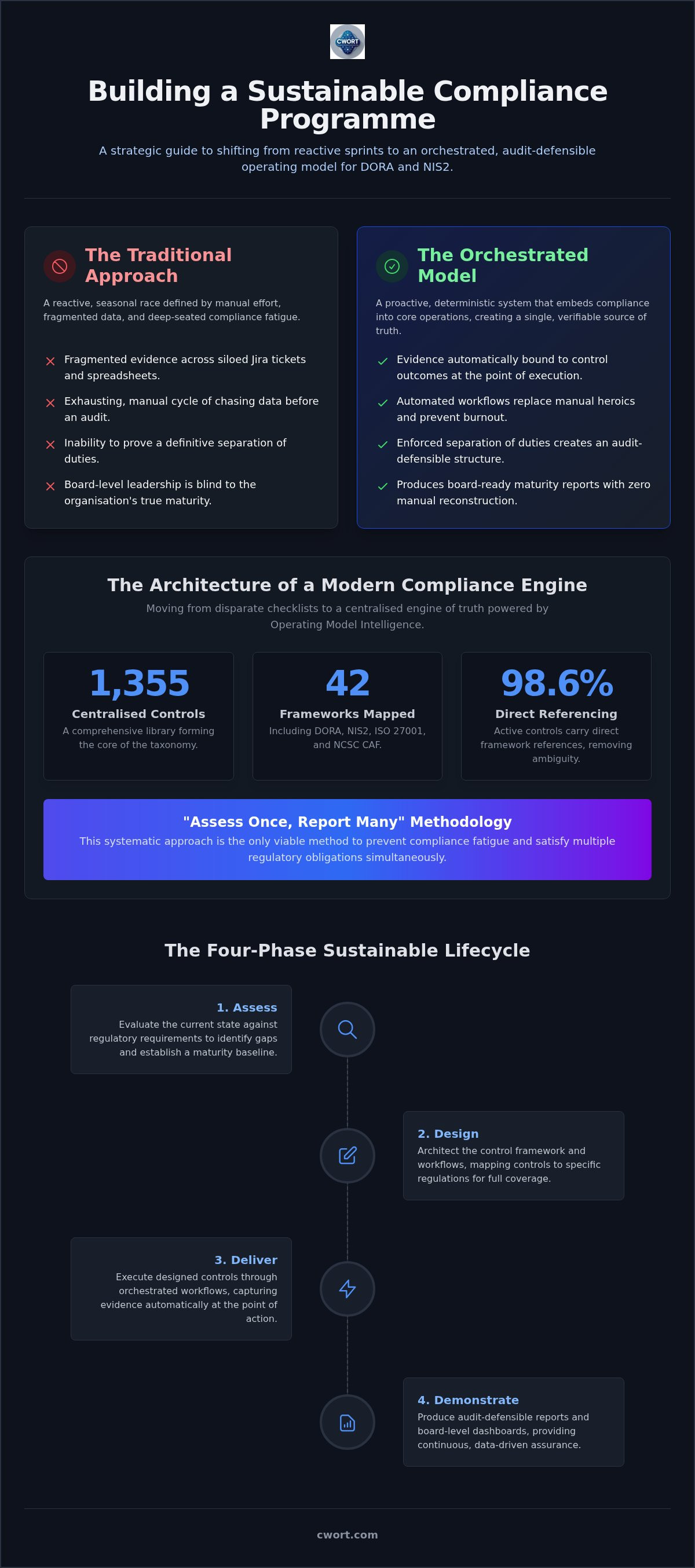
Most organisations treat compliance as a seasonal race to gather evidence, yet this reactive sprint is exactly why building a sustainable compliance programme feels like an impossible task under the weight of DORA and NIS2. You've likely spent weeks chasing fragmented data across Jira tickets and Excel spreadsheets, only to find you still can't prove a definitive separation of duties to an auditor. It's an exhausting, manual cycle that creates deep-seated compliance fatigue and leaves the board blind to your actual maturity level.
Transitioning to a deterministic operating model requires moving beyond administrative tracking toward a system of orchestrated execution. This guide provides a strategic roadmap to replace manual heroics with an automated workflow that satisfies both regulators and the board. We will examine how to map 1,355 controls across 42 frameworks to create a repeatable, defensible structure. You'll learn to replace fragmented evidence with audit-ready binding, ensuring your organisation's resilience is documented as a matter of record rather than a matter of luck.
Key Takeaways
- Understand why building a sustainable compliance programme is now a mandatory requirement under DORA and NIS2 rather than an elective operational choice.
- Transition from fragmented spreadsheets to a centralised taxonomy of 1,355 controls to eliminate compliance drift and ensure total audit readiness.
- Adopt a deterministic operating model that enforces separation of duties and replaces manual heroics with orchestrated, repeatable workflows.
- Leverage the "assess once, report many" methodology to satisfy up to 42 frameworks simultaneously, including ISO 27001 and the NCSC CAF.
- Produce board-ready maturity reports with zero manual reconstruction by binding evidence directly to control outcomes.
Table of Contents
- Defining a Sustainable Compliance Programme in the 2026 Regulatory Landscape
- The Architecture of a Compliance Operating Model
- Compliance Orchestration vs. Manual Tracking: A Strategic Comparison
- A Seven-Step Framework for Building a Sustainable Programme
- Future-Proofing Your Programme with CWORT Compliance Intelligence
Defining a Sustainable Compliance Programme in the 2026 Regulatory Landscape
Building a sustainable compliance programme is no longer a matter of administrative preference; it's a strategic necessity for survival. In the 2026 regulatory environment, sustainability refers to a reproducible system that matures alongside the organisation. It moves away from the heroic efforts of individuals manually tracking spreadsheets and towards a governed digital workflow. This lifecycle consists of four distinct phases: Assess, Design, Deliver, and Demonstrate. By embedding these stages into the core operating model, enterprises replace the anxiety of audit failure with the certainty of auditable truth. It's about moving from a state of constant reaction to a position of controlled, deterministic execution.
The Shift from 'Tick-Box' to 'Audit-Defensible' Proof
Regulators have shifted their focus from intent to execution. Fragmented Jira tickets and siloed Excel files are no longer accepted as valid evidence of Regulatory compliance. Modern oversight demands deterministic results. This means moving from subjective self-assessments, which are often prone to bias or inaccuracy, to evidence-backed validation. An audit-defensible position requires that every control outcome is bound to concrete evidence. Without this link, board-level assurance remains a hollow promise. Sustainable systems ensure that evidence is captured at the point of execution, eliminating the need for manual reconstruction during an audit. This transition reduces the labour-intensive "crunch" periods and provides a continuous view of the organisation's true posture.
Key Regulatory Drivers: DORA, NIS2, and UK NIS
Frameworks such as DORA and NIS2 have raised the bar for operational maturity across the UK. These mandates require organisations to demonstrate resilience through a centralised control taxonomy. Building a sustainable compliance programme involves cross-walking controls across 42 different standards to ensure that a single action satisfies multiple obligations. This "assess once, report many" approach is the only viable method to prevent compliance fatigue. By mapping 1,355 controls within a unified engine, organisations can maintain structural integrity whilst facing relentless regulatory scrutiny. This isn't just about meeting a deadline. It's about creating a reusable model that survives the next wave of legislation. Organisations that fail to align these frameworks will find themselves trapped in a cycle of redundant work and escalating risk.
The Architecture of a Compliance Operating Model
Building a sustainable compliance programme requires a departure from static checklists toward what we define as Operating Model Intelligence. This framework evaluates not just the technical design of a control, but the organisational capacity to maintain it over time. At the centre of this architecture sits a centralised control taxonomy. By utilising a library of 1,355 controls mapped across 42 frameworks, organisations can achieve an "assess once, report many" capability. This systematic approach ensures that 98.6% of active controls carry direct framework references, removing the ambiguity that typically plagues manual mapping exercises. It transforms compliance from a series of disconnected projects into a single, orchestrated engine of truth.
Capability vs. Capacity: The Sustainability Gap
Success in regulatory oversight depends on bridging the gap between capability and capacity. Capability identifies whether a control works as designed; capacity determines if your team has the resources to sustain it without burning out. Many programmes fail because they focus solely on the former. If a control requires manual evidence collection that exceeds your team's available hours, it is inherently unsustainable. A robust model incorporates the Seven steps to sustainable compliance by enforcing a strict separation of duties. This ensures that the individuals executing a task are not the same ones validating the outcome, creating a disciplined, self-correcting system that stands up to intense auditor scrutiny.
Integrating with the Existing Security Stack
A mature operating model doesn't replace your existing security tools. It orchestrates them. It aggregates evidence from SIEM, EDR, and IAM solutions into a unified validation layer that sits above individual point-solutions. This provides a single version of the truth for both auditors and senior leadership. Instead of hunting for fragmented evidence across Jira and Excel, you maintain a deterministic record of every control's status. This level of visibility replaces administrative anxiety with auditable certainty. To see how this unified view transforms regulatory readiness, you might request a platform demonstration to explore the taxonomy in detail. By binding evidence directly to outcomes, you ensure that your compliance posture remains resilient regardless of future regulatory shifts.
Compliance Orchestration vs. Manual Tracking: A Strategic Comparison
Spreadsheets remain the primary catalyst for audit failure in the modern enterprise. They are static, siloed, and fundamentally disconnected from the live environment they claim to monitor. Building a sustainable compliance programme requires a decisive move away from these legacy tools in favour of digital orchestration. Orchestration enforces accountability through immutable audit trails that record every action in real-time. This ensures that the evidence presented to a regulator is exactly what was captured during execution, rather than a narrative reconstructed weeks after the event. By removing the human element from evidence collection, you eliminate the risk of manipulation or accidental omission.
The Hidden Cost of Manual Compliance
Manual evidence hunting consumes hundreds of man-hours that should be dedicated to strategic risk mitigation. When data is scattered across disconnected trackers, it becomes stale almost immediately, creating a dangerous lag between operational reality and reporting. Compliance Drift is the gap between policy and operational reality. To close this gap, organisations must adopt a deterministic scoring system where the same evidence produces the same result every time. This removes the subjectivity that auditors view with increasing skepticism. A sustainable system ensures that your compliance posture is a reflection of live operations, not a point-in-time snapshot that is obsolete by the time it reaches the board.
Why Jira and Excel Fail the DORA Audit Test
Generic project management tools like Jira lack the structural integrity required for high-stakes regulations like DORA. They don't offer native evidence binding, meaning there's no verified link between a task completion and the specific regulatory requirement it satisfies. Manual reconstruction of these trails during an audit leads to significant regulatory skepticism and potential fines. Auditors in 2026 demand a clear, unbroken line of sight from the framework requirement to the specific proof of execution. You can read more about ensuring compliance evidence integrity to understand how orchestration solves this fundamental gap.
The "assess once, report many" model is the only viable alternative to traditional, framework-specific assessments. Instead of repeating the same validation exercises for ISO 27001, NIS2, and DORA, a centralised engine maps a single piece of evidence to all relevant requirements across 42 frameworks. This efficiency is only possible with a library of 1,355 controls that are pre-mapped to these standards. It reduces the burden on control owners and ensures that the organisation’s compliance posture is always current. By moving to an orchestrated model, you replace the frantic fire drill of audit season with a state of continuous, defensible readiness.
A Seven-Step Framework for Building a Sustainable Programme
Establishing a governed digital workflow is the cornerstone of building a sustainable compliance programme. It replaces fragmented, ad-hoc efforts with a structured methodology that ensures consistency across the enterprise. The process begins with defining or importing your specific model. By leveraging Bring Your Own Content (BYOC) capabilities, organisations can integrate their existing proprietary frameworks whilst mapping them against the 1,355 controls already available in the taxonomy. This ensures that previous investments in compliance logic aren't discarded but are instead enhanced by a more rigorous orchestration engine.
Once the model is defined, you must configure the assessment blueprint with precise scales and scoring rules. This step removes subjectivity, ensuring that every participant evaluates controls against the same deterministic criteria. Following this, you assign scope, owners, and participants to ensure absolute accountability. This clear delegation of responsibility is vital for satisfying regulators who demand proof of oversight. Finally, the system captures responses and binds immutable evidence to every control. This binding creates a permanent record that stands up to the most intense auditor scrutiny, providing a level of defensibility that manual trackers simply cannot match.
Calculating Maturity and Confidence
Traditional binary "Pass/Fail" metrics are insufficient for modern corporate governance. Sustainable programmes utilise nuanced maturity and confidence scores to provide a realistic view of the organisation's resilience. Heat-map dashboards allow leadership to visualise status at a glance, highlighting areas where capability is high but capacity is strained. This visibility enables the board to prioritise remediation based on business risk rather than guesswork. It transforms raw data into a strategic asset, allowing for more informed decision-making at the highest levels of the organisation.
Continuous Improvement and Reassessment
Sustainability is maintained through a recurring assurance cycle rather than a once-a-year fire drill. By tracking the progress of remediation actions in real-time, you ensure that gaps are closed before they become liabilities. Implementing regulatory compliance workflow automation ensures that this momentum is maintained without constant manual intervention. This proactive stance replaces the annual "panic" audit with a state of continuous readiness. To see how this structured framework can be applied to your specific regulatory requirements, you can request a demo of our orchestration platform to explore the workflow in detail.
Future-Proofing Your Programme with CWORT Compliance Intelligence
CWORT serves as the definitive strategic partner for UK enterprises navigating the intensified scrutiny of 2026. Building a sustainable compliance programme requires more than just a repository of documents; it demands a centralised intelligence engine capable of mapping 1,355 controls across 42 frameworks. This "assess once, report many" value proposition is vital for multi-regulated firms that must satisfy DORA, NIS2, and ISO 27001 simultaneously. By consolidating these requirements into a single orchestration layer, organisations eliminate redundant effort and ensure that 98.6% of active controls carry precise framework references. It's a transition from fragmented tracking to structural integrity.
Board-Ready Reporting and Audit Defensibility
The platform generates regulator-ready outputs that require zero manual reconstruction. This level of automation provides board-level assurance that is both reproducible and defensible. Whilst the system utilises AI, it remains advisory only to ensure that deterministic results are never compromised by opaque algorithms. This transparency is essential for building trust with UK regulators such as Ofgem and the NCSC. By providing a clear line of sight from high-level obligations to granular evidence, you replace regulatory skepticism with auditable certainty. Leaders gain the confidence to present maturity reports that reflect the true resilience of the organisation.
Getting Started: From Pilot to Full Orchestration
We advocate for an Option B implementation strategy. This focuses on building a governed, reusable model catalogue rather than a rapid, one-off conversion. It's a more disciplined approach that prioritises long-term sustainability over temporary fixes. Most organisations begin with a controlled pilot on a single sub-function to prove the value of the orchestration engine before scaling. This phased rollout ensures that the operating model is refined and validated at every stage. To understand how this transition can secure your regulatory future, you should book a demonstration of the CWORT compliance validation platform today. We invite you to schedule a pilot session to map our taxonomy to your specific programme requirements and begin the journey toward total assurance.
Securing Regulatory Resilience for the Decade Ahead
The transition to a mature regulatory posture in 2026 requires a fundamental shift from reactive tracking to orchestrated validation. Building a sustainable compliance programme is no longer about merely surviving the next audit cycle; it's about establishing a deterministic operating model that matures alongside your organisation. By centralising 1,355 controls mapped across 42 frameworks, you replace the fragmentation of legacy spreadsheets with the clarity of board-ready maturity dashboards. This transition ensures that every control outcome is backed by audit-defensible proof, effectively removing the subjectivity that leads to regulatory skepticism.
It's time to replace compliance fatigue with a system of orchestrated certainty. You can eliminate the administrative burden of manual evidence hunting whilst providing leadership with the definitive transparency they demand. Moving toward a reproducible, future-proof model is the only way to maintain structural integrity in an increasingly complex landscape. We invite you to Request a CWORT Implementation Pilot to witness how deterministic scoring and automated workflows can transform your organisation's defensive posture. Secure your professional peace of mind by turning compliance from a burden into a strategic advantage.
Frequently Asked Questions
What makes a compliance programme truly sustainable?
A sustainable programme is defined by its ability to function as a reproducible system that matures alongside the organisation. Building a sustainable compliance programme requires moving away from manual, heroic efforts toward governed digital workflows. It ensures that compliance activities are embedded into daily operations rather than treated as a seasonal fire drill. This approach provides continuous visibility into both capability and capacity, allowing leadership to maintain a defensible posture without exhausting internal resources.
How does DORA change the requirements for compliance evidence?
DORA shifts the regulatory focus from static policy documentation to active operational resilience. It requires organisations to provide definitive proof that their digital systems can withstand, respond to, and recover from disruptions. This mandate necessitates a move toward deterministic evidence that is captured at the point of execution. Regulators now expect to see a clear, unbroken line of sight between specific regulatory obligations and the technical or procedural controls that satisfy them.
Why is 'evidence binding' critical for regulatory audits?
Evidence binding is the process of linking a specific control outcome directly to its immutable proof of execution. This is critical for audits because it eliminates the need for manual reconstruction, which often leads to regulatory skepticism. By binding evidence within a governed digital environment, you ensure that auditors can verify the validity of a claim without searching through fragmented systems. This practice creates a permanent, defensible record that remains accessible long after the assessment.
Can we use our existing maturity model with CWORT?
Yes, organisations can import their proprietary maturity models using the Bring Your Own Content (BYOC) capability. This feature allows you to turn your existing criteria and weighting into a repeatable, evidence-backed management system. You retain your unique intellectual property whilst benefiting from centralised governance, automated workflows, and portfolio-level analytics. It ensures that your established internal standards are validated with the same rigour and audit-defensibility as international frameworks like ISO 27001 or NIS2.
What is the difference between a GRC tool and a compliance orchestration platform?
Traditional GRC tools typically serve as passive repositories for policy documents and manual spreadsheets. In contrast, a compliance orchestration platform acts as a proactive execution engine that sits above your security stack. It aggregates evidence from tools like SIEM and EDR to provide a live, validated view of your posture. Orchestration enforces discipline by design, ensuring that compliance is a continuous outcome of operational activities rather than a separate, disconnected administrative task.
How do I prove separation of duties under NIS2?
Proving separation of duties requires a system that enforces role-based access and maintains an immutable audit history of all changes. Under NIS2, you must demonstrate that the individuals executing a control are not the same people validating the results. A governed digital workflow records every action and approval, providing regulators with transparent proof that your organisational structure prevents conflicts of interest. This ensures that your reporting integrity remains high and satisfies intense auditor scrutiny.
How does 'assess once, report many' work in practice?
This methodology allows a single assessment to satisfy multiple regulatory obligations simultaneously. By utilising a centralised taxonomy of 1,355 controls, a single piece of evidence is mapped across up to 42 different frameworks. In practice, this means validating a user access control once and automatically generating compliance proof for DORA, NIS2, and ISO 27001. It significantly reduces the burden on control owners and eliminates the redundant work typically associated with multi-framework audits.
Is the CWORT scoring system truly deterministic?
The scoring system is entirely deterministic, meaning identical evidence will always produce the same result. This reproducibility is fundamental to providing audit-defensible assurance to regulators and the board. Whilst the platform includes AI advisory features to suggest improvements or identify gaps, these suggestions never alter the core scoring logic. This strict separation ensures that your maturity reports remain objective and transparent, free from the unpredictability often found in purely AI-driven or subjective assessment methods.
Disclaimer
The content on this site is provided for general information and educational purposes only. It does not constitute legal, regulatory, financial, or professional advice. CWORT provides AI-assisted insights and workflow automation, but all compliance decisions remain the responsibility of your organisation and its management. Always seek qualified legal or regulatory guidance for decisions relating to the UK NIS Regulations, CAF, DORA, NIS2, ISO 27001, or other obligations.
Related posts
Streamlining Regulatory Compliance Processes: From Manual Tracking to Orchestrated Validation
Stop wasting money on manual compliance. Learn about streamlining regulatory compliance processes to reduce personal liability under DORA & NIS2 and gain aud...
GRC Platform vs Compliance Validation Tool: Choosing the Right Architecture for 2026
GRC platform vs compliance validation tool: Is your GRC ready for 2026? Learn how automated validation provides the defensible proof needed for DORA & NIS2.
Ensuring Compliance Evidence Integrity: A Strategic Guide for UK Enterprises in 2026
Master ensuring compliance evidence integrity for 2026. Our UK guide helps you move from risky spreadsheets to an audit-ready system for DORA & NIS2.
Article by
Michael Iyiola
Co-Founder, CWORT
Michael Iyiola is a co-founder of CWORT and a Cyber and AI Security Engineer with deep experience in vulnerability management, detection engineering and operational resilience across UK critical national infrastructure, including rail, energy and financial services. At CWORT, he designs scalable, evidence-driven workflows that help teams meet modern regulatory and security demands.
Build Your Foundation of Auditable Certainty
Take control of your regulatory obligations and secure your infrastructure with CWORT.