The Strategic Shift to Auditable Compliance Proof Software in 2026

Michael Iyiola
Co-Founder, CWORT
Discover why auditable compliance proof software is vital for DORA and NIS2 readiness in 2026. Eliminate manual evidence trails and satisfy UK regulators now.

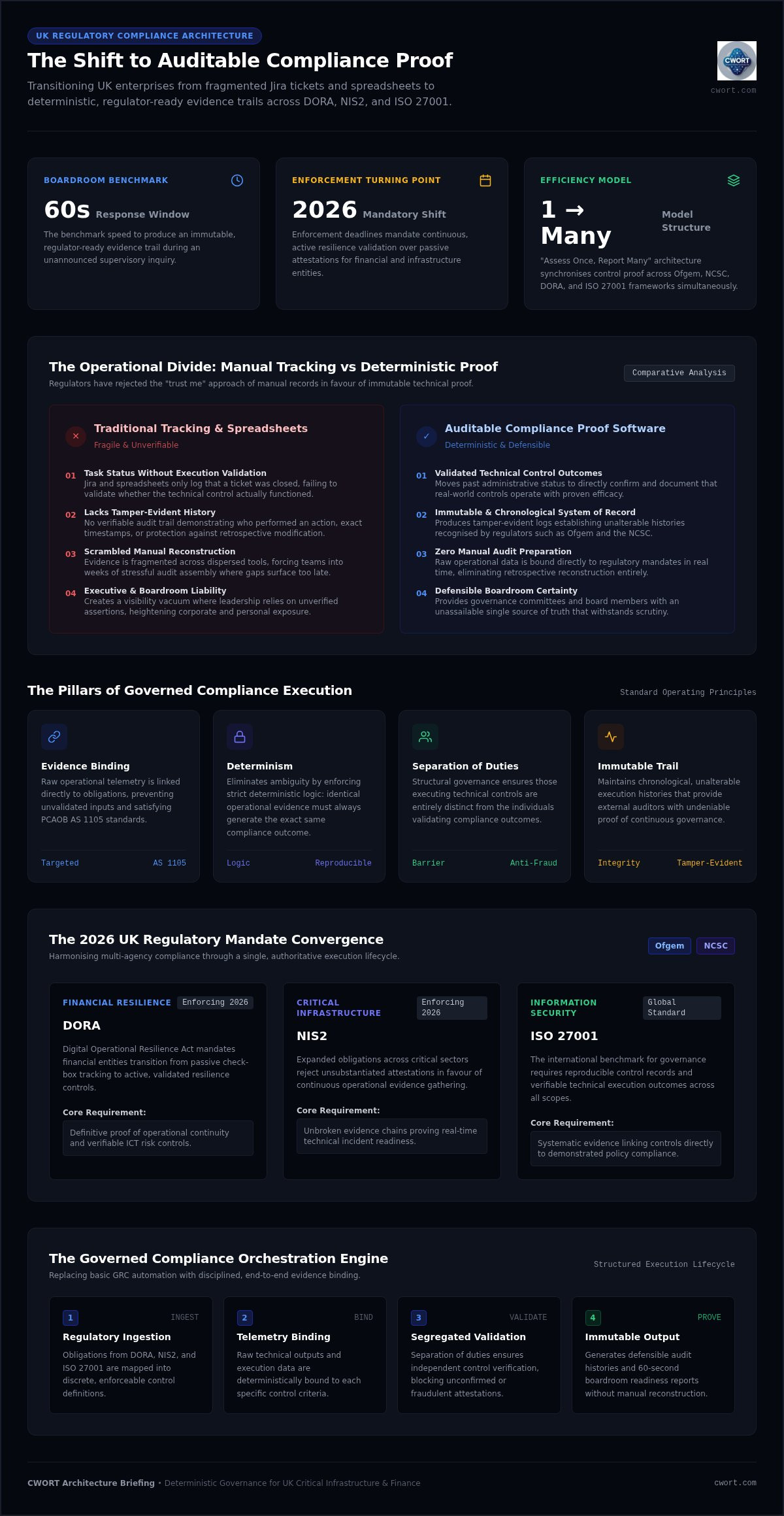
If a regulator walked into your boardroom tomorrow, could you produce an immutable evidence trail in sixty seconds, or would you be scrambling through a labyrinth of Jira tickets and Excel spreadsheets? Most UK compliance leads are exhausted by the manual burden of proving DORA or NIS2 readiness. You likely feel the mounting pressure of increased scrutiny and the constant anxiety that a single missing screenshot could lead to a catastrophic fine. It's a common frustration to realise that your current tools only track tasks rather than validating actual control outcomes. This article demonstrates how to move beyond fragmented tracking to a deterministic system that provides regulator-ready, auditable compliance proof for DORA, NIS2, and ISO 27001. We'll explore why the strategic shift to auditable compliance proof software is no longer optional for firms aiming for total assurance in 2026. You'll discover how to establish a single source of truth that generates defensible reports with zero manual effort. This transition replaces administrative guesswork with a rigorous orchestration engine that binds evidence to execution, ensuring your organisation remains beyond reproach.
Key Takeaways
- Replace manual tracking with a system of record that regulators such as Ofgem and the NCSC recognise as authoritative and immutable.
- Adopt auditable compliance proof software to establish a deterministic system of record that binds raw evidence directly to specific regulatory obligations.
- Shift from basic automation to compliance orchestration to ensure every obligation is governed through a disciplined, structured execution lifecycle.
- Optimise your approach to DORA, NIS2, and ISO 27001 by utilising an "Assess Once, Report Many" model designed for the UK regulatory landscape.
- Secure a defensible, regulator-ready evidence trail that eliminates manual audit preparation and provides absolute visibility for your board and audit committees.
Table of Contents
- The Failure of Manual Tracking: Why Regulators Demand Auditable Proof
- Defining Auditable Compliance Proof: Evidence Binding and Determinism
- Compliance Orchestration vs. Basic GRC Automation
- Building an Audit-Defensible Operating Model for UK Enterprises
- CWORT: Turning Regulatory Obligations into Validated Execution
The Failure of Manual Tracking: Why Regulators Demand Auditable Proof
Manual tracking is no longer a viable defence against modern regulatory scrutiny. For years, UK enterprises relied on fragmented Jira tickets and static spreadsheets to manage their obligations, but these methods offer no real protection during a rigorous audit. Regulators, including Ofgem and the NCSC, have shifted their expectations. They now reject the "trust me" approach of manual logs in favour of verifiable, real-time data. This shift has formalised the need for auditable compliance proof software. This isn't a mere administrative tool; it's a deterministic system of record that binds raw evidence directly to specific control outcomes. It ensures that every claim of compliance is backed by data that is chronological, linked, and impossible to manipulate after the fact.
Boards are feeling the pressure. Regulatory scrutiny has moved from a back-office administrative concern to a primary boardroom risk. Leaders now require a single source of truth that survives intense questioning from external auditors. Without it, they face not just operational failure, but significant personal and corporate liability. Relying on disconnected tools creates a visibility vacuum where leadership cannot truly know if a control is effective or merely "checked" on a list.
The Limitations of Traditional GRC and Spreadsheets
Spreadsheets are fundamentally incapable of supporting a modern compliance operating model. They lack robust version control and, crucially, fail to provide a tamper-evident audit trail that proves who performed an action and when it occurred. When evidence is scattered across different teams and tools, "compliance gaps" inevitably emerge. These gaps are often only discovered during an audit, leaving teams to scramble through weeks of manual reconstruction. This process is error-prone, resource-intensive, and fails to satisfy an auditor's requirement for integrity. Traditional GRC tools often suffer from the same flaw; they track the status of a task rather than validating the technical outcome of the execution.
Why 2026 is the Year of Mandatory Validation
The arrival of 2026 marks a decisive turning point for UK regulatory enforcement. For financial entities, the enforcement phase of DORA mandates a shift from passive tracking to active resilience validation. Similarly, the expansion of NIS2 requirements across critical national infrastructure means that simple attestations are no longer sufficient. Regulators now require firms to demonstrate that their controls are actually effective through continuous evidence gathering. Auditable compliance proof software facilitates this by moving the organisation from a state of trust to a state of definitive proof. Auditable Proof is a deterministic outcome of governed execution. By centralising these obligations within a structured framework, firms can ensure that their resilience posture is always ready for immediate inspection.
Defining Auditable Compliance Proof: Evidence Binding and Determinism
True audit-defensibility requires more than just gathering data; it demands a deterministic logic where evidence is inextricably linked to the outcome. This process, known as Evidence Binding, ensures raw operational data maps directly to specific control obligations. It prevents the "garbage in, garbage out" trap found in basic automation tools by requiring that every data point validates a predefined requirement. When you implement auditable compliance proof software, you're establishing a system where identical evidence must always yield the same compliance result. This reproducibility is essential for satisfying PCAOB auditing standards for evidence, which demand sufficient and appropriate proof of control effectiveness.
Governance frameworks must also enforce a strict separation of duties within every workflow. By ensuring those who execute a task aren't the same individuals who validate the outcome, the system creates a structural barrier against internal fraud or accidental error. These actions culminate in immutable audit histories. These records serve as the bedrock of trust, providing external auditors with a chronological, unalterable account of every governance activity performed across the organisation. It replaces anecdotal claims with a defensible reality.
The Anatomy of a Regulator-Ready Output
In 2026, a board-level maturity report cannot rely on vague percentages or simple "checked" boxes. It must present validated outcomes that survive deep technical inspection. Every control must carry a clear lineage back to its source requirement. Within the CWORT platform, 98.6% of active controls carry direct framework references, ensuring that every piece of evidence serves a specific regulatory purpose. This level of granularity allows leadership to visualise their true resilience posture with absolute certainty, shifting the focus from administrative tracking to definitive proof of maturity.
The Role of AI in Auditable Compliance
The integration of AI into auditable compliance proof software must be handled with extreme caution. Whilst many vendors use "black box" AI to generate automated results, this approach creates unacceptable risks in high-stakes environments. If an auditor can't trace exactly how a result was reached, that result is effectively worthless. CWORT adopts an "AI advisory only" stance to preserve deterministic integrity. This ensures that whilst AI can suggest improvements or identify gaps, the final compliance result remains a transparent outcome of governed execution. This prioritises reproducibility and ensures your audit trail remains beyond reproach during a regulator's visit.
Compliance Orchestration vs. Basic GRC Automation
Automation collects data whilst orchestration governs the entire execution lifecycle of an obligation. Basic GRC tools often act as passive repositories, merely recording that a task occurred. In contrast, auditable compliance proof software enforces discipline by design. It sits above your existing security stack, including SIEM, EDR, and IAM tools, to provide a unified governance layer. This orchestration ensures that technical data from your security tools is translated into validated evidence that meets specific regulatory requirements. It moves the organisation from a state of reactive data gathering to a proactive, governed operating model.
True resilience requires a "Capability + Capacity" view of the organisation. It's not enough to know if a security practice works; leadership must understand if the team has the capacity to sustain it under pressure. Orchestration provides this visibility by measuring the maturity of the execution itself. This aligns with the UK Cyber Governance Code of Practice, which emphasises executive accountability and the need for rigorous assurance. By governing the execution rather than just the reporting, firms can ensure their compliance posture remains robust and defensible.
Replacing Fragmented Workflows
Jira is an excellent tool for project management, but it is not a compliance orchestration engine. Relying on tickets leads to fragmented workflows where critical context is lost during hand-offs between teams. These manual processes are expensive and create significant risk when evidence is not captured in real-time. Establishing Regulatory Compliance Workflow Automation allows organisations to eliminate these bottlenecks. It replaces the chaos of disconnected tasks with a structured, linear progression from obligation to evidence. This ensures that every stakeholder knows exactly what is required and when it must be delivered to maintain the integrity of the audit trail.
The "Assess Once, Report Many" Advantage
Audit fatigue is a common symptom of a fragmented compliance programme. Teams often find themselves answering the same questions for DORA, ISO 27001, and NIS2 in separate, siloed assessments. Auditable compliance proof software solves this by utilising a "Assess Once, Report Many" model. By leveraging a comprehensive taxonomy of 1,355 controls across 217 domains, CWORT allows you to map a single validated activity to multiple frameworks simultaneously. This reduces the administrative burden on technical teams whilst ensuring total coverage across all regulatory obligations. It transforms compliance from a series of annual hurdles into a continuous, orchestrated state of readiness.
Building an Audit-Defensible Operating Model for UK Enterprises
Establishing a robust governance structure requires a transition from abstract policy to concrete execution. For UK enterprises, this begins with defining a maturity model that reflects both regulatory mandates and internal risk appetite. By utilising auditable compliance proof software, organisations can prioritise their efforts by importing custom frameworks or leveraging pre-mapped taxonomies. This "Bring Your Own Content" approach ensures the system adapts to the unique needs of the business rather than forcing a generic template. It turns a static requirement into a dynamic, governed process.
Once the framework is established, the next phase involves translating high-level obligations into structured activities. This process eliminates ambiguity by assigning clear ownership and enforcing a strict separation of duties. Accountability is not just a concept; it's a technical requirement enforced by the workflow. As teams execute these activities, the system captures responses and binds evidence directly to the control outcomes. This creates a linear, unalterable path from the requirement to the result. Finally, leadership can generate board-ready reports that provide a definitive view of maturity, backed by a fully defensible evidence trail.
Orchestrating Cyber Resilience
Successful cyber resilience depends on a well-designed target operating model. Within the platform, leadership can track remediation efforts and delivery status in real-time, ensuring that gaps are closed before they become liabilities. This is particularly vital when using NCSC CAF Assessment Software to measure maturity across the four objectives of the Cyber Assessment Framework. By monitoring both the capability of a control and the capacity of the team to maintain it, organisations can avoid the common trap of "paper-thin" compliance that collapses under operational stress. It ensures your defences are as robust in practice as they are on paper.
Governance for Critical Infrastructure
For those managing critical national infrastructure, governance must extend beyond traditional IT. Addressing OT and ICS standards, such as IEC 62443, is essential for maintaining operational stability. Auditable compliance proof software provides the necessary isolation and attribute-based access controls to manage these complex environments securely. It produces evidence logs specifically tailored for regulators like Ofgem or the NCSC, ensuring every technical validation is visible and verifiable. This level of granularity is essential for maintaining the integrity of essential services. To see how this structured approach can transform your resilience posture, request a demonstration of the CWORT platform today.
CWORT: Turning Regulatory Obligations into Validated Execution
CWORT establishes a definitive system of record for senior leadership and audit committees. It replaces the anxiety of potential failure with the certainty of a single governed digital environment. Implementing auditable compliance proof software ensures that every claim of maturity is backed by verifiable data. The platform facilitates a disciplined "Diagnose, Design, Deliver, Demonstrate" lifecycle, ensuring that every regulatory obligation is translated into a concrete activity. This isn't just about tracking; it's about enforcing accountability by design. For consultancies, CWORT provides the unique ability to productise proprietary maturity models, turning abstract advisory into a scalable, validated service. By centralising all resilience activities, organisations achieve a level of structural integrity that manual processes cannot match.
Ready for DORA and NIS2
The platform is specifically engineered to handle the complexities of the UK's evolving regulatory landscape. It provides a robust framework for DORA Compliance Validation, allowing firms to validate ICT risk management and operational resilience with precision. Rather than treating compliance as a series of disconnected hurdles, CWORT enables a cross-framework mapping strategy. This allows you to address the requirements of the NIS2 Compliance Platform UK alongside other standards like CAF or ISO 27001. This "assess once, report many" approach ensures that resources are allocated efficiently whilst maintaining a total coverage of obligations. It bridges the gap between different regulatory silos, ensuring that a single validated execution satisfies multiple reporting requirements simultaneously.
Next Steps for Strategic Assurance
Strategic assurance requires a shift from passive administrative tracking to active operating model intelligence. A controlled pilot provides the necessary foundation for this transition, allowing your governance team to validate the platform's effectiveness within a specific domain. This initial phase demonstrates how the system enforces discipline and captures the evidence required for a successful audit. It's the first step toward replacing fragmented, manual efforts with a rigorous orchestration engine. To see how your organisation can achieve total resilience, request a demo of CWORT’s auditable compliance proof software and secure your defensible truth.
Secure Your Defensible Truth in a Regulated Landscape
The transition from administrative tracking to deterministic orchestration is no longer a strategic choice; it's a regulatory mandate. Organisations that continue to rely on manual spreadsheets risk catastrophic failure during an audit. By adopting auditable compliance proof software, you establish a rigorous operating model that binds raw evidence to specific control outcomes. This ensures that your resilience posture is always visible, verifiable, and beyond reproach. Moving to a single source of truth eliminates the anxiety of fragmented data and replaces it with the security of governed execution.
CWORT provides the structural integrity required to meet the demands of DORA, NIS2, and ISO 27001. With 1,355 controls in our taxonomy library and 42 frameworks already mapped, the platform delivers immediate strategic value. The fact that 98.6% of active controls carry direct framework references ensures that every activity serves a specific obligation. Stop guessing and start validating. Request a CWORT demo to validate your compliance execution today. You can achieve the calm of auditable certainty and protect your organisation's future with confidence.
Frequently Asked Questions
What is auditable compliance proof software?
Auditable compliance proof software is a deterministic system of record designed to translate regulatory obligations into structured execution activities. Unlike basic tracking tools, it binds raw operational evidence directly to specific control outcomes to produce a defensible audit trail. This ensures that every claim of compliance is backed by immutable data, providing regulators with the transparency they require without the need for manual reconstruction or guesswork.
How does CWORT differ from a standard GRC tool?
CWORT functions as a compliance orchestration engine rather than a passive GRC repository. Whilst standard GRC tools merely record that a task was completed, CWORT governs the entire execution lifecycle. It provides a unique "Capability + Capacity" view, measuring both the effectiveness of a control and the team's ability to sustain it. This transforms compliance from a simple administrative tick-box exercise into a rigorous, evidence-backed operating model.
Can we use our own maturity models within the software?
Yes, the platform features a "Bring Your Own Content" (BYOC) capability that allows organisations to import or define their proprietary maturity models. This ensures that your unique internal standards are managed through the same governed digital workflow as external regulations. Consultancies can also use this feature to productise their own methods whilst leveraging CWORT's immutable audit history and prioritisation engine to deliver repeatable, high-quality assessments.
How does the platform handle DORA and NIS2 requirements simultaneously?
CWORT utilises an "Assess Once, Report Many" model to handle multiple frameworks like DORA and NIS2 simultaneously. By mapping a single validated activity to several regulatory standards through its comprehensive taxonomy library, the platform eliminates redundant work. This cross-framework approach ensures that evidence captured for one obligation automatically populates others, providing a unified view of resilience whilst significantly reducing the administrative burden on your technical teams.
What is deterministic scoring in the context of an audit?
Deterministic scoring ensures that identical evidence always yields the exact same compliance result, providing absolute reproducibility for auditors. In auditable compliance proof software, this logic is essential for establishing a defensible truth. CWORT explicitly uses AI for advisory purposes only to prevent "black box" outcomes that could undermine an audit. This transparency allows regulators to trace every score back to its specific evidence and execution logic.
Is the evidence stored in CWORT immutable?
Yes, the platform maintains an immutable audit history for all changes and evidence gathered within the system. Once evidence is bound to a control outcome, it is protected against alteration to ensure the integrity of the record. This chronological, tamper-evident log is the bedrock of trust for external auditors and regulators, as it proves exactly what happened, when it occurred, and who was responsible for the execution.
How does the platform enforce separation of duties?
The platform enforces separation of duties through its governed digital workflow by requiring that different individuals perform execution and validation tasks. This structural barrier prevents internal fraud or accidental errors from compromising your compliance posture. By making accountability a technical requirement rather than a conceptual policy, CWORT ensures that every governance activity is independently verified before it is recorded in the permanent, auditable evidence register.
Does CWORT replace our existing security tools like SIEM or EDR?
No, CWORT does not replace your existing security stack; instead, it sits above tools like SIEM, EDR, and IAM. It acts as an integration layer that consumes raw data from these operational tools and translates it into validated evidence for governance purposes. This provides senior leadership with a unified, explainable view of the entire security environment, ensuring that technical outputs are correctly mapped to regulatory obligations and maturity goals.
Disclaimer
The content on this site is provided for general information and educational purposes only. It does not constitute legal, regulatory, financial, or professional advice. CWORT provides AI-assisted insights and workflow automation, but all compliance decisions remain the responsibility of your organisation and its management. Always seek qualified legal or regulatory guidance for decisions relating to the UK NIS Regulations, CAF, DORA, NIS2, ISO 27001, or other obligations.
Related posts
Reducing Audit Preparation Time and Costs: A Strategic Guide for UK Enterprises
Tired of costly audit seasons? Our guide for UK enterprises shows you how to stop the manual scramble, reducing audit preparation time and costs with automat...
Proof of Control Effectiveness: A Strategic Guide for UK Enterprise Compliance in 2026
Struggling with DORA & NIS2? Learn how to generate definitive proof of control effectiveness and move beyond risky spreadsheets for UK enterprise compliance ...
Mastering the Regulatory Obligation Execution Workflow: A Guide to Auditable Certainty
Struggling with UK compliance audits? Learn to build a regulatory obligation execution workflow for auditable certainty and replace risky spreadsheets with t...
Article by
Michael Iyiola
Co-Founder, CWORT
Michael Iyiola is a co-founder of CWORT and a Cyber and AI Security Engineer with deep experience in vulnerability management, detection engineering and operational resilience across UK critical national infrastructure, including rail, energy and financial services. At CWORT, he designs scalable, evidence-driven workflows that help teams meet modern regulatory and security demands.
Build Your Foundation of Auditable Certainty
Take control of your regulatory obligations and secure your infrastructure with CWORT.