Proof of Control Effectiveness: A Strategic Guide for UK Enterprise Compliance in 2026

Michael Iyiola
Co-Founder, CWORT
Struggling with DORA & NIS2? Learn how to generate definitive proof of control effectiveness and move beyond risky spreadsheets for UK enterprise compliance ...

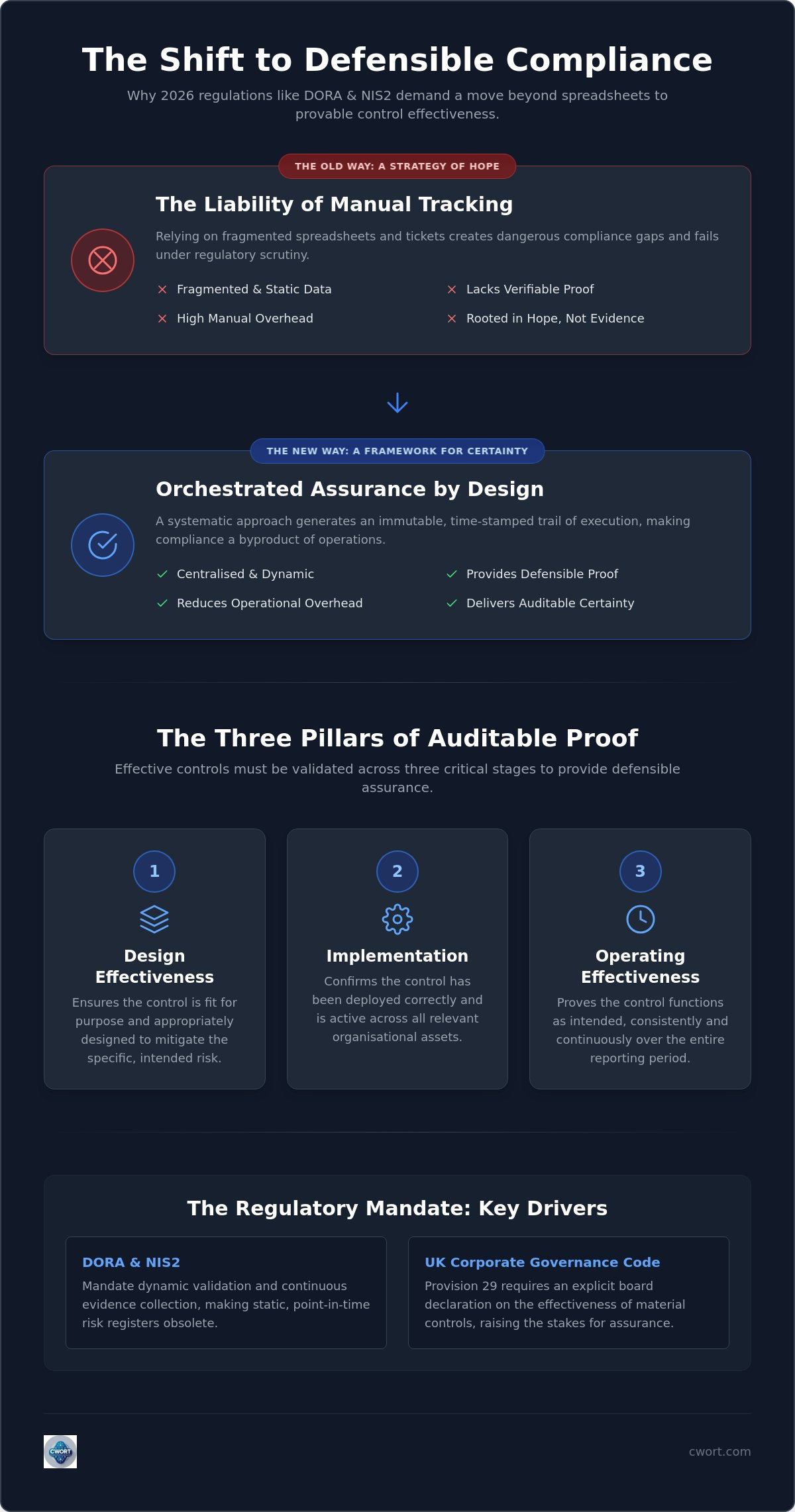
In the high-stakes regulatory environment of 2026, a spreadsheet is no longer a shield; it's a liability. Relying on fragmented Excel trackers and Jira tickets to survive a DORA or NIS2 audit is a strategy rooted in hope rather than evidence. You've likely felt the mounting pressure to provide definitive proof of control effectiveness whilst struggling to translate raw execution data into the sophisticated assurance that UK regulators now demand. It's a common frustration to have robust security measures in place but lack the structured, auditable trail required to prove they actually work under pressure.
We'll help you bridge this gap by transitioning from assumed compliance to a state of total, defensible certainty. This guide outlines a strategic framework to move beyond administrative tracking and toward orchestrated validation. You'll learn how to generate audit-ready outputs that satisfy the board and regulators alike, all whilst stripping away the manual overhead that currently hampers your compliance teams. We'll examine the shift from manual reconstruction to a systematic approach that makes compliance a natural byproduct of your daily operations.
Key Takeaways
- Understand why 2026 regulations like DORA and NIS2 demand a shift from static, paper-based compliance to active, defensible reporting.
- Discover how to establish definitive proof of control effectiveness by validating the design, implementation, and ongoing operation of your security measures.
- Identify the critical limitations of using general-purpose tools like Excel and Jira for high-stakes audits and how they create dangerous compliance gaps.
- Learn a repeatable framework for mapping controls to specific organisational assets and owners to ensure total accountability and traceability.
- Explore how orchestrated validation replaces manual tracking to generate regulator-ready outputs whilst significantly reducing operational overhead.
Table of Contents
- The Shift from Assumed Compliance to Defensible Proof
- Anatomy of Auditable Proof: What Constitutes Effectiveness?
- Why Spreadsheets and Jira Fail the Effectiveness Test
- Implementing a Validated Execution Workflow
- CWORT: Orchestrating Auditable Assurance by Design
The Shift from Assumed Compliance to Defensible Proof
The era of checkbox compliance has reached its definitive end. By 2026, the UK regulatory environment has pivoted toward a "show, don't tell" model that prioritises active validation over static documentation. Regulators no longer accept a signed policy as evidence of security; they demand proof of control effectiveness that demonstrates a control's ability to perform under stress. This shift marks a transition from "paper-based" compliance, where the mere existence of a control was sufficient, to a regime of defensible proof, where the burden of validation rests entirely on the organisation.
For organisations operating within critical infrastructure, this burden includes securing complex industrial control systems; learn more about specialist OT cyber security consultancy to understand how to validate effectiveness within automation environments.
Central to this change is the UK Corporate Governance Code Provision 29. It requires boards to provide an explicit declaration regarding the effectiveness of their material controls. This isn't a mere administrative formality. It's a high-stakes commitment that necessitates a granular understanding of how internal control frameworks actually function in real-time. You must distinguish between control existence and control effectiveness. A policy exists; a validated process works. Without the latter, your organisation remains exposed to both operational failure and regulatory sanction.
DORA and the New Standard for ICT Risk
DORA has fundamentally altered the requirements for ICT risk management by mandating dynamic validation. Static risk registers are now obsolete. The regulation's technical standards require continuous evidence collection to ensure that digital operational resilience isn't just a theoretical goal but a functional reality. If you can't produce a time-stamped, immutable trail of execution, the regulator will assume the control has failed. This level of scrutiny makes manual tracking impossible to sustain; it demands a move toward automated orchestration to maintain an audit-ready posture.
The Board’s Requirement for Actionable Assurance
Boards are no longer satisfied with vague assurances or fragmented data. They require actionable insights that translate technical control performance into strategic certainty. To meet these expectations, you must identify "material controls" and subject them to rigorous, evidence-backed validation. This process replaces the anxiety of potential audit failure with the calm of auditable certainty. By using a platform like CWORT, organisations can move away from the "compliance gap" inherent in spreadsheets and adopt a system that enforces discipline by design. This transition ensures that board-level declarations are supported by definitive proof of control effectiveness, rather than hopeful assumptions.
Anatomy of Auditable Proof: What Constitutes Effectiveness?
Definitive proof isn't a matter of opinion or anecdotal success. It is the verifiable demonstration that a control achieves its specific, intended outcome under real-world conditions. For UK enterprises in 2026, proof of control effectiveness requires a move away from the traditional point-in-time audit. These snapshots are inherently flawed because they ignore the reality of control decay. Continuous validation provides the only reliable baseline for modern assurance. It shifts the focus from what was true on the day of an audit to what is true every single day of the reporting cycle.
To implement the technical infrastructure needed for this constant oversight, you can check out Trinity Networx, LLC to discover how Remote Monitoring and Management (RMM) enables proactive IT maintenance and continuous validation.
Achieving this level of rigour requires focus on three distinct pillars: design, implementation, and operating effectiveness. Design ensures the control is fit for purpose. Implementation confirms it was deployed correctly across the relevant assets. Operating effectiveness proves it functions consistently over the entire reporting period. The National Audit Office guide on internal control highlights that public accountability depends on this multi-layered approach. Without all three, your assurance is incomplete and remains indefensible under DORA or NIS2 scrutiny.
This rigorous approach to validation is equally vital for physical infrastructure, where the integrity of the building envelope acts as a primary control against environmental risk. To see how these principles apply to property maintenance, you can discover CavClear for specialist damp proofing and cavity wall services that ensure your physical assets remain compliant and resilient.
Binding Evidence to Control Outcomes
The integrity of your proof depends on how evidence is collected and stored. It's not enough to simply upload a document to a shared folder. You must bind evidence directly to the control outcome using tamper-proof mechanisms. Automated metadata plays a crucial role here. It establishes an immutable timeline that proves exactly when, how, and by whom a control was executed. This level of traceability ensures that evidence isn't just present; it's relevant. For a deeper look at the technical standards required for this process, consult our guide on Ensuring Compliance Evidence Integrity.
Separation of Duties as a Proof Variable
A control isn't truly effective if its validation lacks independence. Separation of duties is a fundamental requirement for proof of control effectiveness. The individual responsible for executing a task cannot be the same person who validates its success. Enforcing this independent verification within your workflow eliminates bias and prevents the manipulation of results. It transforms a simple task list into a disciplined audit trail that stands up to the most rigorous regulatory scrutiny. If you're ready to move beyond manual tracking, you can book a demonstration of our orchestration engine to see how these pillars are enforced by design.
Why Spreadsheets and Jira Fail the Effectiveness Test
General-purpose task managers like Jira and Excel are built for productivity, not for the exacting standards of regulatory oversight. When you rely on these tools to manage complex obligations like DORA or NIS2, you create a dangerous "Compliance Gap." This gap exists because spreadsheets cannot enforce the separation of duties or provide the immutable audit trail required for definitive proof of control effectiveness. Regulators are increasingly sceptical of Excel-based trackers precisely because they are easily manipulated, lack version control, and offer no real-time validation of whether a control actually worked at the point of execution. A spreadsheet can tell you that a task was marked as "done," but it cannot prove that the underlying control achieved its intended outcome.
The reliance on fragmented data across siloed enterprise tools creates a state of perpetual reactive compliance. Instead of having a clear, real-time view of your resilience, you're forced into a cycle of manual reconstruction. This process is inherently prone to error. It relies on the memory and availability of individuals rather than the integrity of a system. When an auditor asks for evidence, the scramble to find the right file or ticket leads to audit fatigue and undermines the credibility of your entire compliance programme. Defensible proof must be a structured byproduct of execution, not a retrospective narrative assembled under pressure.
The Limitations of General GRC Tools
Most traditional GRC platforms function as little more than risk databases. They store information but fail to orchestrate the underlying activities. They lack the execution-level enforcement necessary to guarantee compliance by design. In contrast to standard Jira workflows, which focus on task completion rather than regulatory validation, Regulatory Compliance Workflow Automation ensures that every action is bound to a specific regulatory requirement. This system-led approach replaces the hope of compliance with the certainty of orchestrated enforcement.
The True Cost of Manual Evidence Gathering
The hidden burden of manual systems is the "Audit Tax" levied on your internal subject matter experts. Reconstructing evidence from fragmented emails and siloed tools takes weeks of manual effort, leading to inevitable errors. This fragmented approach often fails to meet the expectations set out in the Government Functional Standard for Internal Audit, which demands a structured framework to enhance the effectiveness of governance and control. When evidence is gathered manually months after the event, it loses its integrity and fails to provide the board with the real-time insights needed for proof of control effectiveness.
Implementing a Validated Execution Workflow
Constructing a defensible compliance posture requires a methodical, phase-based approach that replaces manual guesswork with disciplined orchestration. It's no longer enough to simply identify a risk; you must orchestrate the response through a structured workflow that generates proof of control effectiveness as a natural byproduct. This transition from abstract policy to concrete execution ensures that every regulatory obligation is met with a validated action. Follow this five-phase framework to build a system that stands up to the most rigorous scrutiny from UK regulators.
This methodical approach is not limited to digital workflows; ensuring the safety of physical assets and personnel requires a similar level of disciplined execution. To see how these standards are applied in high-level security, you can visit Stone Security Services to discover their executive protection and event security services.
- Phase 1: Decomposition. Translate complex regulatory obligations into granular, executable activities that leave no room for interpretation.
- Phase 2: Attribution. Map every control to specific organisational assets and accountable owners to ensure total traceability.
- Phase 3: Orchestration. Execute these activities within a system that mandates evidence capture at the point of action.
- Phase 4: Validation. Enforce independent verification. Under DORA and NIS2, the separation of duties is a critical requirement; the individual performing the task cannot be the one who validates its success.
- Phase 5: Consolidation. Automatically aggregate these validated activities into a regulator-ready audit pack that proves compliance in real-time.
Orchestrating the Compliance Lifecycle
Stop checking boxes and start executing obligations. A truly effective workflow automates the notification and collection of evidence, removing the burden from your internal subject matter experts. By utilising ISO 27001 Control Mapping, you can align your existing security frameworks with new regulatory requirements like DORA. This alignment ensures that your validation efforts are consistent across the entire enterprise, reducing duplication and strengthening your overall resilience posture.
Continuous Monitoring vs. Annual Testing
Annual testing is a relic of the past that fails to account for control decay. You must implement continuous monitoring by setting specific triggers for control re-validation based on time or event-based changes. When a control failure occurs, your system should handle it in real-time without losing the integrity of the audit trail. A live compliance dashboard provides executive oversight, allowing the board to see proof of control effectiveness at any moment, rather than waiting for a quarterly report. This proactive stance transforms compliance from a seasonal hurdle into a continuous strategic advantage. To see this orchestration in action, request a demo of the CWORT platform and learn how to automate your validation workflows.
CWORT: Orchestrating Auditable Assurance by Design
The transition from administrative tracking to definitive proof requires more than a process change; it necessitates a structural shift in how your organisation handles evidence. CWORT replaces the instability of manual tracking with an orchestrated execution engine that enforces regulatory discipline by design. Instead of relying on the memory of individuals or the fragmented logs of task managers, the platform translates your obligations into a sequence of validated actions. This ensures that proof of control effectiveness is captured at the precise moment of execution, creating an immutable record that stands up to the most rigorous UK regulatory standards.
To ensure your IT infrastructure is robust enough to support these rigorous standards, you can learn more about Proactive Networking Ltd and their managed IT support services for SMEs.
Maintaining a single source of defensible truth is the only way to survive the high-stakes audits of 2026. CWORT provides this by binding every piece of evidence to a specific control outcome, ensuring that nothing is left to chance. This systematic approach allows leadership to replace the anxiety of potential failure with the calm of auditable certainty. You no longer need to spend weeks reconstructing timelines or searching for missing files; the system generates regulator-ready audit packs and board-level assurance reports in minutes.
For firms managing large-scale technical certifications, this certainty must extend to the integrity of the exams themselves; you can visit Aiseptor to explore research on how AI-assisted cheating is being tackled in the assessment sector.
Replacing Fragmented Systems with One Orchestrator
Siloed enterprise tools often lack the technical rigour required for modern governance. CWORT bridges this gap by integrating with existing enterprise frameworks like NIS2 to create a unified compliance environment. By eliminating the need for manual audit reconstruction, you empower your consulting teams and internal subject matter experts to focus on resilience rather than administration. The platform provides clear execution paths that enforce the separation of duties, ensuring that your proof of control effectiveness remains untainted by bias or error.
Getting Started with Evidence-Based Validation
Achieving DORA and NIS2 readiness doesn't have to be a reactive struggle. The path forward begins with mapping your current controls into a validated model that prioritises execution over documentation. By moving your compliance activities into an orchestrated environment, you build a sustainable framework for long-term operational resilience. This proactive strategy ensures that your organisation is always audit-ready, regardless of when the regulator calls. Request a CWORT demonstration to see validated execution in action and discover how to transform your compliance obligations into definitive, evidence-backed assurance.
Securing Your Regulatory Future through Defensible Evidence
Transitioning from assumed compliance to definitive assurance isn't merely an administrative upgrade; it's a strategic necessity. The 2026 regulatory landscape demands that you move beyond static documentation and embrace a model of continuous, orchestrated validation. By replacing fragmented spreadsheets with a disciplined execution engine, you eliminate the "Compliance Gap" and ensure that your organisation remains resilient under the scrutiny of DORA and NIS2. This systematic approach transforms proof of control effectiveness from a manual burden into a structured, auditable byproduct of your daily operations.
CWORT serves as your UK-based strategic partner, providing a robust platform for audit-ready evidence binding and total transparency. Don't let the anxiety of upcoming audits dictate your operational pace. Shift your focus from reactive reconstruction to proactive certainty. Orchestrate your compliance validation with CWORT today to secure your DORA and NIS2 readiness. You can replace operational uncertainty with the calm of auditable truth, ensuring your enterprise is always prepared for the next regulatory challenge.
Frequently Asked Questions
What is the primary difference between a control and proof of its effectiveness?
A control is the mechanism designed to mitigate a specific risk, whilst proof of its effectiveness is the empirical evidence that the mechanism achieves its intended outcome. For example, a password policy is a control; a system log showing that 100% of logins utilised multi-factor authentication is the proof. Defensible validation requires verifying the design, implementation, and operating consistency of the control over a defined period.
How does DORA change the requirements for proving control effectiveness?
DORA shifts the focus from static documentation to dynamic, continuous validation of ICT risk management. It mandates that financial entities provide granular proof of control effectiveness through time-stamped, immutable evidence trails. Regulators now expect to see that controls are tested and functional under stress, rather than just existing on paper. This requires a transition from "point-in-time" audits to a state of constant, auditable readiness.
Can I use Jira to prove control effectiveness for a DORA audit?
No, Jira is generally insufficient for proving effectiveness because it lacks the regulatory rigour and immutable evidence binding required for high-stakes audits. Jira is a task manager, not a validation engine. It doesn't enforce the separation of duties or provide a tamper-proof audit trail that links technical execution directly to regulatory obligations. Relying on it often results in a "compliance gap" that fails regulator scrutiny.
What types of evidence are considered "auditable" by UK regulators?
UK regulators prioritise objective, system-generated evidence such as configuration logs, time-stamped screenshots, and cryptographically signed metadata. Qualitative evidence, like email confirmations or manual sign-offs, is increasingly viewed as secondary or insufficient. The most valuable evidence is that which is bound directly to the control outcome without manual intervention, ensuring the data remains untainted by human error or intentional manipulation.
How often should control effectiveness be tested in a regulated environment?
Regulated environments are moving away from annual testing toward a model of continuous or trigger-based validation. The frequency depends on the criticality of the control and the volatility of the underlying asset. High-risk controls under DORA or NIS2 often require monthly or even weekly validation. This ensures no decay in effectiveness occurs between audit cycles and maintains a state of constant compliance.
What is separation of duties, and why is it critical for control validation?
Separation of duties is the requirement that the person executing a control must be different from the person validating its success. This is critical for proof of control effectiveness because it eliminates bias and prevents the manipulation of evidence. It ensures that validation remains independent and objective. Without this separation, your audit trail lacks the integrity required to satisfy modern UK governance standards.
How does CWORT help in generating board-level compliance reports?
CWORT translates granular execution data into high-level strategic insights by aggregating validated evidence into real-time dashboards. It replaces technical jargon with clear assurance statuses, allowing the board to declare control effectiveness with absolute confidence. These reports provide a direct line of sight from regulatory obligations to definitive, evidence-backed proof. This replaces quarterly guesswork with a permanent state of auditable certainty.
Is automated evidence collection enough to satisfy NIS2 requirements?
Automated collection is a vital component, but NIS2 also requires independent validation and human oversight to ensure total accountability. Automation ensures the consistency of data gathering, whilst the validation layer confirms that the collected evidence actually satisfies the regulatory requirement. A complete posture requires both automated orchestration and a disciplined workflow that enforces the separation of duties and independent verification.
Disclaimer
The content on this site is provided for general information and educational purposes only. It does not constitute legal, regulatory, financial, or professional advice. CWORT provides AI-assisted insights and workflow automation, but all compliance decisions remain the responsibility of your organisation and its management. Always seek qualified legal or regulatory guidance for decisions relating to the UK NIS Regulations, CAF, DORA, NIS2, ISO 27001, or other obligations.
Related posts
The Evolution of the Enterprise GRC Validation Tool: From Tracking to Orchestration in 2026
Stop chasing compliance ghosts in spreadsheets. Create a single source of truth for compliance with GRC orchestration to master NIS2, DORA, and UK audit dema...
Reducing Audit Preparation Time and Costs: A Strategic Guide for UK Enterprises
Tired of costly audit seasons? Our guide for UK enterprises shows you how to stop the manual scramble, reducing audit preparation time and costs with automat...
Streamlining Regulatory Compliance Processes: From Manual Tracking to Orchestrated Validation
Stop wasting money on manual compliance. Learn about streamlining regulatory compliance processes to reduce personal liability under DORA & NIS2 and gain aud...
Article by
Michael Iyiola
Co-Founder, CWORT
Michael Iyiola is a co-founder of CWORT and a Cyber and AI Security Engineer with deep experience in vulnerability management, detection engineering and operational resilience across UK critical national infrastructure, including rail, energy and financial services. At CWORT, he designs scalable, evidence-driven workflows that help teams meet modern regulatory and security demands.
Build Your Foundation of Auditable Certainty
Take control of your regulatory obligations and secure your infrastructure with CWORT.