UK NIS Framework Implementation Guide: Orchestrating Audit-Defensible Compliance

Michael Iyiola
Co-Founder, CWORT
Avoid £17m fines with our UK NIS framework implementation guide. Transition from manual tracking to an audit-defensible model for NCSC CAF 4.0 compliance.

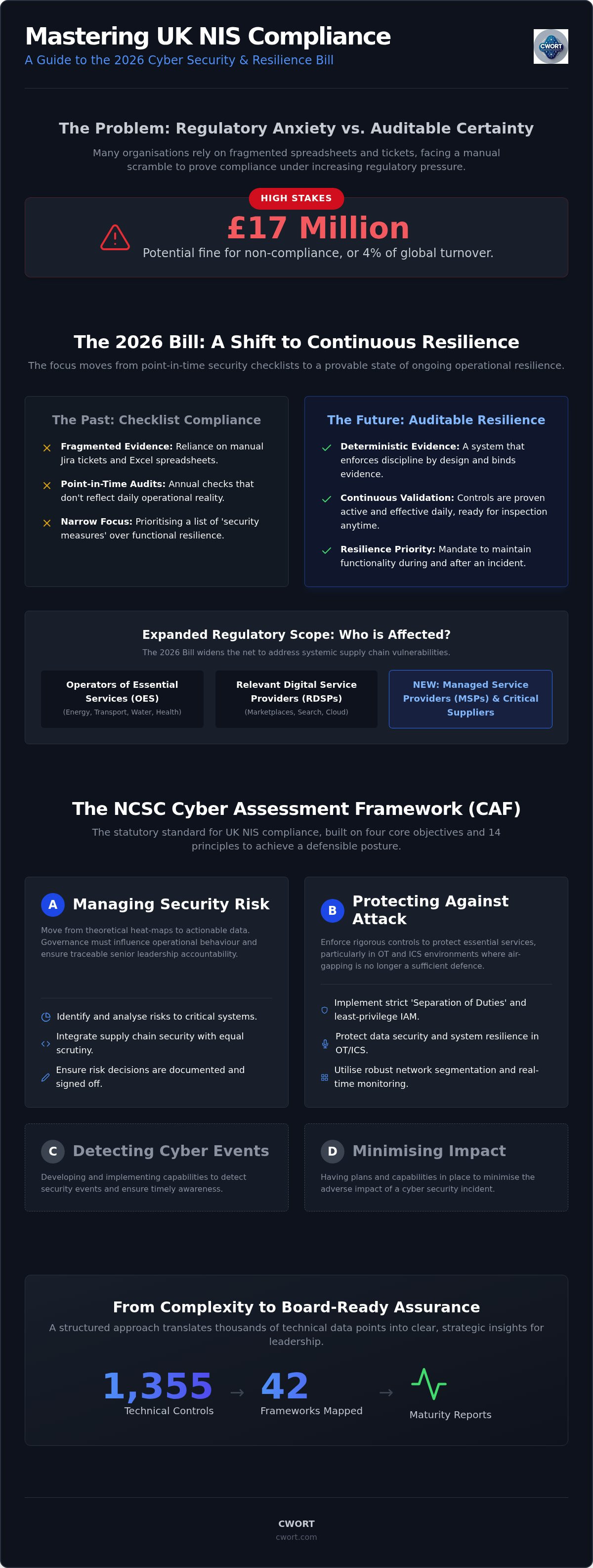
What if the only thing standing between your organisation and a £17 million fine is a fragmented collection of Jira tickets and Excel spreadsheets? For many critical infrastructure providers, the reality of compliance is a manual scramble to reconstruct evidence whilst facing the looming pressure of the 2026 Cyber Security and Resilience Bill. This UK NIS framework implementation guide moves beyond mere administrative tracking. It provides a structured path to transition from a state of regulatory anxiety to one of auditable certainty.
You likely recognise that spreadsheets cannot prove separation of duties or provide the deterministic evidence binding required by modern regulators. You need a system that enforces discipline by design. This guide details how to master the transition from a regulatory obligation to an evidence-backed assurance model. We will examine the orchestration of NCSC CAF 4.0 controls, the elimination of manual audit preparation, and the generation of board-ready maturity reports that satisfy the most rigorous professional scrutiny.
Key Takeaways
- Identify how the 2026 Cyber Security and Resilience Bill expands regulatory scope to include managed service providers and critical suppliers.
- Align your security strategy with the four core objectives of NCSC CAF 4.0 to satisfy statutory requirements and enhance resilience.
- Use this UK NIS framework implementation guide to replace manual tracking with a deterministic, audit-defensible operating model.
- Follow a structured phased approach to configure assessment blueprints that map directly to your specific organisational risk profile.
- Translate complex technical outcomes into board-ready reports by leveraging a taxonomy of 1,355 controls mapped across 42 frameworks.
Table of Contents
- Navigating the UK NIS Framework: From Legislation to Implementation
- Leveraging the NCSC CAF: The Foundation of UK NIS Compliance
- Beyond Spreadsheets: Orchestrating an Audit-Ready Operating Model
- A Step-by-Step Guide to UK NIS Framework Implementation
- Securing Board-Level Assurance with CWORT Compliance Intelligence
Navigating the UK NIS Framework: From Legislation to Implementation
The UK regulatory environment for critical infrastructure has reached a point of no return. Whilst the Network and Information Systems (NIS) Regulations 2018 established the initial baseline, the 2026 Cyber Security and Resilience Bill introduces a more aggressive enforcement regime. This legislation doesn't just suggest security; it mandates a level of operational integrity that can withstand sophisticated threats. For any leadership team, this UK NIS framework implementation guide serves as the blueprint for moving from abstract risk to concrete, auditable proof.
Implementation oversight falls to specific "Competent Authorities" such as Ofgem for energy, Ofwat for water, or the ICO for digital services. These bodies work alongside the NCSC to ensure organisations meet statutory obligations. This framework often intersects with other key legislation, such as the Data Protection Act 2018, creating a complex web of governance. Failure to align these systems carries a heavy price. Beyond the headline fines of £17 million or 4% of global turnover, a breach signals an operational collapse that can permanently erode public trust and stakeholder value.
Who is in Scope for UK NIS in 2026?
Defining your status is the critical first step. Operators of Essential Services (OES) traditionally include those in the energy, transport, water, and health sectors. Relevant Digital Service Providers (RDSPs) encompass online marketplaces, search engines, and cloud computing services. Under the latest UK regulations, managed service providers (MSPs) and data centres are now formally included within the scope to address systemic supply chain vulnerabilities.
The Shift from Compliance Checklists to Cyber Resilience
The UK government has pivoted its focus. It prioritises "resilience" over mere "security measures," a distinction that demands organisations maintain functionality during and after an incident. This shift is a core pillar of the National Cyber Strategy, which expects entities to move away from annual "point-in-time" audits. Modern implementation requires a continuous validation model. You must prove that controls are active and effective every day, not just during an audit window. This transition is essential for building a deterministic system where evidence is always ready for inspection.
Leveraging the NCSC CAF: The Foundation of UK NIS Compliance
The NCSC Cyber Assessment Framework (CAF) represents the statutory standard for OES compliance in the United Kingdom. It shifts the focus from administrative checkboxes to measurable outcomes. This UK NIS framework implementation guide highlights that the CAF is built upon four primary objectives: managing risk, protecting against attacks, detecting events, and minimising impact. To achieve a defensible posture, you must map the 14 principles of the CAF directly to your technical control environment. Using Indicators of Good Practice (IGPs), organisations can define clear maturity targets that move beyond basic achievement to a state of sustained resilience.
Objective A: Managing Security Risk
Governance must influence operational behaviour, not just sit in a policy folder. Effective risk management requires strategies that move beyond theoretical heat-maps and into the realm of actionable data. You must identify every critical system and the specific risks they face, ensuring that supply chain security is a core component of your implementation. The 2026 landscape demands that you treat third-party providers with the same level of scrutiny as internal assets. Establish clear lines of accountability and ensure that risk decisions are documented, traceable, and signed off by senior leadership to survive a Competent Authority inspection.
Objective B: Protecting Against Cyber Attack
Service protection starts with the rigorous enforcement of "Separation of Duties". Identity and access management (IAM) remains a primary hurdle for UK NIS auditors; you must prove that access is granted on a least-privilege basis and regularly reviewed. In Operational Technology (OT) and Industrial Control Systems (ICS) environments, data security and system resilience are paramount. You cannot rely on air-gapping as a sole defence. Instead, implement robust network segmentation and real-time monitoring to protect the integrity of essential services. To see how these principles map to a live, orchestrated environment, you can request a demo of a system designed for deterministic compliance results.
Beyond Spreadsheets: Orchestrating an Audit-Ready Operating Model
Manual tracking is the single greatest liability in modern governance. Most organisations fall into the "Spreadsheet Trap," relying on static trackers that fail under the pressure of a formal inspection. This UK NIS framework implementation guide advocates for a shift toward a deterministic system. In such a model, identical evidence must always yield the same compliance result, ensuring that your posture remains consistent regardless of the individual performing the assessment. This level of reproducibility is impossible to achieve whilst toggling between Jira tickets, Excel spreadsheets, and internal wikis.
Replace these fragmented tools with a single orchestrated validation engine. This approach enables an "Assess Once, Report Many" strategy that is essential for complex environments. By leveraging a centralised taxonomy of 1,355 controls mapped across 42 frameworks, you can satisfy requirements for UK NIS, NIS2, and ISO 27001 simultaneously. This reduces manual effort and ensures that your compliance posture reflects real-time operational truth rather than a creative writing exercise performed the night before an audit.
The Danger of Manual Evidence Reconstruction
Regulators increasingly reject evidence gathered "after the fact." If you are reconstructing logs or narrative justifications weeks after a control activity occurred, you are failing the test of ensuring compliance evidence integrity. Audit-defensible compliance requires an immutable history. Every control change and validation activity must be stamped with a clear identity and timestamp. This creates a chronological record that provides auditors with the defensible truth they require, eliminating the anxiety of manual reconstruction and proving that your governance is a living process.
Orchestrating Capability and Capacity
Maturity is not a binary state. You must measure not just if a control exists, but how well it functions at scale. Assessing organisational capacity is vital; you need to know if your team can maintain these standards whilst scaling operations. Use maturity assessment heat-maps to visualise gaps in capability. These visual tools translate technical debt into a language that boards understand. They drive investment decisions by showing exactly where more resources are needed to bridge the gap between current performance and statutory requirements, moving the conversation from abstract risk to concrete capability.
A Step-by-Step Guide to UK NIS Framework Implementation
Execution is the bridge between regulatory obligation and evidence-based proof. This UK NIS framework implementation guide provides a methodical, five-phase approach to building a defensible posture. It replaces the anxiety of potential failure with the calm of auditable certainty by enforcing discipline by design.
- Phase 1: Define and import your maturity model based on the NCSC CAF. This establishes the baseline for all subsequent validation activities.
- Phase 2: Configure the assessment blueprint to match your specific organisational scope. You must include all critical systems and managed service providers.
- Phase 3: Assign clear ownership and enforce separation of duties. This structural discipline is vital for satisfying the most rigorous auditors.
- Phase 4: Capture real-world evidence directly from SIEM, EDR, and IAM tools. Automated data ingestion eliminates the risks associated with manual reconstruction.
- Phase 5: Calculate maturity and confidence scores based on deterministic logic. This removes the subjectivity that often undermines compliance reports.
To see how these phases translate into a live operating model, request a demo of our orchestrated validation platform.
Step 6: Prioritising Remediation with a Business Lens
Identify the most critical gaps and rank them by risk, effort, and expected value. Effective remediation isn't about fixing everything at once; it's about creating actionable roadmaps that operational teams can actually execute. By leveraging regulatory compliance workflow automation, you can ensure that remediation tasks are tracked and validated in real-time. This prevents the drift that often occurs after an initial assessment and ensures your resources are focused on the highest-impact vulnerabilities.
Step 7: Continuous Reassessment and Audit Readiness
Transition your organisation to a continuous operating-model intelligence cycle. This move away from point-in-time audits ensures your implementation is audit-defensible at any given moment. You should be able to generate regulator-ready outputs instantly, without the need for manual reconstruction or the frantic gathering of evidence. This state of total assurance replaces the anxiety of potential failure with a rigorous, repeatable process that survives the most demanding professional scrutiny. Continuous validation is the only way to maintain resilience whilst scaling operations in a volatile threat environment.
Securing Board-Level Assurance with CWORT Compliance Intelligence
Boards of Directors require definitive proof of resilience, not a collection of raw technical logs. CWORT bridges the gap between granular security activities and strategic oversight by translating technical control outcomes into sophisticated maturity reports. This UK NIS framework implementation guide emphasises that true assurance comes from total traceability. Within the platform, 98.6% of active controls carry direct framework references. This ensures transparency for every validation activity, allowing leadership to see exactly how specific technical successes contribute to statutory compliance.
The Compliance Intelligence module provides a "report once, satisfy many" architecture. It maps a single assessment to 42 different frameworks, including the NCSC CAF and ISO 27001. Organisations can also protect their unique intellectual property through the "Bring Your Own Content" (BYOC) capability. This allows you to integrate proprietary standards alongside global regulations, maintaining a bespoke governance model whilst ensuring all activities remain audit-defensible. It transforms compliance from a reactive burden into a governed strategic asset.
Deterministic Results for Total Confidence
CWORT functions as an orchestration layer that sits above your existing security stack. It aggregates evidence from disparate tools into a unified, deterministic view. This eliminates the subjectivity often found in manual assessments. By using NCSC CAF assessment software, you ensure that identical evidence always yields the same compliance result. The platform also includes an AI advisory module. This provides intelligent suggestions to improve control effectiveness whilst preserving the integrity of the underlying data, ensuring that your results remain evidence-backed and beyond reproach.
Accelerating Your UK NIS Journey
Speed shouldn't compromise structural integrity. A governed reusable model service offers far greater long-term value than rapid "document-to-assessment" conversions that lack depth. You can accelerate your implementation by starting with a controlled pilot. This validates your compliance workflow and ensures that your evidence-gathering processes are robust before a full-scale rollout. This methodical approach builds momentum and provides early wins for stakeholders. If you're ready to move beyond fragmented trackers, you can enquire about a CWORT implementation session to start building your audit-defensible operating model today.
Mastering the Transition to Audit-Defensible Assurance
UK NIS compliance in 2026 demands more than administrative tracking; it requires a rigorous, deterministic approach to evidence. This UK NIS framework implementation guide has detailed how to move beyond fragmented tools and into a state of total auditable certainty. By aligning with the NCSC CAF and replacing manual trackers with an orchestrated validation engine, you replace the anxiety of regulatory failure with a disciplined, reproducible operating model. You now have the blueprint to translate technical outcomes into board-ready maturity reports that withstand professional scrutiny.
Achieving this level of structural integrity is a strategic necessity for critical national infrastructure. CWORT provides the essential orchestration layer, offering a taxonomy library of 1, 355 controls and deterministic, reproducible scoring that regulators expect. Trusted by critical national infrastructure operators, our platform ensures your compliance posture is always ready for inspection. Book a CWORT implementation session to orchestrate your UK NIS compliance and secure your organisation's future. You've seen the path from obligation to evidence; now is the time to enforce that discipline across your entire estate.
Frequently Asked Questions
What is the difference between the UK NIS Regulations and the EU NIS2 Directive?
UK NIS and EU NIS2 share an objective of increasing national resilience, but they operate under separate legal jurisdictions. The UK's primary regime is based on the NIS Regulations 2018 and the Cyber Security and Resilience Bill 2026. Whilst the UK aligns with many NIS2 principles, such as expanding scope to managed service providers, it remains a distinct regime managed by UK Competent Authorities. This UK NIS framework implementation guide helps organisations navigate these specific British requirements whilst maintaining alignment with international standards.
How does the NCSC Cyber Assessment Framework (CAF) relate to UK NIS implementation?
The NCSC Cyber Assessment Framework (CAF) is the official methodology used by UK regulators to measure compliance with the NIS Regulations. It provides a structured approach based on 14 principles and four high-level objectives. Alignment with CAF 4.0 is now a statutory requirement under the latest 2026 legislation. By using the CAF, organisations can translate abstract security concepts into measurable outcomes that satisfy Competent Authorities like Ofgem or the ICO during a formal inspection.
What are the penalties for non-compliance with the UK NIS framework in 2026?
Penalties under the 2026 Cyber Security and Resilience Bill follow a tiered structure designed to enforce accountability. Serious breaches can result in fines reaching £17 million or 4% of global turnover, whichever is higher. Less severe violations are capped at £10 million or 2% of global turnover. These financial risks, combined with the potential for operational collapse and reputational damage, make a robust, evidence-backed implementation strategy a critical priority for senior leadership and boards.
Can I use ISO 27001 to satisfy UK NIS requirements?
ISO 27001 provides a strong foundation for information security management, but it doesn't automatically satisfy every UK NIS requirement. Regulators specifically look for CAF alignment. However, you can leverage your existing ISO controls by mapping them to the CAF taxonomy. CWORT enables this through a "report once, satisfy many" model. This approach ensures that a single validation activity can provide evidence for both ISO 27001 and the specific statutory obligations of the UK NIS framework.
What organisations are classified as "Operators of Essential Services" (OES)?
Operators of Essential Services (OES) traditionally include organisations in the energy, transport, water, and health sectors. However, the 2026 Bill significantly expands this classification. Managed service providers (MSPs), data centres, and critical suppliers to essential services are now formally included. This change addresses systemic supply chain vulnerabilities. If your organisation provides services that the UK's economy or public safety depends upon, you likely fall within the scope of these updated regulations.
How often should a UK NIS assessment be conducted?
Regulators are moving away from annual, point-in-time assessments in favour of continuous validation. Whilst traditional audits might occur every one to two years, the expectation is now for "continuous operating-model intelligence." Organisations must demonstrate that their controls are effective every day, not just during an audit window. Implementing a system that provides real-time visibility and immutable audit history ensures you are always ready for a spot inspection by your Competent Authority.
What role does evidence binding play in a UK NIS audit?
Evidence binding is the process of linking specific control outcomes to immutable data from your security stack, such as SIEM or IAM logs. In a UK NIS audit, this prevents the risk of manual evidence reconstruction, which regulators increasingly reject. By binding evidence directly to the control, you provide a deterministic and reproducible proof of compliance. This level of traceability is essential for building a defensible posture that survives the most rigorous professional scrutiny.
Why is separation of duties a mandatory requirement for UK NIS?
Separation of duties is a fundamental governance control designed to prevent fraud and reduce the risk of accidental errors. It ensures that no single individual has total control over a critical process from design to validation. For UK NIS compliance, auditors require proof that validation activities are performed by someone other than the person responsible for the control's operation. Enforcing this discipline by design within your operating model is a mandatory step for achieving audit-defensible assurance.
Disclaimer
The content on this site is provided for general information and educational purposes only. It does not constitute legal, regulatory, financial, or professional advice. CWORT provides AI-assisted insights and workflow automation, but all compliance decisions remain the responsibility of your organisation and its management. Always seek qualified legal or regulatory guidance for decisions relating to the UK NIS Regulations, CAF, DORA, NIS2, ISO 27001, or other obligations.
Related posts
NIS2 Compliance for Critical Infrastructure: A Strategic Guide to Evidence-Based Validation (2026)
Master NIS2 compliance for critical infrastructure. Our guide helps you move beyond manual tracking to build an auditable, evidence-based system and avoid hu...
Four ways to understand and reduce human error in compliance
Discover four ways of reducing the risk of human error in compliance, investigating near misses and improving controls, procedures and cyber risk management.
How to Demonstrate Control Effectiveness to Regulators: A Strategic Guide
Learn how to demonstrate control effectiveness to regulators with our guide. Shift from chaos to an evidence-based, audit-ready compliance programme today.
Article by
Michael Iyiola
Co-Founder, CWORT
Michael Iyiola is a co-founder of CWORT and a Cyber and AI Security Engineer with deep experience in vulnerability management, detection engineering and operational resilience across UK critical national infrastructure, including rail, energy and financial services. At CWORT, he designs scalable, evidence-driven workflows that help teams meet modern regulatory and security demands.
Build Your Foundation of Auditable Certainty
Take control of your regulatory obligations and secure your infrastructure with CWORT.