UK NIS Framework Management Tool: From Obligations to Evidence

Michael Iyiola
Co-Founder, CWORT
Discover how a UK NIS framework management tool turns regulatory obligations into defensible CAF evidence, clear accountability and audit-ready assurance.

What should a UK NIS framework management tool actually do to demonstrate progress and assurance? More than list requirements and mark actions complete. It should connect UK NIS expectations to CAF outcomes, accountable owners and evidence, so teams can show what has been done, what remains blocked and whether controls are achieving their intended outcomes.
If requirements, responsibilities and evidence sit in disconnected records, a green status alone won’t give leaders a defensible view of compliance. The NCSC Cyber Assessment Framework (CAF) provides the assessment context, but organisations still need a disciplined way to turn expectations into operational work and reviewable proof.
This article explains how to assess a tool against real UK NIS workflows: how it should link obligations to CAF-aligned controls, assign ownership, bind evidence to activity and control outcomes, and make progress visible. It also explains how a compliance validation system such as CWORT supports evidence-backed execution, with separation of duties enforced by design, so assurance is built into the work rather than reconstructed afterwards.
Key Takeaways
- Assess a UK NIS framework management tool by how it connects obligations to accountable work, evidence and reviewable outcomes.
- Trace applicable requirements through controls and assigned activities to the evidence that supports assessment and improvement.
- Use spreadsheets for small, bounded exercises, but consider whether ownership, evidence links, audit history and reporting will remain reliable as governance needs grow.
- Implement in stages: define scope, pilot relevant controls, test governance and review whether reporting meets leadership needs.
- Look for compliance validation that links execution evidence to control outcomes, with role assignment and separation of duties built into the process.
Table of Contents
- What a UK NIS framework management tool should help you achieve
- How a UK NIS management tool connects requirements, controls and evidence
- Can spreadsheets manage UK NIS, or do you need a dedicated tool?
- How to implement a UK NIS framework management tool
- How CWORT validates UK NIS execution and supports assurance
What a UK NIS framework management tool should help you achieve
A useful management tool does more than hold a list of requirements. It gives teams a governed way to interpret applicable obligations, coordinate accountable activity and connect that work to evidence. The aim is to make the route from expectation to assessment and improvement visible, with decisions and responsibilities clear enough to review.
A UK NIS framework management tool turns applicable requirements into owned work, links that work to evidence and makes the resulting control outcomes reviewable. The practical test is whether the organisation can explain not only its current status, but who is responsible, what has happened, what supports the assessment and what needs attention next.
How UK NIS expectations relate to the Cyber Assessment Framework
The Network and Information Systems Regulations 2018 establish regulatory obligations for organisations that fall within their scope. The NCSC Cyber Assessment Framework (CAF) provides an approach for evaluating cyber resilience against relevant outcomes. CAF is not legislation, and using it does not replace determining which legal requirements apply to a particular organisation.
Applicability depends on an organisation’s services and circumstances, while competent-authority responsibilities are sector-specific. Establish scope against current official guidance and relevant regulatory direction before mapping requirements to CAF. The NCSC’s CAF v4.0 sets out the assessment framework, but interpretation must still connect applicable obligations to the organisation’s actual services, risks and controls. A tool should preserve that distinction rather than treating every CAF outcome as a standalone legal duty or assuming one mapping fits every organisation.
What management teams need to see beyond a compliance status
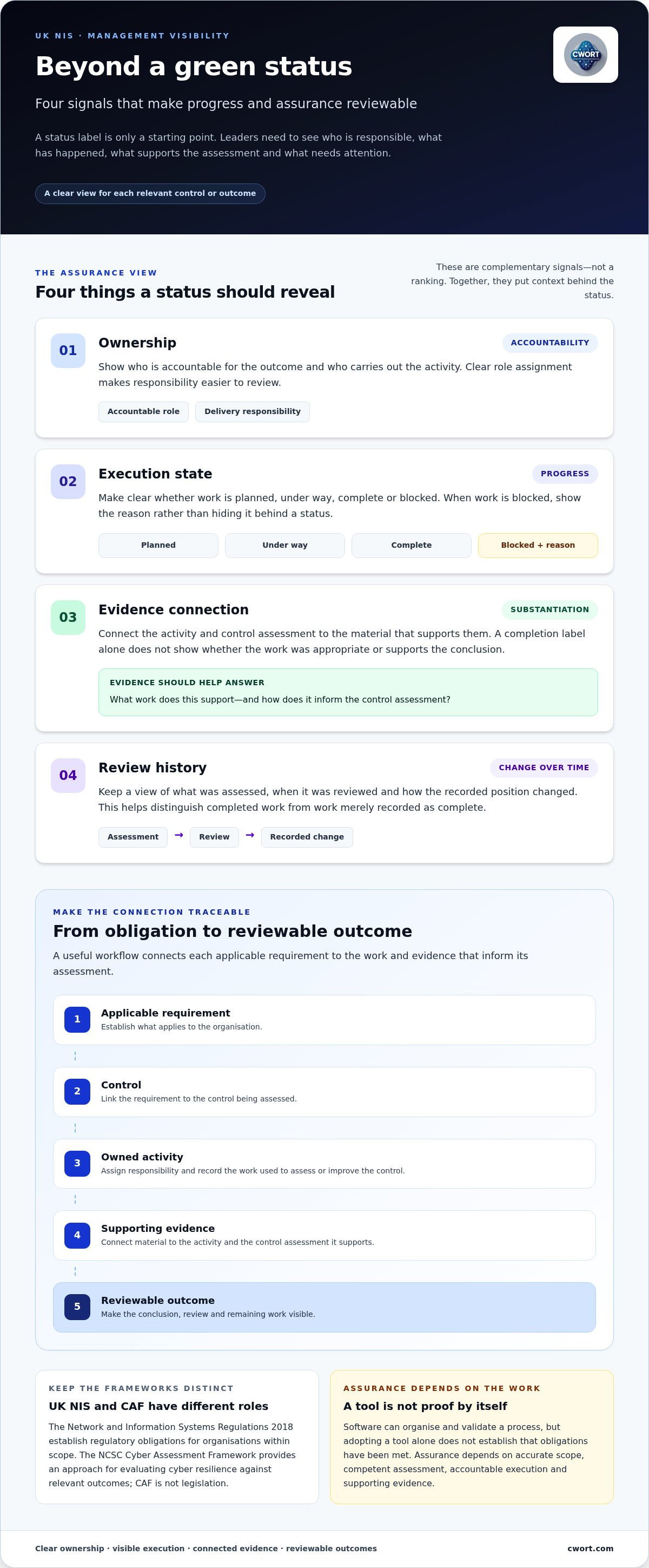
A status label such as “in progress” is only a starting point. Without context, it can conceal a missed dependency, an unclear owner or evidence that doesn’t support the conclusion. Leaders need a clear line of sight from assessment to execution and review, so they can distinguish completed work from work that is merely recorded as complete.
For each relevant control or outcome, a management view should make it possible to establish:
- Ownership: who is accountable for the outcome and who carries out the activity.
- Execution state: whether work is planned, under way, complete or blocked, with the reason for any blockage visible.
- Evidence connection: what material supports the activity and control assessment, rather than presenting a status without substantiation.
- Review history: what was assessed, when it was reviewed and how the recorded position changed.
These connections help teams give leadership a credible progress picture and make assessment discussions with auditors or regulators more structured. They also help practitioners identify missing evidence and outcomes that need further work. Software can organise and validate the process, but adopting a tool alone doesn’t establish that obligations have been met. Assurance depends on accurate scope, competent assessment, accountable execution and evidence that supports the conclusions reached.
How a UK NIS management tool connects requirements, controls and evidence
A traceable workflow links each applicable requirement to the control that addresses it, the activity used to assess or improve that control, the evidence produced and the outcome reached. This creates a chain that can be examined in either direction: from an obligation to its supporting work, or from a piece of evidence back to the conclusion it informs.
Evidence-linked validation shows what an activity supports and why, while a standalone progress record shows only that someone changed a status. That distinction matters. A completion label without supporting material can’t explain whether the work was appropriate, who reviewed it or what the result means for the control.
Turning requirements into owned execution
Start by establishing which requirements apply, then translate them into controls that can be assessed. Break each control into defined activities, assign an accountable owner and identify what input or output will demonstrate progress. Subject-matter experts can contribute knowledge at relevant checkpoints, while the people responsible for delivery provide evidence of the work performed. These are governance decisions, not clerical details. Role assignment clarifies accountability, and separation of duties helps distinguish execution from review.
For example, in a hypothetical assessment, an organisation identifies an applicable control concerning access management. It assigns an owner to assess the process, asks the relevant subject-matter expert to provide input at a review checkpoint, then records the activity and supporting evidence. A reviewer considers whether that evidence supports the control outcome. This example illustrates a workflow, not a statement of any particular UK NIS requirement.
- Interpret: identify the applicable requirement and its relationship to the control being assessed.
- Assign: set the accountable role, delivery activity and review responsibility.
- Execute: carry out the activity and record its state, including any blockage or further work required.
- Substantiate: connect relevant evidence to the activity and the control outcome it informs.
- Review: record the assessment and rationale, then update the outcome as work or evidence changes.
Binding evidence to activity and control outcomes
Evidence has limited assurance value when it sits in a shared folder without context. A reviewer needs to understand what it relates to, why it is relevant and whether it supports the stated outcome. Linking evidence to the specific activity and control makes that relationship clearer. Recording review history and status changes helps preserve how the conclusion developed over time.
This is evidence provenance in practice: retain the connection between the source material, the work it supports and the assessment that relies on it. A changed status should not erase the story behind the change. The record should show what was reviewed, what conclusion followed and whether further action remains. For teams exploring how to structure this chain in a compliance validation system, see how evidence-linked compliance validation works.
Can spreadsheets manage UK NIS, or do you need a dedicated tool?
There isn’t one answer for every organisation. A spreadsheet can be practical for a small, bounded assessment with stable scope, few contributors and straightforward evidence needs. The decision changes when work spans teams, requirements evolve or leaders need assurance that connects progress to supporting evidence. Compare the approaches against the governance your process requires, not simply the number of features on a product list.
When spreadsheets or general workflow tools may be enough
For a contained exercise, a well-managed spreadsheet or general workflow tool may help allocate activities and record findings. Control access, retain version history and make each evidence reference specific enough for a reviewer to locate and understand it. If contributors can maintain these controls consistently and the scope remains manageable, replacing existing tools may add unnecessary complexity. Reassess as the work expands or the audit trail becomes harder to maintain.
- Ownership: A spreadsheet can name an owner, but responsibility and review roles may depend on consistent upkeep. A dedicated system can structure role assignment.
- Evidence linkage: A spreadsheet can store references, but the link between evidence, activity and outcome may need to be maintained manually. A validation system binds these relationships into the execution record.
- Audit history: File versions can show changes, but may not explain the assessment rationale or how an outcome developed. Look for review history that preserves this context.
- Separation of duties: A general tool may record different contributors, but the process must ensure execution and review are appropriately separated. In CWORT, separation of duties is enforced by design.
- Reporting: Spreadsheets can support summaries, but teams need a reliable route from each reported status to its supporting work and evidence.
What a dedicated UK NIS validation system adds
A dedicated UK NIS framework management tool should do more than coordinate actions. Assess whether it maps applicable obligations to controls and defined execution activities, assigns accountable roles, and connects evidence to both activity state and control outcomes. This distinguishes workflow coordination from compliance validation: the former records that work is moving, while the latter supports a reasoned view of what the work demonstrates.
Use practical tests when evaluating an approach. Can a reviewer trace an outcome back to the relevant activity and evidence? Can leaders distinguish blocked work from substantiated completion? Does the record retain review history when a control position changes? If the answers depend on stitching together files, messages and separate registers, the governance burden may outweigh the convenience of familiar tools. CWORT provides compliance validation for UK NIS and NCSC CAF, with evidence bound to activity state and control outcomes.
Choose proportionately. Keep spreadsheets where the scope is contained and traceability remains reliable; consider structured validation when ownership, evidence and assurance need to operate as one governed process. Explore CWORT’s compliance validation approach against your workflow and reporting needs.
How to implement a UK NIS framework management tool
Implement in controlled stages. Start with scope and governance, then test a representative workflow before extending it across the organisation. This limits avoidable configuration and process errors, and helps teams confirm that records support meaningful assessment rather than simply producing activity reports.
Define scope, ownership and evidence expectations
Establish which UK NIS obligations apply using current official guidance, and identify the relevant competent authority. Record the rationale, assumptions and exclusions so the assessment boundary is explicit. Before configuring the tool, agree who is accountable for each control, who reviews the work, what evidence is relevant and how statuses such as blocked or complete are used. Clear definitions prevent teams from interpreting the same status differently.
Pilot the workflow before scaling across the organisation
Select a defined assessment area and run it from assignment through evidence review to reporting. Include the people who will perform, oversee and review the work. Test permissions, separation of duties, evidence traceability, audit history and output generation using realistic scenarios, including a blocked activity and a changed assessment. Use the results to refine roles, templates and governance before expanding coverage.
Use this sequence to keep adoption deliberate:
- Set the boundary: document relevant obligations, the assessment area, exclusions and the source used to determine applicability.
- Design the workflow: map selected requirements to controls and activities. Define accountable owners, reviewers, evidence expectations and status meanings.
- Configure a bounded pilot: enter a manageable set of controls and roles. Keep the scope large enough to test hand-offs, but limited enough to review closely.
- Run and challenge it: complete the assessment workflow, then test whether users can access only appropriate records and whether execution and review remain distinct.
- Review outputs and refine: confirm that reports reflect the underlying activity and evidence, and that changes remain traceable. Resolve gaps before broader rollout.
A controlled UK NIS tool pilot must verify scope, ownership, access, separation of duties, evidence traceability, review history and reporting before wider adoption. Treat this as a gate, not a box-ticking exercise. If a reviewer can’t follow the path from selected control to activity, supporting evidence and reported outcome, adjust the workflow before scaling. A successful pilot tests governance as well as usability.
After rollout, review whether the defined roles remain accurate, evidence continues to support assessments and reporting meets leadership needs. Changes in scope or operating arrangements may require the assessment workflow to be revisited. A UK NIS framework management tool should support that ongoing review, while accountable people remain responsible for interpretation and decisions.
Request a demonstration of CWORT’s compliance validation system to see how structured execution and evidence-linked outcomes can support a controlled UK NIS workflow.
How CWORT validates UK NIS execution and supports assurance
CWORT is a compliance validation system for organisations managing UK NIS and NCSC CAF. It connects framework expectations with the work performed and the outcomes assessed, rather than simply displaying a list of tasks or progress statuses. Regulation is translated into controls and execution activities, with accountable roles assigned across the workflow. Evidence is bound to activity state and control outcomes, creating a structured basis for demonstrating how an assessment was reached.
This distinction matters for assurance. A recorded status can show that work has moved forward; validation connects that work to evidence and the control outcome it supports. CWORT provides a continuous validation state, so the view of execution and evidence is not limited to a periodic reporting exercise. The organisation remains responsible for determining its applicable obligations and making sound assessments. The system supports that work, but adopting software alone doesn’t establish that regulatory obligations have been met.
From UK NIS requirements to continuous validation
Within the workflow, requirements are translated into controls and activities that can be assigned, performed and assessed. Roles establish accountability, while separation of duties is enforced by design. As work progresses, evidence remains connected to the relevant activity and outcome, giving teams a traceable view of what supports the current assessment. For context on how CAF assessment fits into this process, see the NCSC CAF assessment software guide.
This structure supports a continuous view of validation rather than relying solely on a report assembled at a single point in time. Changes to activity state and control outcomes can be understood in relation to the evidence and execution they concern. Enterprise teams and consulting teams can use this structured approach to coordinate assessment work and review the basis for conclusions. The value lies in a clearer assurance record, not an automatic guarantee of compliance.
What to examine in a CWORT demonstration
Use a demonstration to follow a relevant UK NIS workflow from requirement through to output. Focus on how the system connects each stage and whether those connections make the resulting position understandable to people responsible for delivery, oversight and assurance.
- Traceability: follow a requirement to its control, assigned activity, accountable role and supporting evidence.
- Governance: see how role assignment and separation of duties operate within the workflow.
- Validation: examine how evidence relates to activity state and control outcomes, including how the validation state reflects execution.
- Outputs: review regulator-ready and audit-ready PDF outputs for boards, regulators and clients, generated automatically by CWORT from the structured work.
Assess whether the workflow reflects your programme’s scope, responsibilities and assurance needs. Request a CWORT demonstration to examine how its compliance validation approach could support your UK NIS execution and evidence review.
Make your next assurance step deliberate
Test whether your chosen operating approach can support the decisions your programme needs to make. Use a real assessment scenario to examine how responsibilities, evidence and review come together, and identify where your current process leaves gaps in accountability or assurance.
A UK NIS framework management tool should make the basis for an assessment easier to examine, not just make activity easier to record. CWORT supports UK NIS and NCSC CAF, binds evidence to activity state and control outcomes, and enforces separation of duties by design. These capabilities provide practical criteria for assessing whether a workflow can support a clear, reviewable account of execution, without treating software adoption as proof that obligations have been met.
Bring your scope, roles and reporting needs into the discussion. Request a CWORT demonstration to see how the workflow could align with your programme and help your team build a more disciplined route to assurance.
Frequently Asked Questions
What is a UK NIS framework management tool?
A UK NIS framework management tool helps an organisation organise assessment and improvement work against applicable Network and Information Systems requirements. It can give teams a consistent way to record control assessments, assign responsibilities and retain supporting material. The key is whether it helps people explain the basis for decisions, not just store documents. It supports governance and assurance; it doesn’t determine legal applicability or replace accountable judgement.
Which organisations need to manage UK NIS requirements?
Under the Network and Information Systems Regulations 2018, requirements apply to organisations within defined categories, including designated Operators of Essential Services and Relevant Digital Service Providers. Whether a particular organisation is in scope depends on its services and circumstances, so assess this against current official guidance and relevant competent-authority information. Don’t assume that operating in a related sector alone establishes scope. Keep the rationale for your applicability assessment documented and review it if services or regulatory guidance change.
How does the UK NIS framework relate to the NCSC Cyber Assessment Framework?
The NIS Regulations set out legal requirements, while the NCSC Cyber Assessment Framework (CAF) provides an approach for assessing cyber resilience against relevant outcomes. CAF helps structure an assessment, but it isn’t legislation and shouldn’t be treated as a substitute for identifying applicable obligations. For example, a team can use CAF to organise evidence and evaluate an outcome, then document how that assessment relates to the organisation’s specific regulatory responsibilities.
Can a spreadsheet be used to manage UK NIS compliance?
Yes, a spreadsheet may suit a contained review where scope is stable and a small group can maintain records consistently. Use controlled access, version history and evidence references that identify what each item supports. For example, a register could include the assessment rationale and a link to the source record, rather than only a status field. If ownership or review changes, update the record so the assessment remains understandable to someone who wasn’t involved.
Does UK NIS require organisations to use compliance management software?
No specific software requirement is established by the information presented here. Organisations should focus on meeting applicable obligations and supporting their assessments, using processes and records suited to their circumstances. A spreadsheet, existing internal systems or dedicated software may each form part of that approach. Whatever the method, define accountability, protect records appropriately and ensure evidence can be related to the assessment it supports.
How can a management tool link evidence to UK NIS control outcomes?
Give each evidence item context: identify the activity that produced or reviewed it, the control outcome it informs, its source and the assessment rationale. For instance, a procedure document may show that a process is defined, but additional records may be needed to demonstrate how that process operates. A useful tool preserves these distinctions, so reviewers can see what an item demonstrates and where evidence gaps remain.
What should be included in a UK NIS management tool pilot?
Choose a defined assessment area and include representative users who will contribute, oversee and review the work. Test access permissions, role separation, evidence relationships, change history and the usefulness of the resulting report. Include a scenario where evidence is insufficient or an activity is blocked, then check whether the record makes that limitation clear. Capture feedback and resolve governance issues before extending the pilot workflow more widely.
Disclaimer
The content on this site is provided for general information and educational purposes only. It does not constitute legal, regulatory, financial, or professional advice. CWORT provides AI-assisted insights and workflow automation, but all compliance decisions remain the responsibility of your organisation and its management. Always seek qualified legal or regulatory guidance for decisions relating to the UK NIS Regulations, CAF, DORA, NIS2, ISO 27001, or other obligations.
Related posts
UK NIS Audit Readiness Tool: Orchestrating Compliance for 2026
Master your 2026 audit with our guide to UK NIS compliance orchestration. Move from fragmented evidence to a single source of truth for NCSC CAF 4.0 readiness.
UK NIS Evidence Management Platform: Orchestrating Auditable Compliance in 2026
Is your NIS evidence audit-ready for 2026? A UK NIS evidence management platform orchestrates compliance, replacing risky spreadsheets to avoid £17m fines.
Enterprise Compliance Evidence Management: A 2026 Checklist for Regulated Firms
Is your firm ready for DORA & NIS2? Our 2026 checklist for enterprise compliance evidence management shows how to replace manual tracking with a defensible, ...
Article by
Michael Iyiola
Co-Founder, CWORT
Michael Iyiola is a co-founder of CWORT and a Cyber and AI Security Engineer with deep experience in vulnerability management, detection engineering and operational resilience across UK critical national infrastructure, including rail, energy and financial services. At CWORT, he designs scalable, evidence-driven workflows that help teams meet modern regulatory and security demands.
Build Your Foundation of Auditable Certainty
Take control of your regulatory obligations and secure your infrastructure with CWORT.