Automating Audit Evidence: Enterprise Compliance Framework

Michael Iyiola
Co-Founder, CWORT
Eliminate the audit tax by automating evidence collection for audits. Build a resilient pipeline to satisfy ISO 27001, DORA, and UK GDPR requirements easily.
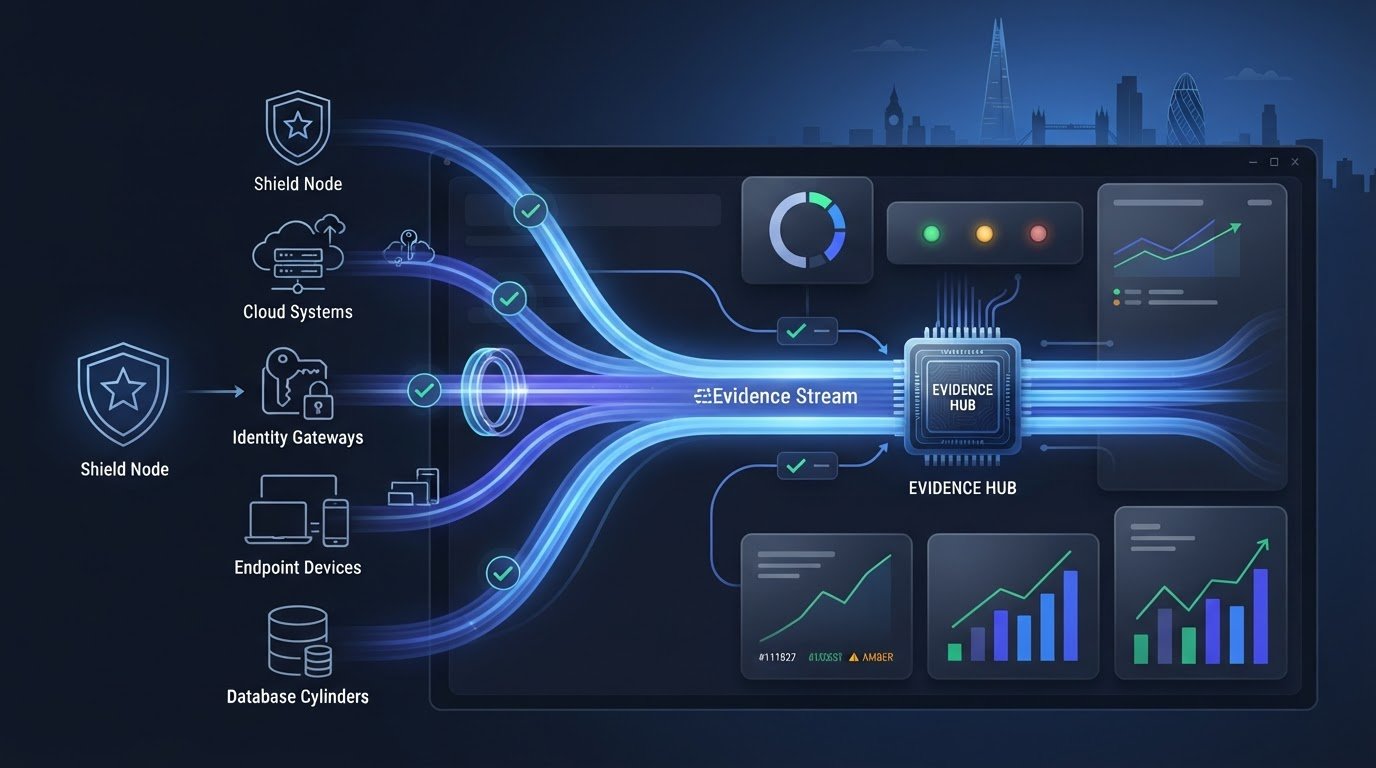
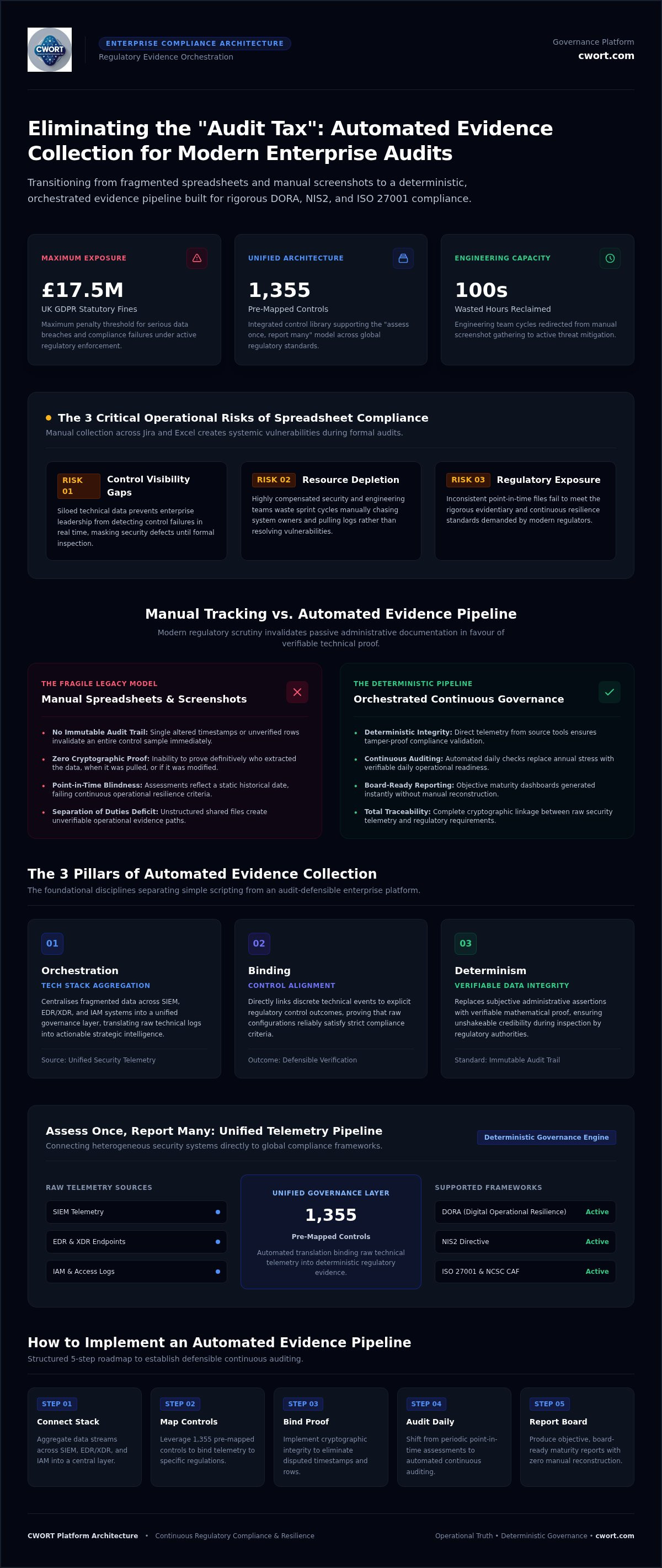
The "Audit Tax" isn't merely a drain on your security team's time; it's a structural failure that leaves your organisation exposed to regulatory rejection. You've likely felt the exhaustion of chasing screenshots across Jira and Excel, whilst knowing that fragmented data often fails to prove control effectiveness during a formal inspection. With UK GDPR fines now reaching up to £17.5 million for serious breaches, the cost of administrative friction has never been higher. Transitioning toward automating evidence collection for audits is no longer a tactical choice for enterprise leadership. It's a strategic necessity for maintaining cyber resilience.
We understand the anxiety of potential failure that comes with manual spreadsheet tracking. This guide shows you how to replace that uncertainty with the calm of auditable certainty by building a deterministic, orchestrated evidence pipeline. You'll discover how to create a single source of truth that satisfies DORA, NIS2, and ISO 27001 requirements simultaneously. We'll outline the path from fragmented administrative tracking to definitive, board-ready maturity reports that require zero manual reconstruction. By shifting focus from mere tracking to definitive proof, your team can finally reclaim hundreds of wasted hours.
Key Takeaways
- Eliminate the "Audit Tax" by replacing manual spreadsheet tracking with a deterministic governance layer that ensures total data integrity.
- Transition from fragmented scripts to automating evidence collection for audits to establish a defensible pipeline that withstands rigorous DORA and NIS2 inspections.
- Adopt an "assess once, report many" model to unify compliance efforts across ISO 27001, NCSC CAF, and global regulatory standards.
- Bind raw technical data from SIEM, EDR, and IAM tools directly to specific regulatory outcomes through a structured five-step implementation plan.
- Utilise a pre-mapped library of 1,355 controls to generate objective, board-ready maturity reports without the need for manual reconstruction.
Table of Contents
- The Hidden Cost of Manual Evidence: Why Spreadsheets Fail Audits
- The 3 Pillars of Automated Evidence Collection for Audits
- Orchestration vs. Simple Automation: Choosing the Right Strategy
- How to Implement an Automated Evidence Pipeline: A 5-Step Guide
- Future-Proofing Your Audit Readiness with CWORT
The Hidden Cost of Manual Evidence: Why Spreadsheets Fail Audits
Enterprise leadership faces an unsustainable operational drag known as the "Audit Tax." Highly paid engineering teams spend hundreds of hours manually collecting screenshots, pulling logs, and chasing system owners before an inspection. This manual gathering method creates fragmented evidence silos across Jira, Excel, and disconnected security tools, inevitably leading to control gaps and severe regulatory fines. Traditional Governance, Risk, and Compliance (GRC) tools promise relief, but they don't solve the core data problem; they quickly devolve into fancy spreadsheets that still require manual input. True operational security requires moving away from passive administrative tracking. Organisations must transition to orchestrated validation by automating evidence collection for audits to turn abstract requirements into a defensible reality.
This fragmented approach exposes organisations to three specific operational risks:
- Control visibility gaps: Siloed data prevents leadership from seeing where controls fail in real time.
- Resource depletion: Technical teams waste valuable sprint cycles gathering historical data instead of mitigating active vulnerabilities.
- Regulatory exposure: Inconsistent data fails to satisfy the rigorous evidentiary standards of modern inspectors.
The Fragility of Manual Compliance Workflows
Standard office software lacks the immutable audit trails and strict version control required to survive modern regulatory scrutiny. Manual data entry introduces systemic human errors that experienced auditors flag immediately. For instance, a single altered timestamp or an unverified spreadsheet row invalidates an entire control sample, casting doubt on your entire compliance posture. Proving a strict separation of duties becomes nearly impossible when evidence resides in shared files without cryptographic verification. You can't definitively prove who extracted the data, when it was pulled, or whether it was manipulated prior to the audit. This lack of traceability leaves the organisation highly vulnerable during rigorous inspections.
Regulatory Scrutiny in 2026: DORA and NIS2 Expectations
Regulators have fundamentally changed their baseline expectations. Under frameworks like the Digital Operational Resilience Act (DORA) and the NIS2 Directive, authorities demand real-time, evidence-backed proof of operational resilience rather than static, historical documentation. The era of point-in-time assessments has ended. Modern compliance requires continuous auditing to verify that technical controls operate effectively every single day. Meeting these stringent, high-stakes expectations demands a centralised platform for regulatory compliance workflow automation. By establishing a deterministic, orchestrated pipeline, enterprises can replace the anxiety of manual data gathering with the calm of auditable certainty.
The 3 Pillars of Automated Evidence Collection for Audits
Successful transition from manual tracking to a defensible pipeline requires more than simple data fetching. It demands a disciplined architecture built on three core pillars: orchestration, binding, and determinism. Whilst many organisations mistake basic scripts for automation, true regulatory readiness depends on the ability to prove that every piece of technical telemetry directly satisfies a specific control requirement. Automating evidence collection for audits is the only way to establish this link at scale, replacing subjective assessments with objective, verifiable proof. This structured approach ensures that your compliance posture remains resilient under the most rigorous scrutiny from authorities.
Integration: Connecting Your Security Tech Stack
Modern enterprises operate across a fragmented landscape of SIEM, EDR/XDR, and IAM systems. To achieve total visibility, you must aggregate data from these diverse sources into a single governance layer. This integration layer acts as a translator, converting technical logs into a unified view that senior leadership can actually use to make strategic decisions. It eliminates the need for manual data extraction and ensures that evidence is always current, rather than weeks out of date. Evidence Orchestration is the central hub for compliance data that synchronises technical telemetry with regulatory obligations to provide a definitive view of operational readiness.
Control Mapping and Evidence Binding
Binding is the technical mechanism that links raw data to specific regulatory outcomes. Unlike simple automation, which merely moves data from point A to point B, binding ensures compliance evidence integrity by creating an immutable history of every validation activity. This allows you to adopt an "Assess Once, Report Many" philosophy. A single piece of evidence, such as a password policy configuration, can be mapped simultaneously to NIST, ISO 27001, and DORA frameworks. This cross-walking capability reduces redundant testing and ensures that your evidence remains consistent across all audits. To see how this orchestration works in practice, you can request a platform demonstration to explore our library of 1,355 pre-mapped controls.
Determinism and Verification
The final pillar of a mature framework is deterministic validation. This ensures that identical evidence always yields the same audit result, removing the "human element" that often leads to inconsistent findings. The system must also verify that evidence meets a required "Confidence Level" before it is accepted. If a log file is incomplete or a signature is missing, the system should flag the deficiency immediately rather than waiting for an auditor to find the gap. This proactive verification cycle transforms compliance from a reactive administrative burden into a proactive security function that reinforces your organisation's structural integrity.
Orchestration vs. Simple Automation: Choosing the Right Strategy
Relying on generic workflow tools to manage compliance is a critical architectural error. Platforms built for general business automation connect applications smoothly, yet they completely fail to preserve the data integrity required by financial regulators. They lack the structural mechanisms to guarantee that data remains unaltered during transit. Similarly, project management tools like Jira serve well for tracking daily execution, but they aren't audit-defensible governance systems. True compliance orchestration requires a platform designed specifically to enforce a strict separation of duties and maintain absolute data lineage. When evaluating your strategy for automating evidence collection for audits, you must look beyond basic task automation and demand a system built for rigorous corporate oversight.
Deterministic vs. Probabilistic Outcomes
Auditors reject probabilistic assumptions; they demand definitive proof. Recent trends toward using generative AI agents to execute compliance tasks introduce unacceptable risk into high-stakes environments. These models operate on probabilities, meaning they produce suggestions rather than verifiable facts. AI must function strictly as an advisor rather than a final decision-maker. For true validation, you must rely on deterministic systems that process identical evidence to yield the exact same result every single time. This absolute predictability forms the foundation of a reproducible assurance system that stands up to intense regulatory scrutiny.
Governance Features to Look For
An enterprise-grade orchestration layer must enforce discipline by design. Look for platforms that offer robust role-based access control (RBAC) alongside strict tenant isolation to guarantee data security. Every single control modification, configuration change, or evidence pull must generate an immutable audit history that cannot be altered or deleted by any user. This strict enforcement prevents collusion and satisfies the separation of duties required by modern frameworks. To see how these rigorous governance mechanisms operate in a live enterprise environment, you can request a demo of an orchestrated validation system.
How to Implement an Automated Evidence Pipeline: A 5-Step Guide
Constructing a resilient assurance framework requires a methodical transition from fragmented manual tasks to a structured, reproducible pipeline. Leadership must view this as a strategic transformation rather than a technical patch. Automating evidence collection for audits involves five distinct stages to ensure that every regulatory obligation is backed by immutable technical proof. Following this sequence allows organisations to replace administrative friction with auditable certainty whilst maintaining total control over data lineage.
- Step 1: Define your regulatory model and control taxonomy. Establish a comprehensive baseline by selecting from a library of 1,355 pre-mapped controls to align technical actions with specific framework requirements like DORA or NIS2.
- Step 2: Map organisational obligations to specific technical data sources. Identify exactly which SIEM, EDR, or IAM telemetry provides the definitive proof for each control outcome.
- Step 3: Configure automated data capture and evidence binding rules. Build the deterministic logic that extracts raw logs and binds them to regulatory requirements without human intervention.
- Step 4: Execute a governed pilot to validate scoring and confidence levels. Test the pipeline in a controlled environment to ensure that the validation logic produces accurate, repeatable results.
- Step 5: Generate board-ready maturity reports and audit registers. Produce high-level intelligence that demonstrates compliance status across the entire enterprise portfolio.
Designing Your Target Operating Model (TOM)
Assess your current capability maturity before initiating large-scale automation. You cannot automate a broken process; you must first define the desired end state of your compliance operations. Use heat-map dashboards to identify critical gaps in your current control environment. These visual tools allow leadership to prioritise remediation actions based on real-world risk rather than subjective guesses. Linking remediation directly to evidence requirements ensures that every fix contributes to a defensible audit trail. To see how this target operating model functions at scale, you can request a demo of our compliance maturity platform.
Scaling from Pilot to Enterprise-Wide Assurance
Scale the framework by onboarding consulting teams and internal SMEs into a unified workflow. Maintaining consistency across diverse business units requires a single source of truth that enforces the same standards regardless of the portfolio. Shift your focus from annual audit preparation to continuous monitoring to maintain a state of permanent readiness. This transition ensures that your cyber resilience is a constant reality rather than a point-in-time performance for regulators. A centralised approach allows for rapid expansion whilst preserving the structural integrity of your governance model.
Future-Proofing Your Audit Readiness with CWORT
Future-proofing compliance requires a fundamental shift from reactive, point-in-time assessments to a state of permanent resilience. CWORT facilitates this transition by replacing fragmented tracking with a single, orchestrated compliance validation system. By leveraging a comprehensive library of 1,355 controls, organisations can simplify complex framework cross-walking whilst ensuring that 98.6% of active controls carry direct regulatory references. This level of precision transforms compliance from a technical obligation into strategic intelligence. Automating evidence collection for audits through CWORT ensures that your audit history remains immutable, providing a definitive source of truth that satisfies the most rigorous international standards as of June 2026.
Adopting this platform allows leadership to move beyond "Compliance Readiness" toward a model of "Continuous Assurance." Instead of scrambling to reconstruct evidence during an inspection, your teams maintain a deterministic, reproducible scoring model that is always ready for scrutiny. This shift enforces discipline by design and ensures that every technical activity translates directly into a defensible regulatory outcome.
The "Assess Once, Report Many" Advantage
Modern regulatory environments demand efficiency. A single assessment within CWORT can simultaneously satisfy the requirements of DORA, NIS2, and ISO 27001 control mapping. This "assess once, report many" capability significantly reduces the burden on technical teams by automating the roll-up of telemetry into high-level reports. Senior leadership gains a real-time view of cyber resilience across 42 different frameworks and standards. By eliminating redundant testing, technical specialists can focus on enhancing security posture rather than performing repetitive administrative tasks for multiple auditors.
Getting Started: From Spreadsheets to Orchestration
Leading organisations are rapidly moving away from traditional GRC tools in favour of deterministic orchestration. Spreadsheets and passive tracking systems simply cannot provide the level of structural integrity required to manage modern cyber risks. Transitioning to an orchestrated pipeline provides the auditable certainty necessary to protect your organisation's reputation and bottom line. A professional implementation ensures that even custom controls are mapped accurately to your specific technical environment. To replace administrative anxiety with definitive proof, Book your CWORT demo today to automate your evidence collection and secure your regulatory future.
Establishing a Defensible Standard of Truth
Manual evidence gathering is no longer a viable strategy in a regulatory landscape defined by DORA and NIS2. Fragmented data silos create unnecessary risk and operational drag that technical teams can't afford to maintain. By automating evidence collection for audits, your organisation replaces administrative anxiety with the calm of auditable certainty. CWORT enforces this discipline by design. With 1,355 controls already mapped to 42 global frameworks, our deterministic scoring engine delivers the objective proof that modern regulators demand. Trusted by enterprises for rigorous DORA, NIS2, and ISO 27001 validation, CWORT ensures your compliance posture remains resilient and board-ready. It's time to reclaim your technical resources. You can secure your regulatory future by building a pipeline that proves control effectiveness every single day.
Request a CWORT Demo to Automate Your Evidence Collection
Frequently Asked Questions
What is automated evidence collection for audits?
Automated evidence collection for audits is the programmatic extraction of technical telemetry to validate specific regulatory controls. Instead of manual data gathering, this process creates a deterministic pipeline that aggregates real-time logs from your security stack. This approach turns abstract obligations into concrete, defensible reality. It ensures that your compliance posture is based on objective data rather than subjective manual entries, providing total assurance to both internal stakeholders and external inspectors.
Can I use Jira or Excel for automating evidence collection?
Whilst Jira and Excel are excellent for tracking tasks, they aren't designed for regulatory governance. These tools lack the immutable audit trails, tenant isolation, and deterministic validation required by modern standards. Spreadsheets are prone to human error and version control failures that auditors quickly flag. True compliance orchestration requires a dedicated system that enforces a strict separation of duties and maintains a verifiable history of every control change across your enterprise.
How does automated evidence binding work under DORA?
Evidence binding under DORA links raw technical telemetry directly to specific ICT risk management and operational resilience outcomes. Under this framework, regulators demand proof that your resilience controls are active and effective. Binding ensures that every piece of data from your SIEM or asset register is cryptographically tied to a DORA requirement. This process establishes a transparent lineage of proof that demonstrates your organisation's ability to maintain service continuity during disruptions.
Is automated evidence collection actually defensible to regulators?
Automated systems are highly defensible if they utilise a deterministic scoring model. Regulators, including the NCSC and Ofgem, require reproducible evidence where identical data always produces the same result. A rigorous system provides an explainable view that removes the "human element" from the validation process. By maintaining an immutable audit history and protecting evidence from alteration, you satisfy the most stringent requirements for structural integrity and traceability in high-stakes environments.
What is the difference between GRC and compliance orchestration?
Traditional GRC platforms often function as passive repositories that still require significant manual data entry. In contrast, compliance orchestration sits above your point-tools to proactively enforce discipline and accountability. It aggregates data from your technical stack to provide a single source of truth for all maturity and resilience activities. This shift from mere administrative tracking to orchestrated validation ensures that your operating model remains sustainable and fully auditable by design.
How much time can I save by automating audit evidence collection?
Automating evidence collection for audits eliminates the "Audit Tax," which frequently consumes hundreds of engineering hours during each inspection cycle. By replacing manual screenshot gathering with an automated pipeline, your technical teams can reclaim valuable time for high-priority security tasks. A centralised platform generates board-ready reports and maturity assessments without the need for manual reconstruction, significantly reducing the administrative friction associated with frameworks like NIS2 and ISO 27001.
Does CWORT integrate with my existing security tools like SIEM or EDR?
CWORT features a robust integration layer designed to consume telemetry from your existing SIEM, EDR/XDR, IAM/PAM, and vulnerability management tools. It aggregates this data to present a unified, explainable view of your cyber resilience. The platform doesn't replace your operational tools but rather sits above them as a governance orchestrator. This allows you to leverage your current technology investments whilst ensuring that all technical data is correctly bound to regulatory obligations.
How do I handle "Bring Your Own Content" (BYOC) for custom audits?
CWORT’s Bring Your Own Content (BYOC) capability allows you to import proprietary maturity models into a governed digital workflow. You can define your own criteria, weighting, and evidence requirements whilst benefiting from CWORT’s analytics and immutable audit history. This process enables you to turn custom maturity models into repeatable, evidence-backed management systems. It's an ideal solution for consultancies or enterprises that need to productise their own methods whilst maintaining strict governance standards.
Disclaimer
The content on this site is provided for general information and educational purposes only. It does not constitute legal, regulatory, financial, or professional advice. CWORT provides AI-assisted insights and workflow automation, but all compliance decisions remain the responsibility of your organisation and its management. Always seek qualified legal or regulatory guidance for decisions relating to the UK NIS Regulations, CAF, DORA, NIS2, ISO 27001, or other obligations.
Related posts
Streamlining Regulatory Compliance Processes: From Manual Tracking to Orchestrated Validation
Stop wasting money on manual compliance. Learn about streamlining regulatory compliance processes to reduce personal liability under DORA & NIS2 and gain aud...
GRC Platform vs Compliance Validation Tool: Choosing the Right Architecture for 2026
GRC platform vs compliance validation tool: Is your GRC ready for 2026? Learn how automated validation provides the defensible proof needed for DORA & NIS2.
Reducing Audit Preparation Time and Costs: A Strategic Guide for UK Enterprises
Tired of costly audit seasons? Our guide for UK enterprises shows you how to stop the manual scramble, reducing audit preparation time and costs with automat...
Article by
Michael Iyiola
Co-Founder, CWORT
Michael Iyiola is a co-founder of CWORT and a Cyber and AI Security Engineer with deep experience in vulnerability management, detection engineering and operational resilience across UK critical national infrastructure, including rail, energy and financial services. At CWORT, he designs scalable, evidence-driven workflows that help teams meet modern regulatory and security demands.
Build Your Foundation of Auditable Certainty
Take control of your regulatory obligations and secure your infrastructure with CWORT.