Avoiding Auditor Findings for ISO 27001: A Strategic Readiness Guide for 2026

Michael Iyiola
Co-Founder, CWORT
Secure your 2026 certification by avoiding auditor findings for ISO 27001. Ditch manual tracking for a strategic framework that proves control effectiveness.

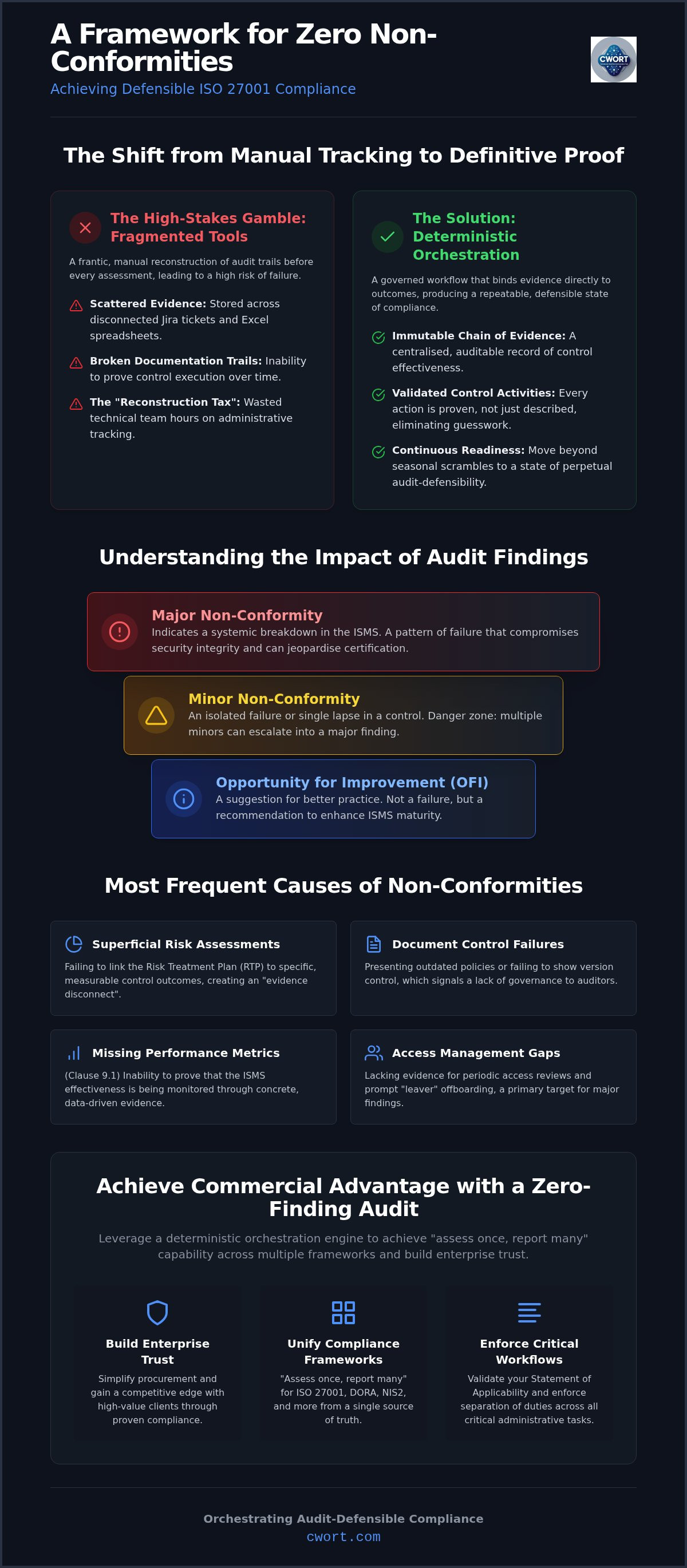
The presence of a security control is irrelevant if you cannot prove its execution through an immutable chain of evidence. Most organisations find that the weeks preceding an audit are consumed by a frantic, manual reconstruction of audit trails whilst evidence remains scattered across disconnected Jira tickets and Excel spreadsheets. You recognise that managing compliance through fragmented tools is a high-stakes gamble that frequently leads to broken documentation trails; however, avoiding auditor findings for ISO 27001 requires a shift from administrative tracking to definitive proof. It's an exhausting cycle of tracking that fails to provide evidence of control effectiveness when the auditor arrives.
This guide provides a rigorous framework for eliminating non-conformities by moving to a deterministic compliance orchestration system. We'll examine how to bind evidence directly to outcomes, ensuring that every control activity is validated and defensible. You'll learn to replace the anxiety of potential failure with a repeatable, governed workflow that produces board-ready maturity reports and enforces zero major non-conformities for your 2026 assessment.
Key Takeaways
- Categorise audit findings to understand the commercial risks of major non-conformities and the hidden costs of manual audit reconstruction.
- Secure your certification by avoiding auditor findings for ISO 27001 through the elimination of superficial risk assessments and broken documentation trails.
- Abandon fragmented tracking systems that lack version control in favour of a centralised, auditable record of control effectiveness.
- Execute a structured readiness plan that validates your Statement of Applicability and enforces separation of duties across all critical administrative workflows.
- Leverage a deterministic orchestration engine to achieve "assess once, report many" capability across ISO 27001, DORA, and NIS2 frameworks.
Table of Contents
- Understanding the Impact of ISO 27001 Audit Findings
- The Most Frequent Non-conformities in ISO 27001 Audits
- Why Spreadsheets and Generic Task Managers Invite Auditor Scrutiny
- The ISO 27001 Audit-Readiness Checklist: Proactive Prevention
- Orchestrating Audit-Defensible Compliance with CWORT
Understanding the Impact of ISO 27001 Audit Findings
Audit findings aren't merely administrative hurdles. They represent a fundamental challenge to your organisation's operational integrity. In the current regulatory climate, auditor behaviour has shifted decisively. They've moved away from accepting verbal assurances or "best effort" descriptions. Instead, they demand deterministic proof that controls are functioning as intended. This shift means that the foundational requirements of the ISO/IEC 27001 standard must be met with granular, verifiable evidence. Failing to provide this leads to a hierarchy of findings that can stall your business objectives.
The hierarchy of findings begins with the Opportunity for Improvement (OFI), which is a suggestion for better practice. It scales up to the Minor Non-conformity, representing an isolated failure, and culminates in the Major Non-conformity. A Major finding indicates a systemic breakdown in your Information Security Management System (ISMS). Strategically avoiding auditor findings for ISO 27001 is critical because the hidden costs are substantial. Beyond reputational damage, you face delayed tenders and a "reconstruction tax". This tax is the heavy price of manual labour required to rebuild audit trails at the last minute whilst your technical teams should be focused on core operations.
The Distinction Between Major and Minor Non-conformities
A systemic breakdown leads to a Major finding, whilst isolated slips remain Minor. The auditor's role is to assess the maturity of your ISMS. They look for patterns. A single missing signature is a Minor; a process where signatures are consistently absent indicates a failed control. These "danger zones" are where Minors frequently escalate into Majors. If you can't prove that a risk was identified, treated, and recorded in the Statement of Applicability, the auditor sees a structural failure. You must demonstrate that your readiness is continuous, not a seasonal scramble triggered by an upcoming visit.
The Business Case for Zero-Finding Audits
Securing a zero-finding audit creates an immediate commercial advantage. It builds enterprise trust and simplifies the procurement process for high-value clients. Avoiding auditor findings for ISO 27001 through proactive prevention ensures that your technical teams aren't pulled away from critical security tasks to fix documentation gaps. Achieving this state requires a move towards "defensible truth". This means using a platform like CWORT to orchestrate compliance rather than just tracking it. When you have a system that enforces discipline by design, you replace manual guesswork with a rigorous, auditable reality that satisfies the most demanding external assessments.
The Most Frequent Non-conformities in ISO 27001 Audits
Non-conformities are rarely the result of a total absence of security measures. Instead, they arise from a failure to demonstrate that those measures are consistently applied and monitored. Avoiding auditor findings for ISO 27001 requires moving beyond superficial compliance to a state of verifiable operational integrity. Auditors specifically look for the "evidence disconnect" where a policy exists in name, but the execution lacks an immutable trail. If your internal audit program is neglected or lacks independence, these gaps remain hidden until the external assessor arrives.
Common failure points include:
- Superficial Risk Assessments: Failing to link the Risk Treatment Plan (RTP) to specific control outcomes. The RTP must serve as the definitive bridge between risk identification and control execution.
- Document Control Failures: Presenting outdated policies or procedures that do not match the current operational reality of the business.
- Missing Performance Metrics: Clause 9.1 failures occur when organisations cannot prove they are monitoring ISMS effectiveness through concrete, data-driven evidence.
- Access Management Gaps: Missing evidence for periodic access reviews and "leaver" offboarding remains a primary target for major findings.
Risk Management and the Statement of Applicability (SoA)
Auditors scrutinise the exclusion of controls in the SoA with extreme rigour. You must provide a reproducible risk methodology that avoids subjective bias and clearly justifies every exclusion. This process should align with the established framework for ISO 27001:2013 auditing to ensure your assessment is robust enough to withstand technical interrogation. A robust RTP ensures that every identified risk has a corresponding, validated control activity that produces a deterministic result.
Operational Control Gaps: Access and Suppliers
Supplier security management (Annex A 5.19 to 5.23) is a frequent "evidence trap". Auditors require proof that you are actively managing third-party risks, not just filing contracts. Proving that access controls are enforced, rather than just documented, is equally vital. You must be able to demonstrate "Separation of Duties" (SoD) by providing system logs that prove different individuals initiate and approve critical administrative workflows. If your current evidence is trapped in fragmented task managers, you risk presenting outdated data during a live audit session. You can explore how orchestration eliminates these gaps by binding evidence to outcomes automatically, ensuring your audit trail is always defensible and current.
Why Spreadsheets and Generic Task Managers Invite Auditor Scrutiny
Relying on spreadsheets or fragmented task managers for audit readiness is a strategic vulnerability. Auditors recognise that manual logs are susceptible to retrospective editing, which undermines the integrity of your entire Information Security Management System (ISMS). Avoiding auditor findings for ISO 27001 requires a shift from passive tracking to active validation. When evidence is scattered across disparate files, you create a "reconstruction tax" that forces your team into a frantic scramble before every assessment. This approach lacks the structural integrity required to meet modern regulatory expectations.
The risks of manual tracking include:
- The Evidence Disconnect: A closed Jira ticket confirms a task was "done", but it rarely provides auditable proof of the control outcome.
- Lack of Version Control: Presenting outdated policy versions or obsolete evidence during a live audit session triggers immediate scrutiny.
- No Immutable Audit Trail: Manual logs lack the non-repudiation that auditors demand. If a record can be edited after the fact, it's not defensible.
- Single Point of Failure: Compliance often rests on one individual who manages the master tracker, creating an organisational risk.
The Myth of "Compliance by Jira"
There is a fundamental difference between tracking a task and validating a control outcome. Whilst Jira is excellent for project management, it was never designed to enforce the rigorous discipline required for ISO 27001. Regulators increasingly reject manual compliance trackers because they lack the necessary context and binding. You must move beyond simple task completion to ensure your activities align with broader standards like the NIST Cybersecurity Framework. To understand the technical limitations of this approach, read our analysis on Why Jira is Not a Compliance Orchestration Tool.
The Structural Integrity of Evidence
Evidence binding is the process of linking raw data directly to a specific regulatory obligation. Modern auditors no longer accept verbal assurances; they require deterministic results where identical evidence always yields the same result. Avoiding auditor findings for ISO 27001 is only possible when your evidence is bound to specific controls in a way that prevents manual tampering. By automating the validation process, you ensure that every control activity is backed by a permanent, unalterable record. Learn more about Ensuring Compliance Evidence Integrity to ensure your audit trails remain unassailable during high-stakes reviews.
The ISO 27001 Audit-Readiness Checklist: Proactive Prevention
Proactive prevention is the only reliable method for avoiding auditor findings for ISO 27001. A checklist approach ensures that no critical control is overlooked whilst providing a structured path to total assurance. Your strategy must move beyond a simple list of tasks to a verified state of readiness that withstands the most rigorous technical interrogation. By implementing a deterministic workflow, you replace the uncertainty of manual tracking with evidence-based proof of compliance.
Follow these five critical steps to secure your audit outcome:
- Validate the SoA: Ensure your Statement of Applicability aligns with the latest ISO 27001:2022 updates and reflects your current risk assessment.
- Enforce Separation of Duties (SoD): Implement SoD across all critical administrative workflows to prevent the concentration of authority; this is a frequently overlooked preventative control.
- Execute a "Dry Run": Conduct a rigorous internal audit using an independent party or a platform that mirrors the auditor's methodology.
- Bind Evidence to Controls: Link every active control in your assurance register to a specific, immutable piece of data.
- Generate Maturity Reports: Produce board-ready reports that prove active management oversight, fulfilling the requirements of Clause 9.3.
Step-by-Step Internal Validation
Internal validation is designed to identify "stale" evidence before the external auditor discovers it. Stale evidence occurs when a control activity is performed but the record is not updated or linked to the current obligation. To maintain consistency, you should utilise a comprehensive Control Taxonomy Library that maps activities to specific framework requirements. This structured mapping prevents the common industry pitfall of fragmented evidence. You can learn more about this approach in our ISO 27001 Control Mapping Tool Guide.
Preparing Leadership for the Management Review
Auditors often interview senior leadership to verify that the ISMS is integrated into the business's strategic direction. The Board needs to understand the current maturity of the security posture without being overwhelmed by raw technical data. Presenting maturity heat-maps instead of spreadsheets allows leadership to visualise gaps and remediation progress clearly. This visibility ensures the "Operating Model" is explainable to non-technical stakeholders, proving that the ISMS is a living system rather than a static document. To ensure your leadership team is fully prepared for the next audit cycle, request a platform demonstration to see how we automate maturity reporting.
Orchestrating Audit-Defensible Compliance with CWORT
Avoiding auditor findings for ISO 27001 is not a matter of luck; it is a matter of structural discipline. CWORT replaces fragmented trackers with a single orchestrated compliance validation system. It functions as an orchestration engine that sits above your existing security tools, such as SIEM and EDR, to translate abstract obligations into concrete, structured activities. By enforcing separation of duties and binding evidence directly to outcomes, the platform ensures that your compliance posture is always visible and unassailable. This proactive system enforces discipline by design, making non-compliance impossible to hide from internal or external assessors.
Operational efficiency in modern compliance requires an "assess once, report many" strategy. With 1,355 controls in the taxonomy library and 42 frameworks mapped, CWORT allows you to align ISO 27001 requirements with DORA, NIS2, and UK NIS seamlessly. This systematic mapping removes the burden of manual cross-referencing whilst providing a unified view of regulatory maturity across the enterprise. Moving from administrative tracking to deterministic proof ensures that your audit-ready state is continuous and defensible. You no longer need to rely on the manual reconstruction of trails because the evidence is already bound to the required outcome.
Deterministic Outcomes vs. Manual Reconstruction
CWORT operates on a deterministic principle where identical evidence always yields the same auditable result. This consistency is vital for maintaining the structural integrity of your Information Security Management System (ISMS). It eliminates the subjectivity and variance inherent in manual reconstruction efforts that typically occur in the frantic weeks before an audit. Whilst an AI Advisory assists in navigating framework complexities, it never alters these deterministic results. This ensures the integrity of your audit trail remains absolute and fully traceable. Such rigour is essential for high-stakes environments, as discussed in our analysis of NCSC CAF Assessment Software & Resilience.
Board-Ready Maturity Reporting
Senior leadership and audit committees require explainable views of organisational risk rather than raw technical logs. CWORT generates sophisticated maturity reports that highlight the 98.6% framework reference rate for active controls. These reports replace vague status updates with board-ready intelligence, demonstrating definitive proof of control effectiveness and management oversight. By providing a clear, governed workflow, you replace the anxiety of potential failure with the calm of auditable certainty. To transform your compliance capability and enforce accountability by design, book a pilot to see CWORT in action and secure a successful audit outcome for 2026.
Achieving Continuous Audit Readiness for 2026
The transition from manual oversight to an orchestrated compliance system is no longer a luxury; it's a strategic necessity for high-stakes environments. You've identified that fragmented evidence and outdated spreadsheets are the primary drivers of major non-conformities. By shifting your focus toward deterministic proof and evidence binding, you ensure your Information Security Management System remains resilient and defensible. Avoiding auditor findings for ISO 27001 requires this deliberate transition from administrative tracking to a proactive, governed workflow.
CWORT provides the structural integrity needed to survive technical interrogation. With 1,355 controls mapped across 42 frameworks, including ISO 27001, DORA, and NIS2, the platform delivers reproducible scoring for auditable certainty. You can now generate board-ready maturity reports directly from validated evidence, replacing audit anxiety with professional maturity. It's time to enforce discipline by design and secure your certification with total assurance.
Replace your spreadsheets with CWORT’s audit-defensible orchestration platform today.
Frequently Asked Questions
What is the most common ISO 27001 audit finding?
Superficial risk management remains the most frequent finding. Auditors often cite a failure to link the Risk Treatment Plan (RTP) to actual control outcomes. If your documentation doesn't show a clear path from risk identification to validated execution, it creates a broken trail. Avoiding auditor findings for ISO 27001 requires a rigorous mapping process where every identified risk is countered by a specific, evidence-backed control activity that yields a deterministic result.
Can an organisation fail an ISO 27001 audit due to one minor non-conformity?
Certification is rarely denied based on a single isolated incident. One minor non-conformity indicates a lapse in a specific area rather than a total system failure. However, you must demonstrate a clear remediation plan to the auditor. The danger lies in a cluster of minor findings; these suggest a systemic breakdown in your Information Security Management System (ISMS), which will inevitably escalate to a Major non-conformity and stall your certification.
How often should ISO 27001 internal audits be conducted to avoid findings?
Conducting internal audits at least annually is considered a baseline requirement. For organisations targeting total assurance, a continuous internal review cycle is more effective for avoiding auditor findings for ISO 27001. You should schedule a full internal assessment approximately two to three months before your external certification audit. This timeframe provides sufficient opportunity to identify gaps and implement remediation before the final external assessor evaluates your operating model maturity.
What is the difference between a Major and Minor non-conformity in ISO 27001?
A Major non-conformity represents a systemic failure to meet a requirement of the standard, whilst a Minor non-conformity is an isolated slip. Majors prevent certification until they are resolved through a follow-up audit. Minors allow for certification on the condition that an agreed action plan is implemented. Auditors assess these based on patterns; consistent failures across multiple departments indicate a structural breakdown that requires immediate strategic intervention.
How do I prove "Separation of Duties" to an ISO 27001 auditor?
You must provide immutable system logs that clearly demonstrate different individuals initiated and approved critical administrative workflows. Auditors demand deterministic proof that no single person possesses end-to-end control over sensitive processes. Using a platform like CWORT enforces this discipline by design, providing a permanent audit trail. This verifiable separation replaces verbal assurances with structural integrity, ensuring that your access controls are both enforced and auditable during high-stakes reviews.
Why do auditors reject spreadsheets for ISO 27001 evidence management?
Spreadsheets lack the version control and immutable history required for defensible compliance proof. Auditors distrust manual trackers because they can be edited retrospectively, which undermines the integrity of the evidence. Fragmented files also create a reconstruction tax, where teams must manually rebuild audit trails at the last minute. Transitioning to an orchestrated system ensures that evidence is bound to outcomes automatically, providing a single, unalterable record of control effectiveness.
How does ISO 27001:2022 change the audit finding landscape?
The 2022 revision restructured the Annex A controls into 93 specific items across four themes: Organisational, People, Physical, and Technological. This update places a stronger emphasis on cloud security and threat intelligence, requiring organisations to provide more granular evidence of control effectiveness. Auditors now look for proof of continual improvement and active monitoring. Failure to adapt your Statement of Applicability to this new structure is a guaranteed path to a major finding.
What happens if we cannot resolve an auditor finding before the deadline?
Failing to resolve a Major finding within the specified timeframe will result in the suspension or denial of your certification. For Minor findings, you must demonstrate progress against an agreed remediation plan during the next surveillance audit. If these isolated issues are neglected, the auditor will escalate them to Major non-conformities. Maintaining a continuous state of audit readiness prevents these deadlines from becoming points of failure for your organisation's regulatory standing.
Disclaimer
The content on this site is provided for general information and educational purposes only. It does not constitute legal, regulatory, financial, or professional advice. CWORT provides AI-assisted insights and workflow automation, but all compliance decisions remain the responsibility of your organisation and its management. Always seek qualified legal or regulatory guidance for decisions relating to the UK NIS Regulations, CAF, DORA, NIS2, ISO 27001, or other obligations.
Related posts
ISO 27001 Control Effectiveness Proof: Moving Beyond Static Certification to Defensible Validation
Move beyond static ISO 27001 certification. Discover how an ISO 27001 compliance validation tool delivers continuous, defensible proof for UK regulators.
NIS2 Audit Readiness Tool: Orchestrating Evidence-Based Compliance in 2026
Is your NIS2 compliance built on spreadsheets? Discover how a dedicated NIS2 audit readiness tool orchestrates evidence to deliver auditable proof and certai...
Reducing Audit Preparation Time and Costs: A Strategic Guide for UK Enterprises
Tired of costly audit seasons? Our guide for UK enterprises shows you how to stop the manual scramble, reducing audit preparation time and costs with automat...
Article by
Michael Iyiola
Co-Founder, CWORT
Michael Iyiola is a co-founder of CWORT and a Cyber and AI Security Engineer with deep experience in vulnerability management, detection engineering and operational resilience across UK critical national infrastructure, including rail, energy and financial services. At CWORT, he designs scalable, evidence-driven workflows that help teams meet modern regulatory and security demands.
Build Your Foundation of Auditable Certainty
Take control of your regulatory obligations and secure your infrastructure with CWORT.