Board-Level Compliance Dashboard: From Metrics to Defensible Oversight

Michael Iyiola
Co-Founder, CWORT
Build an auditable board-level compliance dashboard. Link reported metrics to accountable owners, verifiable evidence, and defensible governance oversight.

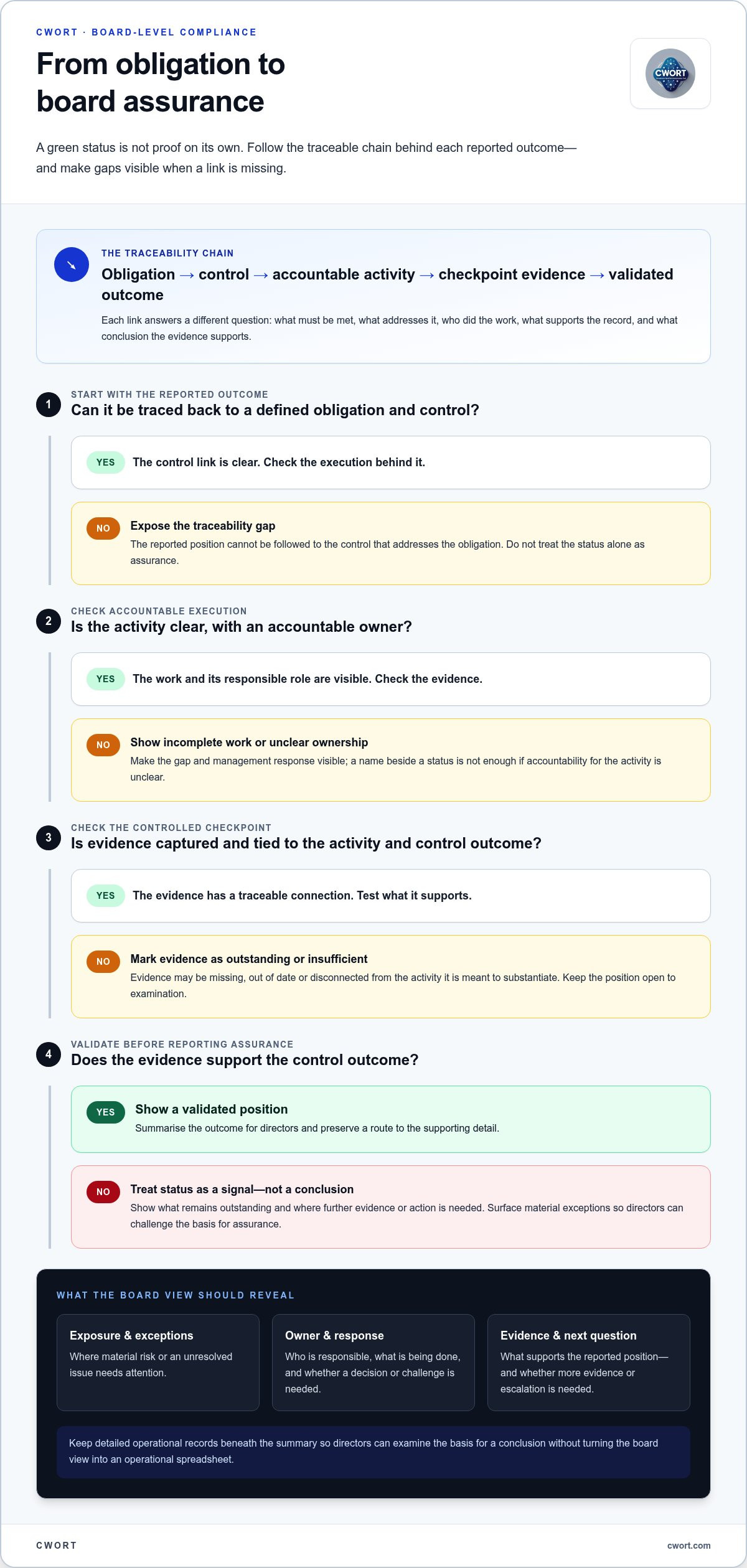
What does a green status mean if directors can’t trace it to an accountable owner and current evidence? A board-level compliance dashboard should make that connection clear. Without it, reassuring indicators can conceal material exposure, unresolved exceptions or work that has stalled since the last governance meeting.
Boards need concise reporting, not a stripped-back operational spreadsheet. They need to see where risk sits, who owns the response, what evidence supports the reported position and which decisions require their attention. Status alone isn’t assurance. Effective oversight depends on being able to challenge the basis for it.
This article explains how to shape a board-level view that links compliance metrics to accountable execution and verifiable evidence. You’ll learn what the dashboard should show, how to surface exceptions without overwhelming directors and why continuous validation helps keep reporting relevant between formal meetings. The aim is a clear line from risk signal to governance action, with an auditable basis for the conclusions presented to the board.
Key Takeaways
- Shape a board-level compliance dashboard around material exposure, assurance and decisions, rather than operational detail alone.
- Trace each reported outcome from obligation to control, accountable activity and checkpoint evidence.
- Choose metrics that help directors assess risk, ownership and evidence readiness, and prompt a clear governance response.
- Structure reviews around material exceptions, accountable owners and agreed follow-up, while keeping supporting detail accessible.
- See how CWORT connects regulatory requirements to controls and execution, with separation of duties enforced by design and evidence bound to activities.
Table of Contents
- Why a Board-Level Compliance Dashboard Must Show More Than Status
- Build the Compliance Dashboard on Controls, Execution and Evidence
- Choose Board Compliance Dashboard Metrics That Lead to Decisions
- Design a Dashboard Review That Preserves Context and Accountability
- How CWORT Connects Board Visibility to Continuous Compliance Validation
Why a Board-Level Compliance Dashboard Must Show More Than Status
A board pack can show a sequence of green indicators and still leave directors unable to answer the question that matters: what supports this assurance? A board-level compliance dashboard should bring material exposure, response and evidence into view, rather than compress operational activity into reassuring colours.
A board-level compliance dashboard is a decision-focused view of compliance exposure and assurance for directors. It provides oversight visibility, but the dashboard view alone is not proof of compliance. That distinction reflects the purpose of corporate governance: directors oversee how an organisation is directed and controlled, while management is responsible for running and monitoring its activities.
Management may need detailed records of control checks, deadlines and individual execution steps to coordinate work. Directors need a different level of information: whether material risks are being addressed, where the response is not working, who is accountable and whether the evidence supports the reported outcome. The board view should summarise those signals while preserving a route back to the underlying detail.
What should directors be able to understand at a glance?
Show the position, its significance and the next governance question. A concise view should make it possible to identify:
- Material risks and exceptions: where exposure or an unresolved issue needs attention.
- Accountable owners: who is responsible for the response and its progress.
- Management response: what is being done, and whether a decision or challenge is needed from directors.
Each indicator should prompt a useful question, such as whether a delayed response needs escalation or whether further evidence is needed before assurance is accepted. Keep detailed operational records beneath the summary, available for examination when directors need to test a conclusion. This keeps the board view concise without making its claims untraceable.
Why can a green dashboard still leave assurance gaps?
Colour and completion status describe a reported state. Neither establishes that a control produced its intended outcome. A green indicator may reflect completed activity, but directors still need context: which control was addressed, who performed and reviewed the work, and what evidence supports the result? Without those links, status is a signal to examine, not a conclusion.
For example, a control may appear complete while its supporting evidence is missing, out of date or disconnected from the activity it is meant to substantiate. Ownership can also be unclear, leaving no obvious person accountable for resolving a gap. These are reasons to examine the supporting detail, not to infer a regulatory outcome from a colour alone.
Make the distinction explicit in reporting: show what is validated, what remains outstanding and where management’s assessment depends on further action. That gives directors a basis to challenge assumptions and agree follow-up, while avoiding the false certainty of a dashboard that looks clear but cannot explain its status.
Build the Compliance Dashboard on Controls, Execution and Evidence
A defensible compliance view needs a traceable chain behind every reported outcome. Start with the obligation, identify the control that addresses it, assign the execution activity, capture evidence at a controlled checkpoint, then validate the outcome. Each link answers a different question: what must be met, what is designed to address it, who carried out the work, what supports the record and what conclusion can reasonably be drawn?
Evidence-linked status is a traceable outcome, not an unsupported indicator. If the chain breaks, the board should be able to see where: an activity may be incomplete, a checkpoint may lack evidence, or the evidence may not support the control outcome. This makes the status meaningful because its basis can be examined, rather than accepted on appearance alone.
How does a compliance signal become evidence-backed?
Translate regulatory obligations into defined controls and structured execution activities. At each controlled checkpoint, capture evidence and bind it to the relevant activity state and control outcome. The result is a clear path from requirement to validated position, rather than a disconnected document or completion tick. A consistent approach to compliance evidence integrity helps preserve that traceability as work progresses.
For example, a reported control outcome should connect to the activity performed and the evidence recorded for it. A board summary can show the resulting position, while authorised readers can examine its supporting detail. CWORT follows this model, translating regulatory requirements into controls and execution activities, then binding checkpoint evidence to activity state and control outcomes.
How should ownership and separation of duties appear?
Assign responsibility at the activity level so directors can see who is accountable for execution and management can identify where follow-up rests. Accountability is more than a name beside a status: it connects the work to a responsible role and the evidence to the activity performed. CWORT enforces separation of duties by design, supporting distinct responsibility in the execution and validation process.
Summarise ownership in the board view, but retain the underlying activity detail so a reported outcome can be traced to its responsible roles and checkpoint evidence. Avoid reducing accountability to a single completion figure. A concise indicator should still lead to the control, activity, owner and validated result behind it.
This structure also supports reporting across DORA, NIS2, UK NIS, ISO 27001 and NCSC CAF. CWORT is a compliance validation system that connects requirements to execution and evidence through continuous validation. It automatically generates board, regulator and audit-ready PDF outputs. To see how this evidence-linked approach is presented in practice, request a CWORT demonstration.
Choose Board Compliance Dashboard Metrics That Lead to Decisions
A useful metric does more than describe activity. It helps directors judge exposure, assess whether management’s response is adequate and decide whether challenge or escalation is needed. Every board metric should point to an oversight question.
For a board-level compliance dashboard, distinguish measures of effort from measures of outcome. Activity counts show volume, while completion status shows progress. Neither, on its own, establishes whether a control is effective or whether its result is supported by evidence. Give directors a compact summary, then preserve a route to the control, execution activity and evidence behind each signal.
Which signals help directors assess exposure and response?
Prioritise material control exceptions, unresolved gaps, execution status and accountable ownership. Trends can reveal whether exposure is improving or worsening, but only compare periods when the metric’s definition, scope and reporting basis remain consistent. Show whether management owns the response within agreed oversight, or whether the issue’s materiality, persistence or required decision brings it to the board.
A compact metric table can connect the signal to its purpose and evidence:
How should a board compare status with supporting proof?
Keep the headline concise, but make its source traceable. A percentage needs context: what is in scope, how the figure is derived, which reporting period it covers and where its supporting records sit. Without that information, directors can’t reliably compare positions or determine whether a change reflects improved control outcomes or simply a different basis of calculation.
CWORT dashboard examples show ICT Risk 72%, TPR Oversight 58% and BCP/DR 84%. These are illustrative dashboard figures, not benchmarks or universal thresholds. Don’t infer a risk rating or compliance conclusion from the percentage alone. Pair each figure with its scope, relevant control outcomes, execution state and supporting evidence, so directors can understand what the score represents and what action, if any, it calls for.
The summary should not become a catalogue of operational records. Surface the decision-relevant signal and exception; retain the underlying controls, activities, ownership and evidence for review. That structure lets the board challenge the conclusion without losing the audit trail that supports it.
Design a Dashboard Review That Preserves Context and Accountability
A board review should convert visibility into accountable decisions, not simply confirm that a report has been presented. Use a consistent sequence to keep discussion focused and make the outcome traceable:
- Frame the decision. State what directors are being asked to oversee, challenge or approve.
- Surface material exceptions. Lead with changes, unresolved gaps and issues that may affect the organisation’s exposure.
- Examine ownership. Identify the accountable management role, the response underway and any barrier to progress.
- Agree follow-up. Record the decision, owner and next review point so the discussion leads to action.
This keeps the board-level compliance dashboard concise without stripping away context. Present the decision-relevant signal in the main view; retain supporting controls, activities and evidence beneath it for directors who need to examine the basis of a reported position. Keep metric definitions and reporting periods visible when discussing trends, so a change in the figures isn’t mistaken for a change in underlying risk.
How can a board review avoid data overload?
Start with material changes, exceptions and decisions, not a catalogue of activity volume. Give each trend a clear definition and reporting period, then make the underlying detail available for scrutiny. This drill-down approach preserves accountability without crowding the executive view with operational records. Directors can focus on what needs challenge, while management retains the information required to explain execution.
Separate the dashboard’s live oversight function from formal reporting outputs. A live programme view can show current execution status as work progresses; automatically generated board and audit-ready outputs provide a structured record for governance and assurance. They serve different purposes: one supports ongoing visibility, while the other presents a reportable view without requiring teams to reconstruct it. For a fuller treatment of automated compliance reporting for the board, use the companion guide alongside this review process.
What should happen after the board identifies an exception?
Capture the governance decision and assign a responsible owner for follow-up. Management should connect the response to its relevant activity, then ensure evidence is captured through controlled checkpoints and bound to the activity state and control outcome. At the next review, directors can assess what changed, what remains unresolved and whether the evidence supports the updated position.
Keep the record of the board’s decision distinct from the evidence that demonstrates execution. Both matter: the decision establishes what oversight requires, while linked activity and evidence show how management responded. This creates continuity between meetings and helps prevent an exception from disappearing into meeting minutes without an accountable path to resolution.
To see how continuous validation can support this link between board visibility and evidence-backed execution, explore a compliance validation demonstration.
How CWORT Connects Board Visibility to Continuous Compliance Validation
A board-level compliance dashboard is only as defensible as the execution state behind it. CWORT is a compliance validation system: it translates regulatory requirements into controls and assigned execution activities, then connects activity progress and supporting evidence to control outcomes. This gives leadership a view grounded in validated work, rather than a collection of unsubstantiated status updates.
What does CWORT bring into the board-level view?
A live programme cockpit shows execution status, while structured checkpoints capture SME input and delivery evidence against activities. For example, “Execution activities 1 / 3 done” indicates progress, but the wider validation context helps explain what remains and how the reported position is supported. Evidence is captured through controlled checkpoints and bound to activity state and control outcomes.
Dashboard figures, where shown, are examples rather than benchmarks or universal thresholds. ICT Risk 72%, TPR Oversight 58% and BCP/DR 84% are illustrative figures; they shouldn’t be treated as standalone judgements of risk or compliance. Directors need the related scope, execution context and evidence to understand what each signal represents and whether it calls for oversight action.
How does CWORT support traceable oversight across frameworks?
CWORT supports work across DORA, NIS2, UK NIS, ISO 27001 and NCSC CAF. A governed execution model connects the relevant framework requirements to controls, accountable roles, activities and evidence. This allows the reported position to be traced back to its basis, while separation of duties is enforced by design. For DORA obligations, DORA compliance validation depends on making that route from requirement to execution visible and supportable.
The distinction matters when obligations overlap. Rather than presenting disconnected status for each requirement, the board can review control outcomes and their supporting execution in context. Management retains the detailed activity view; directors receive a concise account of the validated position, exceptions and ownership, with underlying detail available to support challenge and scrutiny.
Continuous validation provides the operational basis for that view. As execution and evidence change, the validation state reflects the current position. CWORT automatically generates board, regulator and audit-ready PDF outputs, reducing the need to prepare a separate account for each review. These outputs support board, regulator and audit review; they don’t replace the underlying control evidence or the board’s scrutiny of management’s conclusions.
For a practical view of how requirements, accountable execution and evidence can come together, request a CWORT demonstration.
Make Defensible Oversight the Standard
The next step is to make board reporting a disciplined governance practice, not a presentation prepared only for meeting day. Agree how material exceptions are raised, who is accountable for the response and what evidence directors need before accepting an assurance claim. This creates a consistent basis for scrutiny and helps keep attention on decisions that matter.
A board-level compliance dashboard should remain useful between formal reviews, giving leadership a clearer way to challenge status and direct follow-up as circumstances change. CWORT supports that approach by binding evidence to activity state and control outcomes, with separation of duties enforced by design. It also automatically generates regulator-ready, audit-ready PDF outputs for boards, regulators and clients, helping carry validated information into formal review.
Move towards oversight that is both concise and defensible. Request a CWORT demonstration to see how compliance validation connects board visibility with accountable execution and supporting evidence.
Frequently Asked Questions
What is a board-level compliance dashboard?
A board-level compliance dashboard is a concise governance view that helps directors focus on material compliance exposure and the oversight decisions it may require. Unlike a management console, it should not reproduce every operational record. For example, a director might need to understand whether an unresolved control issue affects a critical service, who is addressing it and whether management needs a board decision or escalation.
Which compliance metrics should a board-level dashboard include?
Include measures that help directors assess exposure and response: material exceptions, unresolved gaps, the status of remediation, control outcomes and evidence readiness. Add the accountable role and the reporting period so a change in position can be interpreted properly. A useful test is whether each measure helps the board decide to challenge management, accept the stated position, request further assurance or escalate an issue.
How often should a compliance dashboard be updated for the board?
There isn’t one suitable update interval for every organisation. Refresh the underlying position as execution or evidence changes, then provide a clearly dated view in line with the board’s governance calendar. Define additional escalation triggers for material exceptions or changes that shouldn’t wait for the next scheduled meeting. This lets directors distinguish a current operational position from the snapshot formally presented for review.
Can a compliance dashboard prove that an organisation is compliant?
A dashboard alone can’t establish that an entire organisation complies with every applicable requirement. It can present a defensible view of assessed controls and their outcomes when those claims are linked to relevant, traceable evidence and a defined scope. Directors should consider what was assessed, for which period and where gaps remain. CWORT is designed to prove compliance through evidence-backed validation, rather than present status without substantiation.
Who should own a board-level compliance dashboard?
Ownership should be shared through clear governance roles, not left to the person preparing the presentation. A senior executive should be accountable for the overall assurance position; compliance or risk leads can coordinate reporting definitions, while control and activity owners remain responsible for their assigned execution. Directors oversee and challenge the information. This division makes it easier to identify who must explain a variance and who is responsible for resolving it.
Can one compliance dashboard support more than one regulatory framework?
Yes, a shared view can support multiple frameworks when obligations are mapped to relevant controls and the scope of each assessment remains clear. CWORT supports DORA, NIS2, UK NIS, ISO 27001 and NCSC CAF. A shared control or evidence item may be relevant across frameworks, but its mapping and relationship to each requirement should remain visible so a common status doesn’t obscure differences in scope or outcome.
Does a compliance dashboard replace a board report?
No. A dashboard supports ongoing visibility and helps frame questions; a board report provides a formal, dated account for the meeting, including context, material changes and decisions sought. The report should interpret the dashboard rather than reproduce every operational detail. CWORT automatically generates board-ready PDF outputs to support formal review, while directors retain responsibility for scrutiny, challenge and recording their governance decisions.
Disclaimer
The content on this site is provided for general information and educational purposes only. It does not constitute legal, regulatory, financial, or professional advice. CWORT provides AI-assisted insights and workflow automation, but all compliance decisions remain the responsibility of your organisation and its management. Always seek qualified legal or regulatory guidance for decisions relating to the UK NIS Regulations, CAF, DORA, NIS2, ISO 27001, or other obligations.
Related posts
How to Demonstrate Control Effectiveness to Regulators: A Strategic Guide
Learn how to demonstrate control effectiveness to regulators with our guide. Shift from chaos to an evidence-based, audit-ready compliance programme today.
Streamlining Regulatory Compliance Processes: From Manual Tracking to Orchestrated Validation
Stop wasting money on manual compliance. Learn about streamlining regulatory compliance processes to reduce personal liability under DORA & NIS2 and gain aud...
Real-Time Compliance Dashboards for Executive Decisions
See how real-time compliance dashboards for executives turn trusted data into clear risk signals, accountable actions and stronger regulatory oversight.
Article by
Michael Iyiola
Co-Founder, CWORT
Michael Iyiola is a co-founder of CWORT and a Cyber and AI Security Engineer with deep experience in vulnerability management, detection engineering and operational resilience across UK critical national infrastructure, including rail, energy and financial services. At CWORT, he designs scalable, evidence-driven workflows that help teams meet modern regulatory and security demands.
Build Your Foundation of Auditable Certainty
Take control of your regulatory obligations and secure your infrastructure with CWORT.