Build a Defensible Compliance Position Through Risk Management

Michael Iyiola
Co-Founder, CWORT
Learn how building a defensible compliance position connects obligations, risks, accountable controls and evidence, while using AI with human oversight.
A compliance policy is not proof of compliance. Building a defensible compliance position means linking applicable obligations to assessed risks, accountable controls and evidence of what the organisation did, when it did it and why. AI can support the work, but recommendations need context, human oversight and a traceable decision record.
Strong compliance takes more than keeping documents on file. It requires coordinated research into applicable obligations, meaningful risk assessment, clear ownership and monitoring that shows whether controls work in practice. These foundations help leaders explain decisions and identify where action is needed.
This article explains how AI can support analysis without replacing human judgement, how legal, IT, risk and operational stakeholders can work together, and how assessments and control monitoring turn obligations into evidence. Together, these elements form a connected system, not a set of separate administrative tasks.
Key Takeaways
- Use AI to support compliance decisions, while retaining a clear record of the data, recommendations and human approvals behind them.
- Connect compliance policies, training, risk assessments and remediation so leaders can trace how obligations are addressed.
- Map applicable regulatory obligations to your organisation’s activities, locations and data-handling practices before assessing controls.
- Coordinate legal, IT, risk and information governance teams so evidence is accessible and response responsibilities are clear.
- Use assessments and ongoing control monitoring to identify weaknesses, track remediation and make compliance performance visible.
Table of Contents
- How Do You Build a Defensible Compliance Programme Using AI?
- Proactive compliance and organisational risk management
- Researching applicable legal and regulatory obligations
- Coordinating information governance and IT stakeholders
- Compliance assessments and control monitoring
- CWORT
How Do You Build a Defensible Compliance Programme Using AI?
Use AI to support analysis, not replace accountable judgement. A defensible programme links audit findings, decisions and evidence to specific actions and owners.
Internal audits and programme improvement
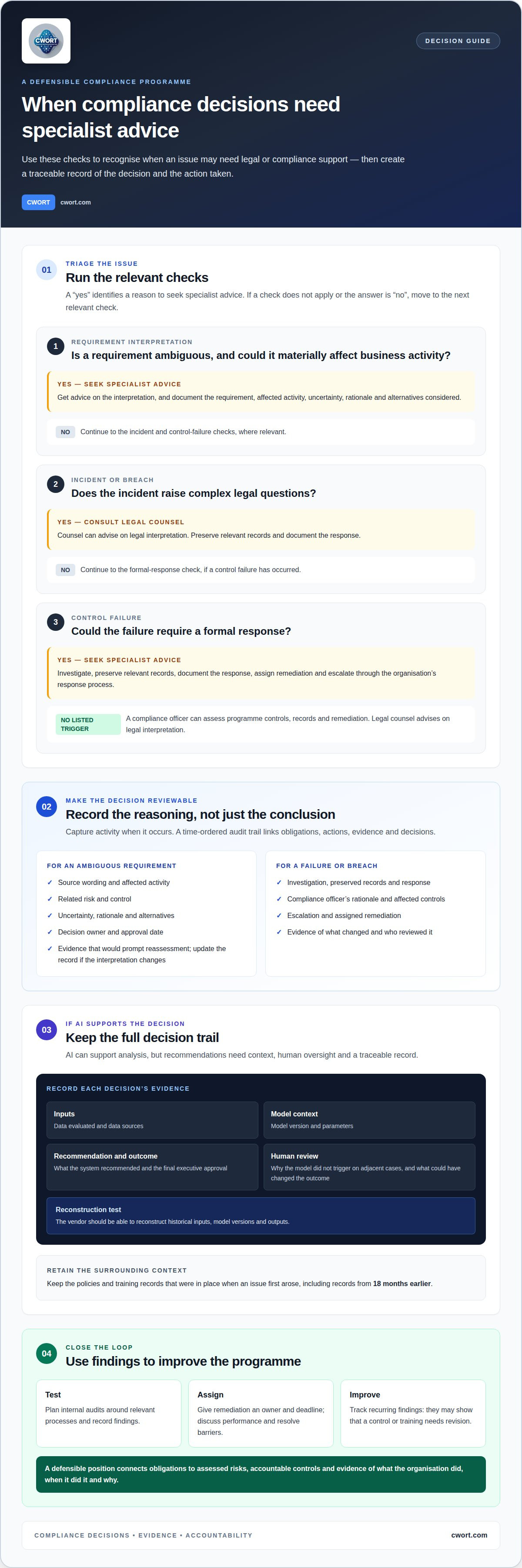
An internal audit tests whether compliance activities work as intended and identifies improvements. Policies alone cannot show whether people follow procedures or controls address risks. Plan audits around relevant processes, record findings, and assign owners and deadlines for remediation. Regular discussions with key decision-makers can assess programme performance, resolve barriers and approve improvements. Track recurring findings: they may signal that a control or training needs revision.
Compliance and decision audit trails
An audit trail is a time-ordered record of obligations, actions, evidence and decisions. Capture activity when it occurs, rather than relying on memory. Retain the policies and training records that were in place when an issue first arose, including records from 18 months earlier. For AI-supported decisions, record the data evaluated, recommendation, final executive approval, model version, parameters and data sources. Include counterfactual analysis: why the model did not trigger on adjacent cases, and what could have changed the outcome. The vendor should be able to reconstruct historical inputs, model versions and outputs.
If a control failure or breach emerges, investigate the issue, preserve relevant records, document the response and assign remediation. The compliance officer should record the rationale, identify affected controls and escalate the issue through the organisation’s response process. Link corrective actions to evidence showing what changed and who reviewed it.
Documenting ambiguous requirements
Document an interpretation by linking the requirement’s wording to the affected activity, risk and control. Record the source text, any uncertainty, the rationale for the chosen interpretation, alternatives considered, the decision owner and approval date. This creates a reviewable basis for action rather than an undocumented assumption. For emerging issues, note what evidence would prompt reassessment and update the record if the interpretation changes. A clear rationale helps leaders explain how they addressed regulatory concerns.
Seeking legal or compliance advice
Seek specialist advice when an ambiguous requirement could materially affect business activity, an incident raises complex legal questions, or a control failure may require a formal response. Legal advice and compliance support serve different needs: counsel can advise on legal interpretation, while a compliance officer can assess programme controls, records and remediation. Costs depend on scope, complexity, urgency and expertise, so there is no single typical fee. Set out the issue and relevant records to help define the work.
Proactive compliance and organisational risk management
Proactive compliance links regulatory obligations to organisational risks before failures occur. It makes risk management part of operational decisions, rather than a response after harm.
Proactive organisational risk management
Start by identifying activities that could create compliance exposure, such as supplier access to sensitive information or AI influencing operational decisions. Assess potential effects on customers, services and regulatory commitments. Then assign an owner, select relevant controls and define how they will be assessed. This gives decision-makers a practical basis for prioritising risks and directing resources.
Link risk assessment to policy changes, employee training and remediation. If an assessment identifies a weakness in supplier oversight, for example, update the review process, brief responsible staff and track corrective actions. A connected governance workflow helps show how these activities support broader risk mitigation and reveals gaps between written procedures and actual conduct.
AI governance should address intended use, data inputs, oversight and accountability. Maintain an inventory of systems, document who owns each use and assess potential effects before deployment. Validate outputs against relevant cases, and give a human decision-maker authority to challenge recommendations. Record how outputs were considered and escalate unexpected results. Reassess when the system, data or business process changes.
Model risk management should cover design, validation, use and ongoing monitoring. A screening model, for example, may behave differently after its input data changes. Document its purpose, limitations, validation approach and approval. Define the conditions that prompt review, restriction or withdrawal. This creates governance around model use instead of treating an automated output as inherently reliable.
Managing regulatory change
Regulatory change management identifies new or revised requirements and translates them into operational action. Assess each change against affected activities, risks, policies, controls, training and evidence. Assign owners, record decisions and track remediation to completion. This helps distinguish developments that affect the organisation from those that do not.
UK operational resilience requirements make technology, outsourcing and business continuity relevant to compliance planning. DORA, NIS2 and UK NIS are examples of frameworks that may shape an organisation’s control environment, depending on applicability. Map relevant requirements to existing controls, identify gaps and document planned remediation. A policy update alone does not resolve a gap if related procedures or staff guidance remain misaligned.
Review emerging requirements through a controlled process. Log the change, assess its effect, approve the response and update affected controls and guidance. For an AI-related development, consider whether intended uses, oversight or evidence practices need adjustment. Revisit the assessment when the organisation changes its services, suppliers or technology. This keeps compliance decisions connected to current operations and provides a reasoned basis for prioritising action. A structured compliance workflow can help coordinate obligations, assessments and remediation.
Researching applicable legal and regulatory obligations
Map obligations to the organisation’s activities, locations and data before testing controls. The regulatory landscape includes UK requirements and, where relevant, European Union rules.
Identifying applicable obligations
Applicability research identifies the legal and regulatory requirements that affect an organisation’s operations, data and locations. This scope matters: assess controls against obligations that genuinely apply.
Start with the organisation’s services, customers, technology, suppliers and data locations. Then map relevant requirements to the activities and controls they influence. The General Data Protection Regulation (GDPR), for example, forms part of the context for accountability, data protection and operational resilience. The European Union AI Act may also be relevant where an organisation’s activities bring it within scope. Record the source, interpretation, affected process, control owner and supporting evidence for each obligation.
Repeatability matters. For each decision, retain the applicable requirement, facts considered, rationale, approver and resulting action. If an AI system informs a decision, document its role and how a human reviewer assessed its output. Compliance officers remain accountable to regulators for explainability outcomes; that accountability cannot be delegated to vendors. This record helps demonstrate a consistent approach in similar cases.
Prepare for regulatory examinations by organising evidence around obligations and controls, rather than collecting documents without context. A regulator’s request can then be traced to the relevant policy, control activity, decision record and remediation evidence. Assign responsibility for retrieving each record and explaining how it supports the organisation’s compliance position. This approach can also reveal missing or inconsistent evidence before an examination begins.
Regulatory developments and compliance consequences
Regulatory change management tracks developments and assesses their implications for the organisation’s obligations, controls and evidence. It matters because an unchanged process may no longer address an applicable requirement.
The EU AI Act provides an example of a changing framework: its general-purpose AI model obligations began applying on 2 August 2025. Article 50 chatbot and AI interaction disclosure obligations apply from 2 August 2026. The Act’s full high-risk framework obligations for Annex III standalone systems are scheduled for 2 December 2027 under the Omnibus agreement. These dates do not establish that every UK organisation is in scope; applicability depends on the relevant activities and locations.
For UK organisations, failing to demonstrate compliance can intensify regulatory scrutiny and lead to consequences under the applicable regime. The outcome depends on the requirement, conduct, evidence and circumstances. Strong preparation means presenting a coherent account of the obligation, control operation, decisions and corrective action, rather than relying on unsupported assurances.
Coordinating information governance and IT stakeholders
Compliance evidence is spread across teams, platforms and suppliers. Governance needs to connect those sources to clear responsibilities and reliable retrieval.
Bring legal counsel, IT, risk management and information governance into the same planning process. Each team sees a different part of the evidence trail. Legal counsel can define preservation needs; IT can locate systems and access paths; risk teams can assess exposure; information specialists can organise records. Without coordination, relevant messages or decisions may remain isolated in a mailbox, shared drive or external platform.
Set ownership before an incident occurs. Identify who can locate, preserve, review and release each type of information. Record system names, business owners, storage locations and access controls. For example, a supplier may host files outside the organisation’s network. Understand how those files are accessed and stored, and assess the supplier’s capabilities and confidentiality arrangements.
A legal-hold process gives teams a coordinated way to preserve relevant information when litigation or a regulatory inquiry is anticipated. It should identify trigger events, define scope, implement and enforce the hold, and preserve relevant material. Counsel, IT, risk management and information stakeholders need agreed roles at each stage. A hold notice should reach the people who control relevant records, with a way to confirm preservation and escalate problems.
Preservation must account for how systems work in practice. Ask IT to identify routine deletion, backups, collaboration tools and retention settings that could affect relevant information. Document which sources are in scope, who can suspend ordinary disposal, and how that action is recorded. Where a supplier manages information, clarify access routes and preservation responsibilities. A process that exists only on paper may fail if a system no longer retains the evidence.
Form a response team with named deputies, decision authority and an escalation route. Run a simulation based on a realistic event, such as a regulator requesting records about a control failure. Test whether teams can identify custodians, preserve records and assemble a coherent response. Record delays, access problems and unclear hand-offs, then assign corrective actions. This turns institutional knowledge into an operational process instead of relying on individual memory.
The Three Lines Model can help clarify oversight: compliance provides independent oversight and challenge, while internal audit gives separate assurance to the board. Keep these responsibilities distinct from operational control ownership. A process owner supplies evidence; compliance challenges whether it addresses the relevant risk; internal audit provides separate assurance. Clear boundaries help leaders understand who performed each action and who reviewed it.
Failure to manage legal holds can lead to spoliation or adverse instructions. Coordinated governance therefore needs practical procedures, accessible records and tested communication among counsel, IT, risk and information teams. Rehearsals expose gaps before an actual inquiry makes them harder to resolve.
Compliance assessments and control monitoring
Assessments establish whether controls address applicable obligations and organisational risks. Monitoring then shows whether those controls continue to work as business processes and the regulatory landscape change.
Start with a defined scope. Identify the obligation, related risk, control owner and evidence needed to demonstrate operation. An assessment can then compare the control’s design with its performance in practice. A documented approval procedure, for example, may appear adequate on paper, but sampled records could reveal missing approvals or inconsistent application. Record the finding, its impact, the accountable owner and the corrective action.
Choose a testing approach that fits the control and its risk. Annual testing can assess controls at planned intervals; continuous monitoring can surface exceptions as they occur; risk-focused testing can direct attention to greater exposure. These approaches can work together. A high-impact access control, for instance, may receive ongoing exception monitoring alongside a deeper scheduled review. Define what constitutes failure before testing to keep results consistent and comparable.
Make each test reproducible. Document the sample or data examined, test method, result, reviewer and evidence location. If a test identifies an exception, establish whether it is isolated or signals a wider weakness. A missed approval might require correcting one record, or reveal that a workflow allows approvals to be bypassed. Support that distinction with evidence, not assumption.
Useful measures show performance and areas requiring intervention. Track:
- Overall compliance rate and training completion rate.
- Policy and procedure adherence, plus audit finding recurrence.
- Mean time to detect issues and document expiration rate.
- Exception rate, with findings grouped by control or business process.
Interpret measures together. A high training completion rate does not prove that staff follow procedures; compare it with adherence findings and recurring audit issues. A rising exception rate may indicate a deteriorating control, a process change or stronger detection. The chief compliance officer can use these patterns to report current risk, escalate concerns and direct further assessment.
Close the loop. Assign remediation to a named owner, agree a completion point and retain evidence of the fix. Retest the affected control to establish whether the change addressed the cause. Keep the original finding, corrective action and retest result connected, so leadership can distinguish completed activity from validated improvement. Closing a ticket without confirming a revised approval workflow, for example, would leave the control’s effectiveness untested.
To see how structured compliance workflows can support assessment and monitoring, request a CWORT demonstration.
CWORT
CWORT helps organisations translate regulatory obligations into structured activities, with evidence linked to control outcomes. Its compliance validation platform supports accountable execution and enforces separation of duties, creating a traceable record of how controls are addressed. It is useful when obligations, owners, actions and evidence are fragmented across teams or tools, making gaps and progress difficult to assess.
Its work includes DORA Compliance Readiness and Assessment, UK NIS Compliance Management, NIS2 Readiness and Compliance Management, and ISO 27001 Readiness and Control Mapping. These offerings help organisations assess readiness and connect applicable frameworks with control activity. CWORT supports compliance execution and validation; it does not replace legal advice or the organisation’s accountability for its decisions.
Contact CWORT to discuss how its structured compliance validation workflow can support your organisation’s requirements.
Turn compliance intent into sustained execution
Building a defensible compliance position is an ongoing governance commitment, not a point-in-time exercise. Make responsibility for evidence, control performance and remediation part of routine operational decision-making. This gives leadership a basis for reviewing whether compliance activity remains aligned with changing risks and business priorities.
CWORT supports this work through DORA Compliance Readiness and Assessment, UK NIS Compliance Management, and NIS2 Readiness and Compliance Management. These offerings help organisations structure compliance activity around applicable requirements and control evidence. Select the relevant focus for your organisation, then establish the decisions and outcomes you need to bring into view.
For a discussion about your compliance requirements and how CWORT may support your approach, contact CWORT. A clear next step can help turn fragmented activity into a more structured programme.
Frequently Asked Questions
What does it mean to build a defensible compliance position in the UK?
It means being able to explain how the organisation identified relevant obligations, made decisions and addressed risks. That explanation needs supporting evidence, not simply a policy statement. For example, a board reviewing a supplier incident should be able to understand which controls applied, who approved the response and what corrective action followed. Building a defensible compliance position makes this reasoning traceable and open to scrutiny.
Which UK laws, regulations and regulator guidance apply to a business’s compliance obligations?
Applicable requirements depend on the organisation’s activities, operating locations, data and sector. UK GDPR and the Data Protection Act 2018 may be relevant to data protection; DORA, UK NIS or NIS2 may be relevant to particular organisations and activities. Standards such as ISO 27001 and frameworks such as NCSC CAF can also shape control expectations, but they are not interchangeable with legislation. Map each requirement to the activity it concerns.
How can a UK organisation identify and assess its legal and regulatory compliance risks?
Begin by mapping services, data flows, suppliers, technology and locations, then connect each activity to potentially applicable obligations. Assess what could go wrong, who could be affected and which controls address the exposure. If a supplier stores information outside the organisation’s network, for example, consider access, storage and confidentiality. Record the assessment rationale and assign responsibility for addressing identified gaps.
What records and evidence should be kept to demonstrate compliance to UK regulators?
Keep dated versions of relevant policies, approval records, training acknowledgements, control test results and evidence of completed corrective actions. For an AI-supported assessment, retain the inputs, model details, output and human review record needed to explain the decision. Organise evidence by obligation and control, with an owner and retrieval location. This structure distinguishes the record of an activity from evidence showing whether it achieved its intended outcome.
What governance, policies and controls help support a defensible compliance position?
Define who owns each control, who reviews its operation and who provides independent challenge. Policies should connect requirements to practical procedures, while escalation channels let staff raise concerns. A process owner may perform a control, compliance may challenge its design, and internal audit may provide separate assurance. Clear decision rights and separation of duties help prevent a person from performing and approving the same activity without oversight.
How often should UK compliance risk assessments and controls be reviewed?
Set review timing according to risk, control purpose and rate of change. Continuous monitoring can identify exceptions promptly, while scheduled testing can assess whether controls work over a defined period. Reassess sooner after a material process change, new technology, incident, recurring finding or relevant regulatory development. A supplier change affecting data access, for example, may warrant an immediate review of the related risk assessment and control design.
How does a defensible compliance position differ across UK sectors and regulators?
The underlying discipline is similar, but obligations, evidence and control priorities vary by activity and sector. A financial services organisation may need to assess operational resilience and relevant DORA requirements, while a critical infrastructure operator may focus on UK NIS and applicable cyber controls. Data protection, outsourcing and technology risks can also change the evidence expected. Map applicable frameworks to actual operations rather than applying an unchanged generic control set.
Disclaimer
The content on this site is provided for general information and educational purposes only. It does not constitute legal, regulatory, financial, or professional advice. CWORT provides AI-assisted insights and workflow automation, but all compliance decisions remain the responsibility of your organisation and its management. Always seek qualified legal or regulatory guidance for decisions relating to the UK NIS Regulations, CAF, DORA, NIS2, ISO 27001, or other obligations.
Related posts
How to Demonstrate Control Effectiveness to Regulators: A Strategic Guide
Learn how to demonstrate control effectiveness to regulators with our guide. Shift from chaos to an evidence-based, audit-ready compliance programme today.
Real-Time Compliance Dashboards for Executive Decisions
See how real-time compliance dashboards for executives turn trusted data into clear risk signals, accountable actions and stronger regulatory oversight.
Four ways to understand and reduce human error in compliance
Discover four ways of reducing the risk of human error in compliance, investigating near misses and improving controls, procedures and cyber risk management.
Article by
Michael Iyiola
Co-Founder, CWORT
Michael Iyiola is a co-founder of CWORT and a Cyber and AI Security Engineer with deep experience in vulnerability management, detection engineering and operational resilience across UK critical national infrastructure, including rail, energy and financial services. At CWORT, he designs scalable, evidence-driven workflows that help teams meet modern regulatory and security demands.
Build Your Foundation of Auditable Certainty
Take control of your regulatory obligations and secure your infrastructure with CWORT.