Calculating ROI on Compliance Management Software: A Strategic Guide for UK Enterprises

Michael Iyiola
Co-Founder, CWORT
Our UK guide to calculating ROI on compliance management software helps you build a business case, cut costs, and ensure auditable certainty for DORA & NIS2.

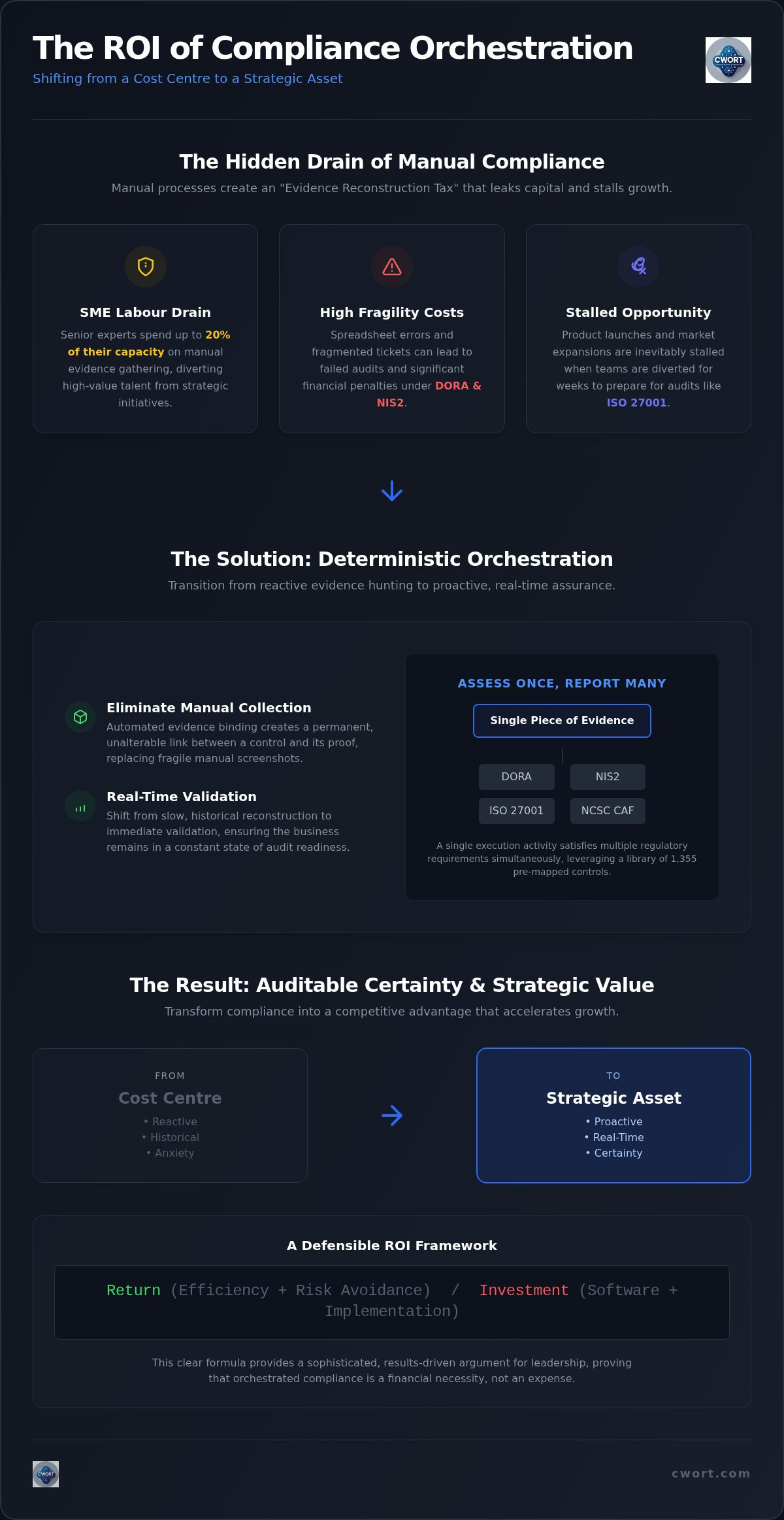
Your current compliance process is likely leaking capital through a hidden reconstruction tax. Every hour a senior subject matter expert spends hunting for evidence amongst fragmented Jira tickets or manual spreadsheets is an hour stolen from strategic growth. You recognise that the status quo is unsustainable, especially with the looming enforcement of DORA and NIS2 regulations that carry the threat of significant financial penalties. Transitioning from manual tracking to a rigorous orchestration platform isn't just an operational preference; it's a financial necessity for the modern UK enterprise.
This guide will show you exactly how to build a bulletproof business case by calculating ROI on compliance management software with precision. You'll learn how to quantify the reduction in manual labour and the value of producing audit-defensible evidence on demand. We'll provide a clear formula to help you present a sophisticated, results-driven argument to the board, shifting the perception of compliance from a cost centre to a strategic asset that ensures auditable certainty. We will move from the anxiety of potential failure to a state of total, evidenced assurance.
Key Takeaways
- Establish a defensible framework that balances implementation costs against the strategic value of risk avoidance and operational efficiency.
- Eliminate the "evidence reconstruction tax" by leveraging orchestration to automate evidence collection across DORA, NIS2, and ISO 27001.
- Build a robust business case for leadership by calculating ROI on compliance management software using deterministic financial and operational metrics.
- Quantify the strategic advantages of rapid audit readiness, including accelerated speed-to-market for new services and reduced regulatory anxiety.
- Secure high-value government contracts by demonstrating orchestrated maturity through NCSC CAF assessments and validated control mapping.
Table of Contents
- Establishing a Defensible ROI Framework for Compliance Management
- Quantifying Efficiency Gains through Automated Orchestration
- Calculating Risk Mitigation and Audit Readiness ROI
- Assessing Strategic ROI: Market Entry and Operational Maturity
- Building the ROI Business Case for CWORT: A Step-by-Step Guide
Establishing a Defensible ROI Framework for Compliance Management
Quantifying the value of regulatory oversight requires moving beyond the "cost of doing business" mindset. For UK enterprises, a defensible framework for calculating ROI on compliance management software begins with defining the Total Cost of Compliance (TCC). This metric is the aggregate of all visible and invisible expenses, including software licences, external consultancy fees, and the internal labour required to maintain standards. The ROI itself is the ratio between the 'Return' (the sum of risk avoidance and operational efficiency) and the 'Investment' (the total cost of software and its implementation).
Traditional GRC tools often fail to deliver a positive return because they function as passive digital filing cabinets. They require constant manual data entry, which creates a cycle of diminishing returns. The effort to maintain the tool often exceeds the value of the insights it provides. To achieve a true return, enterprises must shift from administrative tracking to deterministic orchestration. This transition allows leadership to distinguish between direct financial returns, such as reduced headcount costs, and qualitative strategic gains like board-level confidence and auditable certainty.
Identifying the Direct Costs of Manual Compliance
Manual compliance is an expensive, high-friction activity that drains resources from strategic growth. To build an accurate ROI case, you must first quantify these hidden drains:
- SME Labour: Calculate the hourly rate of senior Subject Matter Experts (SMEs) who spend up to 20% of their capacity on manual evidence gathering. These are often your highest-paid technical assets.
- Fragility Costs: Factor in the financial impact of errors inherent in spreadsheet-based tracking. A single broken link or missed Jira ticket can lead to a failed audit or a regulatory fine under DORA or NIS2.
- Opportunity Cost: Measure the delay in strategic projects. When a team is diverted to prepare for an ISO 27001 audit, product launches and market expansions are inevitably stalled.
Shifting the Perspective: Compliance as a Strategic Asset
A rigorous orchestration platform transforms compliance from a reactive obligation into a proactive strategic asset. By using a system like CWORT, organisations replace the anxiety of potential failure with the calm of auditable certainty. This shift is critical for entering high-value regulated markets where proof of maturity is a prerequisite for contract awards. Whilst manual models are reactive and rely on historical reconstruction, an orchestrated model provides real-time validation. This ensures that the business remains in a constant state of audit readiness, providing a defensible reality that satisfies both internal boards and external regulators.
Quantifying Efficiency Gains through Automated Orchestration
The most pervasive drain on corporate resources is the "Evidence Reconstruction Tax". This is the hidden cost of manually retracing steps to prove that a control was active months after the event occurred. For many UK enterprises, this process involves scouring fragmented Jira tickets and legacy spreadsheets, a method that is both slow and prone to human error. By implementing regulatory compliance workflow automation, businesses capture evidence in real-time. This shifts the focus from historical reconstruction to immediate validation, significantly impacting the bottom line.
When calculating ROI on compliance management software, efficiency is best measured through the "Assess Once, Report Many" capability. Using a library of 1,355 controls mapped across 42 frameworks, an orchestration engine allows a single execution activity to satisfy multiple regulatory requirements simultaneously. Whether you're addressing DORA, NIS2, or ISO 27001, the administrative overhead for the Compliance Office is drastically reduced. You no longer need to repeat assessments for every new framework; instead, you leverage a crosswalk that translates one action into multiple points of evidence.
Eliminating Manual Evidence Collection
Manual screenshotting is an archaic practice that offers no structural integrity. It's easily manipulated and difficult to audit at scale. In contrast, automated evidence binding creates a permanent, unalterable link between a control and its proof. This provides senior leadership with a single, explainable view of the organisation's posture. The deterministic nature of CWORT's scoring removes the ambiguity that often plagues audits. There's no debate over compliance status when the evidence is bound and validated by design. This clarity allows you to see exactly how orchestration simplifies the audit process.
Reducing the "Compliance Tax" on SMEs
Your technical leads are hired to build products, not to populate spreadsheets. The "Compliance Tax" refers to the significant portion of SME capacity lost to administrative tasks during audit cycles. Freeing these experts from manual data entry delivers a measurable return on investment through improved focus on core engineering work and reduced burnout. Structured execution activities ensure that compliance becomes a background process rather than a disruptive event. This preservation of high-value labour is a critical component for any leader looking to justify the transition from manual GRC tools to a rigorous validation platform.
Calculating Risk Mitigation and Audit Readiness ROI
The financial impact of a regulatory breach extends far beyond the immediate penalty. When calculating ROI on compliance management software, enterprises must account for the staggering costs of non-compliance under the current UK and EU regimes. Failure to meet standards isn't just an administrative oversight; it's a significant balance sheet risk. Transitioning to an orchestrated system allows you to identify gaps continuously, preventing the astronomical costs associated with late-stage remediation or "forced remediation" under regulator-imposed deadlines.
A proactive approach ensures that your organisation avoids the "remediation spike" where costs escalate as deadlines loom. By ensuring compliance evidence integrity, you eliminate the risk of an auditor rejecting your proof. Rejection leads to re-work, delayed certifications, and prolonged exposure to risk. Real-time validation ensures that every control is backed by deterministic evidence, securing your position against intense regulatory scrutiny.
The True Cost of Regulatory Scrutiny
The penalty structures for modern regulations are designed to be punitive. Under DORA, regulators can impose periodic penalty payments of up to 1% of the average daily worldwide turnover of the financial entity. For essential entities under NIS2, fines can reach €10 million or 2% of total worldwide annual turnover. Beyond these figures, you must factor in the reputational damage and the inevitable share price volatility that follows a publicly disclosed failure. The ROI of an orchestration platform is found in its ability to provide a defensive shield against these catastrophic financial outcomes.
Accelerating Audit Cycles with Reproducible Evidence
External audits are expensive, time-consuming engagements. Every day an auditor spends hunting for evidence or clarification increases your billable costs. You can quantify "Audit Speed" ROI by measuring the reduction in auditor billable hours when they are presented with a validated, orchestrated system. CWORT provides board-ready reports that offer deterministic proof, drastically reducing follow-up queries. Instead of an auditor spending weeks piecing together a narrative from fragmented data, they move through a structured environment where every claim is already bound to its evidence. This efficiency transforms the audit from a resource-heavy ordeal into a streamlined validation exercise.
Assessing Strategic ROI: Market Entry and Operational Maturity
Strategic ROI transcends simple cost reduction; it functions as a competitive accelerator. When calculating ROI on compliance management software, leadership must evaluate how orchestration facilitates rapid entry into new, highly regulated markets. The "Assess Once, Report Many" capability is the primary engine here. By leveraging a library of over 1,300 controls, organisations can enter a new jurisdiction with up to 80% of their regulatory obligations already mapped and validated. This removes the traditional compliance bottleneck, allowing for service launches that occur months ahead of competitors who are still bogged down in manual mapping.
The financial gain from accelerated market entry is substantial. Launching a regulated service even three months earlier can result in significant revenue capture that would otherwise be lost to more agile competitors. This strategic agility is supported by framework crosswalks that protect your proprietary operational methods whilst ensuring every action meets local standards. For those targeting UK public sector frameworks, the use of NCSC CAF assessment software is a prerequisite for securing high-value contracts, making the platform a direct revenue enabler rather than a cost centre.
Enabling Rapid Expansion into Regulated Markets
Market expansion requires more than just a sales strategy; it requires a repeatable compliance blueprint. Orchestration allows you to apply a consistent maturity lens across multiple regions or business units. This is particularly valuable for Private Equity teams who need to apply a disciplined, deterministic lens across a diverse portfolio. Instead of accepting fragmented reports from different subsidiaries, leadership gains a unified view of maturity. This level of auditable certainty increases the valuation of the portfolio and reduces the risk profile during exit events.
Improving Operational Resilience and Capacity
Operational maturity is the foundation of cyber resilience. A well-orchestrated system provides a clear view of both capability and capacity, preventing the common pitfall of under-resourced security functions. By improving maturity, organisations reduce the frequency and impact of downtime, leading to faster incident recovery. This isn't a theoretical benefit; it's a structural improvement that ensures business continuity. Board-level visibility into these metrics allows for defensible investment decisions, ensuring that capital is allocated where it will have the most significant impact on resilience. To see how these strategic levers can be applied to your organisation, request a tailored demonstration of the CWORT platform.
Building the ROI Business Case for CWORT: A Step-by-Step Guide
The final stage in calculating ROI on compliance management software is the translation of operational gains into a board-ready financial narrative. A compelling business case contrasts the current state of manual, fragmented tracking with the future state of orchestrated validation. Whilst many organisations claim they already have Jira to manage compliance, this assumes that task completion is synonymous with control effectiveness. It isn't. Jira tracks activity; CWORT validates reality. By shifting from a task-based model to a deterministic validation engine, you eliminate the gap between what you believe is happening and what you can actually prove to a regulator.
A "Before vs. After" comparison should highlight the elimination of the reconstruction tax and the significant reduction in SME capacity drain. In the old model, audits are disruptive, high-anxiety events that pull technical leads away from core projects. In the orchestrated model, compliance is a continuous, background process that produces audit-defensible evidence by design. This structural shift ensures that the organisation remains in a state of constant readiness, satisfying the board's requirement for auditable certainty and risk control.
Generating Audit-Defensible Proof for the Board
Presenting to the Risk and Audit Committee requires more than just static spreadsheets. Use CWORT's heat-map dashboards to provide an immediate, visual representation of organisational maturity across frameworks such as DORA, NIS2, and ISO 27001. These reports demonstrate reproducible results, showing exactly how each control maps to specific regulatory obligations. This level of transparency builds trust with leadership. Highlighting the built-in separation of duties further strengthens the case, as it demonstrates a level of structural governance that manual systems cannot replicate. You're no longer reporting on promises; you're presenting evidenced truth.
Finalising the Business Case Calculation
To reach a definitive figure, aggregate the direct labour savings from SMEs and the Compliance Office, the quantified value of risk mitigation, and the strategic revenue gains from accelerated market entry. Subtract the SaaS subscription costs and implementation fees. This calculation provides the final ROI percentage and a clear Payback Period, which is the exact timeframe required to break even on the investment. Most enterprises find that the reduction in manual evidence collection alone covers the cost of the platform within the first two audit cycles. Secure your path to auditable certainty by arranging a working session to build a tailored ROI model for your specific regulatory environment.
Transitioning from Administrative Burden to Strategic Assurance
The transition from manual tracking to deterministic orchestration is no longer a matter of operational preference; it's a financial imperative. By calculating ROI on compliance management software, you move beyond the "cost of doing business" and unlock measurable value through reduced SME labour and rapid market entry. You've seen how eliminating the reconstruction tax and leveraging "Assess Once, Report Many" capabilities transforms compliance from a reactive drain into a proactive asset. This structural shift replaces regulatory anxiety with the calm of auditable certainty.
CWORT is already utilised by critical national infrastructure providers to map over 42 global regulatory frameworks with precision. Our platform provides the deterministic scoring required for audit-defensible assurance, ensuring your organisation remains resilient in an increasingly complex landscape. It's time to replace fragmented Jira tickets with a rigorous validation engine. Book a working session to map CWORT to your compliance programme and secure your path to total, evidenced assurance. Your board deserves a business case built on defensible truth.
Frequently Asked Questions
How long does it typically take to see a positive ROI on compliance software?
Positive ROI is typically achieved within 12 to 18 months, or roughly two audit cycles. When calculating ROI on compliance management software, you must factor in the immediate cessation of the "evidence reconstruction tax". By automating the validation process, organisations stop paying senior SMEs to perform administrative tasks. This shift allows technical leads to focus on revenue-generating projects, providing an immediate boost to operational capacity and strategic output.
Can we calculate ROI for compliance if we haven't been fined yet?
You can calculate ROI by quantifying risk exposure and operational friction rather than relying solely on historical fines. Use the cost of "forced remediation" and the daily turnover penalties under DORA as a baseline for avoided risk. Additionally, measure the efficiency gains from "Assess Once, Report Many". These tangible savings in labour and the ability to enter regulated markets faster provide a clear financial return regardless of your past fine history.
How does CWORT differ from a standard GRC tool in terms of ROI?
CWORT delivers a higher ROI by functioning as an orchestration engine rather than a passive GRC tool. Standard tools require constant manual data entry, which creates a cycle of diminishing returns. In contrast, CWORT translates regulatory obligations into execution activities, providing deterministic scoring and evidence binding. This proactive approach ensures auditable certainty and eliminates the human error inherent in manual tracking, delivering a more robust and defensible business case.
What is the biggest hidden cost in manual compliance management?
The "Evidence Reconstruction Tax" is the most significant hidden cost, representing the hundreds of hours spent hunting for proof months after a control was executed. Manual systems rely on fragmented Jira tickets and spreadsheets that lack structural integrity. When an audit begins, SMEs are pulled from their primary duties to reconstruct historical events. This process is expensive, inefficient, and creates an opportunity cost that often exceeds the price of an orchestration platform.
How do I quantify the value of 'audit readiness' to my CFO?
Quantify audit readiness by calculating the reduction in external auditor billable hours and the elimination of internal "remediation spikes". A validated system like CWORT allows auditors to move through evidence significantly faster, reducing the duration of the engagement. Present the CFO with a comparison of the cost of a three-week manual audit versus a one-week orchestrated validation. The difference in consulting fees and internal disruption provides a definitive financial metric.
Does compliance software reduce the need for external consultants?
Orchestration software reduces the volume of hours required from external consultants for basic data gathering and report preparation. Instead of paying high hourly rates for administrative reconstruction, you utilise consultants for high-value strategic validation and gap analysis. This ensures that consultancy spend is focused on improving your security posture rather than simply populating a spreadsheet. It shifts the relationship from a resource-heavy necessity to a strategic partnership.
How do we measure the ROI of naively using Jira for compliance tracking?
The ROI of using Jira for compliance is often negative when you account for the lack of auditable integrity and high manual maintenance. Jira tracks tasks, not controls; it cannot provide the deterministic proof required for DORA or NIS2. When calculating ROI on compliance management software, compare Jira's manual overhead against an automated platform. You'll find that the "Jira Tax" in SME labour and audit queries far outweighs the cost of a dedicated orchestration engine.
Disclaimer
The content on this site is provided for general information and educational purposes only. It does not constitute legal, regulatory, financial, or professional advice. CWORT provides AI-assisted insights and workflow automation, but all compliance decisions remain the responsibility of your organisation and its management. Always seek qualified legal or regulatory guidance for decisions relating to the UK NIS Regulations, CAF, DORA, NIS2, ISO 27001, or other obligations.
Related posts
Compliance Evidence Management Software: Proving Regulatory Readiness in 2026
Prepare for DORA & NIS2. See how compliance evidence management software replaces chaotic audit trails with a single, defensible source of truth.
Streamlining Regulatory Compliance Processes: From Manual Tracking to Orchestrated Validation
Stop wasting money on manual compliance. Learn about streamlining regulatory compliance processes to reduce personal liability under DORA & NIS2 and gain aud...
Regulatory Scrutiny Management Tool: Orchestrating Defensible Compliance in 2026
Facing DORA & NIS2? A regulatory scrutiny management tool orchestrates defensible compliance, ending manual evidence chaos for permanent audit-readiness in 2...
Article by
Michael Iyiola
Co-Founder, CWORT
Michael Iyiola is a co-founder of CWORT and a Cyber and AI Security Engineer with deep experience in vulnerability management, detection engineering and operational resilience across UK critical national infrastructure, including rail, energy and financial services. At CWORT, he designs scalable, evidence-driven workflows that help teams meet modern regulatory and security demands.
Build Your Foundation of Auditable Certainty
Take control of your regulatory obligations and secure your infrastructure with CWORT.