Compliance posture: Its meaning, scope and ongoing requirements

Michael Iyiola
Co-Founder, CWORT
Improving compliance posture visibility means linking obligations to owned, tested controls and current evidence. See gaps, owners and open actions clearly.

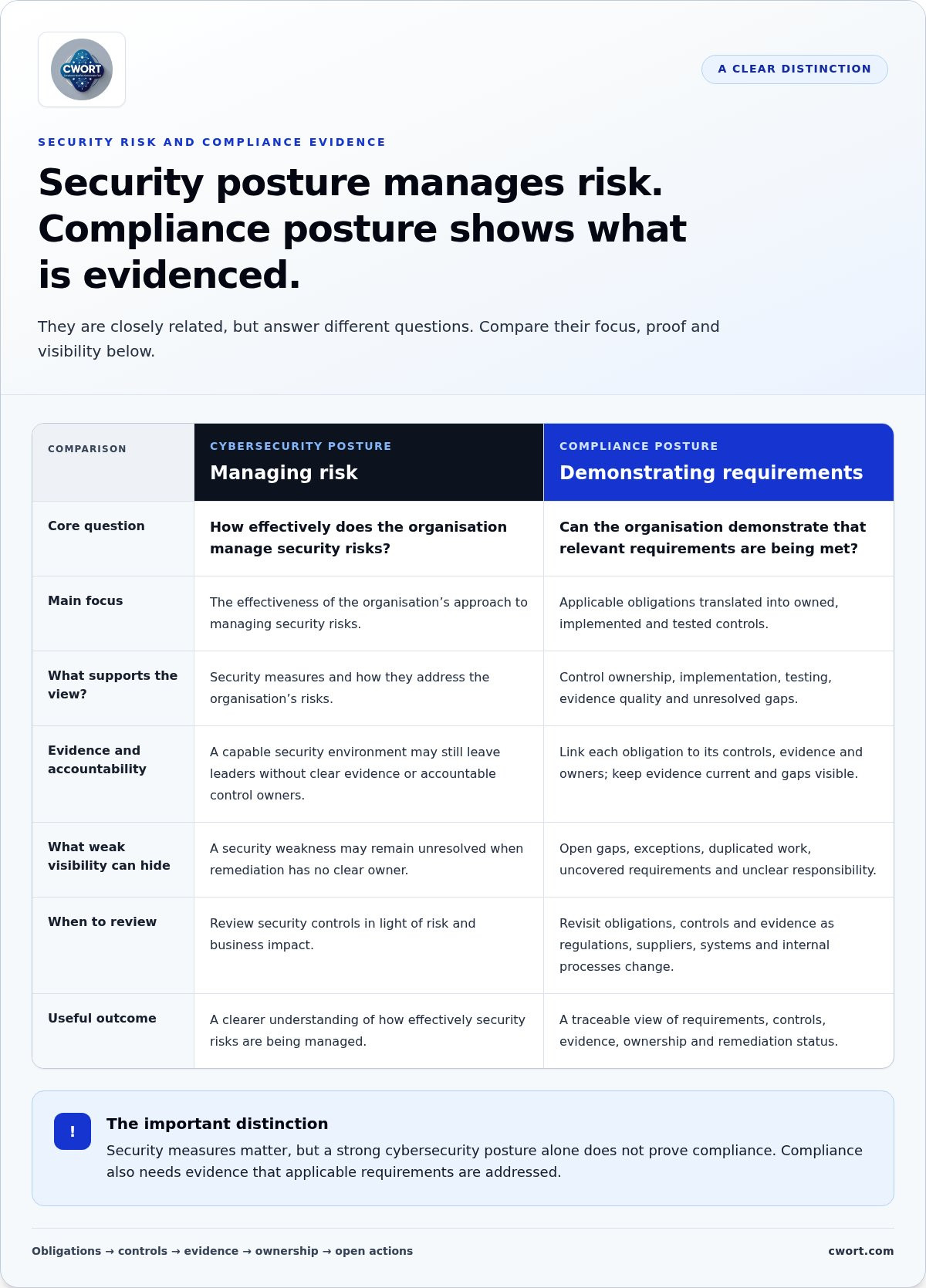
A strong cybersecurity posture does not, by itself, prove compliance. Compliance posture shows whether an organisation has translated its applicable obligations into owned, implemented and tested controls, with current evidence of how those controls operate. Improving compliance posture visibility means seeing these connections clearly, including open gaps, exceptions and who is responsible for remediation.
Security and compliance are closely related, but they answer different questions. Cybersecurity posture concerns how effectively an organisation manages security risks. Compliance posture concerns whether it can demonstrate that relevant requirements are being met. Even a capable security environment may leave leaders without clear evidence, accountable control owners or a reliable view across frameworks and business units.
This article explains what compliance posture covers, how it differs from cybersecurity posture and why it needs review as obligations, suppliers, systems and internal processes change. Meaningful visibility connects requirements to controls, evidence, ownership and unresolved actions, giving decision-makers a clearer view of the organisation’s position.
Key Takeaways
- Assess compliance by linking applicable obligations to control owners, implementation, testing and evidence, not by relying on framework labels alone.
- Identify overlapping framework requirements and evidence gaps to reduce fragmented reporting and unclear accountability.
- Separate compliance posture from cybersecurity posture: security measures matter, but compliance also requires evidence that relevant requirements are addressed.
- Review controls and evidence as regulations, suppliers, systems and internal processes change; keep open actions visible and assigned.
- Explore how CWORT’s DORA Compliance Readiness and Assessment and related readiness and control-mapping offerings can support structured compliance validation.
Table of Contents
- What is compliance posture?
- Compliance posture definition and scope
- Compliance posture versus cybersecurity posture
- Continuous compliance and changing regulatory requirements
- What does compliance posture visibility mean?
- CWORT: DORA Compliance Readiness and Assessment
What is compliance posture?
Compliance posture is the evidenced position of an organisation against its applicable obligations. Assess it by reviewing control ownership, implementation, testing, evidence quality and unresolved gaps.
Overlapping Frameworks and Evidence Gaps
Overlapping frameworks set related expectations, while evidence gaps leave some control outcomes unproven. For example, ISO 27001 and GDPR may both relate to information security, but a single policy document won’t demonstrate that every relevant control operates effectively. Map each obligation to its supporting controls, evidence and owners. This reveals duplicated work, uncovered requirements and risks hidden between frameworks.
Poor visibility can leave remediation without clear owners or allow a security weakness to remain unresolved. Start by listing applicable obligations, assigning control owners, testing controls and recording evidence gaps. Prioritise fixes by risk and business impact, then track each action through to closure.
Evidence Freshness and Quality
Evidence freshness indicates whether records still reflect how controls operate; evidence quality shows whether they support the claimed outcome. A past access review, for example, may not show whether current users still have appropriate permissions. Record the evidence date, control covered, responsible owner and test result. Review open gaps alongside the evidence, since an outdated record may mean a control needs retesting.
In the UK, compliance-monitoring tool costs depend on scope, integrations and evidence requirements; suppliers provide pricing after a quote request. Avoid treating a low number of open actions as proof of strong posture without checking their severity and age.
Tools for Real-Time Visibility
Dashboards, evidence repositories and workflow tools can bring control status, ownership and remediation actions into one view. Real-time visibility depends on current inputs and connected records; a dashboard cannot make stale evidence current. Compare platforms by framework mapping, evidence traceability, update frequency, exception handling and reporting. Look for a clear view of gaps and accountable owners, with evidence behind each status.
To improve visibility, connect obligations to controls, assign owners, capture test evidence and update status as work changes. Where records are split across spreadsheets and teams, a structured workflow can make ownership and evidence easier to follow.
Compliance Metrics and Assessment
Useful measures include control coverage, controls tested, current evidence, overdue reviews, open exceptions and remediation progress. No single score captures compliance posture, so pair completion measures with evidence quality and risk severity. Compare obligations with controls, check whether controls are implemented and tested, and record gaps with owners and actions.
Give senior leaders and auditors a concise framework view, evidence references, significant exceptions and remediation status. This makes the basis for each status visible. Review security controls in light of risk and business impact, then test whether completed fixes address the original gap.
Compliance posture definition and scope
Compliance posture is an organisation’s current position against obligations that apply to its activities. Those obligations may come from regulations, frameworks, contracts, customer requirements, industry standards or internal policies. The scope is therefore specific to each organisation, rather than a fixed checklist. A UK organisation might need to consider GDPR, UK NIS requirements, ISO 27001 controls and contractual commitments alongside its own policies.
Start by identifying the obligations relevant to the organisation’s services, locations, data and business relationships. Then map each requirement to the controls intended to address it. This distinction matters: a framework names expectations, while controls describe how the organisation puts those expectations into operation. An inventory of obligations gives risk management a defined boundary and helps teams assess what is in scope.
Scope should reflect how work actually happens. ISO 27001 addresses information security across people, processes, governance, suppliers, physical security and organisational responsibilities. A review limited to software and technical security posture can miss a supplier’s access, a staff process or a physical environment that handles sensitive information. Consider where information is collected, processed, stored and shared, then identify the teams and environments supporting each activity.
For each applicable requirement, record the linked control, operational owner, implementation status and testing approach. For example, a customer contract may require restricted access to shared information. The organisation can identify the relevant access control, assign its owner, inspect permissions and retain evidence of the review. This creates a traceable link between an obligation and the activity used to address it.
Requirements can expand when an organisation changes its services, suppliers, systems or operating model. A new product may introduce another data flow; an outsourced process may add third-party access. Reassess scope after these changes instead of assuming an earlier assessment still covers current operations. Where obligations overlap, map them to shared controls while retaining each requirement’s distinct evidence needs.
Compliance posture is not a legal opinion or a certificate. It is a structured view of applicable requirements, supporting controls, evidence, exceptions and decisions. It helps leaders understand what is implemented, what remains unresolved and who must respond. It also gives internal audit a clearer basis for examining control design and operation.
A compliance maturity assessment can examine scope, ownership and control execution together. Use the findings to distinguish a missing control from one that exists but lacks evidence or testing. This gives teams a more useful risk picture for prioritising action and aligning compliance work with operational responsibilities.
Compliance posture versus cybersecurity posture
Cybersecurity posture describes how well an organisation manages threats and protects systems, information and users. Compliance posture asks whether applicable requirements are addressed and supported by evidence. The two connect, but they measure different outcomes. A secure cloud environment, for example, doesn’t automatically demonstrate that an organisation meets ISO 27001 or SOC 2 expectations.
Cybersecurity teams might measure exposure through vulnerabilities, access weaknesses, security alerts or incident investigations. Compliance teams examine whether relevant controls have owners, operate as intended and are tested. NIST SP 800-53 Rev 5 provides a reference point for control expectations and governance evidence. A vulnerability dashboard can show technical risk, but not necessarily whether control evidence is current or an exception is approved.
This distinction matters when leaders review a single status score. Few detected threats do not prove that policies are followed, supplier risks are reviewed or audit actions are closed. Conversely, complete compliance records do not establish that every attack path is detected or that security defences work effectively. Consider both perspectives when assessing the organisation’s risk.
Connect them through shared controls and decisions. For example, an access control may reduce cybersecurity exposure and support a compliance requirement. Record its owner, test results, evidence and any remediation action. NIST Cybersecurity Framework 2.0 includes GV.RM, the Risk Management Strategy reference, which connects posture metrics to owned risk decisions and approved exceptions.
Governance establishes accountability: control owners manage implementation, while leaders review risk and approve exceptions. Security teams can prioritise remediation by risk and business impact. Automation can consolidate status information, but evidence still needs validation and risk acceptance needs clear ownership. Keep operational security measures distinct from compliance evidence, then link both to accountable decisions.
A paired review can reveal gaps between these perspectives. Compare cybersecurity findings, such as a configuration weakness, with the controls and evidence intended to address them. Check whether critical assets are covered, alerts and investigation workflows are reviewed, and response procedures are tested. Then assess whether the issue affects a framework requirement, an internal policy or a documented exception.
This joined-up view helps senior teams avoid treating a passing control check as proof of overall security, or a strong security posture as proof of compliance. A cyber resilience assessment can examine how security risks, controls and response capabilities work together. Its findings can inform remediation planning while preserving the distinct evidence needed to demonstrate compliance.
Continuous compliance and changing regulatory requirements
Continuous compliance means maintaining an accurate view of requirements, controls and evidence as the organisation changes. It is not a one-off assessment: a new supplier, product launch, incident or internal process update can affect compliance posture. Ongoing monitoring helps identify changes, assess their impact and prompt control reviews before outdated assumptions become embedded in reporting.
In the UK, relevant requirements depend on an organisation’s activities and sector. GDPR, UK NIS requirements and DORA may be relevant to different organisations, while ISO 27001 provides a framework for information security management. NIS2 may also be relevant to organisations assessing European requirements. Compliance monitoring should identify which obligations apply, then map each requirement to the controls that support it.
Changes do not always begin with a new regulation. A supplier change can introduce different access arrangements; a product launch can create new data flows. An incident may expose a control weakness, while an internal process update can make existing evidence inaccurate. Define who reviews these triggers, assesses their impact and identifies which control owners need to respond.
Disconnected tracking can separate regulatory updates from control records, risk registers and remediation actions. This makes it harder to see whether a changed requirement affects existing controls. A structured monitoring process links each identified change to an impact assessment, accountable owner, required evidence and any open action. Teams can then distinguish a change requiring control redesign from one needing updated documentation or testing.
Continuous monitoring also means reviewing whether controls remain effective, not just whether they were once implemented. A supplier review, for example, should reflect current services and access, while a security test should relate to the environment being assessed. Record the review outcome, evidence date, exceptions and remediation status. Prioritise unresolved issues by risk and business impact.
Set review triggers for regulatory updates, vendor changes, new products, incidents, audits and internal process changes. Assign responsibility for assessing each trigger, updating control mappings and escalating material gaps. This creates a repeatable path from change detection to documented action. A compliance posture assessment can establish which requirements apply and whether supporting controls, evidence and open actions remain aligned with current operations.
Proactive oversight ensures visibility is maintained where evidence or controls need attention. GDPR and CCPA are examples of regulations relevant to organisational compliance, so monitoring should reflect the obligations that apply to the organisation rather than rely on a fixed checklist. Evidence for audits and regulatory obligations should be quick, complete, searchable, contextual and tied to response activity. Keeping records connected to the control gap, decision and remediation helps reviewers understand not only what was found but how it was addressed by CWORT.
Security posture management should continuously assess, measure and improve security posture across an organisation. Compliance posture checks are an ongoing process that should evolve with an organisation’s network, policies and regulatory landscape. NIST CSF 2.0 includes ID.IM, Improvements, which relates to tracking control gaps and driving continuous remediation. Applying that focus means refreshing checks when systems or expectations shift, recording progress against open gaps and confirming whether corrective work has resolved the issue. These practices keep compliance monitoring connected to operational changes and make improving compliance posture visibility part of routine oversight rather than an isolated response.
What does compliance posture visibility mean?
Compliance posture visibility means seeing how obligations, controls, evidence and exceptions connect across the organisation. It gives leaders more than a framework status: they can identify who is responsible, what information supports a control and what remains unresolved. Improving compliance posture visibility starts with making these relationships accessible and current.
The view should reflect the organisation’s operating footprint. Cybersecurity compliance may require visibility across users, endpoints, networks, IT and OT environments, cloud services and third-party access. A dashboard covering only corporate laptops, for example, could miss operational technology or supplier access. Map the systems and relationships in scope, then show which controls apply to each area.
Visibility also includes staff actions. Organisations should know whether employees have read and accepted current information security policies and completed required security training. These records distinguish a published policy from one communicated to and acknowledged by its intended audience. Connect them to relevant teams and controls so leaders can identify where follow-up is needed.
NIST Cybersecurity Framework 2.0 includes GV.OV, Oversight, which relates to executive visibility into control status and exceptions. A useful leadership view should therefore present more than completion totals. Show material exceptions, accountable owners, evidence status and decisions requiring attention. Link each reported issue to its underlying control and risk, so an executive summary remains traceable to operational detail.
Visibility should help teams understand how risk moves across connected environments. Correlate activity across users, networks, endpoints, cloud services and third-party access to assess where exposure began and how far it travelled. For example, a supplier account connected to a cloud service may affect several systems. Connecting the records helps teams assess the scope and direct investigation or remediation.
Reports should support different decisions. A control owner may need a specific evidence gap and assigned action; senior leaders may need a view of significant exceptions and risk decisions. Auditors need searchable, contextual evidence tied to the control being assessed. Consistent status definitions, clear evidence references and recorded ownership help keep these views aligned.
Meaningful visibility is not about collecting every available data point. It means selecting information that supports oversight and action, then validating its source and context. Review whether the view covers relevant environments, current exceptions, policy acceptance, training completion and assigned actions. A structured demonstration can help teams assess how their compliance information is presented and used.
Cloud security posture and compliance posture should be assessed separately. A strong cloud security posture does not automatically mean an organisation has a strong compliance posture when managing frameworks such as ISO 27001 or SOC 2. The view should show whether obligations are evidenced across the relevant framework, rather than treating secure cloud settings as a substitute for compliance evidence. A security tool that is deployed but not monitored does not create resilience, so visibility should make monitoring status clear alongside deployment.
AI governance includes oversight of how AI is used, what data it can access, and how its decisions and actions can be traced and reviewed. Making these elements visible helps leaders see whether oversight, access and review are accounted for, and where further attention is needed.
CWORT: DORA Compliance Readiness and Assessment
CWORT’s DORA Compliance Readiness and Assessment helps organisations translate regulatory obligations into structured activities and auditable evidence. It links evidence to control outcomes and supports clear accountability, giving teams a more organised view of readiness, gaps and remediation work.
Turn to this assessment when DORA obligations need to be mapped against controls and supported by defensible evidence. For organisations working across other relevant frameworks, CWORT also offers UK NIS Compliance Management, NIS2 Readiness and Compliance Management, and ISO 27001 Readiness and Control Mapping. These offerings address distinct requirements, while helping bring structure to compliance validation.
To discuss how CWORT can support your compliance work, visit CWORT.
Turn compliance insight into accountable action
Make the next review a decision point, not another reporting exercise. Choose a priority obligation, identify the evidence leaders need and assign responsibility for addressing material gaps. Improving compliance posture visibility then has a clear purpose: helping the organisation direct attention and resources towards accountable action.
CWORT can support this work through its DORA Compliance Readiness and Assessment, UK NIS Compliance Management, and NIS2 Readiness and Compliance Management. These offerings help organisations structure compliance activity around the relevant requirements and their evidence. The right starting point is the framework or obligation that most directly shapes your current priorities.
Contact CWORT to discuss your compliance requirements and consider how to bring greater structure to your next assessment. A clear view of priorities can help your team move forward with focus and confidence.
Frequently Asked Questions
How can organisations map controls to multiple compliance frameworks?
Map each requirement to a shared control only when its purpose and evidence genuinely align. One access review may support related requirements, for example, but each framework may require different scope, approval or retention evidence. Record those distinctions in a crosswalk, including applicability, evidence references and control-specific gaps. Review mappings when requirements or processes change. CWORT’s Control Mapping and Framework Crosswalks can help structure this work.
Disclaimer
The content on this site is provided for general information and educational purposes only. It does not constitute legal, regulatory, financial, or professional advice. CWORT provides AI-assisted insights and workflow automation, but all compliance decisions remain the responsibility of your organisation and its management. Always seek qualified legal or regulatory guidance for decisions relating to the UK NIS Regulations, CAF, DORA, NIS2, ISO 27001, or other obligations.
Related posts
UK NIS Audit Readiness Tool: Orchestrating Compliance for 2026
Master your 2026 audit with our guide to UK NIS compliance orchestration. Move from fragmented evidence to a single source of truth for NCSC CAF 4.0 readiness.
Common NIS2 Compliance Mistakes: A Strategic Guide to Avoiding Audit Failure in 2026
Avoid costly NIS2 audit failure in 2026. This guide reveals common NIS2 compliance mistakes and shows how to build a defensible, audit-ready strategy.
NIS2 Audit Readiness Tool: Orchestrating Evidence-Based Validation for 2026
Ditch spreadsheets for the 2026 audit. A NIS2 audit readiness tool provides orchestrated, evidence-based validation for total compliance certainty.
Article by
Michael Iyiola
Co-Founder, CWORT
Michael Iyiola is a co-founder of CWORT and a Cyber and AI Security Engineer with deep experience in vulnerability management, detection engineering and operational resilience across UK critical national infrastructure, including rail, energy and financial services. At CWORT, he designs scalable, evidence-driven workflows that help teams meet modern regulatory and security demands.
Build Your Foundation of Auditable Certainty
Take control of your regulatory obligations and secure your infrastructure with CWORT.