Compliance Reporting for Board of Directors: The 2026 Strategic Checklist

Michael Iyiola
Co-Founder, CWORT
Master compliance reporting for board of directors with our 2026 checklist. Move from manual trackers to auditable proof and reduce liability for DORA & NIS2.

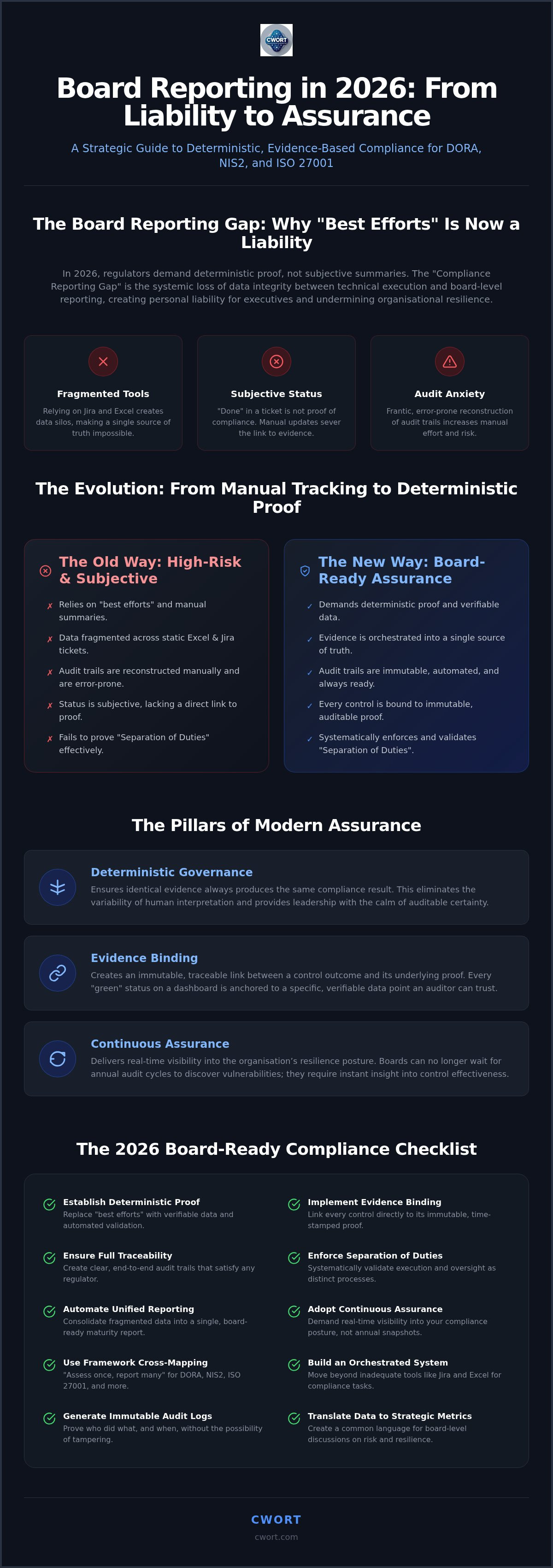
In 2026, a board report that relies on "best efforts" is no longer a strategic update; it's a liability. For many executives, compliance reporting for board of directors remains a manual exercise in reconstructing audit trails from fragmented Jira tickets and Excel spreadsheets. You likely feel the mounting pressure of personal liability whilst struggling to prove "Separation of Duties" to regulators. It's a high-stakes environment where subjective status updates simply won't suffice. Professional maturity requires a shift from administrative tracking to definitive, evidence-based proof.
We understand that the anxiety of potential failure often stems from a lack of auditable certainty. This article provides the roadmap to replace that uncertainty with a reproducible reporting system that reduces manual effort for audit prep. We'll show you how to master the transition from fragmented snapshots to deterministic, board-ready assurance using our 2026 strategic checklist. We'll examine how to align your evidence with DORA, NIS2, and ISO 27001 requirements to move from mere administrative tracking to a state of total, evidence-based proof that satisfies even the most rigorous corporate oversight and ensures organisational resilience.
Key Takeaways
- Identify why manual trackers and spreadsheets fail to provide the deterministic proof required for high-stakes regulatory environments in 2026.
- Master the transition from subjective status updates to evidence binding, ensuring every control outcome is linked to immutable, auditable proof.
- Utilise a comprehensive 10-point checklist to refine compliance reporting for board of directors, prioritising traceability and organisational accountability.
- Enforce a rigorous "Separation of Duties" by implementing a system that validates execution and oversight as distinct, non-conflicting processes.
- Reduce manual audit preparation by orchestrating fragmented data into a single, board-ready maturity report that covers multiple regulatory frameworks simultaneously.
Table of Contents
- The Board Reporting Gap: Why Manual Compliance Summaries Fail in 2026
- Defining Board-Level Assurance: From Subjective Status to Deterministic Proof
- The Board-Ready Compliance Reporting Checklist: 10 Critical Criteria
- Orchestrating the Flow of Evidence: Replacing Spreadsheets with Validation
- CWORT: Transforming Compliance Data into Strategic Board Intelligence
The Board Reporting Gap: Why Manual Compliance Summaries Fail in 2026
The "Compliance Reporting Gap" is the systemic loss of data integrity that occurs as granular operational evidence moves from technical teams to the boardroom. In 2026, boards are no longer passive observers; they're active participants in risk governance with potential personal liability under frameworks like DORA and NIS2. When technical data is summarised into a PowerPoint slide, the deterministic link between a control and its proof is often severed. This creates a dangerous reliance on subjective "status reporting" rather than objective validation. Effective compliance reporting for board of directors requires a shift away from "what we think is happening" toward a definitive operating record of what we can prove is happening.
Fragmented tracking across disconnected tools breeds "audit anxiety" amongst leadership. When a regulator asks for proof of Regulatory compliance, manual reconstruction of audit trails becomes a frantic, error-prone race. This lack of structural integrity doesn't just increase manual effort; it undermines the board's confidence in the organisation’s actual resilience. To survive the 2026 regulatory climate, leadership must demand a single, orchestrated system that enforces discipline by design.
The Failure of the Spreadsheet Operating Model
Spreadsheets are inherently static and lack the immutable audit trails required for modern scrutiny. They cannot prove who modified a cell or when the validation occurred, making them useless for demonstrating "Separation of Duties." Manual data entry is a catalyst for human error; a single misplaced digit can misrepresent an entire compliance posture. Relying on Excel for compliance reporting for board of directors is a strategic risk that leaves executives exposed to claims of negligence whilst providing no real-time visibility into control failures.
Why Jira is Not a Compliance Orchestration Tool
Jira is designed to track tasks and developer workflows, not to bind evidence to regulatory obligations. It lacks a deterministic scoring system and cannot provide the "Assess once, report many" capability required for multi-framework environments. Whilst Jira might tell you a ticket is "Done," it doesn't verify if the output of that ticket satisfies a specific control in ISO 27001 or NIS2. Organisations must move beyond task management and implement a dedicated regulatory compliance workflow automation system. This transition ensures that every action taken by the technical team is automatically mapped to a board-level assurance metric, replacing manual summaries with auditable certainty.
Defining Board-Level Assurance: From Subjective Status to Deterministic Proof
Board assurance in 2026 requires a transition from subjective narratives to "Deterministic Governance." This concept ensures that identical evidence always yields the same compliance result; eliminating the variability of human interpretation. For leadership; this provides the calm of auditable certainty. Effective compliance reporting for board of directors must go beyond high-level summaries to implement "Evidence Binding." This process creates an immutable link between a control outcome and its underlying proof; ensuring that every "green" status on a dashboard is anchored to a specific; verifiable data point that auditors can trace back to the source.
Continuous assurance is the new standard for compliance reporting for board of directors. Boards can no longer wait for annual audit cycles to discover vulnerabilities. They require real-time visibility into the organisation’s resilience posture. This shift necessitates a common language that translates technical execution into strategic risk metrics; allowing non-technical directors to understand the gravity of operational gaps without getting lost in technical jargon.
Assess Once, Report Many: The Efficiency Framework
Efficiency in governance is achieved through framework cross-mapping. By utilising an ISO 27001 control mapping tool; organisations can validate a single control and automatically update its status across multiple frameworks; such as NIST CSF 2.0 or UK NIS. This "assess once, report many" approach reduces the reporting burden on subject matter experts whilst increasing the depth and accuracy of the data presented to the board. It ensures that 98.6% of active controls have direct framework references; providing a robust foundation for multi-framework compliance that stands up to regulatory scrutiny.
Operating Model Intelligence vs. Simple GRC
Traditional GRC tools often focus on simplistic pass/fail checklists. In contrast; operating model intelligence measures both capability maturity and capacity. This distinction is vital for protecting the board from over-stating resilience. A "pass" on a control is meaningless if the delivery team lacks the capacity to maintain it under stress. Heat-map dashboards provide a sophisticated yet accessible way to communicate this maturity to directors; highlighting areas where strategic investment is required to bridge the gap between obligation and evidence. To see how this looks in practice; you may wish to explore our orchestration platform and its ability to produce board-ready maturity reports.
The Board-Ready Compliance Reporting Checklist: 10 Critical Criteria
To achieve auditable certainty, compliance reporting for board of directors must adhere to a rigorous set of criteria. It isn't enough to present a summary; the report must be a defensible record of reality. In 2026, the board’s role is to verify, not just trust. This requires a shift from administrative status updates to evidence-based proof. Effective compliance reporting for board of directors ensures that every claim made to leadership is backed by a deterministic operating record.
A robust reporting framework must meet these four foundational requirements:
- Traceability: Directors must have the ability to trace a high-level "Green" status back to a specific evidence file. A status without a source is merely an opinion.
- Separation of Duties: The report must provide definitive proof that the individual executing a control is not the same person validating its success. This is a core mandate for DORA and NIS2 governance.
- Framework Cross-Walking: Align your reporting to satisfy DORA, NIS2, and UK NIS simultaneously. "Assess once, report many" is the only sustainable model for multi-framework compliance.
- Deterministic Results: Scoring must be based on a reproducible system rather than individual SME opinion. If the evidence remains the same, the compliance score must remain the same, regardless of who performs the assessment.
Evidence Integrity and Audit Readiness
Maintaining compliance evidence integrity is the cornerstone of modern audit readiness. Reports must be generated from immutable audit trails that prevent tampering or retrospective data manipulation. This approach ensures "Regulator-Ready" outputs are available on demand, eliminating the need for manual reconstruction before an inspection. A centralised Assurance Evidence Register should track status on a control-by-control basis, providing a clear line of sight from regulatory obligation to granular execution.
Maturity and Remediation Tracking
The report must distinguish between the current state and the Target Operating Model (TOM). This gap analysis allows the board to see exactly how far the organisation has to go to reach its resilience goals. Remediation actions should be prioritised by business risk and the level of effort required for implementation. By utilising NCSC CAF assessment software, organisations can bench-mark their maturity against national standards, providing directors with an objective view of resilience that transcends internal bias and spreadsheet-based guesswork.
Orchestrating the Flow of Evidence: Replacing Spreadsheets with Validation
Orchestration acts as the mechanical bridge between technical telemetry and executive assurance. Whilst siloed tools like SIEM, EDR/XDR, and IAM/PAM generate vast quantities of data, they don't inherently provide a unified view for compliance reporting for board of directors. An orchestration engine solves this by translating high-level regulatory obligations into specific, executable activities. It enforces discipline by design, ensuring that compliance tasks cannot be bypassed or "short-cut" without leaving a visible gap in the audit trail. This systematic approach replaces the fragility of manual data aggregation with a robust, automated flow of evidence.
The system also integrates AI Advisory capabilities. These tools suggest optimisations and identify potential control weaknesses without interfering with the deterministic scoring system. This ensures that whilst the board receives strategic guidance on how to improve, the underlying evidence remains untainted and auditable. This transition from manual tracking to automated validation is what allows organisations to maintain 98.6% of active controls with direct framework references, providing the structural integrity required for 2026 audits.
The 7-Step Digital Assessment Workflow
A structured digital workflow is essential for maintaining zero-gap reporting. This seven-step process begins with defining the maturity model and moves through participant assignment, evidence collection, and validation, before finally calculating deterministic confidence scores. It assigns clear ownership to specific participants within a governed environment, ensuring accountability at every stage. By capturing evidence at the point of execution, the system eliminates the need for retrospective data collection. This workflow transforms compliance from a periodic event into a continuous, auditable process that provides leadership with real-time visibility into the organisation’s defensive posture.
BYOC: Bringing Your Own Content to Board Reports
Enterprises often possess proprietary maturity models that reflect their unique risk appetite and operational context. The Bring Your Own Content (BYOC) capability allows these organisations to productise their custom frameworks within a platform like CWORT. This ensures that compliance reporting for board of directors remains relevant to the specific needs of the business whilst maintaining version control and an immutable history of all changes. For Private Equity firms or group-level oversight, this provides portfolio-level visibility, allowing for a consistent, high-level comparison of maturity across multiple disparate entities. To see how this orchestration can transform your reporting, book a demonstration of our validation platform.
CWORT: Transforming Compliance Data into Strategic Board Intelligence
CWORT functions as the authoritative orchestration layer that sits above your existing security stack. Rather than adding another siloed tool, it consolidates telemetry from across the enterprise to provide a unified compliance reporting for board of directors. With 1,355 controls in the taxonomy library and 42 frameworks already mapped as of June 2026, CWORT ensures that 98.6% of active controls have direct framework references. This structural integrity allows leadership to move from abstract requirements to a concrete, defensible reality whilst eliminating the fragmentation inherent in manual tracking systems.
The platform enables a disciplined four-stage lifecycle: Diagnose, Design, Deliver, and Demonstrate. This methodology ensures that organisations don't just track administrative tasks but validate objective outcomes. For boards facing the specific pressures of DORA, NIS2, and UK NIS, CWORT acts as a strategic partner, providing the evidence-based proof required to satisfy high-stakes regulatory scrutiny. Whilst some competitors focus exclusively on the financial sector, CWORT offers broader coverage that includes Critical National Infrastructure and OT/ICS environments, ensuring resilience across the entire organisational ecosystem.
Audit-Defensible Assurance for Senior Leadership
Regulators such as Ofgem or the NCSC require more than just a summary; they demand an auditable trail of truth. CWORT produces reports that these bodies can trust immediately because they're built on a foundation of "No-Nonsense" evidence binding. If a piece of evidence isn't bound to a specific control, it simply doesn't count towards the maturity score. This uncompromising approach replaces the anxiety of potential failure with the calm of auditable certainty. Discover how CWORT orchestrates board-level compliance to ensure your organisation is always regulator-ready and defensible by design.
Next Steps for the Compliance Function
Transitioning to a deterministic model requires a choice between two strategic paths. Option A involves a rapid conversion of existing manual trackers into the orchestration engine for immediate visibility. Option B focuses on building a governed, reusable model service that scales across the entire enterprise. We recommend starting with a controlled pilot to demonstrate end-to-end workflow validation and the "assess once, report many" capability. It's time to join the forward-thinking enterprises replacing fragile spreadsheets with CWORT’s compliance validation platform to secure definitive compliance reporting for board of directors.
Securing the Future of Board-Level Governance
The transition from manual trackers to automated orchestration isn't merely an operational upgrade; it's a strategic necessity for 2026. By adopting a deterministic approach to evidence binding, you replace subjective updates with auditable certainty. Effective compliance reporting for board of directors now demands a system that enforces discipline by design, ensuring every control outcome is linked to immutable proof.
Organisations must move beyond the fragility of spreadsheets and embrace a unified validation platform. CWORT provides this foundation with 1,355 controls mapped across 42 frameworks, specifically designed to meet the rigours of UK Critical National Infrastructure. This system enables you to diagnose gaps, design resilient models, and demonstrate compliance with uncompromising objectivity. Stop struggling with fragmented data and start providing the board with the confidence they require. You can master this transition today by implementing a reproducible reporting system that stands up to regulatory scrutiny.
Book a CWORT pilot to validate your board-level reporting and secure your organisation’s defensive posture with total assurance.
Frequently Asked Questions
What are the key elements of a board-level compliance report?
A board-level report must contain deterministic maturity scores, evidence-backed status tracking, and a clear gap analysis against the Target Operating Model. It should prioritise traceability, allowing directors to verify that 98.6% of active controls carry specific framework references. Effective compliance reporting for board of directors moves beyond task-based summaries to measure both capability and capacity, ensuring leadership understands whether the organisation has the skills and tools to sustain its current resilience posture.
How does DORA change compliance reporting requirements for the board?
DORA mandates that boards take full responsibility for ICT risk management, turning cybersecurity oversight into a legal obligation. It requires directors to understand the organisation's digital resilience and be able to explain it to regulators like the NCSC or Ofgem. compliance reporting for board of directors must now prove the effectiveness of third-party risk management and incident reporting, replacing general updates with auditable evidence that stands up to legally binding scrutiny.
Why is "Separation of Duties" critical for board-level assurance?
Separation of Duties ensures that the individual responsible for executing a control is not the same person validating its success. This structural independence is a core requirement for frameworks like DORA and NIS2 because it prevents internal bias and data manipulation. For a board, this provides the calm of auditable certainty. Without this enforced discipline, reports lose their integrity, leaving directors exposed to personal liability for inaccurate or misleading governance disclosures.
Can we use Jira for board-level compliance reporting?
Whilst Jira is excellent for task management, it lacks the deterministic links and evidence binding required for regulatory assurance. It cannot provide a reproducible scoring system or manage the "assess once, report many" capability essential for multi-framework compliance. Boards need a dedicated orchestration engine that sits above Jira to translate tickets into validated control outcomes. Relying on Jira alone creates audit anxiety because it cannot prove that a completed task satisfies a specific regulatory obligation.
How often should the board receive compliance maturity reports?
Boards should move away from annual or bi-annual "point-in-time" audits toward continuous or monthly maturity reporting. In the high-stakes environment of 2026, real-time visibility is the only way to manage emerging risks like AI vulnerabilities or supply chain disruptions. Frequent reporting ensures that remediation actions are prioritised by business risk and effort, allowing directors to maintain a state of total assurance rather than reacting to failures after they occur.
What is the difference between GRC software and a compliance orchestration platform?
Traditional GRC software often relies on manual data entry and subjective "pass/fail" checklists that are prone to human error. A compliance orchestration platform, such as CWORT, sits above existing security tools to aggregate live evidence directly from SIEM and IAM systems. It enforces discipline by design and produces deterministic results, ensuring that identical evidence always yields the same compliance score. This replaces administrative tracking with a rigorous, automated operating model.
How does evidence binding improve the reliability of board reports?
Evidence binding creates an immutable link between a high-level compliance claim and its underlying proof. This process ensures that every "green" status on a board dashboard is anchored to a specific, verifiable data point within an assurance evidence register. By eliminating the disconnect between operational reality and executive summaries, evidence binding provides the structural integrity needed to survive rigorous audits from regulators whilst removing the need for manual data reconstruction.
What frameworks should a UK enterprise board be monitoring in 2026?
In 2026, UK enterprise boards must monitor a convergence of frameworks, including DORA for financial entities and UK NIS for critical infrastructure. Boards should also track maturity against the NCSC CAF, ISO 27001:2022, and the EU AI Act where applicable. Managing these 42 frameworks simultaneously requires a system that can map a single control to multiple standards, ensuring that 98.6% of active controls carry the necessary framework references for multi-regulator reporting.
Disclaimer
The content on this site is provided for general information and educational purposes only. It does not constitute legal, regulatory, financial, or professional advice. CWORT provides AI-assisted insights and workflow automation, but all compliance decisions remain the responsibility of your organisation and its management. Always seek qualified legal or regulatory guidance for decisions relating to the UK NIS Regulations, CAF, DORA, NIS2, ISO 27001, or other obligations.
Related posts
Streamlining Regulatory Compliance Processes: From Manual Tracking to Orchestrated Validation
Stop wasting money on manual compliance. Learn about streamlining regulatory compliance processes to reduce personal liability under DORA & NIS2 and gain aud...
DORA Obligation Mapping Tool: Orchestrating Defensible Compliance in 2026
Stop manual DORA tracking. A DORA obligation mapping tool orchestrates compliance, automates reporting, and creates a defensible audit trail for central banks.
Automated IT Audit Preparation: Streamlining Compliance Workflows
Ditch spreadsheets for automated IT audit preparation. Learn how to streamline compliance for DORA & NIS2, and provide your board with total auditable assura...
Article by
Michael Iyiola
Co-Founder, CWORT
Michael Iyiola is a co-founder of CWORT and a Cyber and AI Security Engineer with deep experience in vulnerability management, detection engineering and operational resilience across UK critical national infrastructure, including rail, energy and financial services. At CWORT, he designs scalable, evidence-driven workflows that help teams meet modern regulatory and security demands.
Build Your Foundation of Auditable Certainty
Take control of your regulatory obligations and secure your infrastructure with CWORT.