Compliance spreadsheet alternatives: How to choose a system that proves control execution

Michael Iyiola
Co-Founder, CWORT
Explore compliance spreadsheet alternatives to prove control execution, bind audit evidence, eliminate manual reporting, and achieve defensible assurance.
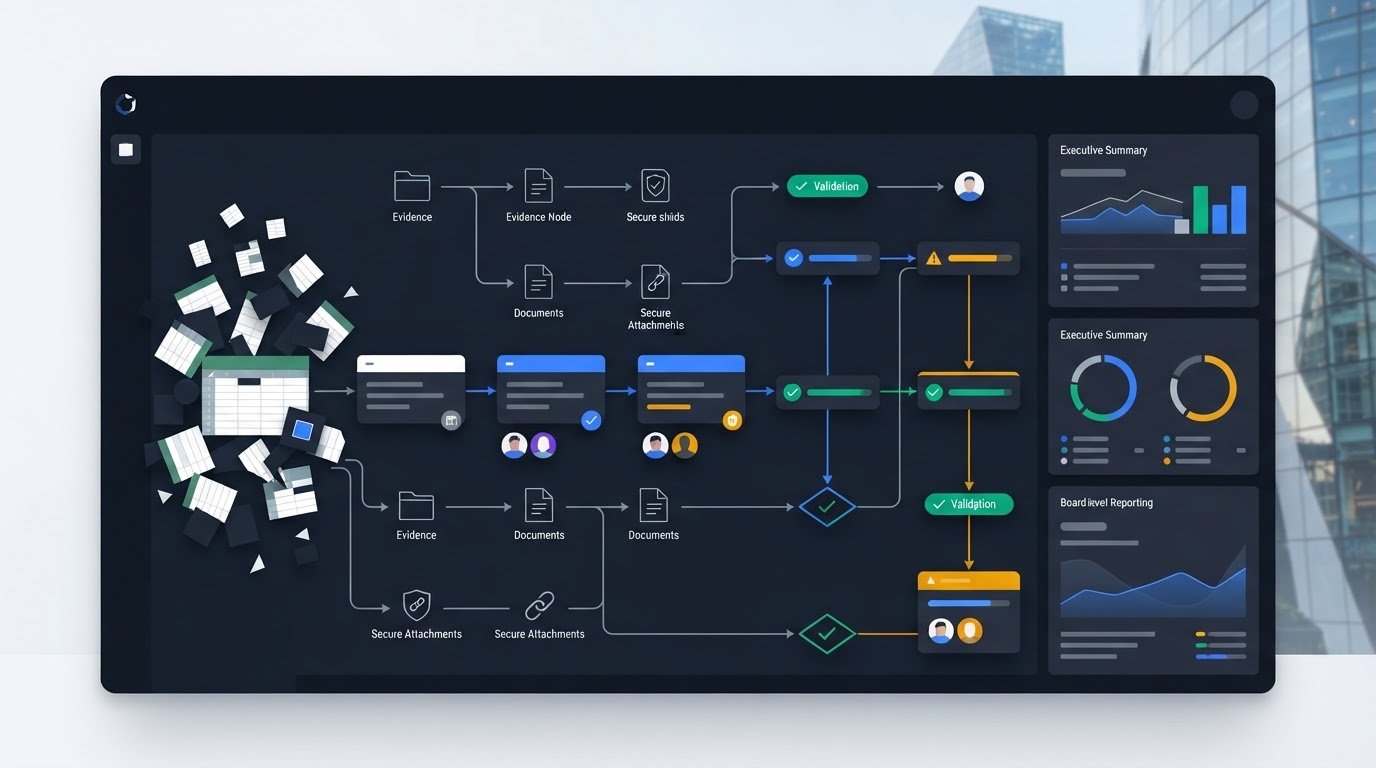
What does “complete” prove if the activity’s owner, supporting evidence and decision history sit in different places? For organisations weighing up compliance spreadsheet alternatives, the real question isn’t how to record status. It’s how to show that each control was executed and validated.
Spreadsheets are familiar and easy to adapt, but they can leave leaders piecing together updates from files, folders and team messages. That makes ownership harder to establish, evidence more difficult to assess and overlapping frameworks more likely to create duplicate work. The goal is a defensible view of execution, not another status report.
This article compares practical alternatives and explains how to choose an approach that fits your control environment. It covers what to assess, how to transition without losing ownership or decision history, and how to build repeatable, auditable reporting. CWORT takes a compliance validation approach: it translates obligations into controls and execution activities, binds evidence to activity state and control outcomes, and automatically generates board and audit outputs without manual reconstruction.
Key Takeaways
- Recognise when a spreadsheet register no longer provides a dependable view of ownership, dependencies and assurance.
- Assess compliance spreadsheet alternatives for traceability, role controls, evidence binding, repeatability and reporting.
- Compare governed spreadsheets, document repositories, workflow platforms and compliance validation systems by fit and assurance limits.
- Plan a controlled transition by mapping obligations, controls, owners, evidence references and dependencies before configuration.
- See how structured execution connects requirements to evidence and supports auditable compliance outputs.
Table of Contents
- When does a compliance spreadsheet stop being reliable?
- What should compliance spreadsheet alternatives do beyond storing status?
- How do the main compliance spreadsheet alternatives compare?
- How can you move from compliance spreadsheets without losing control?
- How does CWORT turn compliance execution into auditable proof?
When does a compliance spreadsheet stop being reliable?
Spreadsheets can be a sensible starting point. A small, clearly scoped register with one accountable owner and a manageable update process may be easy to maintain and review. A spreadsheet can also help structure an early assessment while the scope and operating process are still taking shape.
As the programme grows, the limitations become more apparent. Teams may create separate files for different frameworks, while summary tabs rely on formulas maintained elsewhere. Updates to one copy may not reach the others. If the person who understands the workbook is unavailable, colleagues may struggle to interpret its logic or identify which version reflects the current position.
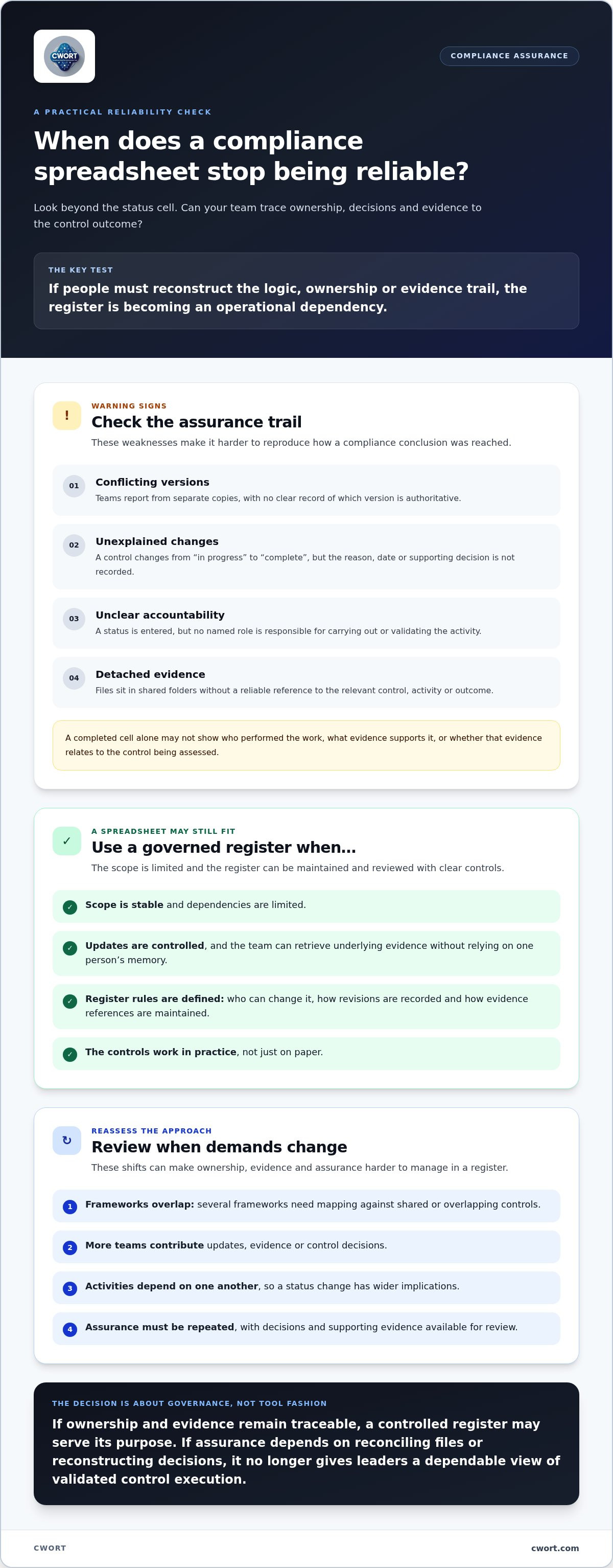
A compliance tracker becomes an operational dependency when people must reconstruct its logic, ownership or evidence trail to explain whether a control was actually executed.
Which spreadsheet warning signs matter most to compliance teams?
Look for weaknesses that affect assurance, rather than treating the use of a spreadsheet as the problem. A register can remain useful when it is governed. It becomes harder to rely on when records cannot be traced consistently from requirement to outcome.
- Conflicting versions: Teams report from separate copies, with no clear record of which version is authoritative.
- Unexplained changes: A control moves from “in progress” to “complete”, but the reason, date or supporting decision isn’t recorded.
- Unclear accountability: A status is entered, but no named role is responsible for carrying out or validating the activity.
- Detached evidence: Files sit in shared folders without a reliable reference to the relevant control, activity or outcome.
These conditions don’t prove that the reported status is wrong, but they make it harder to reproduce how the conclusion was reached. A reviewer may see a completed cell and still need to find out who performed the work, what evidence supports it and whether that evidence relates to the control being assessed.
Is a spreadsheet still suitable for a limited compliance scope?
It can be. A governed register may be proportionate when the scope is stable, dependencies are limited, updates are controlled and the team can retrieve the underlying evidence without relying on one person’s memory. Define who can change the register, how revisions are recorded and how evidence references are maintained. Then check that these controls work in practice.
Reassess the approach when demands change. Common triggers include:
- Several frameworks need to be mapped against shared or overlapping controls.
- Multiple teams contribute updates, evidence or control decisions.
- Activities depend on one another, so a status change has wider implications.
- Assurance must be repeated, with decisions and supporting evidence available for review.
The case for compliance spreadsheet alternatives rests on governance needs, not tool fashion. If your team can maintain clear ownership and traceable evidence in a controlled register, a spreadsheet may still serve its purpose. If assurance depends on reconciling files or reconstructing decisions, the register no longer gives leaders a dependable view of validated control execution.
What should compliance spreadsheet alternatives do beyond storing status?
A useful alternative does more than turn rows and columns into digital forms. It creates a governed connection between regulatory obligations, the controls that address them, the activities people perform, accountable roles and the evidence supporting each outcome. The aim is not just to make updates easier. It is to show how a compliance conclusion was reached and make that conclusion reproducible.
IBM describes Integrated Compliance Management Systems as bringing tools, processes and controls together. For compliance teams, the practical test is whether that integration supports control validation, rather than just coordinating workflow. A workflow platform can assign work and show progress. A compliance validation system must also connect execution and evidence to the control outcome.
How should obligations, controls and evidence connect?
Start with a traceable path: an obligation maps to one or more controls, each control is carried out through defined activities, and relevant evidence supports the resulting control outcome. Evidence is meaningful when its relationship to the work is clear, rather than stored as an unlinked file or general reference.
An obligation is only defensibly evidenced when the record connects what was required to the control performed, the accountable activity and its validated outcome.
Which governance controls make assurance more defensible?
Assess how the system establishes ownership and governs changes. Named roles should make responsibility clear, and permissions should reflect who can perform, review or approve work. Separation of duties helps ensure that one person’s action is not treated as independent validation. Look for an attributable, immutable change history and a clear evidence status, including whether the evidence supports the control outcome.
Where scoring is used, its criteria should be defined and applied consistently. Reproducible scoring gives reviewers a basis for comparing assessments and understanding why a result changed, rather than relying on undocumented judgement.
What outputs should a compliance system produce?
Leaders need a coherent view of execution without reconciling separate files. Audit-ready outputs should retain the links between activity, evidence and outcome, so each report can be traced back to its basis. A report created only at review time may show a snapshot. A continuous validation state shows how the position stands as work and evidence change.
- Traceability: Can users follow an obligation through controls to execution and outcome?
- Governance: Are roles, permissions, changes and evidence status clear?
- Repeatability: Can the same criteria support consistent review and scoring?
- Reporting: Do outputs preserve the links needed to explain the assurance position?
Use these criteria to compare compliance spreadsheet alternatives against the assurance your programme requires, rather than relying on a feature checklist alone. For a closer look at execution-linked validation, explore a CWORT demonstration.
How do the main compliance spreadsheet alternatives compare?
No single approach suits every compliance programme. Compare each option against the same scenario: an accountable person completes a control, provides relevant evidence, and the result is reviewed and reported without rebuilding the assurance picture from separate records. This makes the trade-offs visible, rather than treating a longer feature list as proof of stronger control.
When can a governed spreadsheet or shared repository work?
A controlled spreadsheet or repository can remain proportionate when the scope is narrow, ownership is clear and evidence references are straightforward to maintain. Documented naming conventions, permissions and review procedures can improve discipline, provided people apply them consistently. Reconsider the approach when several teams need to validate linked controls and it becomes difficult to show who acted, what evidence supports the decision and how the conclusion was reached.
What do workflow platforms and compliance systems solve differently?
Workflow platforms help coordinate work, such as assigning an action and moving it through review. That can be useful without establishing whether the control itself has been validated. A compliance validation system must also connect the obligation, control, accountable activity, evidence and outcome. Where orchestration is part of the operating model, regulatory compliance workflow automation can help frame how those steps fit together.
Which comparison criteria should carry the most weight?
Score each approach against the same representative control and assurance need. Prioritise whether evidence remains traceable to execution, whether roles support separation of duties, whether reviews can be reproduced and whether outputs preserve the basis for their conclusions. Then check framework coverage against your organisation’s actual obligations. CWORT supports DORA, NIS2, UK NIS, ISO 27001 and NCSC CAF. The value of a system depends on its fit with the required assurance, not a universal ranking of tool categories.
How can you move from compliance spreadsheets without losing control?
A controlled transition involves more than transferring cells into a new system. First establish what the records mean, which evidence supports them and who is authorised to make or validate each decision. Then configure and test the replacement against a defined scope before expanding it. This sequence helps preserve assurance as teams move from spreadsheets to a more governed process.
Migration should preserve the lineage from obligation to evidence and outcome, not just copy spreadsheet rows into a new system.
- Define scope and inventory the source material. Decide which compliance area will move first, then catalogue registers, tabs, formulas, control references, named owners, review dates and evidence locations. Include linked files and dependencies, not just the main workbook. Identify duplicate records, undocumented formula logic and decisions that need subject-matter review before treating them as reliable inputs.
- Map and assess the records. Connect each in-scope obligation to its controls, accountable owners, evidence references and dependencies. Compare duplicate entries and investigate gaps rather than silently choosing one version. Ask relevant subject-matter owners to confirm ambiguous interpretations or logic. Classify historic material for migration, retention or governed archiving, and record the rationale so exclusions aren’t mistaken for missing data.
- Design access and accountability. Define who can carry out activities, provide evidence, review results and approve changes. Set permissions to match those responsibilities, with separation of duties where independent execution and validation are required. Assign ownership for changes to the control model and establish how evidence references will be maintained. Keep the original source records under controlled access during the transition, rather than leaving uncontrolled copies in circulation.
- Pilot a bounded scope and test it. Agree roles, evidence requirements and validation criteria before entering sample records. Compare the resulting control outcomes with approved source records, investigate discrepancies and resolve them before widening the rollout. Test whether permissions work as intended, separation of duties is maintained, changes are traceable and required outputs can be generated with supporting evidence intact. Record the test findings and decisions.
- Adopt, review and validate the operating process. Train users to follow the governed workflow, rather than recreating familiar spreadsheet workarounds in a new interface. Assign accountable owners for model changes, evidence checkpoints and recurring review. Monitor completeness, timeliness, traceability and unresolved gaps. Extend the process when the team can perform it consistently and explain how a sample outcome was reached.
Use this sequence to assess whether your chosen compliance spreadsheet alternatives preserve control over records and decisions. To see how CWORT structures compliance execution and validation, request a CWORT demonstration.
How does CWORT turn compliance execution into auditable proof?
CWORT is a compliance validation system for organisations that need to demonstrate control execution, not simply record a status. It translates regulatory requirements into controls and structured activities, then connects those activities to accountable roles, evidence and control outcomes. That connection matters: a completed activity is not, by itself, proof that a control outcome has been validated.
How does CWORT connect execution and validation?
Requirements are mapped to controls, with execution activities providing a structured route for the work. CWORT enforces separation of duties by design, distinguishing execution from validation rather than relying on an informal sign-off. Evidence is bound to activity state and control outcomes, linking it to the work and the result it supports.
CWORT’s validation model connects requirements, controls, execution and evidence to prove compliance. Assurance can therefore be assessed through the underlying execution record, rather than inferred from a percentage alone.
What does the assurance view give teams and leadership?
A live programme cockpit brings the compliance position into a structured view. Checkpoints capture subject-matter expert input and delivery evidence as part of execution, while continuous validation state reflects the status of control outcomes. A dashboard indicator can help direct attention, but it isn’t proof on its own. Assurance depends on the activities, roles and evidence behind the result.
CWORT automatically generates regulator-ready, audit-ready PDF outputs for boards, regulators and clients, without manual reconstruction. The reports are grounded in execution and evidence, rather than assembled from separate updates when a review is due. CWORT supports DORA, NIS2, UK NIS, ISO 27001 and NCSC CAF.
How should a team assess whether CWORT fits its programme?
Start with the intended operating process. Map the frameworks in scope, the roles responsible for execution and validation, the required evidence checkpoints and the reports leaders or reviewers need. Then test whether the model can represent a real compliance activity from requirement through to control outcome. A working session or pilot on a real sub-function can help the team assess that flow against its programme.
Focus on whether ownership is clear, evidence remains tied to the activity and outcome, and the assurance view can be reproduced from the execution record. This gives teams a practical basis for evaluating compliance spreadsheet alternatives against the standard they need to meet: defensible proof of control execution.
Request a CWORT demo to explore the validation approach against your compliance workflow.
Make assurance the measure of your next step
Judge compliance spreadsheet alternatives by the confidence they give your organisation in its control outcomes, not simply by how efficiently they capture updates. Use that standard to guide your next decision: can your team show how work was completed, who was responsible and what supports the assurance position?
With CWORT, evidence is bound to activity state and control outcomes, separation of duties is enforced by design, and regulator-ready and audit-ready PDF outputs are generated automatically. These capabilities support a disciplined basis for assurance, without relying on manually assembled compliance information when scrutiny arises.
Choose a next step that tests the approach against your operating needs. Map the requirements, roles and evidence checkpoints that matter to your programme, then consider how they would flow through execution and validation. Request a CWORT demo to explore that approach. With clear ownership and evidence at the centre, your organisation can build a more dependable, defensible view of compliance.
Frequently Asked Questions
Can a compliance spreadsheet still be suitable for a small programme?
Yes, if the register has a defined scope, a clear owner and a controlled way to record changes. For example, one team reviewing a small set of controls may be able to maintain evidence references and explain each status without additional systems. Reassess when another team, framework or evidence source is added, or when assurance reviews become more frequent. The test is whether the record remains explainable.
What is the difference between compliance tracking and compliance validation?
Tracking records a reported position; validation examines whether the work and supporting material justify it. For example, an access review marked “complete” shows progress, but validation also considers whether the review covered the intended accounts and whether its result supports the relevant control. This distinction helps decision-makers interpret status accurately. A system should preserve enough context for another reviewer to understand the basis of the outcome.
How do you migrate compliance data from Excel without losing evidence?
Keep the source workbook as a controlled reference while reconciling its records. Map each control reference to its supporting documents and responsible owner, then investigate duplicate entries or formulas whose purpose is unclear. Have accountable subject-matter owners resolve ambiguities before migration. Test selected records against the approved source, document any changed interpretation, and retain or archive historical material according to your organisation’s records governance.
Do compliance spreadsheet alternatives need to enforce separation of duties?
They should support the separation required by your operating model. A person who performs a control may need a distinct reviewer to validate the result, particularly where independent oversight is part of the process. Assess whether role assignments are explicit and whether the activity history shows who performed each step. CWORT enforces separation of duties by design within its compliance validation system, rather than leaving the distinction to informal practice.
Can one compliance system support more than one regulatory framework?
Yes, some systems can map controls across frameworks, but assess whether the mapping preserves each framework’s context rather than flattening different requirements into one generic record. Shared evidence may support related controls, while the rationale for each mapping still needs to be clear. CWORT supports DORA, NIS2, UK NIS, ISO 27001 and NCSC CAF. Compare coverage with the frameworks your organisation needs to address.
What should a compliance system show during an audit?
It should let a reviewer follow a selected control from its requirement to the work performed, the responsible roles, relevant evidence and recorded outcome. The reviewer should also be able to understand material changes and when they occurred. Choose a sample control and trace it end to end before an audit. This practical test reveals whether reports reflect governed records or require explanations held outside the system.
How can organisations compare compliance software without relying on feature lists?
Use one realistic scenario for every option, such as a control that needs evidence from two teams and independent review. Assess whether each approach records ownership, preserves evidence context, supports reproducible decisions and produces usable assurance outputs. Include the effort required to govern changes and maintain mappings. A bounded pilot can expose gaps that a feature list misses, helping you judge compliance spreadsheet alternatives by the assurance they support.
Disclaimer
The content on this site is provided for general information and educational purposes only. It does not constitute legal, regulatory, financial, or professional advice. CWORT provides AI-assisted insights and workflow automation, but all compliance decisions remain the responsibility of your organisation and its management. Always seek qualified legal or regulatory guidance for decisions relating to the UK NIS Regulations, CAF, DORA, NIS2, ISO 27001, or other obligations.
Related posts
Streamlining Regulatory Compliance Processes: From Manual Tracking to Orchestrated Validation
Stop wasting money on manual compliance. Learn about streamlining regulatory compliance processes to reduce personal liability under DORA & NIS2 and gain aud...
How to Demonstrate Control Effectiveness to Regulators: A Strategic Guide
Learn how to demonstrate control effectiveness to regulators with our guide. Shift from chaos to an evidence-based, audit-ready compliance programme today.
Reducing Audit Preparation Time and Costs: A Strategic Guide for UK Enterprises
Tired of costly audit seasons? Our guide for UK enterprises shows you how to stop the manual scramble, reducing audit preparation time and costs with automat...
Article by
Michael Iyiola
Co-Founder, CWORT
Michael Iyiola is a co-founder of CWORT and a Cyber and AI Security Engineer with deep experience in vulnerability management, detection engineering and operational resilience across UK critical national infrastructure, including rail, energy and financial services. At CWORT, he designs scalable, evidence-driven workflows that help teams meet modern regulatory and security demands.
Build Your Foundation of Auditable Certainty
Take control of your regulatory obligations and secure your infrastructure with CWORT.