DORA Article 15 and ICT Risk Management Requirements

Michael Iyiola
Co-Founder, CWORT
DORA Article 15 requirements explained: see who is in scope, what ICT risk controls apply, and how governance, third-party risk and incident reporting connect.
DORA’s reach extends beyond the financial entities it regulates. The framework covers 20 categories of financial entities and their ICT service providers, while UK-regulated firms are not directly subject to DORA unless their EU operations or activities bring its requirements into scope. DORA Article 15 requirements explained in practical terms means understanding how ICT risk-management tools, methods, processes and policies must be further specified.
It’s understandable to focus first on whether your organisation is in scope. But identifying the relevant entity and service-provider relationships is only the starting point: Article 15 also connects risk management to project governance, continuity planning, incident detection and reporting.
This article explains who must comply, what Article 15 requires and how those obligations fit into wider ICT risk management. It also sets out the reporting stages for major ICT incidents, including the deadline for a final report after resolution, so you can assess the requirements that apply to your organisation.
Key Takeaways
- Understand which financial entities fall within DORA’s scope and how UK firms’ EU activities can bring requirements into view.
- See how Article 15 links ICT project governance with risk assessment, testing, approval and management-body oversight.
- Identify the role of ICT third-party risk management, including the contractual controls financial entities need to address.
- Follow the major ICT incident reporting process, from initial notification through to the final report after resolution.
- Clarify how DORA’s wider framework, implementation deadlines and oversight of critical ICT providers fit together.
Table of Contents
- What requirements does DORA place on ICT risk management?
- Major ICT incident reporting timelines
- What Is the Digital Operational Resilience Act (DORA)?
- Who Must Comply with DORA?
- Financial entities and ICT third-party providers in scope
- CWORT: DORA Compliance Readiness and Assessment
What requirements does DORA place on ICT risk management?
Article 15 of the EU Digital Operational Resilience Act requires further harmonisation of ICT risk-management tools, methods, processes and policies. It further specifies measures for detecting anomalous activity, continuity planning, response and recovery, access management, and framework reviews.
DORA’s ICT Risk Management Framework
The ICT risk management framework is the governance and control structure financial entities use to manage ICT risks and support digital resilience. Article 15 requires further specification of the framework review report referred to in Article 6(5), and mechanisms for promptly detecting anomalous activities under Article 10(1).
For access control, authentication and monitoring, Article 15 calls for further components covering access-management controls and associated human-resource policy under Article 9(4), point (c). It also addresses anomalous-activity detection. The specific control design sits within those broader requirements, rather than a standalone authentication checklist in Article 15.
Management-Body Accountability
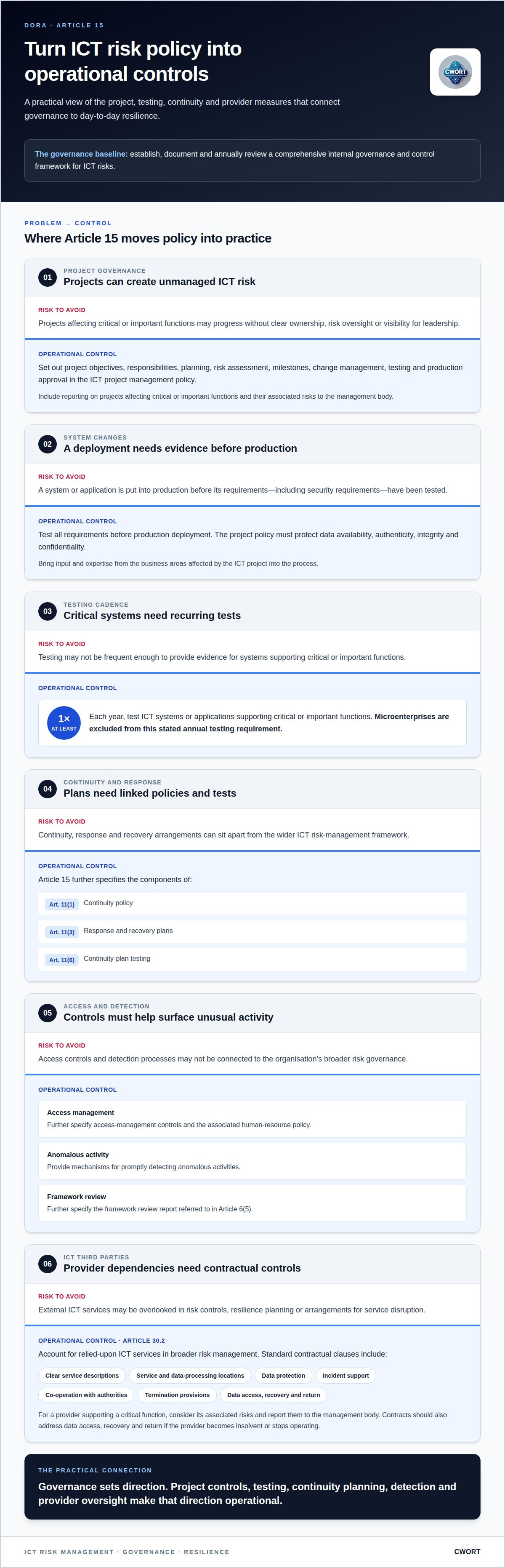
Management-body accountability means leadership oversees ICT risk governance and receives information needed to direct and assess it. DORA requires financial entities to establish, document and annually review a comprehensive internal governance and control framework for ICT risks. ICT project oversight can include reporting on projects affecting critical or important functions and their associated risks.
For teams seeking DORA Article 15 requirements explained in operational context, the project policy is a practical starting point. It must address objectives, responsibilities, planning, risk assessment, milestones, change management, testing and production approval. UK-regulated firms are not directly subject to DORA, but UK firms’ EU activities may fall within its requirements. PRA SS1/26 sets UK operational-resilience expectations described as comparable to DORA, not as the same legal regime.
ICT Third-Party Risk Management
ICT third-party risk management brings services supplied by external providers into the financial entity’s risk controls. Financial entities should account for the ICT services they rely on as part of their broader risk management. Article 30.2 sets out standard contractual clauses, including clear service descriptions, service and data-processing locations, data protection, incident support, authority cooperation and termination provisions.
These controls make provider dependencies visible in governance and resilience planning. For example, a service supporting a critical function should be considered alongside its associated risks and reported to the management body under Article 15(5). Contract terms should also address access to, recovery of and return of data if a provider becomes insolvent or stops operating. DORA Article 15 requirements explained as connected obligations show how project governance, provider oversight and resilience controls support a coherent risk-management framework.
Article 15 connects policy to operational evidence. An ICT project management policy must explain how projects to acquire, maintain and, where applicable, develop ICT systems are managed. It must protect data availability, authenticity, integrity and confidentiality, and provide for input and expertise from affected business areas.
Testing must cover all requirements, including security requirements, before production deployment. Financial entities other than microenterprises must test ICT systems or applications supporting critical or important functions at least annually. Article 15 also further specifies continuity policy components under Article 11(1), response and recovery plans under Article 11(3), and continuity-plan testing under Article 11(6).
Major ICT incident reporting timelines
DORA links incident handling to timely reporting, so classification and escalation must work together. For significant incidents, distinguish the detection time, the point of classification and the deadline for the final report.
Incident Handling and Reporting
ICT-related incident handling covers identifying, assessing, containing and resolving an event, then reporting it through the required channels. A documented sequence helps teams maintain a clear record as an incident develops.
For a significant ICT incident, the initial notification should be completed within 24 hours after detection and within 4 hours after classification. The reporting process should capture when the incident was detected, when it was classified and what response followed. Those timestamps help demonstrate how the organisation moved from detection to notification.
Reporting Timeframes
Reporting timeframes set the deadlines for notifying competent authorities and submitting follow-up information. DORA requires an initial notification within 24 hours after an incident is classified as significant, and a final incident report one month after resolution.
Operationally, the detection and classification clocks also matter: initial notification should be completed within 24 hours after detection and 4 hours after classification. Keep these milestones visible in the incident record. The final report follows resolution, so the process must retain details needed to explain the incident and response.
Build the reporting workflow around clear ownership. The person handling an incident needs a route to escalate it for classification, while the reporting function needs the decision and timing recorded. If a service provider detects an event affecting a financial entity, the contract’s incident-support provisions define the assistance available to that entity. DORA requires service agreements to address incident support at no additional cost or at a cost determined in advance.
Keep the reporting stages distinct. An initial notification communicates that a significant incident has been identified; later reports explain its progression and resolution. DORA sets the final report deadline at one month after resolution. Linking detection, classification, response and resolution in the record supports consistent reporting, rather than relying on recollection after systems are restored.
Testing can reveal gaps before an actual event. A scenario involving disruption to a critical ICT service can test whether escalation responsibilities, classification decisions and authority reporting work together. Record decisions and timings during the exercise, then use the results to refine incident procedures. This connects operational resilience planning with the practical demands of reporting.
Review incident-support clauses alongside internal procedures. DORA requires agreements to provide for cooperation with competent authorities and resolution authorities. Aligning those provisions with escalation routes helps clarify how provider support feeds into the financial entity’s response and reporting. An incident-response readiness review can help identify where those processes and evidence need stronger alignment.
What Is the Digital Operational Resilience Act (DORA)?
DORA is Regulation (EU) 2022/2554, adopted on 14 December 2022 and fully applicable to in-scope entities from 17 January 2025. It establishes a common framework for financial entities to manage ICT risk, strengthen digital operational resilience and oversee dependencies on ICT service providers.
Oversight of critical ICT third-party providers
DORA adds EU-level oversight for ICT providers designated as critical to the financial sector. The European Supervisory Authorities designated 19 critical ICT third-party providers on 18 November 2025. This oversight addresses systemic dependencies: a disruption at a widely relied-upon provider could affect several financial entities and the services they deliver.
The EU Lead Overseer monitors designated critical providers and can require information, investigate and impose corrective measures. This supervisory role complements, but does not replace, each financial entity’s responsibility for its own ICT risk management. A designation does not transfer the regulated entity’s accountability to its provider.
For a financial entity, the practical task is to identify which services support its operations and how disruption could affect critical or important functions. For example, a cloud service supporting customer transactions creates a dependency to include in the entity’s risk assessment. Provider concentration, service importance and potential disruption all inform how that dependency is governed.
Contract terms for important functions
DORA Article 30.3 sets additional contractual requirements for ICT services supporting critical or important functions. These sit alongside the general contract requirements in Article 30.2. The agreement must address the service’s locations, data processing, data protection, incident support and cooperation with competent authorities.
Contracts must also cover access to, recovery of and return of data if the provider becomes insolvent or discontinues operations. Termination rights and minimum notice periods matter because an entity needs a workable way to address material service concerns. Where subcontracting is involved, the contract must include provisions on it, enabling the entity to account for relevant dependencies.
These terms turn oversight into enforceable governance. A financial entity can use the agreement to establish what service is delivered, where it operates and how the provider supports incident response. For a service underpinning payments, clear recovery and data-return arrangements help define the entity’s options if the relationship ends or the service fails.
How regulation and oversight connect
DORA combines entity-level controls with EU oversight of critical providers. Competent authorities supervise financial entities, while the Lead Overseer focuses on designated critical ICT providers. This division addresses both sides of the dependency: the entity’s resilience arrangements and provider-level risks that may affect the wider financial sector.
Operationally, map each relevant service to the function it supports, the contract governing it and the risks requiring oversight. A cyber threat affecting a provider, for example, should be assessed against the entity’s service dependency and response arrangements. This linkage gives governance discussions a clear basis: the service, its business impact and the controls addressing the risk.
Who Must Comply with DORA?
DORA entered into force on 16 January 2023 and became fully applicable to in-scope entities on 17 January 2025. Article 15 did not have a separate implementation deadline: its requirements form part of DORA’s framework. The European Supervisory Authorities were required to submit draft regulatory technical standards under Article 15 by 17 January 2024.
That distinction matters for compliance planning. The 2024 date concerned the standards-development process, whilst 17 January 2025 marked full application of DORA to covered entities. A financial institution should therefore treat Article 15 as an operational requirement, not as an obligation waiting for a later implementation date.
Implementation means translating the regulation into working governance. For Article 15, that includes documenting an ICT project management policy, assigning responsibilities, assessing risks and recording testing and approval before production deployment. Projects affecting critical or important functions also require reporting to the management body, periodically and when events warrant it. These activities create evidence that policies operate in practice, rather than existing only as written statements.
Deadlines also apply to ongoing processes. Financial entities other than microenterprises must test ICT systems or applications supporting critical or important functions at least annually. DORA also requires an annual review and documentation of the internal governance and control framework for ICT risks. Schedule these recurring activities, assign ownership and retain evidence. A missed review can leave leadership without a current view of operational exposure.
Enforcement gives these requirements practical force. Competent authorities can access relevant documents and data, conduct on-site inspections or investigations, and require corrective or remedial measures for breaches. DORA also provides for penalties for serious violations. Incomplete records can make it difficult for an institution to demonstrate how it handled risk decisions, control testing or remediation when supervisory scrutiny begins.
Contractual oversight is part of implementation. Financial entities must maintain information about their ICT third-party arrangements and address required provisions in service agreements. This supports a traceable view of provider dependencies, including services connected to critical functions. Reporting obligations and supervisory expectations therefore extend beyond internal policies to evidence about external ICT services.
For UK organisations, the regulatory boundary needs careful attention. DORA does not directly apply to UK-regulated firms solely because they operate in the UK. UK firms with EU operations or clients must meet DORA requirements for those activities. Separate UK operational-resilience expectations may apply under the relevant UK regime, so compliance teams should distinguish the regulatory basis for each obligation.
Create a compliance calendar covering the annual framework review, recurring system tests, project approvals and reporting responsibilities. Then map each obligation to an accountable role and retained evidence. This turns DORA’s dates and duties into controlled work, while helping management identify overdue actions and address gaps before they become supervisory findings.
Financial entities and ICT third-party providers in scope
DORA covers 20 categories of financial entities and the ICT service providers that serve them. The framework therefore reaches beyond banks: scope depends on the entity’s regulated activity and, for providers, the ICT services supplied to financial entities.
For a financial group, assess each legal entity and its activities rather than assuming every company has identical obligations. DORA’s scope includes financial entities such as credit institutions, investment firms, insurance and reinsurance undertakings, payment institutions and crypto-asset service providers. Requirements can differ by entity type and size, so a scope assessment should record each entity’s category and relevant exceptions.
Microenterprise status can affect the requirements that apply. Under DORA’s definition, a microenterprise employs fewer than 10 persons and has annual turnover or a balance sheet total not exceeding EUR 2 million. Size does not, by itself, remove the need to understand which DORA obligations apply.
How ICT providers fit into scope
DORA applies to companies providing ICT services to financial entities under Article 2(1)(u). A provider may support a function through cloud hosting, data processing, software or other ICT services. The key connection is the service relationship: identify which financial entity receives the service, what it supports and whether it relates to a critical or important function.
This connection matters even when the provider is not itself a financial entity. The regulated institution must manage its ICT risks and oversee provider relationships, while DORA creates a separate oversight regime for providers designated as critical. Not every supplier is automatically designated critical; that designation applies to providers assessed as important to the financial sector.
For UK organisations, distinguish domestic regulation from European activities. DORA does not directly apply to UK-regulated firms solely because they operate in the UK. However, UK firms with EU operations or clients must meet DORA requirements for those activities. A group operating across both markets should map which entities and services connect to EU-regulated activities, then keep the applicable obligations distinct.
A practical scope register can link each financial entity to its DORA category, operating location, ICT providers and supported functions. For example, a UK group serving EU clients could record the relevant EU-facing entity and the provider services supporting its operations. This helps establish where contractual controls, evidence and oversight responsibilities apply, without treating every supplier or group company as having the same status.
Use a DORA scope and control assessment to structure that mapping and identify where the compliance evidence needs to be strengthened.
CWORT: DORA Compliance Readiness and Assessment
CWORT’s DORA Compliance Readiness and Assessment helps organisations translate regulatory obligations into structured activities and auditable evidence. Turn to it when you need to assess gaps between Article 15 requirements and the policies, controls and records used in practice.
CWORT’s DORA Compliance Readiness and Assessment connects requirements with accountable activities and control outcomes, helping governance teams track remediation and demonstrate compliance. It is particularly relevant when ICT project oversight, framework reviews and evidence are spread across separate processes.
Where your organisation also needs to align related frameworks, CWORT offers UK NIS Compliance Management, NIS2 Readiness and Compliance Management, and ISO 27001 Readiness and Control Mapping.
Contact CWORT to discuss DORA compliance readiness and assessment.
Turn regulatory understanding into sustained control
Having DORA Article 15 requirements explained in operational terms gives teams a starting point. The next step is to make accountability part of routine governance, so changes to systems, suppliers or business processes trigger a timely review of relevant controls and evidence.
Set ownership for keeping that evidence current. Connect each control to the decision-maker responsible, the activity that demonstrates it works and the process for addressing a gap. This creates a more durable approach than treating compliance as a one-off exercise.
CWORT offers DORA Compliance Readiness and Assessment, alongside UK NIS Compliance Management and NIS2 Readiness and Compliance Management. These services can help organisations structure compliance work across the frameworks relevant to their operations.
Take the next step by contacting CWORT to discuss DORA support. A clear, maintained control environment gives your organisation a stronger basis for oversight and ongoing resilience.
Frequently Asked Questions
From when does DORA apply and which additional regulations were published in connection with DORA?
DORA became fully applicable to in-scope entities on 17 January 2025, after entering into force on 16 January 2023. It amended several existing EU regulations, including Regulation (EU) No 648/2012 and Regulation (EU) No 600/2014. Commission Delegated Regulation (EU) 2025/1190, covering threat-led penetration testing, was published in the Official Journal on 18 June 2025 and became directly applicable across EU member states on 8 July 2025.
What are the main provisions of DORA?
DORA establishes a framework for digital operational resilience in financial services. Its provisions cover ICT risk governance, incident handling and reporting, resilience testing, third-party risk, information-sharing and oversight of critical ICT providers. In practice, an institution connects these areas: disruption to a contracted service, for example, may require a coordinated internal response, provider support and regulatory reporting. DORA’s requirements apply alongside the entity’s responsibility to manage its own ICT risks.
Which financial entities must comply with DORA Article 15?
Article 15 applies to financial entities within DORA’s scope, which covers 20 categories. These include credit institutions, investment firms, insurance undertakings, payment institutions and crypto-asset service providers. DORA places obligations on both financial entities and ICT service providers, with project-management policies forming part of financial entities’ responsibilities. For a group with several regulated entities, assess each entity’s activities and applicable category rather than assuming one group-wide scope assessment settles every obligation.
What are the requirements for ICT security policies under DORA Article 15?
Financial entities should maintain a documented policy for managing ICT projects. It must explain how projects to acquire, maintain and, where applicable, develop ICT systems are managed. The policy covers objectives, governance, responsibilities, planning, risk assessment, milestones, change management, testing and approval before production deployment. It also supports secure implementation by involving affected business areas and ensuring testing covers all requirements, including security requirements.
What does Article 15 require for ICT risk management and operational resilience?
Article 15 further harmonises ICT risk-management tools, methods, processes and policies. It specifies elements of the wider framework, including anomalous-activity detection, continuity planning and response and recovery arrangements. For example, an entity should connect a system change to risk assessment, testing and approval, rather than treating those controls as separate paperwork. This helps make operational resilience part of project governance and supports a documented, reviewable approach to ICT risk.
What incident detection, response and recovery capabilities does Article 15 require?
Article 15 further specifies mechanisms for promptly detecting anomalous activities under Article 10(1), continuity policy components under Article 11(1), and response and recovery plans under Article 11(3). It also addresses continuity-plan testing under Article 11(6), including scenarios where critical or important functions deteriorate or fail. These cross-references mean an entity’s plans should connect detection, continuity and recovery, with tests examining how those arrangements work under disruption.
How does DORA Article 15 relate to Articles 5-14 and the ICT risk management framework?
Article 15 further specifies requirements developed across Articles 5-14; it does not replace those provisions. Its references link framework review reporting to Article 6(5), access-management components to Article 9(4), point (c), detection to Article 10(1), and continuity and recovery to Article 11. The European Supervisory Authorities were required to submit draft Article 15 regulatory technical standards to the European Commission by 17 January 2024.
What penalties or supervisory consequences apply for non-compliance with DORA Article 15?
Consequences can include supervisory investigation and required corrective or remedial measures. Under Article 50, competent authorities can access relevant documents and data, conduct on-site inspections or investigations, and require action to address breaches. DORA also provides for financial penalties, with the applicable amount and process depending on the breach and relevant enforcement framework. For an organisation, incomplete policy records or missing test evidence can make it harder to demonstrate how controls operated.
Disclaimer
The content on this site is provided for general information and educational purposes only. It does not constitute legal, regulatory, financial, or professional advice. CWORT provides AI-assisted insights and workflow automation, but all compliance decisions remain the responsibility of your organisation and its management. Always seek qualified legal or regulatory guidance for decisions relating to the UK NIS Regulations, CAF, DORA, NIS2, ISO 27001, or other obligations.
Related posts
DORA Technical Standards Compliance: Moving from Regulatory Theory to Validated Execution
Struggling with DORA technical standards compliance? Move beyond spreadsheets to a validated framework that provides real-time, auditable evidence for regula...
DORA Compliance Validation Software: Orchestrating Defensible Proof in 2026
Is your DORA strategy audit-ready for 2026? Learn how DORA compliance validation software provides defensible proof and protects board members from liability.
Challenges of DORA Compliance for Financial Institutions in 2026: A Strategic Guide
Facing the challenges of DORA compliance for financial institutions? Our 2026 guide helps you move from manual tracking to automated validation for total ass...
Article by
Michael Iyiola
Co-Founder, CWORT
Michael Iyiola is a co-founder of CWORT and a Cyber and AI Security Engineer with deep experience in vulnerability management, detection engineering and operational resilience across UK critical national infrastructure, including rail, energy and financial services. At CWORT, he designs scalable, evidence-driven workflows that help teams meet modern regulatory and security demands.
Build Your Foundation of Auditable Certainty
Take control of your regulatory obligations and secure your infrastructure with CWORT.