DORA Compliance for Banks: Resilience Framework 2026

Michael Iyiola
Co-Founder, CWORT
Master DORA compliance for banks. Replace static spreadsheets with deterministic proof across all five pillars. Explore our complete 2026 resilience framework.

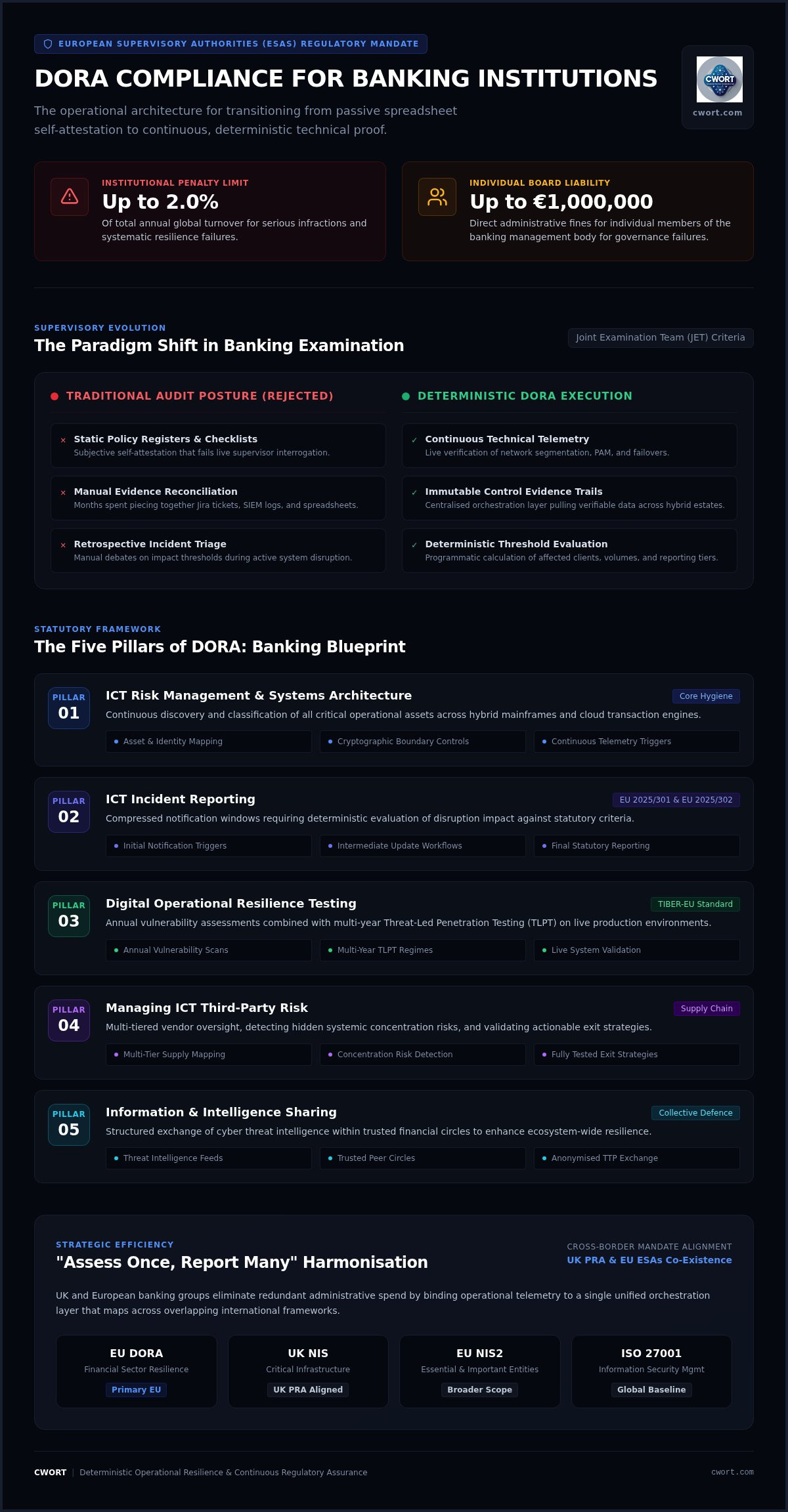
Point tools and static spreadsheets won't protect your balance sheet from central bank scrutiny. Achieving true DORA compliance for banks isn't an administrative exercise; it's an active test of technical survivability under direct European Supervisory Authority supervision.
If your risk teams spend months manually assembling fragmented evidence across Jira, SIEM platforms, and vendor spreadsheets ahead of examinations, you recognise the strain. Reconstructing ICT supply chains and validating third-party concentration risk across legacy infrastructure has left banking leaders trapped in a relentless audit scramble.
You can replace this reactive firefighting with operational certainty. In this resilience guide, you'll discover how banking institutions can move beyond static compliance checklists to build deterministic, audit-defensible proof across all five DORA pillars. We break down the operational blueprint needed to bind continuous technical telemetry directly to regulatory control outcomes, establishing board-level assurance without manual friction.
Key Takeaways
- Transition from passive attestation to deterministic proof to satisfy active European Supervisory Authority supervision and audit expectations.
- Operationalise the five core pillars across banking business units, linking technical telemetry directly to incident reporting, disaster recovery, and third-party oversight.
- Eliminate manual reconciliation risks by abandoning static spreadsheets in favour of structured governance that produces immutable evidence trails.
- Streamline cross-border compliance by applying an "assess once, report many" methodology that harmonises DORA compliance for banks with UK NIS, NIS2, and ISO 27001 mandates.
- Deploy an overarching orchestration layer to aggregate operational data across existing security tooling, achieving continuous board-level visibility and audit defence.
Table of Contents
- What DORA Demands from Banking Institutions in 2026
- The Five Pillars of DORA: A Banking Execution Blueprint
- Why Traditional GRC and Spreadsheets Fail DORA Audits
- Harmonising DORA with UK NIS, NIS2, and ISO 27001
- Executing Continuous DORA Assurance with CWORT
What DORA Demands from Banking Institutions in 2026
Regulators have ceased accepting self-attestation. Following full application across the European Union, the supervisory phase of the Digital Operational Resilience Act (DORA) treats resilience as an active technical capability rather than an annual audit exercise. For financial institutions operating in the UK and continental Europe, the mandate demands continuous, deterministic proof of operational continuity. Supervisory bodies no longer accept retrospective explanations when critical payment channels or core ledgers fail; they inspect the underlying control efficacy directly.
The stakes have fundamentally escalated. Penalties for serious infractions reach up to 2% of total annual global turnover, whilst individual members of the management body face direct administrative fines of up to €1 million for governance failures. Because cross-border UK banking groups must align dual regulatory expectations between the Prudential Regulation Authority (PRA) and European Supervisory Authorities (ESAs), superficial box-ticking presents an existential balance-sheet liability. True DORA compliance for banks requires binding technical telemetry directly to regulatory controls, proving stability across every critical operational function.
The Five Core Pillars of the Digital Operational Resilience Act
DORA establishes five interconnected pillars designed to enforce holistic systemic stability across the financial ecosystem:
- ICT Risk Management: Governing continuous risk identification, protection, detection, and mitigation strategies across complex banking architecture.
- ICT Incident Reporting: Classifying disruptions under strict criteria and executing initial, intermediate, and final notifications within compressed regulatory windows.
- Digital Operational Resilience Testing: Conducting rigorous annual vulnerability assessments and multi-year Threat-Led Penetration Testing (TLPT) aligned with TIBER-EU standards.
- Managing ICT Third-Party Risk: Enforcing strict oversight, supply chain mapping, and contractual requirements across external ICT providers.
- Information and Intelligence Sharing: Exchanging cyber threat intelligence within trusted financial circles to strengthen collective industry defence.
Supervisory Scrutiny: How Joint Examination Teams Assess Banking Resilience
Joint Examination Teams evaluate proof, not promises. Inspectors bypass static policy registers to interrogate live telemetry, validating whether your actual network segmentation, privileged access management, and recovery protocols function as documented. Crucially, supervisors scrutinise multi-tiered supply chains to detect hidden concentration risks, verifying whether banks maintain actionable, fully tested exit strategies for critical third parties. If your operational data cannot immediately substantiate your stated risk appetites, examiners will classify your institution as non-compliant.
The Five Pillars of DORA: A Banking Execution Blueprint
Operationalising resilience requires transforming high-level statutory requirements into enforceable engineering workflows. Banking architectures combine legacy mainframes, cloud-native transaction engines, and sprawling vendor ecosystems. Point solutions addressing individual endpoints or data discovery silos cannot orchestrate this operational complexity. Under the Official Text of DORA Regulation, banks must deploy structured mechanisms that prove control effectiveness across five interrelated functional areas.
ICT Risk Management Framework and Systems Architecture
Continuous discovery forms the foundation. Engineering teams must classify all critical operational assets, mapping identity registers and cryptographic boundary controls directly to core banking workflows. You need continuous telemetry across hybrid estates to ensure control drift triggers immediate executive notifications rather than quietly festering between audit cycles.
Incident Classification, Reporting, and Threat-Led Testing
DORA mandates compressed notification windows under Regulation (EU) 2025/301 and Regulation (EU) 2025/302. Meeting these initial and intermediate thresholds requires pre-configured telemetry triggers that automatically evaluate incidents against statutory criteria:
- Deterministic Threshold Evaluation: Eliminate manual triage debates by programmatically calculating affected clients, transaction volumes, and data impact.
- Synchronised Escalation: Route incident evidence simultaneously to internal response leads and external supervisory authorities.
- Defensible TLPT Evidence: Under Commission Delegated Regulation (EU) 2025/1190, record full-scope Threat-Led Penetration Testing logs, linking every simulated exploit directly to an auditable remediation plan.
Managing Critical ICT Third-Party Concentration Risk
Downstream vendor dependencies represent the banking sector's primary operational vulnerability. Meeting full DORA compliance for banks requires interrogating the entire supply chain, including multi-tier subcontractors governed by Delegated Regulation (EU) 2025/532. Maintaining the mandatory Register of Information demands continuous verification of vendor audit rights, guaranteed recovery parameters, and tested exit pathways. If your financial institution relies on multi-vendor cloud deployments, you must actively track and prove that a failure at an external provider cannot cause an uncontained outage across your core retail payment rails.
Translating these interconnected requirements into repeatable operational workflows requires unified governance oversight. To see how structured telemetry and control mapping replace compliance friction across complex infrastructure, you can explore the CWORT orchestration model.
Why Traditional GRC and Spreadsheets Fail DORA Audits
Static governance tools collapse under supervisory interrogation. Legacy governance, risk, and compliance (GRC) tools treat regulatory alignment as a quarterly administrative exercise, relying on manual data entry, self-attestation, and arbitrary risk scores. Central bank examination teams have seen these static binders for years. They actively dismiss unverified screenshots, out-of-date policy declarations, and retrospective Jira reconciliations because disconnected artefacts offer zero proof of live operational continuity. Under the supervisory expectations detailed by the Digital Operational Resilience Act (DORA), banking institutions must supply deterministic, tamper-evident proof that controls operate effectively right now.
Spreadsheet administration introduces catastrophic operational blind spots. Research indicates that 46% of financial institutions cite maintaining the complex Register of Information on ICT third parties as their primary hurdle. Attempting to track hundreds of vendor dependencies, sub-outsourcing tiers, and contractual terms across disjointed workbooks results in version sprawl, severed context, and unverified data. When joint inspection teams demand immediate lineage linking a critical core-banking database to its disaster recovery validation, manual evidence reconstruction consumes months. It pulls senior engineers away from live security operations, heightening systemic vulnerability instead of reducing it.
The Flaws of Manual Reconstruction and Subjective Scoring
Subjective self-assessments fail basic auditor scrutiny. Point-in-time reviews capture an isolated moment, leaving risk leaders oblivious to mid-year configuration drift, expired cryptographic credentials, and unpatched critical infrastructure. When risk ratings depend on human interpretation rather than programmatic telemetry, assurance evaporates. If two independent compliance officers assess the same control framework and produce divergent ratings, your compliance posture isn't defensible; it's an assumption.
Enforcing Separation of Duties and Immutable Assurance
Achieving resilient DORA compliance for banks requires strict structural integrity within your assurance architecture:
- Programmatic Separation of Duties: Separate the teams operating controls from the personnel validating regulatory compliance, preventing operational bias from colouring assurance reports.
- Cryptographic Evidence Trails: Anchor technical artefacts directly to compliance records with immutable audit histories, ensuring evidence remains tamper-evident from initial telemetry capture through central bank review.
- Deterministic Reproducibility: Enforce objective scoring models where identical technical evidence generates identical compliance outcomes every time, eliminating subjective opinions from board reporting.
Advisory assessments must support, not contaminate, deterministic baselines. Separating operational execution from regulatory validation ensures executive leaders and supervisory bodies view an objective, unvarnished depiction of institutional stability.
Harmonising DORA with UK NIS, NIS2, and ISO 27001
Cross-border financial institutions operating between London and European financial centres face an intricate jurisdictional web. Whilst the Prudential Regulation Authority (PRA) enforces its own operational resilience regime around important business services and impact tolerances, EU operations must align with prescriptive European Supervisory Authority standards. Concurrently, digital infrastructure must often satisfy UK NIS, European NIS2 directives, and ISO/IEC 27001:2022 baselines. Managing these overlapping obligations through fragmented compliance initiatives triggers severe audit fatigue, draining engineering resources across duplicate verification cycles.
Cross-Border Operational Challenges for UK Financial Entities
Divergent supervisory expectations test institutional cohesion. The UK framework establishes principles-focused impact tolerances, whereas DORA dictates granular technical mandates and rigid notification timelines. For international banking groups, DORA operates as lex specialis over NIS2 for EU financial entities; however, shared technology services based in the UK must simultaneously satisfy domestic oversight. Discrepancies between incident severity thresholds, subcontractor oversight rules, and testing intervals make running separate compliance silos unworkable.
Multi-Framework Control Mapping and Taxonomy Architecture
Achieving efficient DORA compliance for banks requires an "assess once, report many" governance philosophy. A single operational control, such as continuous privileged access validation across core payment infrastructure, simultaneously satisfies access management requirements within DORA, ISO 27001, NIS2, and UK NIS. Rather than forcing engineering teams to address separate audit requests for the same system, institutions should utilise structured control crosswalks:
- Unified Taxonomy Libraries: Link technical safeguards across multiple statutory frameworks simultaneously, eliminating redundant evidence collection.
- Automated Evidence Propagation: Validate an operational control once and automatically apply that deterministic proof across every mapped regulatory obligation.
- Tailored Supervisory Reporting: Export framework-specific assurance records on demand, satisfying specific central bank inspectors without disrupting live operations.
Consolidating multi-jurisdiction obligations into a coherent operating model transforms regulatory friction into scalable resilience. To eliminate redundant audit cycles and link your technical evidence directly to UK and European requirements, request a platform demonstration.
Executing Continuous DORA Assurance with CWORT
Modern banking environments do not suffer from a lack of security telemetry. They suffer from an evidence translation deficit. While specialised engineering tools monitor network endpoints, detect perimeter anomalies, and track user privileges, none of these point solutions correlate raw technical output directly with statutory supervisory articles. Developed by Lapace Services UK Ltd, CWORT operates above your existing tooling stack. It ingests live telemetry across SIEM, IAM, PAM, and vulnerability scanners, turning disconnected data feeds into deterministic, auditable governance proof.
Transforming complex technical output into boardroom certainty requires an objective, explainable baseline. Rather than relying on subjective manual scoring, CWORT maps telemetry across a comprehensive taxonomy library of 1,355 controls and 217 domains linked across 42 frameworks. Crucially, 98.6% of active controls carry explicit regulatory framework references. This deterministic scoring architecture ensures identical technical evidence generates identical regulatory assurance, giving leadership the confidence to face central bank scrutiny without manual evidence reconstruction.
Sitting Above the Security Stack: Orchestrating Evidence into Defensible Truth
CWORT integrates seamlessly over your enterprise technology investments without requiring the replacement of existing infrastructure. By linking raw telemetry directly to control requirements, the platform enforces strict separation of duties between engineering operators and assurance personnel. Every ingested artefact is bound to an immutable audit history, establishing cryptographic certainty that prevents evidence tampering. This structured orchestration turns fragmented data into unassailable audit proof during Joint Examination Team evaluations.
The Four-Stage Resilience Journey: Diagnose, Design, Deliver, and Demonstrate
Institutions establish reliable, continuous DORA compliance for banks by following a disciplined operational methodology:
- Diagnose: Execute a baseline compliance gap analysis across your architecture to pinpoint vulnerabilities across all five statutory pillars.
- Design: Structure targeted remediation pathways and refine your operating model maturity to match institutional risk capacity.
- Deliver: Orchestrate corrective actions across business units, tracking remediation milestones against regulatory deadlines.
- Demonstrate: Provide real-time, audit-defensible reporting to boards and supervisory examiners without running manual evidence collection drills.
Moving from manual documentation to automated resilience proof removes supervisory anxiety and safeguards operational stability. You can examine your posture firsthand by visiting CWORT to request a tailored demonstration.
Transform Regulatory Obligation into Defensible Operational Strength
Central bank examinations have irrevocably shifted from reviewing static policy binders to inspecting active control operations. Disconnected spreadsheets and retrospective reconciliations won't protect your institution from supervisory penalties or personal executive liabilities. Sustained digital operational resilience demands an automated governance model that converts live technical telemetry into deterministic, auditable evidence.
Operating directly above your SIEM, IAM, and broader security stack, CWORT eliminates compliance friction. The platform links 1,355 controls across 42 frameworks with 98.6% active coverage, delivering deterministic, reproducible scoring that withstands rigorous central bank examinations. You don't have to disrupt ongoing engineering workflows to secure board-level transparency, comprehensive third-party risk tracking, and unassailable audit readiness across your critical banking estate.
Take command of your supervisory assurance today. Request a tailored CWORT demonstration to establish deterministic, audit-defensible DORA compliance for banks across your entire operational infrastructure.
Frequently Asked Questions
Does DORA apply to UK banks that operate without European branches?
No, DORA doesn't directly regulate UK domestic banks that lack an EU presence or provide no cross-border services into the single market. However, if a UK bank operates an authorised subsidiary, branch, or designated payment entity within any EU member state, that specific entity falls squarely under the regulation. Additionally, UK institutions serving as critical ICT third-party providers to EU financial firms must comply with DORA oversight mandates directly.
What is the specific deadline for establishing full DORA compliance across banking operations?
The statutory deadline was 17 January 2025, which marked the formal commencement of full application across the European Union. In 2026, financial entities reside in the active supervisory and enforcement phase rather than an implementation grace period. Regulators now require established Registers of Information, operational incident reporting procedures, and mature threat-led penetration testing protocols that function under live audit conditions.
How does DORA enforcement differ from existing UK operational resilience regulations?
The UK regime overseen by the PRA focuses heavily on outcome-based principles, requiring firms to map important business services and set dynamic impact tolerances. In contrast, DORA represents a prescriptive, harmonised regulation that enforces granular technical standards across risk governance, supply chain contracts, and reporting templates. Cross-border banking groups must bridge both regimes, aligning high-level UK resilience principles with detailed European technical execution rules.
What penalties can European Supervisory Authorities impose on banks for non-compliance?
National competent authorities can issue administrative fines reaching up to 2% of a banking institution's total annual global turnover for serious infractions. Beyond corporate liabilities, the regulatory framework imposes severe personal accountability on executive management bodies. Senior leadership faces individual fines of up to €1 million alongside temporary management bans if they fail to oversee and resource required ICT risk management controls adequately.
Can our institution use existing GRC tools to satisfy DORA information register requirements?
Legacy GRC platforms and static spreadsheets struggle to meet these mandates. Research shows that 46% of financial institutions find maintaining the Register of Information their most severe compliance hurdle. Conventional tools fail because they lack automated evidence binding and dynamic sub-outsourcing mapping. Meeting expectations requires a deterministic orchestration layer that consumes active technical telemetry, enforces separation of duties, and maintains an immutable audit history.
What constitutes a major ICT-related incident under DORA reporting guidelines?
A major incident is defined through quantitative thresholds established under Regulation (EU) 2024/1772 and Regulation (EU) 2025/301. Criteria include the number of affected clients, financial transaction losses, data compromise, duration of service disruption, and systemic geographical impact. Material incidents trigger mandatory reporting schedules, requiring an initial notification within hours, followed by detailed intermediate updates and a comprehensive root-cause analysis.
How frequently must banks conduct Threat-Led Penetration Testing under DORA?
Under Commission Delegated Regulation (EU) 2025/1190, designated significant financial entities must carry out advanced Threat-Led Penetration Testing (TLPT) at least once every three years. Routine vulnerability testing must occur continuously, with annual assessments conducted across all critical live production environments. These testing programmes must follow updated TIBER-EU methodologies and fully integrate external third-party service providers that support critical banking operations.
How does an evidence-based compliance orchestration platform reduce audit overhead?
Deploying a unified orchestration platform eliminates manual evidence reconstruction by sitting directly above existing tools like SIEM, IAM, and vulnerability scanners. CWORT delivers deterministic DORA compliance for banks by linking 1,355 controls across 42 frameworks, ensuring operational telemetry validates controls programmatically. This "assess once, report many" architecture automates central bank audit readiness, freeing engineering teams from assembling retrospective spreadsheets during supervisory reviews.
Disclaimer
The content on this site is provided for general information and educational purposes only. It does not constitute legal, regulatory, financial, or professional advice. CWORT provides AI-assisted insights and workflow automation, but all compliance decisions remain the responsibility of your organisation and its management. Always seek qualified legal or regulatory guidance for decisions relating to the UK NIS Regulations, CAF, DORA, NIS2, ISO 27001, or other obligations.
Related posts
The Cost of Non-Compliance with DORA Regulation: A Strategic Risk Analysis for 2026
Understand the true cost of non-compliance with DORA regulation. Our 2026 analysis details the 2% turnover fines & personal liability to protect your organis...
CISO Guide to DORA Operational Resilience: Orchestrating Validated Compliance
Master validated compliance with our CISO guide to DORA operational resilience. Swap manual evidence gathering for an orchestrated, audit-ready security post...
Challenges of DORA Compliance for Financial Institutions in 2026: A Strategic Guide
Facing the challenges of DORA compliance for financial institutions? Our 2026 guide helps you move from manual tracking to automated validation for total ass...
Article by
Michael Iyiola
Co-Founder, CWORT
Michael Iyiola is a co-founder of CWORT and a Cyber and AI Security Engineer with deep experience in vulnerability management, detection engineering and operational resilience across UK critical national infrastructure, including rail, energy and financial services. At CWORT, he designs scalable, evidence-driven workflows that help teams meet modern regulatory and security demands.
Build Your Foundation of Auditable Certainty
Take control of your regulatory obligations and secure your infrastructure with CWORT.