DORA compliance for UK investment firms: what to do

Michael Iyiola
Co-Founder, CWORT
See whether DORA compliance for investment firms UK applies, and get a practical roadmap for testing, incident reporting and ICT provider controls now.

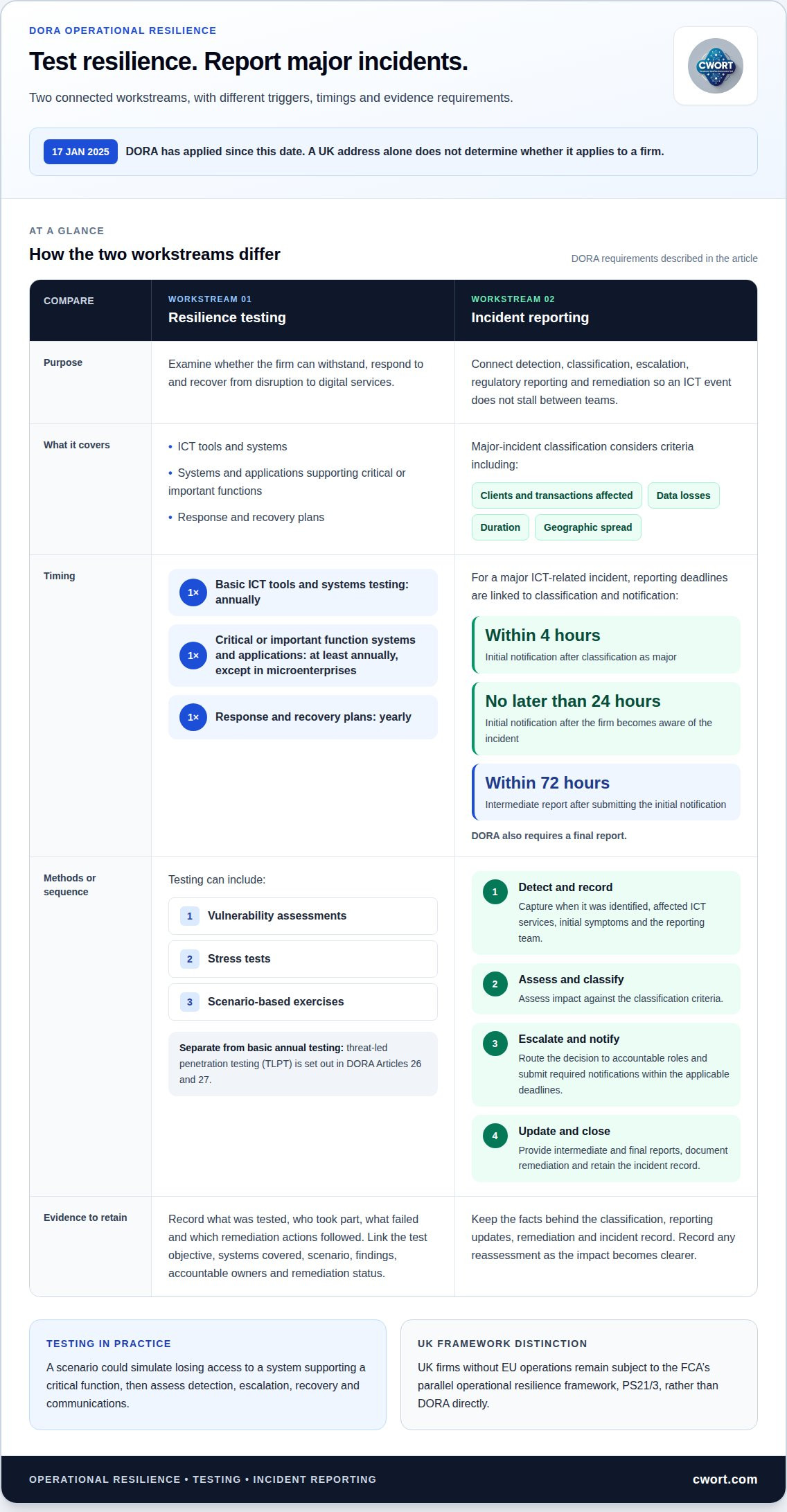
A UK address does not, by itself, put an investment firm outside DORA. For DORA compliance for investment firms in the UK, the deciding factor is whether the firm operates an EU-regulated entity or provides ICT services to EU financial entities. DORA has applied since 17 January 2025; UK firms without EU operations remain subject to the FCA’s parallel operational resilience framework, PS21/3, rather than DORA directly.
That distinction matters: applying the wrong framework can leave gaps in governance, testing, incident reporting or oversight of technology providers. Firms operating across UK and EU structures need a clear view of which obligations apply to each entity and service relationship.
This article explains how to assess whether DORA applies, what its resilience testing, incident reporting and third-party controls involve, and how a readiness assessment can turn requirements into a prioritised compliance roadmap. It also explains how proportionality affects the framework and what evidence helps show that controls are operating, not merely documented.
Key Takeaways
- Determine whether your UK firm operates an EU-regulated entity or provides ICT services to EU financial entities; a UK presence alone does not settle whether DORA applies.
- Build resilience testing around annual ICT testing and tests of response and recovery plans, using methods suited to the systems and functions involved.
- Prepare incident processes to classify major ICT incidents and meet reporting deadlines, including an initial notification within 4 hours of classification and an intermediate report within 72 hours of the initial notification.
- Map ICT providers to the services and functions they support, then connect risk monitoring, contract provisions and exit planning to the criticality of those services.
- Use a readiness assessment to identify gaps, prioritise remediation and build an evidence-based roadmap; CWORT offers DORA Compliance Readiness and Assessment for this work.
Table of Contents
- Digital operational resilience testing
- ICT incident classification and reporting
- ICT third-party risk management
- ICT third-party risk and contractual provisions
- DORA readiness assessments and compliance roadmaps
- CWORT: DORA Compliance Readiness and Assessment
Digital operational resilience testing
DORA makes ICT resilience testing a defined part of operational resilience for in-scope financial entities. UK firms must distinguish these requirements from the UK framework introduced in 2021.
Operational resilience testing
Operational resilience testing examines whether a firm can withstand, respond to and recover from disruption to its digital services. For investment firms, this links ICT resilience with business continuity: an outage affecting a trading platform, for example, can test whether recovery arrangements protect important services.
DORA requires annual basic testing of ICT tools and systems. Systems and applications supporting critical or important functions must also be tested at least annually, except in microenterprises. Financial entities must test response and recovery plans yearly. A documented schedule is therefore essential, with test scope reflecting the systems and functions involved.
Testing can include vulnerability assessments, stress tests and scenario-based exercises. A scenario might simulate losing access to a system that supports a critical function, then assess detection, escalation, recovery and communications. Record what was tested, who took part, what failed and which remediation actions followed. A completed test without documented outcomes offers management limited assurance.
DORA is more prescriptive on ICT and cyber resilience than current UK operational resilience regulation. UK firms should distinguish the regimes that apply to each entity rather than assume UK requirements alone cover DORA obligations. Digital resilience policies should connect governance responsibilities, test schedules, results and remediation, giving management a traceable view of unresolved weaknesses and service-continuity decisions.
Information sharing and threat-led testing
DORA allows financial entities to establish arrangements for exchanging cyber threat information and intelligence. Participation is encouraged, not mandatory. Information sharing can help firms interpret emerging threats and incorporate relevant intelligence into risk assessments and testing. Governance should define what can be shared, who approves it and how sensitive material is handled.
Threat-led penetration testing (TLPT) tests an organisation’s ability to withstand realistic, intelligence-informed cyber threats. DORA’s TLPT requirements sit in Articles 26 and 27. They are distinct from basic annual ICT testing: the threat-led approach examines whether security measures and response capabilities hold up against threats relevant to the firm.
Investment firms should link test scope to the ICT systems supporting critical or important functions. For example, a test may examine whether an attack on a key application is detected, escalated and contained, and whether recovery arrangements work as intended. Findings should inform remediation and management oversight, rather than remain in a standalone technical report.
Keep the evidence connected. A resilience-testing record can link the test objective, systems covered, scenario, findings, accountable owners and remediation status. This helps show how testing informs operational decisions and business continuity planning. It also gives governance bodies a clear basis to review exposure, challenge overdue actions and track whether corrective measures have been validated through subsequent testing.
ICT incident classification and reporting
DORA requires financial entities to establish and implement an ICT-related incident management process under Article 17. For an investment firm, that process must connect detection, classification, escalation, regulatory reporting and remediation, so a technical event does not stall between teams.
For a major ICT-related incident, the initial notification is due within 4 hours of classification as major, and no later than 24 hours after the firm becomes aware of it. The intermediate report is due within 72 hours of submitting the initial notification. DORA also requires initial, intermediate and final reports, so reporting arrangements must support updates as the firm assesses impact and resolves the incident.
Classification determines whether an incident meets the major threshold and triggers reporting. Investment firms assess criteria set out in Delegated Regulation (EU) 2024/1772, including clients and transactions affected, data losses, duration and geographic spread. A disruption to a service may therefore require a different response depending on its reach, duration and consequences. The process should record the facts behind the classification and any reassessment as the impact becomes clearer.
Build the incident framework around a clear sequence:
- Detect and record: capture the time identified, affected ICT services, initial symptoms and reporting team.
- Assess and classify: evaluate client and transaction impact, data loss, duration and geographic spread against the classification criteria.
- Escalate and notify: route the decision to accountable roles, then submit required notifications within the applicable deadlines.
- Update and close: provide intermediate and final reports, document remediation, and retain the incident record.
Consider a system failure that prevents clients from accessing an investment service. The response team needs to establish which functions are affected, how long the disruption lasts, whether data is lost and how widely the impact extends. Those findings inform classification and regulatory reporting. An unstructured email chain can obscure decision times and leave gaps in the evidence.
Incident procedures should define who can declare an incident major, who approves notifications and who communicates with affected stakeholders. Assign named roles and backups, maintain current contact and escalation routes, and prepare report templates around the information the firm must assess. This makes the response workable during disruption, rather than dependent on staff finding scattered instructions.
After resolution, compare the incident record with resilience testing and recovery actions. Identify whether detection, escalation or communications failed, assign remediation owners, and track closure evidence. A structured review of incident-response controls and evidence can help bring those reporting workflows into a defensible framework.
ICT third-party risk management
DORA requires in-scope financial entities to manage ICT risk across their operations and provider relationships. The applicable framework depends on the entity’s status and whether it qualifies for simplified requirements.
ICT risk management frameworks
An ICT risk management framework identifies, classifies and documents critical or important functions, supporting assets and associated risks. This gives an investment firm a structured basis for deciding where controls and oversight matter most.
Firms meeting the conditions for an IFR small and non-interconnected investment firm apply DORA’s simplified framework under Article 16. Other investment firms apply the framework in Articles 5 to 15, proportionate to their circumstances. For example, mapping a critical client service to its applications and infrastructure helps show which ICT risks could disrupt that function.
Investment firm scope
DORA applies to investment firms operating in the EU, subject to the regulation’s stated exemptions. UK firms may be affected if they operate EU-regulated entities or provide ICT services to EU financial entities. A UK location alone does not determine whether DORA applies.
Managers of alternative investment funds and UCITS management companies are generally among the financial entities in scope. The relevant question is which regulated entity or activity is involved, not simply where a group’s head office is located. A UK group with an EU-regulated investment firm should assess that entity’s obligations separately from its UK-only operations.
ICT risk governance
DORA governance connects ICT risk management with decisions about services, assets, controls and response. Financial entities must maintain a framework that identifies and documents critical or important functions and the ICT resources supporting them.
Management bodies must keep their ICT risk knowledge current through specific, regular training under Article 5(4). This equips decision-makers to scrutinise risk assessments, understand material dependencies and oversee response arrangements. A documented governance process should show who owns each risk, how decisions are escalated and how unresolved issues reach the appropriate level of oversight.
Third-party ICT, cloud and outsourcing
Third-party risk management covers ICT providers supporting a financial entity, including cloud and outsourced services. DORA requires firms to account for ICT concentration risks and risks arising from sub-outsourcing, rather than treating each supplier relationship in isolation.
Map each provider to the functions and assets it supports, then assess how disruption or a subcontracting change could affect those services. DORA also covers ICT service providers working with EU financial entities. Providers designated as critical by the European Supervisory Authorities fall within a Union-wide Oversight Framework. Visibility of dependencies is therefore essential to risk management and resilience.
ICT third-party risk and contractual provisions
A provider contract is part of an investment firm’s digital operational resilience controls when ICT services support critical or important functions. DORA’s Article 30 provisions and documented exit strategies make contract oversight a practical risk-management task, not a procurement formality.
Connect each contract to the service it supports
Start with a service map linking each ICT provider to the functions, systems and assets it supports. For example, a cloud service hosting an application used for a critical function should be identifiable in the firm’s third-party register. This connection helps assess disruption impacts and direct monitoring towards operationally significant dependencies.
Maintain a register of critical third-party relationships and demonstrate continuous monitoring of third-party risk. Record the provider, service, supported function, accountable internal owner and material changes. Include subcontracting dependencies, because sub-outsourcing can create risks beyond the direct provider relationship. A register that lists only supplier names cannot show how disruption might affect the firm.
Apply Article 30 to relevant ICT contracts
DORA Article 30 contract clauses and documented exit strategies are relevant where ICT services support critical or important investment-firm functions. The firm should identify which agreements fall into that category, then assess whether their documented terms address the relationship’s resilience requirements.
Review agreements against the service map, rather than in isolation. If a provider supports a critical application, establish who owns the contract, where relevant clauses are recorded and how changes are tracked. Contract governance should also account for the provider’s role in any sub-outsourcing chain. This creates a traceable link between service criticality, contractual provisions and ongoing risk oversight.
Structure contract remediation
When a review identifies a gap, record the affected provider, contract, supported function and required action. Assign an owner, document the decision and track progress to closure. For instance, if an exit strategy is missing for a service supporting an important function, make the gap visible to relevant decision-makers and explain how it will be addressed.
Prioritise remediation by considering the function’s criticality, provider dependencies and potential service disruption. Keep evidence of contract reviews, decisions and follow-up actions together. This helps governance teams distinguish a drafting issue from a wider control weakness and assess whether remediation addresses the underlying risk.
Oversee critical providers
DORA establishes a Union-wide Oversight Framework for critical ICT third-party providers designated by the European Supervisory Authorities. That framework does not remove an investment firm’s responsibility to monitor its own provider relationships. Oversight should connect external developments with the firm’s register, service dependencies and risk assessments.
Review provider changes, subcontracting arrangements and service performance against the documented relationship. When a change affects an ICT service supporting a critical function, assess its impact, update relevant records and escalate material risks through governance. This connects contract provisions to operational evidence for resilience, rather than leaving them separate from day-to-day monitoring.
DORA readiness assessments and compliance roadmaps
A readiness assessment establishes which DORA obligations apply and how current controls meet them. A compliance roadmap turns identified gaps into sequenced, accountable work. For firms planning DORA compliance for investment firms in the UK, the assessment provides a structured starting point.
DORA readiness assessments
A DORA readiness assessment compares an entity’s current arrangements with the regulation’s requirements and identifies evidence gaps. It should examine governance, ICT risk management, resilience testing, incident reporting and third-party oversight, rather than treating each control as an isolated document. This gives investment-firm leaders a view of where controls operate and which remediation needs priority.
In the EU, enforcement authorities can impose administrative fines of up to 1% of an entity’s total annual turnover for DORA non-compliance. An assessment helps expose weaknesses before they become control failures, but it is not a guarantee against enforcement or incidents.
Compliance roadmaps
A compliance roadmap converts assessment findings into a phased plan with accountable owners, dependencies, evidence requirements and governance checkpoints. Actions can be prioritised by considering the functions affected, the severity of each gap and the resources needed to implement a control. This prevents a long list of findings from becoming an unsequenced project.
For example, an investment firm may need clearer incident reporting procedures while improving evidence for ICT risk controls. A roadmap connects these workstreams, identifies decisions requiring management oversight and sets out how progress will be demonstrated. It should also account for dependencies such as provider information, system access and internal approval routes.
Budgeting depends on the firm’s scope, current control maturity, operating model, technology estate and remediation complexity. Costs depend on the case and are given after a quote request; relevant cost factors include assessment scope, evidence readiness, control gaps and implementation resources. Resource planning should identify the internal owners, subject-matter expertise and leadership time needed to deliver each action.
Separate assessment effort from implementation effort. An assessment identifies gaps and priorities; implementing remediation may require changes to governance, procedures, controls or evidence collection. This distinction helps leadership allocate people and funding to defined outcomes, rather than treating a readiness review as the full compliance programme.
Make the roadmap evidence-led. For each action, record the requirement addressed, accountable owner, expected control outcome and proof needed to demonstrate completion. A workstream on incident reporting, for instance, should link revised procedures to evidence that roles, escalation routes and reporting decisions are governed consistently.
Review progress through governance checkpoints, then update priorities when risks, providers or business functions change. A DORA readiness assessment and roadmap review can help establish a structured route to DORA compliance for investment firms in the UK, with remediation organised into verifiable actions.
CWORT: DORA Compliance Readiness and Assessment
CWORT’s DORA Compliance Readiness and Assessment helps investment firms turn applicable obligations into structured execution activities. It is a practical next step when an EU-regulated entity needs to identify gaps, organise remediation and build evidence around control outcomes.
As an enterprise compliance validation platform, CWORT supports separation of duties and links evidence to controls, helping teams create an auditable view of readiness. This structure can bring assessment findings and follow-up actions into a more coherent compliance process. CWORT also offers UK NIS Compliance Management, NIS2 Readiness and Compliance Management, and ISO 27001 Readiness and Control Mapping where these frameworks are relevant to an organisation’s requirements.
Contact CWORT to discuss DORA readiness and assessment for your firm.
Make resilience readiness part of governance
Treat DORA readiness as an ongoing governance discipline, not a project that ends when initial remediation is complete. Changes to business services, technology and provider relationships can alter a firm’s risk profile. A controlled process for reviewing those changes helps keep ownership, evidence and priorities aligned.
For DORA compliance for investment firms in the UK, the next step is to turn the firm’s current position into clear decisions: which gaps need attention, who owns the response and what evidence will demonstrate progress. A structured assessment gives senior leaders a basis for directing that work and maintaining oversight as the operating model evolves.
CWORT supports this work through its DORA Compliance Readiness and Assessment. If your firm is ready to define its next actions, discuss DORA readiness with CWORT. A clear starting point can help your team move forward with focus and control.
Frequently Asked Questions
Are UK entities impacted by DORA?
Yes. UK-based organisations can be affected through EU-regulated entities or ICT services supplied to EU financial entities. For example, a UK investment group may have a UK parent and a separately regulated EU subsidiary, so the subsidiary’s obligations need distinct assessment. UK firms without EU operations remain subject to the FCA’s operational resilience framework rather than DORA directly. Relevant exposure depends on the firm’s activities and relationships, not its registered address alone.
Why is DORA relevant?
DORA is relevant because financial services depend on ICT systems and external providers, and disruption can affect clients and market activities. It creates a common operational resilience framework for EU financial entities, including investment firms. For UK groups with EU-regulated operations, technology risk and continuity arrangements can therefore have cross-border governance implications. DORA is most relevant where an entity’s services, systems or provider relationships connect it to EU financial markets.
Are they in scope?
MiFID II investment firms are generally within DORA’s scope under Article 2(1)(e), subject to the regulation’s exemptions. Article 2(3)(d) excludes certain persons exempted under MiFID II, unless another in-scope authorisation applies. For a UK group, assess each legal entity and authorisation separately. A UK firm may be indirectly affected through its services to an EU financial entity, even where the UK firm itself is not directly subject to DORA.
How can a professional help businesses prepare for DORA?
A professional can assess the firm’s applicable obligations, examine existing control evidence and identify gaps requiring action. CWORT’s DORA Compliance Readiness and Assessment structures this work by linking obligations to execution activities and evidence. For example, an assessment can clarify which control owner must provide evidence and which approval is needed. This supports a prioritised readiness plan; it does not replace legal advice or the firm’s own management accountability.
What are the main requirements of DORA?
DORA’s main areas include ICT risk management, resilience testing, ICT incident handling and reporting, and risk controls for third-party ICT providers. It also addresses governance and the documentation of critical or important functions. For an investment firm, these areas need to work together: a provider dependency can affect a key service, while the firm’s governance, response arrangements and evidence determine how that risk is managed and demonstrated.
Why is DORA compliance important?
Compliance gives financial entities a structured way to govern technology risks that could interrupt services or undermine operational continuity. It also makes responsibilities and control evidence more visible to management and regulators. For firms operating across the UK and EU, clear entity-level accountability helps prevent the assumption that one group-wide policy automatically covers every regulated operation. Effective compliance connects documented controls with decisions and evidence of how they operate.
What challenges are organisations facing with DORA?
Organisations can struggle to establish a complete view of which entities, services and providers fall within scope. Evidence may be spread across teams, while control owners use inconsistent terms or records. Provider dependencies can also be difficult to trace through subcontracting. These issues make it harder to assign accountable owners and demonstrate how a control works. Aligning entity scope, control mapping and evidence ownership within one governance process can help address them.
What is the purpose of DORA?
DORA aims to strengthen digital operational resilience across the EU financial sector by setting a shared framework for managing ICT risk. It focuses on an entity’s ability to prepare for, respond to and recover from ICT disruption, while addressing dependencies on external technology providers. The aim is not simply to document policies. Financial entities need governance and controls that support the continuity and resilience of their services.
Disclaimer
The content on this site is provided for general information and educational purposes only. It does not constitute legal, regulatory, financial, or professional advice. CWORT provides AI-assisted insights and workflow automation, but all compliance decisions remain the responsibility of your organisation and its management. Always seek qualified legal or regulatory guidance for decisions relating to the UK NIS Regulations, CAF, DORA, NIS2, ISO 27001, or other obligations.
Related posts
DORA Obligation Mapping Tool: Orchestrating Defensible Compliance in 2026
Stop manual DORA tracking. A DORA obligation mapping tool orchestrates compliance, automates reporting, and creates a defensible audit trail for central banks.
DORA Compliance Validation Software: Orchestrating Defensible Proof in 2026
Is your DORA strategy audit-ready for 2026? Learn how DORA compliance validation software provides defensible proof and protects board members from liability.
CISO Guide to DORA Operational Resilience: Orchestrating Validated Compliance
Master validated compliance with our CISO guide to DORA operational resilience. Swap manual evidence gathering for an orchestrated, audit-ready security post...
Article by
Michael Iyiola
Co-Founder, CWORT
Michael Iyiola is a co-founder of CWORT and a Cyber and AI Security Engineer with deep experience in vulnerability management, detection engineering and operational resilience across UK critical national infrastructure, including rail, energy and financial services. At CWORT, he designs scalable, evidence-driven workflows that help teams meet modern regulatory and security demands.
Build Your Foundation of Auditable Certainty
Take control of your regulatory obligations and secure your infrastructure with CWORT.