DORA Compliance Gap Analysis Tool: A Strategic Guide to Audit-Ready Validation

Michael Iyiola
Co-Founder, CWORT
Discover how a DORA compliance gap analysis tool replaces spreadsheet tracking with audit-ready validation, ensuring seamless regulatory compliance for 2026.

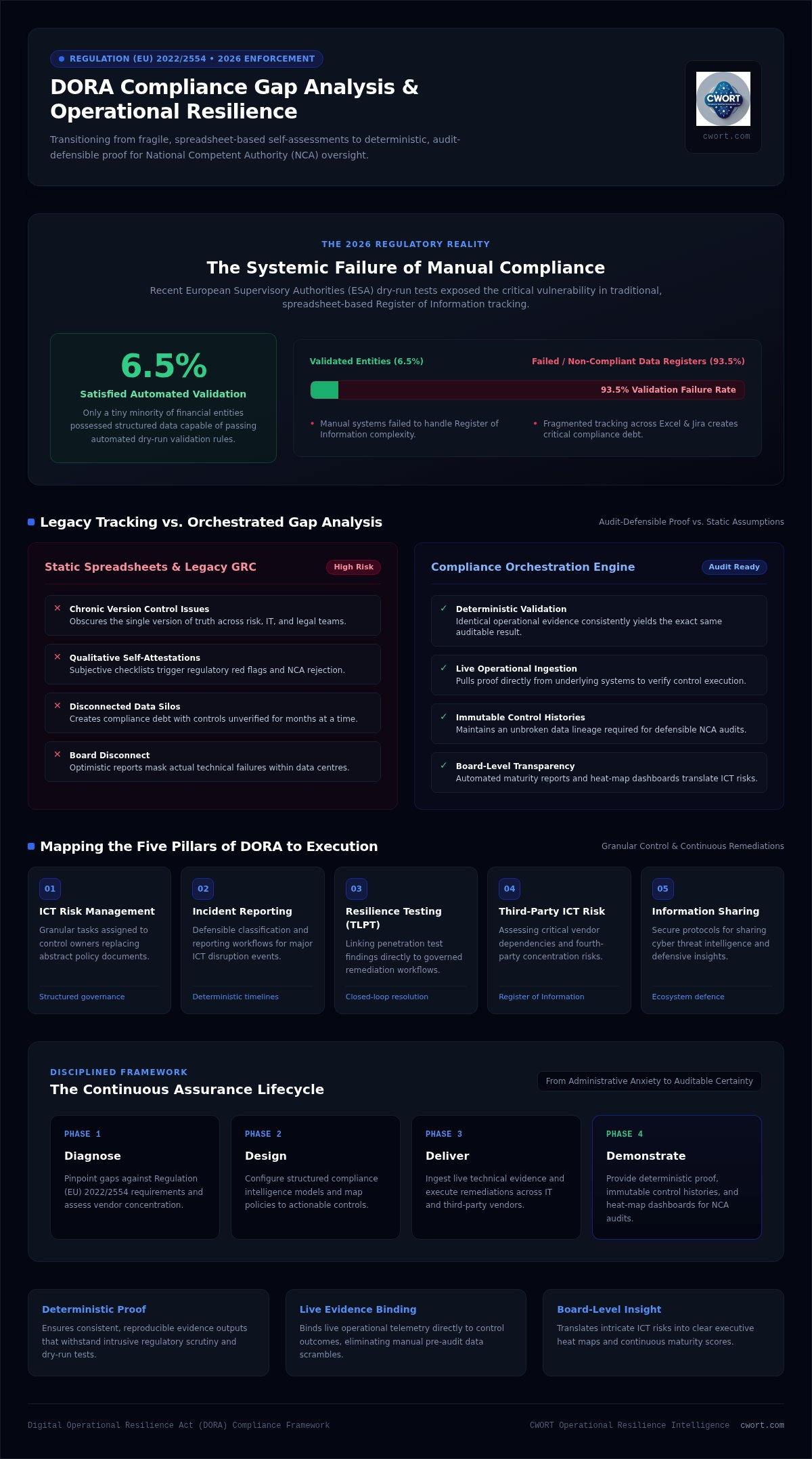
Only 6.5% of financial entities managed to satisfy automated data validation rules during recent regulatory dry-run tests, a statistic that exposes the lethal flaw in traditional, spreadsheet-based tracking. If you're currently managing fragmented compliance data across Jira and Excel whilst facing the 2026 regulatory deadlines, you're already feeling the weight of this systemic failure. It's nearly impossible to provide board-level visibility when your evidence is scattered across disconnected silos. A sophisticated DORA compliance gap analysis tool is no longer a luxury; it's a strategic necessity for survival in a high-stakes oversight environment.
We understand that the transition from qualitative self-assessments to deterministic proof feels daunting. This guide shows you how to move beyond static checklists toward an orchestrated model of validation that regulators actually trust. You'll discover a clear roadmap for remediation and a repeatable process for continuous compliance. We'll explore how to transform abstract obligations into audit-ready evidence, ensuring your organisation moves from administrative anxiety to the calm of auditable certainty. By the end of this article, you'll have the framework required to replace fragmented guesswork with a disciplined, professional operating model.
Key Takeaways
- Replace manual, fragmented tracking with a structured DORA compliance gap analysis tool to ensure your evidence remains defensible during rigorous NCA audits.
- Identify the critical limitations of legacy GRC platforms and transition to a proactive orchestration engine that eliminates data graveyards through deterministic validation.
- Utilise a rigorous seven-step framework to define, configure, and demonstrate compliance, moving from administrative tracking to a state of total assurance.
- Bridge the gap between technical security tools and regulatory requirements by ingesting live operational evidence into a centralised compliance intelligence model.
- Gain board-level visibility with automated maturity reports and heat-map dashboards that translate complex ICT risks into clear, actionable strategic insights.
Table of Contents
- Beyond the Spreadsheet: Why Manual DORA Gap Analysis Fails in 2026
- Essential Features of a Robust DORA Compliance Gap Analysis Tool
- Comparing Traditional GRC Tools vs. Compliance Orchestration Engines
- Executing a Defensible DORA Gap Analysis: A Seven-Step Framework
- CWORT: Transforming DORA Obligations into Auditable Operating Models
Beyond the Spreadsheet: Why Manual DORA Gap Analysis Fails in 2026
The era of managing high-stakes regulatory obligations through Excel is over. For financial entities governed by the Digital Operational Resilience Act, the 2026 landscape is defined by aggressive enforcement and automated validation. Relying on fragmented trackers creates "compliance debt", a backlog of unverified controls that leave your organisation vulnerable during a National Competent Authority (NCA) audit. Regulators now reject the manual reconstruction of data, demanding instead a deterministic governance system that proves resilience in real-time. You cannot defend a multi-million pound fine with a spreadsheet that was last updated three months ago.
The Fragility of Static Checklists in Financial Services
Spreadsheets are inherently fragile and lack the structural integrity required for modern oversight. They suffer from chronic version control issues that obscure the "single version of truth" required across risk, IT, and legal departments. When attempting to manage the five pillars of DORA, manual data entry fails to capture the intricate web of ICT risk and third-party dependencies. A manual DORA compliance gap analysis tool, such as a static checklist, lacks the orchestration needed to track remediation progress dynamically. This leads to a dangerous disconnect between the optimistic reports presented to the board and the operational reality within the data centre. Recent ESA dry-run tests proved this point, only 6.5% of entities satisfied automated data validation rules, largely because their manual systems couldn't handle the complexity of the Register of Information requirements.
Regulatory Scrutiny of Evidence Integrity
Auditors now demand "audit-defensible" proof, which necessitates immutable histories of control execution. You can't defend your resilience posture with a static PDF or a qualitative self-attestation. NCAs expect evidence pulled directly from your underlying systems, proving that controls are not just designed but operating effectively. CWORT replaces fragmented trackers with a single orchestrated system, ensuring every regulatory obligation is mapped to a structured, executable activity. By deploying a sophisticated DORA compliance gap analysis tool, you shift from administrative tracking to a state of auditable certainty. This transition ensures that identical evidence always yields the same deterministic result. It removes the subjectivity that triggers regulatory red flags and provides a clear, repeatable path through the "Diagnose, Design, Deliver, Demonstrate" lifecycle. This disciplined approach is the only way to replace the anxiety of potential failure with the calm of auditable certainty.
Essential Features of a Robust DORA Compliance Gap Analysis Tool
A robust DORA compliance gap analysis tool must do more than list requirements; it must enforce the discipline of execution. Regulation (EU) 2022/2554 mandates a comprehensive ICT risk management framework that leaves no room for qualitative guesswork. To be audit-ready, your platform needs to bind evidence directly to control outcomes, ensuring that every claim is backed by a deterministic data lineage. This eliminates the manual scramble for evidence before a regulatory visit. By translating abstract law into concrete reality, you move from a state of vulnerability to one of auditable certainty.
Mapping the Five Pillars to Execution Activities
Effective gap analysis requires breaking down the five pillars of DORA into granular, actionable tasks. ICT Risk Management and Incident Reporting shouldn't exist as abstract policies; they must be translated into structured activities with assigned owners and clear deadlines. Third-party risk management is particularly critical. Your tool must integrate vendor assessments into the broader resilience landscape, ensuring that fourth-party concentration risks are visible and managed. By linking threat-led penetration testing (TLPT) results directly to remediation workflows, you ensure that vulnerabilities found during testing are closed through a governed process rather than left in a static, ignored report.
Enforcing Separation of Duties and Governance
One of the most significant pitfalls in regulatory readiness is the "self-assessment trap." If the person responsible for a control is also the one validating its effectiveness, the results are inherently biased and will not survive a National Competent Authority (NCA) review. A professional DORA compliance gap analysis tool enforces a strict separation of duties within the platform itself. Role-based and attribute-based access controls ensure that assessors, owners, and auditors operate within defined boundaries. This internal governance prevents the manipulation of results and ensures that maturity scores remain objective. CWORT utilises an AI advisory layer to assist with contextual queries, yet it maintains a deterministic scoring model where AI never alters the mathematical reality of your compliance status.
Efficiency in 2026 comes from the "Assess Once, Report Many" philosophy. With 1,355 controls in the taxonomy library, our platform maps your activities across 42 frameworks, including NIS2 and ISO 27001. This cross-walking capability ensures that a single piece of evidence satisfies multiple regulatory bodies simultaneously. If you're ready to transition from passive tracking to proactive orchestration, explore our compliance validation platform today. This systematic approach ensures that identical evidence always yields the same result, providing the auditable truth that regulators demand.
Comparing Traditional GRC Tools vs. Compliance Orchestration Engines
Legacy GRC platforms have historically functioned as passive utilities, acting as little more than glorified repositories for stale data. In the context of the European Supervisory Authorities' DORA framework, these "data graveyards" represent a significant operational risk. They lack the dynamic orchestration required to validate resilience in a fast-moving threat landscape. A modern DORA compliance gap analysis tool must move beyond passive storage to proactive orchestration. It must sit above existing security tools like SIEM or EDR, ingesting live evidence to provide a deterministic view of your posture. This transition replaces manual report reconstruction with board-ready, automated dashboards that reflect the true state of your organisation's resilience.
Why Jira and Excel Lack Audit-Defensible Proof
Generic project management tools like Jira or spreadsheets like Excel are designed for administrative tracking, not regulatory defence. They fail to provide evidence binding, meaning there's no immutable link between a control requirement and the actual data proving its execution. This lack of traceability is a red flag for auditors who require a verifiable, linked evidence trail. CWORT solves this by enforcing Regulatory Compliance Workflow Automation, ensuring that every control is backed by deterministic evidence rather than subjective status updates. By automating the collection and validation process, you eliminate the human error inherent in manual data gathering and create a defensible record that stands up to the most rigorous supervisory review.
The "Assess Once, Report Many" Efficiency
Financial entities today are drowning in overlapping regulatory requirements, including DORA, NIS2, and the UK NIS regulations. Attempting to manage these in silos is inefficient and unsustainable. A sophisticated DORA compliance gap analysis tool should enable an "Assess Once, Report Many" philosophy. Our platform contains 1,355 controls in its taxonomy library, which are mapped across 42 different frameworks. This cross-walking capability allows you to satisfy multiple regulatory obligations through a single assessment cycle. It builds a unified view for leadership, auditors, and regulators alike, transforming compliance from a recurring burden into a streamlined, repeatable process. This structural integrity ensures that your maturity reports are always based on the same rigorous standards, providing the auditable truth required for board-level oversight and regulatory peace of mind.
Executing a Defensible DORA Gap Analysis: A Seven-Step Framework
Transitioning from regulatory theory to operational execution requires a disciplined, linear framework. A professional DORA compliance gap analysis tool must enforce a rigorous progression from abstract obligation to concrete evidence, eliminating the ambiguity that auditors exploit during supervisory reviews. This systematic approach ensures that your resilience posture isn't just a subjective claim but a defensible reality. By following a structured seven-step process, you replace administrative guesswork with a professional operating model that stands up to the most intense regulatory scrutiny.
- Step 1: Define and import. Establish the regulatory model within a governed environment. This involves importing the specific taxonomy of controls into a system that enforces structural integrity from the outset.
- Step 2: Configure and assign. Build the assessment blueprint and assign clear ownership to operational stakeholders. This step ensures that accountability is hard-coded into the compliance process, preventing the "vague responsibility" trap.
- Step 3: Capture and bind. Collect responses whilst binding them directly to verifiable evidence. Every status update must be linked to a specific system extract or log, ensuring that claims are always backed by deterministic data.
- Step 4: Calculate maturity. Utilise deterministic scoring models to calculate maturity and confidence levels. This ensures that identical evidence always yields the same result, providing the mathematical reproducibility required by National Competent Authorities.
- Step 5: Identify and prioritise. Surface critical gaps and rank remediation activities based on business risk, effort, and expected value. This ensures that your limited resources are focused on the most significant resilience threats.
Prioritising Remediation and Improvement
Once gaps are identified, the focus shifts to strategic execution. Heat-map dashboards allow leadership to visualise critical gaps in resilience at a glance, moving beyond the noise of individual tickets to see the broader risk landscape. By ranking actions within a governed digital workflow, you ensure that remediation follows a logical progression of priority. This process aligns with the "Assess Once, Report Many" philosophy, ensuring that every improvement made for DORA also strengthens your posture against NIS2 and ISO 27001. It transforms a one-time assessment into a continuous cycle of improvement that leadership can track in real-time.
Generating Regulator-Ready Outputs
The ultimate objective of any DORA compliance gap analysis tool is the production of board-level maturity reports without the need for manual data crunching. These outputs must be sophisticated enough for the board whilst remaining granular enough for technical auditors. An orchestrated system ensures that your assurance evidence register is always audit-ready, providing a "living" record of compliance that regulators can trust. This moves your organisation from a state of administrative anxiety to the calm of auditable certainty. Request a demo to see the 7-step process in action and discover how to build a truly defensible operating model for 2026.
CWORT: Transforming DORA Obligations into Auditable Operating Models
CWORT is not merely a tracking utility; it is a sophisticated orchestration engine designed to translate regulatory pressure into structural integrity. By providing both Compliance Intelligence and Operating Model Intelligence, the platform ensures that your resilience strategy is integrated into the very fabric of your business operations. This goes beyond the capabilities of a standard DORA compliance gap analysis tool by enforcing a rigorous "Diagnose, Design, Deliver, Demonstrate" lifecycle. This methodology moves your organisation through a logical progression from initial gap identification to the definitive proof of control effectiveness, ensuring every activity adds measurable value.
One of the platform's most powerful differentiators is its "Bring Your Own Content" (BYOC) capability. This allows enterprises to protect their proprietary intellectual property whilst mapping it against global standards. Whether you are using the 1,355 controls in our taxonomy library or importing your own governed models, the system maintains a deterministic scoring environment. This ensures that your maturity reports are always reproducible and audit-defensible, providing the structural order that National Competent Authorities demand during a review.
Board-Ready Reporting and Continuous Assurance
Senior leadership requires more than raw data; they need auditable certainty. CIOs and CISOs use CWORT to assess complex architecture and cyber resilience, replacing fragmented anxiety with a clear, evidence-based narrative. Our DORA Compliance Validation Guide outlines how to maintain this posture through continuous assurance. Rather than treating compliance as an annual event, the system facilitates recurring assessments and delivery tracking. This proactive approach ensures that your operating model remains aligned with regulatory expectations even as your ICT environment evolves, maintaining a state of constant audit-readiness.
Getting Started: Implementation and Pilots
Transitioning to an orchestrated model does not require an immediate, enterprise-wide overhaul. Whilst some tools offer rapid, surface-level document-to-assessment conversion, CWORT focuses on governed, reusable models that provide long-term strategic value. We recommend starting with a controlled pilot involving three to five critical components. This allows your teams to experience the efficiency of the "Assess Once, Report Many" philosophy in a focused environment before scaling across the organisation. By validating the process at a smaller scale, you build the internal confidence and data lineage needed for a full-scale deployment. If you are ready to move beyond static checklists and build a truly resilient operating model, Request a CWORT Demo today. Our platform provides the structured discipline required to survive the 2026 regulatory landscape and beyond.
Securing the Future of Operational Resilience
The 2026 regulatory deadline demands a transition from administrative tracking to definitive, evidence-based proof. Static spreadsheets cannot defend your organisation against the scrutiny of National Competent Authorities; they only create a false sense of security whilst accumulating compliance debt. By implementing a sophisticated DORA compliance gap analysis tool, you replace fragmented guesswork with a disciplined operating model. This shift ensures that every regulatory obligation is mapped to a structured, executable activity, providing the auditable truth required for board-level oversight and regulatory peace of mind.
CWORT offers the structural integrity needed to survive this high-stakes environment. With 1,355 controls in our taxonomy library and a 98.6% framework mapping rate, we provide the deterministic evidence regulators demand. Our system enforces accountability by design, ensuring identical evidence always yields the same reproducible result. It's time to replace the anxiety of potential failure with the calm of auditable certainty. Request a CWORT Demo to Validate Your DORA Readiness and take command of your resilience posture. You've built a robust organisation; now build the defensible evidence to prove its durability.
Frequently Asked Questions
What is a DORA compliance gap analysis tool?
It's a strategic instrument used to evaluate an organisation's current ICT risk management and operational resilience against the specific mandates of the Digital Operational Resilience Act. Unlike a simple checklist, a professional DORA compliance gap analysis tool orchestrates the transition from abstract regulatory requirements to concrete, auditable activities. It identifies deficiencies in your operating model and provides a structured roadmap for remediation, ensuring your organisation is prepared for rigorous supervisory reviews.
Can I use Excel or Jira for DORA gap analysis?
Whilst many organisations attempt to use Excel or Jira, these tools lack the structural integrity and evidence-binding capabilities required for high-stakes regulatory compliance. They often lead to compliance debt because they cannot provide an immutable audit history or deterministic scoring. Regulators increasingly reject manual data reconstruction from fragmented trackers. A dedicated DORA compliance gap analysis tool like CWORT replaces these passive utilities with a proactive orchestration engine that ensures every control is backed by verifiable proof.
How does a deterministic scoring model improve audit readiness?
A deterministic scoring model ensures that identical evidence always yields the same result, removing the subjectivity that often triggers regulatory red flags. This mathematical reproducibility provides a defensible truth that stands up to intense scrutiny from National Competent Authorities. By using a system where results are calculated based on transparent rules rather than qualitative guesswork, you provide auditors with total assurance regarding the accuracy of your maturity and compliance scores.
How does CWORT handle the separation of duties required by DORA?
CWORT enforces a strict separation of duties through integrated governance controls, including role-based and attribute-based access management. The platform ensures that the individuals responsible for executing a control are not the same as those validating its effectiveness. This architectural discipline prevents the self-assessment trap and ensures that all assessment results remain objective and audit-ready. Every change is logged within an immutable audit history to maintain total transparency and accountability throughout the assessment lifecycle.
Does CWORT support multi-framework mapping for NIS2 and ISO 27001?
The platform enables a highly efficient "Assess Once, Report Many" strategy by mapping a single set of activities across multiple frameworks. With 1,355 controls in our taxonomy library, CWORT currently supports cross-walks for 42 different standards, including DORA, NIS2, UK NIS, and ISO 27001. This capability allows your organisation to satisfy various regulatory bodies simultaneously, reducing the administrative burden whilst maintaining a unified and consistent view of your global compliance and resilience posture.
What evidence is required for a DORA gap analysis?
A defensible analysis requires deterministic data lineage pulled directly from your underlying operational systems. This includes system extracts from IAM and PAM tools, logs from SIEM or EDR platforms, and documented ICT third-party contractual arrangements. Simply stating that a policy exists is insufficient; you must provide verifiable proof that the control is operating effectively. CWORT binds this evidence directly to control outcomes within a governed digital environment, ensuring your assurance evidence register is always audit-ready.
How often should we perform a DORA gap assessment?
DORA compliance is not a one-time event but a continuous requirement that necessitates recurring assurance. You should conduct a comprehensive gap assessment at least annually, or whenever significant changes occur in your ICT architecture or third-party vendor landscape. Regular assessments ensure that your operating model remains aligned with evolving Regulatory Technical Standards. CWORT facilitates this through delivery tracking and recurring assessment workflows, allowing you to maintain constant audit-readiness throughout the entire regulatory cycle.
Is CWORT suitable for small financial entities or only large enterprises?
CWORT is designed to be content-agnostic and scalable, making it suitable for both regulated enterprises and smaller financial entities. The platform's tiered approach allows organisations to start with a controlled pilot, focusing on three to five critical sub-functions before scaling. Whether you are a large credit institution or a smaller payment service provider, the need for auditable certainty and deterministic evidence remains the same. The system provides the professional maturity required to meet national supervisory expectations.
Disclaimer
The content on this site is provided for general information and educational purposes only. It does not constitute legal, regulatory, financial, or professional advice. CWORT provides AI-assisted insights and workflow automation, but all compliance decisions remain the responsibility of your organisation and its management. Always seek qualified legal or regulatory guidance for decisions relating to the UK NIS Regulations, CAF, DORA, NIS2, ISO 27001, or other obligations.
Related posts
CISO Guide to DORA Operational Resilience: Orchestrating Validated Compliance
Master validated compliance with our CISO guide to DORA operational resilience. Swap manual evidence gathering for an orchestrated, audit-ready security post...
How to Demonstrate Control Effectiveness to Regulators: A Strategic Guide
Learn how to demonstrate control effectiveness to regulators with our guide. Shift from chaos to an evidence-based, audit-ready compliance programme today.
Streamlining Regulatory Compliance Processes: From Manual Tracking to Orchestrated Validation
Stop wasting money on manual compliance. Learn about streamlining regulatory compliance processes to reduce personal liability under DORA & NIS2 and gain aud...
Article by
Michael Iyiola
Co-Founder, CWORT
Michael Iyiola is a co-founder of CWORT and a Cyber and AI Security Engineer with deep experience in vulnerability management, detection engineering and operational resilience across UK critical national infrastructure, including rail, energy and financial services. At CWORT, he designs scalable, evidence-driven workflows that help teams meet modern regulatory and security demands.
Build Your Foundation of Auditable Certainty
Take control of your regulatory obligations and secure your infrastructure with CWORT.