DORA compliance project planning for scope, tasks and evidence

Michael Iyiola
Co-Founder, CWORT
Use a DORA compliance project plan template to map scope, owners, tasks, deadlines and evidence, and manage incident reporting and ICT provider oversight.

A compliance tracker alone won’t demonstrate DORA compliance. A DORA compliance project plan template should define which entities and services are in scope, assign accountable owners, and connect each requirement to actions, deadlines and evidence. Regulation (EU) 2022/2554 has applied since 17 January 2025; UK organisations should establish whether their entities fall within its scope.
It’s understandable to view DORA compliance as a substantial coordination exercise: the work spans ICT risk, incident reporting, resilience testing and third-party oversight. A useful DORA compliance project plan template must show not only what needs to be done, but who owns the work and how control outcomes will be evidenced.
This guide explains how to determine scope, organise compliance work, oversee critical ICT providers, manage reporting deadlines and prepare evidence. It also shows how to structure a plan around accountable delivery, rather than simply recording tasks.
Key Takeaways
- Start by mapping in-scope entities, critical or important functions, ICT systems and dependencies so the plan reflects actual exposure.
- Build incident response tasks around detection, classification and reporting, with clear ownership for each deadline and report.
- Prioritise the Register of Information and contract reviews for ICT providers supporting critical or important functions.
- Give each compliance action an owner, target date and linked evidence so progress can be traced to control outcomes.
- Keep the plan under review: DORA compliance requires ongoing oversight, testing and updates as risks and requirements change.
Table of Contents
- How can organisations ensure compliance?
- Critical ICT third-party provider oversight
- Implementation timeline and deadlines
- Compliance evidence and reporting
- DORA applicability and scope
- CWORT: DORA Compliance Readiness and Assessment
How can organisations ensure compliance?
Financial entities should translate the Digital Operational Resilience Act (DORA) into owned controls, tested processes and retained evidence. Its ICT risk-management framework is set out in Articles 5-16, and the management body remains ultimately responsible for ICT risk. An effective compliance plan therefore connects leadership oversight with operational tasks, including incident detection, classification, reporting and response.
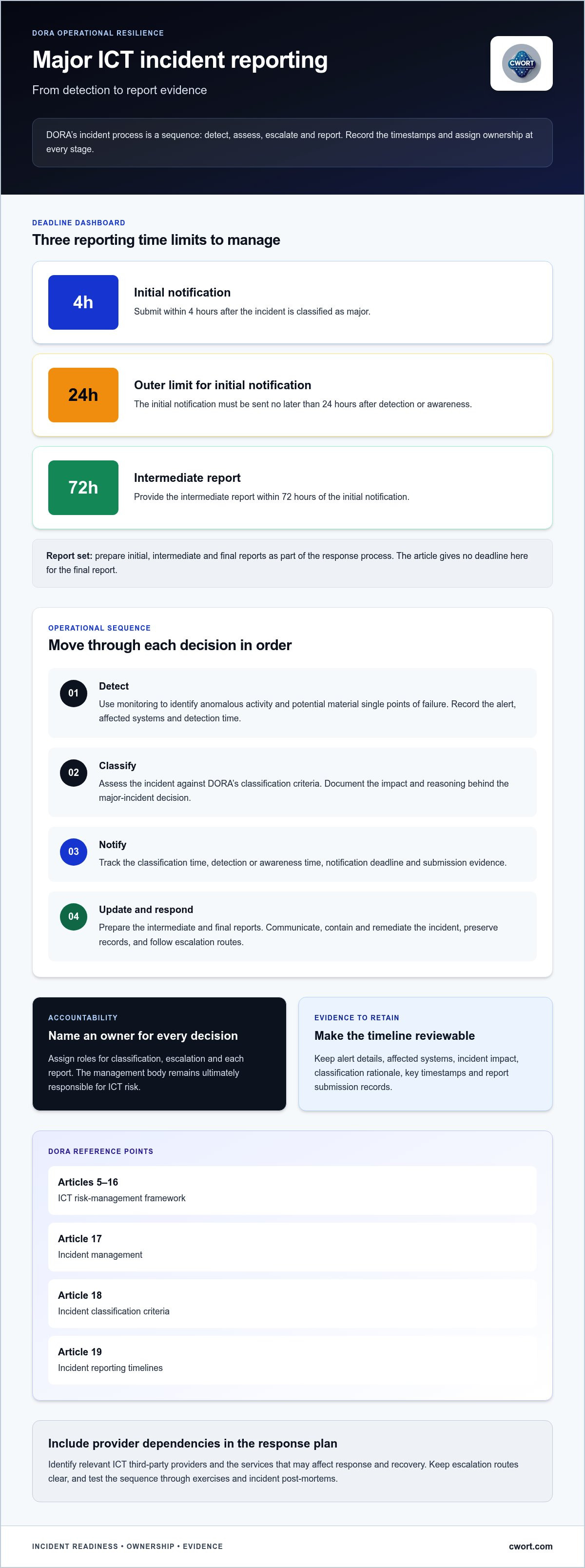
For major ICT-related incidents, DORA establishes a sequence rather than a single notification. Article 17 covers incident management, Article 18 sets classification criteria, and Article 19 sets reporting timelines. Financial entities need a documented route from initial detection through assessment, escalation and submission, with named roles for each decision.
- Detect: use monitoring arrangements to identify anomalous activity and potential material single points of failure. Record the alert, affected systems and time of detection.
- Classify: assess the incident against DORA’s classification criteria. Document the impact and reasoning so the major-incident decision can be understood and reviewed.
- Notify: submit the initial notification within 4 hours after classification as major, and no later than 24 hours after detection or awareness.
- Update: provide an intermediate report within 72 hours of the initial notification. Prepare initial, intermediate and final reports as part of the response process.
These deadlines make incident timestamps and escalation ownership operational controls, not administrative details. A project register, for example, can assign the classification decision to a role, record when an incident was detected, and track each report’s due time and submission evidence. This helps teams spot delays before they affect reporting.
A compliant response also requires a documented ICT incident response plan. Set out how teams communicate internally and externally, contain and remediate incidents, preserve records and prepare reports. Include escalation routes for relevant ICT third-party providers, whose services may affect the financial entity’s response and recovery.
What are the key DORA compliance requirements for financial entities? They include an ICT risk-management framework, incident management and reporting, resilience testing, information sharing and ICT third-party risk management. Articles 17-19 govern incident processes, while Articles 5-16 establish the broader risk framework.
Where can I find a free DORA compliance project plan template or checklist? Create a working checklist in the project register. Include the requirement, owner, classification rationale, deadline, action status and evidence location. For incident reporting, record detection time, major-classification time, notification time and report status.
Review the register through exercises and incident post-mortems. A simulated incident can test whether detection, classification and reporting roles work in sequence. Record findings as remediation actions, with owners and evidence. This turns the operational resilience act from a set of obligations into a controlled process financial entities can maintain across the sector.
Critical ICT third-party provider oversight
Map each ICT provider to the financial entity, service and business function it supports. DORA’s third-party requirements cover arrangements with providers such as cloud, software and data-centre businesses. Focus on operational dependency: a service supporting a critical or important function warrants priority over an arrangement with limited impact.
Article 28 requires financial entities to maintain a Register of Information for ICT third-party service arrangements. Treat it as a managed record, not a one-off spreadsheet. Capture the provider, contracted service, relevant entity, supported function, and links to the contract and risk assessment. Assign an owner to each entry and define how changes, renewals and exits update the record.
Use the register to sequence remediation according to risk. First, identify providers supporting critical or important functions. Then compare their arrangements with applicable DORA requirements, recording gaps, accountable owners and planned actions. This helps institutions prioritise Register of Information compilation and contract uplifts for high-impact services before working through the remaining contract backlog.
- Connect service to impact: document which function depends on the provider and the consequences of disruption.
- Record the risk decision: retain the assessment and rationale behind each priority.
- Track remediation: assign contract changes to an owner, with status and evidence of completion.
Article 30 sets requirements relevant to ICT third-party contract clauses. Review contracts against those requirements, focusing on the service description, responsibilities, access to information, and arrangements for monitoring. DORA also expects contractual provisions supporting audit rights and clear exit strategies. Record each gap against the relevant agreement, rather than treating a general supplier policy as proof that every contract is adequate.
Provider oversight must also account for supervisory scrutiny. Article 31 sets designation criteria for critical ICT third-party providers. ICT service providers are required to cooperate during inspections and audits; DORA also requires providers to cooperate with authorities and participate in threat-led penetration testing where applicable. Keep evidence of the contractual and operational arrangements that support this cooperation.
For each remediation item, retain the contract version reviewed, the clause or control assessed, the decision, approval and closure evidence. That trail lets risk management teams show why one provider was prioritised and how the issue was resolved. A structured compliance validation approach can connect provider obligations, owners and evidence in a traceable workflow.
Reassess the register when a service changes, a provider relationship ends or a function’s dependency shifts. This review keeps ICT risk management aligned with operational reality and helps prevent outdated records and unresolved contract actions.
Implementation timeline and deadlines
DORA’s implementation deadline has passed, so project plans should focus on operating, testing and evidencing controls. Sequence outstanding work by regulatory obligation, exposure and dependency instead of treating compliance as a one-off deadline.
Compliance milestones and sequencing
Compliance milestones turn DORA obligations into owned work, with completion evidence and review points. DORA has applied since 17 January 2025, so entities should baseline current arrangements and prioritise unresolved gaps. Start with governance and ICT risk management, then address incident reporting, resilience testing and provider arrangements. Sequence dependent work deliberately: teams need an agreed scope and accountable owners before they can validate controls or assess evidence.
Set milestones around deliverables, not activity alone. A completed policy draft, for example, is not the same as an approved, operational framework. For each milestone, track the accountable owner, due date, dependency, status, evidence and decision. Escalate blockers to the relevant governance forum and record decisions that change priorities. This makes progress visible to management bodies and gives authorities a clearer account of implementation.
Legislative timeline
The legislative timeline records when DORA was adopted, published and brought into application. The European Parliament and Council adopted DORA on 28 November 2022; it was published in the Official Journal of the EU on 27 December 2022. DORA became effective on 16 January 2023 and provided a 24-month implementation period after entering into force in the European Union. It has applied since 17 January 2025.
These dates distinguish the preparation period from the current compliance position. A project plan should not treat the former implementation period as a future grace period. Instead, record applicable requirements, current control state, remediation actions and the evidence needed to demonstrate operation. Include relevant delegated standards in the framework baseline, then revisit mapped obligations when regulatory requirements or organisational arrangements change.
What are the consequences and penalties for failing to comply with DORA? Article 52 allows EU member states not to establish administrative penalties or remedial actions for violations already subject to criminal penalties under national law. The potential consequences depend on the applicable national framework and the breach.
Which teams and accountable roles should a DORA project plan include? Include risk management, business continuity, cyber security and governance, while the management body retains ultimate responsibility for ICT risk. Assign operational owners to controls and workstreams, and name an executive sponsor to resolve cross-functional dependencies.
Set a controlled review cycle for the plan. Reassess milestone status when testing identifies a weakness, an incident exposes a process gap or a provider arrangement changes. Link remediation actions to the relevant control, owner and evidence. This helps prevent a completed project tracker from obscuring controls that are not embedded in day-to-day operations.
For entities using the simplified ICT risk-management framework, distinguish its requirements from those of the ordinary framework. This scope decision affects which milestones apply and what evidence teams should prepare. Record the rationale and accountable approval, then map each requirement to the operating process that fulfils it. This keeps digital operational resilience work proportionate and traceable.
Compliance evidence and reporting
Evidence turns DORA requirements into a demonstrable record of how an entity manages ICT risk. Since the regulation has applied since 17 January 2025, financial entities need documentation that reflects current systems, processes and risk-management procedures, not only plans drafted before the deadline.
What registers, policies, testing records and other evidence does DORA require? Maintain the Register of Information for ICT third-party service arrangements, documented ICT risk and security policies, incident records and resilience-testing evidence. Keep backup and restoration procedures, business continuity and disaster recovery documentation, and records showing how test results and audit or supervisory recommendations informed reviews.
Structure evidence so each requirement connects to its control, accountable owner and supporting record. For example, a backup restoration control should point to the approved procedure, test results, identified issues and remediation evidence. A policy document shows intent; operational records help demonstrate that teams followed the process.
- Governance: retain management decisions, approvals and records of ICT risk oversight.
- Risk management: document critical ICT systems, data, vulnerabilities and risk assessments.
- Incident handling: preserve detection, classification, escalation and reporting records.
- Resilience testing: link scenarios and outcomes to findings, actions and retests.
- Third-party oversight: connect provider records, contracts and assessments to supported functions.
For incident reporting, retain evidence supporting each classification decision and submission. Record detection and classification times, responsible roles, report versions and submission timestamps. DORA’s incident regime distinguishes initial, intermediate and final reports. Linking the records makes the sequence reviewable and helps teams explain decisions to competent authorities.
Testing evidence should show what was exercised, which systems or functions were affected, who performed the activity and what the outcome revealed. DORA requires financial entities to review their ICT Business Continuity Policy and ICT Disaster Recovery Plan regularly, taking account of test results and audit or supervisory recommendations. Record resulting changes and approvals alongside revised documents.
Control document versions and access so reviewers can identify the applicable record and its owner. A practical evidence index can include the requirement, control reference, evidence location, review date, approver and any open action. Preserve the context alongside each report: a testing result should connect to its scenario, finding and remediation decision.
Use reporting to highlight incomplete evidence, overdue remediation and recurring findings. A management status report can show control coverage, unresolved gaps, accountable owners and decisions required. This makes digital compliance reporting an oversight mechanism, rather than a collection of files assembled only when a review begins.
DORA applicability and scope
Start scope analysis with the legal entity, not the group name or trading brand. Regulation (EU) 2022/2554 has applied since 17 January 2025 and applies to the financial entities listed in Article 2. Banks, insurers, investment firms and other financial market participants are among the types identified in the regulation. Each entity needs a recorded scope decision.
For UK-based groups, map every legal entity and service operating across relevant jurisdictions. DORA is an EU regulation, so a UK headquarters alone does not establish whether every group company is in scope. Identify entities operating in the EU, their regulatory status and the services delivered to them. Include ICT dependencies, even when a provider or system is outside the entity’s home country.
Build the scope assessment around functions and dependencies. Map critical or important functions to the processes, data, systems and providers that support them. A payment function, for example, may rely on applications, cloud hosting, identity services and data centres. This map helps identify which ICT risks, resilience controls and evidence belong in the compliance plan.
- Identify entities: list legal entities and assess each against the financial-entity categories in Article 2.
- Map functions: connect critical or important functions to supporting processes, systems and data.
- Trace dependencies: record internal services and ICT third-party arrangements linked to those functions.
- Document decisions: retain the scope rationale, accountable approver and review triggers.
DORA is a sector-specific Union legal act under NIS2 Article 4. For financial entities covered by DORA, its rules on ICT risk management, incident reporting, resilience testing, information sharing and third-party risk apply instead of corresponding NIS2 rules, as described in NIS2 recital 28. Under NIS2 Article 4(1), group entities or services in a NIS2 sector outside DORA remain subject to NIS2.
Testing obligations also depend on scope. DORA Article 26 requires threat-led penetration testing at least every three years for financial entities identified by competent authorities. Microenterprises follow a risk-based approach to resilience testing under Article 25(3). Entities under the simplified framework in Article 16 need an ICT security testing plan under Article 36 of Commission Delegated Regulation (EU) 2024/1774, rather than a comprehensive resilience-testing programme.
Record which framework applies to each entity and why. That decision affects the testing plan, control assessment and evidence required. Revisit scope when entities, services, functions or ICT dependencies change. A documented assessment helps prevent group-level assumptions from obscuring different obligations across legal entities and supports a proportionate operational resilience plan.
Assess that boundary across the financial entity and its operating relationships, rather than treating it as a country-only exercise. DORA primarily applies to financial entities and institutions operating in the EU, including banks, insurers, investment firms and other financial market participants. Use the entity-level record to document why each relevant organisation is included in the scope assessment.
DORA applies to financial entities across the EU and their global partners, as characterised in the page’s summary. Include global partners in the dependency picture where they support a financial entity, and record the relationship and services considered. This connects the compliance perimeter to the entity while making cross-border dependencies visible for review.
CWORT: DORA Compliance Readiness and Assessment
CWORT’s DORA Compliance Readiness and Assessment helps organisations translate obligations into structured compliance activities. Its enterprise compliance validation platform links controls, assigned work and supporting evidence, helping teams build an auditable view of progress and outcomes.
Consider this support when scope decisions, remediation tasks or evidence are spread across teams and tools, making ownership and control status difficult to trace. CWORT can help organise that work into a more structured validation process. It also offers UK NIS Compliance Management, NIS2 Readiness and Compliance Management, and ISO 27001 Readiness and Control Mapping for organisations managing related frameworks.
To discuss how CWORT may support your DORA compliance work, visit cwort.com.
Turn the plan into sustained operational discipline
A DORA compliance project plan template is a starting point, not the end state. Embed ownership and evidence into everyday governance so control changes remain visible as systems, services and risks evolve. Give leaders a clear way to review progress, challenge unresolved actions and direct remediation.
CWORT offers DORA Compliance Readiness and Assessment, alongside UK NIS Compliance Management and NIS2 Readiness and Compliance Management. These offerings can support organisations managing overlapping compliance work and seeking a structured view of readiness, controls and evidence.
If you’re ready to bring greater structure to your DORA work, contact CWORT to discuss DORA compliance. A disciplined next step can help turn obligations into accountable, traceable work and build confidence in the evidence behind it.
Frequently Asked Questions
What is the EU Digital Operational Resilience Act (DORA), and when does it apply?
DORA is Regulation (EU) 2022/2554, an EU regulation designed to strengthen financial entities’ digital operational resilience and ICT risk management. It has applied since 17 January 2025. For a UK group, assess each legal entity’s status and activities rather than assuming the regulation applies uniformly across the group. ICT dependencies and third-party relationships should also be considered when assessing operational exposure.
What should a DORA compliance project plan include?
A DORA compliance project plan template should bring obligations, accountable owners, dependencies, decisions and evidence into one controlled view. Include a workstream for each requirement area, with fields for the entity, control objective, delivery owner, approval route, status and evidence reference. Add change control so new regulatory interpretations or organisational changes trigger reassessment. For example, a revised service model should prompt a review of affected controls and supporting records.
What are the main DORA implementation phases, tasks, and milestones?
Organise implementation around decision gates: approve scope, validate the requirements baseline, accept remediation priorities, confirm control operation, then move into ongoing oversight. Define a decision-maker and acceptance evidence for each gate. Close a remediation item only when the control has been validated and its evidence reviewed, not merely when a task is marked complete. Reopen the relevant assessment when a significant change affects the control’s design or operation.
Disclaimer
The content on this site is provided for general information and educational purposes only. It does not constitute legal, regulatory, financial, or professional advice. CWORT provides AI-assisted insights and workflow automation, but all compliance decisions remain the responsibility of your organisation and its management. Always seek qualified legal or regulatory guidance for decisions relating to the UK NIS Regulations, CAF, DORA, NIS2, ISO 27001, or other obligations.
Related posts
DORA Compliance Validation Software: Orchestrating Defensible Proof in 2026
Is your DORA strategy audit-ready for 2026? Learn how DORA compliance validation software provides defensible proof and protects board members from liability.
CISO Guide to DORA Operational Resilience: Orchestrating Validated Compliance
Master validated compliance with our CISO guide to DORA operational resilience. Swap manual evidence gathering for an orchestrated, audit-ready security post...
DORA Separation of Duties Enforcement: Moving from Policy to Validated Proof
Achieve effective DORA separation of duties enforcement. This guide shows how to replace manual tracking with an automated system for validated, audit-ready ...
Article by
Michael Iyiola
Co-Founder, CWORT
Michael Iyiola is a co-founder of CWORT and a Cyber and AI Security Engineer with deep experience in vulnerability management, detection engineering and operational resilience across UK critical national infrastructure, including rail, energy and financial services. At CWORT, he designs scalable, evidence-driven workflows that help teams meet modern regulatory and security demands.
Build Your Foundation of Auditable Certainty
Take control of your regulatory obligations and secure your infrastructure with CWORT.