DORA vs NIS2: Navigating Regulatory Differences for UK Firms in 2026

Michael Iyiola
Co-Founder, CWORT
Struggling with DORA vs NIS2 what are the differences for UK firms? Get a clear map of your 2026 obligations and build an audit-proof compliance strategy.

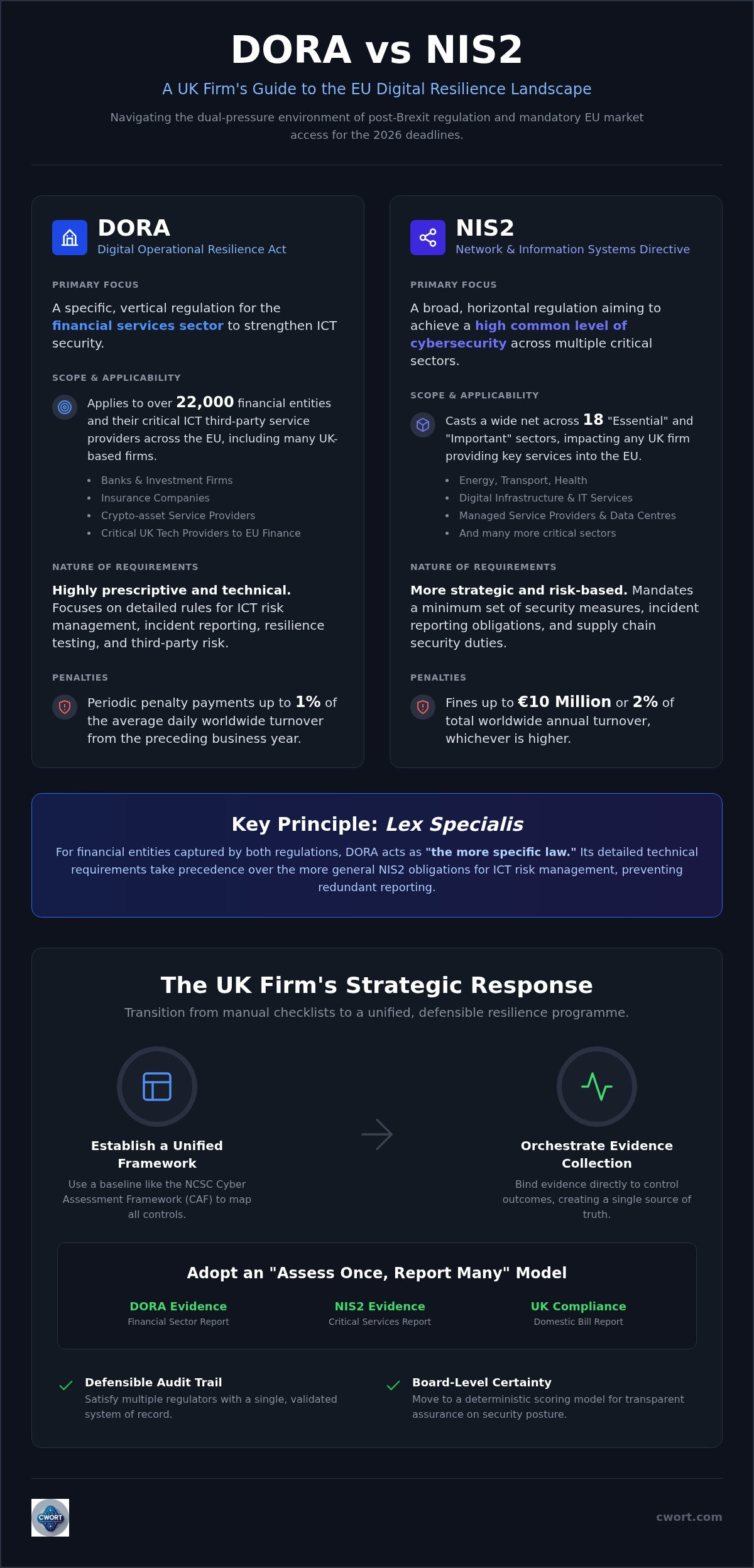
If your compliance strategy relies on manual trackers to bridge the gap between EU mandates and UK legislation, you aren't just wasting resource; you're inviting an audit failure. Many UK compliance leaders struggle with the overlapping technical requirements of the Digital Operational Resilience Act (DORA) and the NIS2 Directive whilst preparing for the UK’s own Cyber Security and Resilience Bill. The anxiety of managing extra-territorial reach post-Brexit is real, especially when you cannot prove control effectiveness across multiple jurisdictions simultaneously.
This guide clarifies DORA vs NIS2 what are the differences for UK firms and provides a framework for structural integrity. We will move beyond administrative box-ticking to establish a deterministic orchestration strategy that allows you to assess once and report many times. You'll gain a clear map of jurisdictional obligations, including where DORA acts as lex specialis for the financial sector, and a method to produce audit-defensible evidence. We will examine how to align your resilience programme with the June 2026 audit deadlines and ensure your evidence register remains beyond reproach.
Key Takeaways
- Distinguish between the broad sector applicability of NIS2 and the prescriptive, vertical requirements of DORA to define your organisation's specific compliance profile for 2026.
- Clarify DORA vs NIS2 what are the differences for UK firms to navigate the dual-pressure environment of post-Brexit regulation and mandatory EU market access.
- Leverage the "Lex Specialis" principle to ensure that DORA technical standards take precedence, preventing redundant reporting for financial entities and their ICT providers.
- Transition from manual tracking to a unified resilience strategy that binds evidence to control outcomes, satisfying multiple regulators with a single, defensible audit trail.
- Address board-level liability by moving to a deterministic scoring model that provides transparent, auditable certainty of your firm's security posture and maturity.
Table of Contents
- The 2026 Regulatory Landscape: DORA, NIS2, and the UK Firm
- Scope and Sector Applicability: Identifying Your Compliance Profile
- Technical Rigour and Reporting: Prescriptive vs Strategic Resilience
- The UK Firm’s Dilemma: Managing EU Regulations from Outside the Bloc
- Orchestrating Compliance: Moving from Checklists to Validation
The 2026 Regulatory Landscape: DORA, NIS2, and the UK Firm
UK enterprises operating within the national financial and infrastructure landscape face a dual-pressure environment that ignores borders. Whilst the UK is no longer an EU member state, the digital interconnectedness of global services makes total regulatory divergence impossible. Compliance leaders must recognise that "Post-Brexit" doesn't equate to "Post-Regulation". Instead, it signifies a more complex burden where firms must satisfy both domestic and European authorities to maintain market access. This reality forces a shift from passive tracking to proactive orchestration across the entire organisation.
UK NIS vs NIS2: A Critical Distinction
The UK currently operates under the NIS Regulations 2018, but the introduction of the Cyber Security and Resilience Bill in November 2025 marks a decisive shift towards alignment with the EU’s NIS2 Directive. This Bill expands the regulatory scope to include managed service providers and data centres, reflecting the sharp increase in nationally significant incidents reported by the NCSC, which reached 204 in the year preceding September 2025. Understanding DORA vs NIS2 what are the differences for UK firms is essential for those with cross-border dependencies, as failure to align with the stricter EU standards can result in fines of up to €10 million or 2% of global turnover. For UK firms in 2026, jurisdictional reach is determined by the location of the service recipient and the critical nature of the underlying infrastructure, regardless of the provider's physical headquarters.
DORA’s Extra-Territorial Reach
The Digital Operational Resilience Act (DORA) applies directly to over 22,000 financial entities and their ICT providers across the EU. UK financial firms are frequently captured by these rules through their EU-based subsidiaries or by providing essential services into the Union. A significant development is the "Critical Third-Party" designation, which allows EU regulators to oversee UK tech providers directly if they're deemed systemic to the European financial ecosystem. Establishing a "centre of excellence" for compliance within the UK HQ is no longer optional; it's a strategic necessity to centralise evidence and avoid duplicated effort across disparate teams.
To bridge the gap between these frameworks, firms are increasingly turning to the NCSC Cyber Assessment Framework (CAF). By using the CAF as a baseline, organisations can map controls to both UK and EU requirements, facilitating an "assess once, report many" model. This approach replaces fragmented manual tracking with a disciplined Cyber Resilience Assessment process that satisfies multiple regulators simultaneously. It ensures that the transition from obligation to evidence is both methodical and audit-defensible, providing a reproducible system of record for senior leadership.
Scope and Sector Applicability: Identifying Your Compliance Profile
Determining your regulatory profile requires a precise understanding of sectoral boundaries. NIS2 casts a broad net across 18 "Essential" and "Important" sectors, whilst DORA focuses on the financial vertical. UK firms often ask about DORA vs NIS2 what are the differences for UK firms when they fall into a "dual-capture" scenario. This occurs when a group's activities span both financial services and critical infrastructure, such as energy or telecommunications. In these cases, the lex specialis principle applies: DORA’s specific requirements take precedence for the financial entity, but NIS2 may still govern the wider group's non-financial operations. This creates a complex reporting hierarchy that demands a unified control framework to avoid duplicated effort.
The Financial Sector Vertical (DORA)
DORA extends far beyond traditional banking. It encompasses insurance, crypto-asset service providers, and crowdfunding platforms. Crucially, it brings "ICT Third-Party Service Providers" directly into the regulatory perimeter. If your UK-based tech firm provides critical services to an EU bank, you're now a regulated entity subject to direct oversight. Mapping these requirements to robust UK NIS compliance management ensures that your resilience strategy isn't just a paper exercise. It transforms abstract obligations into a defensible operational reality that satisfies both the FCA and European supervisory authorities.
The Critical Infrastructure Horizontal (NIS2)
NIS2 organises entities into two categories based on their systemic criticality. "Essential" entities include traditional utilities like energy, transport, and water. However, the directive expands to include "Important" entities such as digital providers, chemical manufacturing, and food distribution. Recent shifts in operational resilience regulations highlight that supply chain security is the new baseline. Your clients' NIS2 status effectively becomes your problem. They'll demand proof of control effectiveness as a condition of contract, forcing UK firms to adopt the same technical standards as their EU counterparts.
Don't assume SME status provides a permanent shield. Whilst the general threshold for NIS2 is 50 employees or €10 million in annual turnover, Member States can designate smaller entities as "Essential" if they're sole providers or systemically critical. DORA applies regardless of size for most financial entities to prevent weak links in the financial ecosystem. This lack of a "safe harbour" means UK firms must move toward a disciplined request a strategic demonstration of their current posture to identify gaps before the June 2026 audit deadlines. Success requires a transition from administrative tracking to a deterministic model where evidence is bound to specific control outcomes, replacing the anxiety of potential failure with auditable certainty.
Technical Rigour and Reporting: Prescriptive vs Strategic Resilience
Compliance leaders must understand that DORA acts as lex specialis, meaning its technical standards override NIS2 for the financial sector. This distinction is critical when evaluating DORA vs NIS2 what are the differences for UK firms, as it dictates which regulator holds primary authority over your technical controls. Whilst NIS2 provides a strategic framework for management body accountability, DORA is uncompromisingly prescriptive. It mandates specific ICT risk management pillars, including protection, detection, and recovery, leaving little room for interpretation. For a granular breakdown of technical connection points, ISACA's comparison of DORA and NIS2 provides the necessary depth for auditors and boards alike.
The intensity of DORA also extends to Threat-Led Penetration Testing (TLPT). Unlike the more generalised testing requirements in NIS2, DORA requires high-impact entities to undergo rigorous, intelligence-led testing every three years. This isn't a simple vulnerability scan; it's a simulated attack designed to prove resilience against sophisticated adversaries. Firms must move from basic administrative tracking to a state of auditable certainty where every test result is documented and remediated with precision.
Incident Reporting and Transparency
The timelines for incident reporting create a high-stakes environment for UK firms. NIS2 requires an "early warning" within 24 hours of becoming aware of a significant incident, followed by a formal notification within 72 hours. DORA Article 19 introduces a multi-stage process that demands initial notifications, intermediate reports, and a final analysis. Managing these varying windows requires a disciplined orchestration of data. You must ensure compliance evidence integrity during a live incident to prevent contradictory disclosures to different regulators. Speed is essential, but accuracy is what survives an audit.
Third-Party Risk Management (TPRM)
Supply chain oversight represents a significant divergence in execution. DORA mandates the maintenance of a "Register of Information", a comprehensive database of all ICT third-party dependencies, including those supporting critical or important functions. NIS2 focuses more broadly on supply chain risk assessments and the security of the relationship between the entity and its direct suppliers. UK firms must update contractual clauses to meet mandatory EU standards, specifically regarding audit rights and service levels. Proving a clear "separation of duties" amongst cloud service providers is no longer a suggestion; it's a requirement for structural integrity. Transitioning to a deterministic model ensures that your evidence register is bound to these specific contractual outcomes, replacing manual trackers with a proactive system of record.
The UK Firm’s Dilemma: Managing EU Regulations from Outside the Bloc
UK organisations often fall into the "equivalence trap", assuming that existing certifications like ISO 27001 satisfy the technical rigour of EU mandates. They don't. Whilst ISO 27001 provides a solid management system, it lacks the prescriptive, legally binding technical requirements found in DORA. Understanding DORA vs NIS2 what are the differences for UK firms requires recognising that these are not just security frameworks; they're legal obligations with direct board-level consequences. The 2026 deadlines leave little room for error. If your UK HQ is disconnected from your EU subsidiary operations, you're creating blind spots that regulators will exploit during a mandatory audit.
Managing the NCSC CAF alongside EU mandates adds another layer of complexity. Boards must now prove they have both the capability and the capacity to sustain this compliance burden. Under NIS2, management bodies face personal liability for cyber risk management failures. This isn't just a corporate fine; it's a direct accountability mechanism. To survive this scrutiny, firms must move away from siloed compliance teams that duplicate effort and instead adopt a unified resilience strategy that addresses multiple jurisdictions through a single control framework.
The Burden of Manual Compliance
Regulators increasingly reject manual trackers like Jira and Excel during DORA audits. These tools lack the traceability required to prove control effectiveness over time. They suffer from "evidence drift", where documentation no longer reflects the live environment, leading to a breakdown in auditable truth. Transitioning to regulatory compliance workflow automation is the only way to maintain a defensible posture. It replaces administrative tracking with a proactive system that binds evidence to specific outcomes, ensuring your evidence register is always audit-ready.
Board-Level Reporting Requirements
Boards require strategic maturity heat-maps, not technical jargon. You must translate 1,355 taxonomy controls into high-level reports that demonstrate progress against the NCSC CAF and EU standards simultaneously. Using deterministic scoring removes subjectivity from these reports. It ensures that identical evidence always yields the same result, providing a clear, uncompromising view of your organisation's security posture. This level of professional maturity replaces the anxiety of potential failure with the calm of auditable certainty.
To see how your organisation can bridge the gap between UK and EU standards and eliminate duplicated effort, request a strategic demonstration of our orchestration platform.
Orchestrating Compliance: Moving from Checklists to Validation
Survival in the 2026 regulatory environment requires a transition from passive checklists to active, deterministic validation. Static spreadsheets cannot keep pace with the dynamic requirements of the Digital Operational Resilience Act or the evolving UK legislative landscape. When considering DORA vs NIS2 what are the differences for UK firms, the most significant operational challenge is not just understanding the rules, but orchestrating a response that satisfies both. A "siloed" approach leads to duplicated effort and conflicting evidence registers. Instead, firms must adopt an "assess once, report many" framework that binds specific technical evidence to multiple regulatory outcomes simultaneously.
Mapping Controls with CWORT
Effective orchestration begins with a unified taxonomy. CWORT provides a library of 1,355 controls, where 98.6% of active controls carry direct framework references to ISO 27001, the NCSC CAF, DORA, and NIS2. This level of granularity allows UK firms to map a single security activity to various jurisdictional obligations without manual cross-referencing. CWORT functions as an orchestration layer that sits above existing security tools like SIEM and EDR, translating their technical outputs into validated compliance outcomes. This ensures that the technical rigour required by DORA's prescriptive pillars is met whilst maintaining the strategic alignment demanded by NIS2’s management body accountability rules.
Execution discipline is further strengthened by enforcing separation of duties by design. By moving away from policy-based promises to system-enforced accountability, organisations ensure that those responsible for operating controls are not the same individuals validating their effectiveness. This structural integrity is what separates a mature resilience programme from a mere administrative exercise.
Audit-Ready Evidence Generation
The final stage of orchestration is the production of audit-defensible evidence. Regulators now demand an immutable audit history that proves compliance over time, rather than a point-in-time snapshot. CWORT’s deterministic scoring ensures that identical evidence always yields the same result, removing the subjectivity that often plagues manual assessments. This consistency is vital for UK firms managing cross-border dependencies, as it provides a single source of truth for both domestic and EU authorities. You can generate regulator-ready outputs without the need for manual reconstruction, significantly reducing the burden on compliance and technical teams during an active audit cycle.
Future-proofing your organisation involves preparing for the next wave of legislation, including the UK’s Cyber Security and Resilience Bill, which is expected to receive Royal Assent later in 2026. By establishing a robust orchestration layer now, you ensure that new requirements can be integrated into your existing control framework with minimal disruption. To begin building your audit-defensible register, explore the NIS2 Compliance Platform for UK firms and transition from administrative tracking to definitive, evidence-based proof.
Securing Your Strategic Position in the 2026 Regulatory Landscape
The transition from administrative box-ticking to definitive, evidence-based proof is no longer optional. UK firms must move beyond the "equivalence trap" and recognise that DORA vs NIS2 what are the differences for UK firms is a question of structural integrity, not just legal interpretation. By implementing a unified resilience strategy, you can eliminate duplicated effort and ensure your organisation satisfies multiple regulators through a single source of truth. Moving forward, your focus must shift from merely tracking obligations to enforcing discipline by design.
This approach replaces the anxiety of potential failure with the calm of auditable certainty. Relying on deterministic scoring trusted by UK infrastructure leaders allows you to produce an audit-defensible evidence register as standard. You can reduce manual compliance reconstruction by up to 80% whilst maintaining total control over your regulatory posture across different jurisdictions. Take the next step toward professional maturity and operational resilience. Orchestrate your DORA and NIS2 compliance with CWORT to secure your firm's future today. You have the tools to turn regulatory pressure into a strategic advantage.
Frequently Asked Questions
Does NIS2 apply to UK firms after Brexit?
Yes, NIS2 applies to UK firms that provide essential or important services within the EU. Extra-territorial reach means UK cloud providers, data centres, or digital service entities with EU customers must comply. They must also appoint a legal representative in an EU Member State where they offer services. Compliance is mandatory for continued market access, regardless of the physical location of the organisation's UK headquarters or registered office.
What is the main difference between DORA and NIS2 for financial institutions?
DORA is a sector-specific regulation (lex specialis) that is more prescriptive than the NIS2 directive. Whilst NIS2 sets a broad baseline for critical infrastructure, DORA dictates specific ICT risk management pillars and threat-led penetration testing for the financial sector. Understanding DORA vs NIS2 what are the differences for UK firms is vital because DORA technical standards take precedence for banks and insurers. This overrides the more general NIS2 requirements, ensuring a vertical deep-dive into financial resilience.
How does the UK NIS Regulation compare to EU NIS2?
The UK is updating its domestic regulations to align with the principles of NIS2 through the Cyber Security and Resilience Bill. Introduced to the House of Commons in late 2025, this legislation expands scope to managed service providers and data centres. It introduces more stringent incident reporting requirements to better align with the EU's approach. This shift ensures the UK maintains a high level of cybersecurity and facilitates seamless cross-border business for national enterprises.
Can ISO 27001 be used to prove DORA compliance?
ISO 27001 provides a foundational management system but is insufficient on its own to prove DORA compliance. DORA requires specific, legally binding technical evidence and prescriptive resilience testing that goes beyond the ISO framework. CWORT's platform bridges this gap by mapping ISO 27001 controls to its taxonomy of 1,355 controls. This allows firms to leverage existing work whilst meeting the higher technical rigour of EU mandates, ensuring every control is audit-defensible.
What are the penalties for non-compliance with DORA and NIS2?
Penalties are severe and designed to enforce accountability at the board level. Under NIS2, essential entities can face fines of up to €10 million or 2% of total global annual turnover. DORA penalties vary by Member State but include significant periodic penalty payments to compel compliance. Additionally, NIS2 introduces personal liability for management bodies. This means senior leaders are directly responsible for their organisation's cybersecurity risk management failures, replacing administrative tracking with definitive accountability.
What is "Lex Specialis" in the context of DORA and NIS2?
Lex specialis is a legal principle where a specialised law takes precedence over a general law. In this context, DORA is the specific law for the financial sector, whilst NIS2 is the general law for critical infrastructure. If a financial entity falls under the scope of both, DORA's prescriptive technical and reporting rules apply instead of the equivalent NIS2 provisions. This prevents regulatory overlap and ensures sector-specific resilience is prioritised over broader infrastructure requirements.
How much time do UK firms have to comply with DORA?
DORA became fully applicable across the EU on 17 January 2025. UK firms providing financial services or critical ICT support within the Union must already meet these prescriptive standards. For those captured by NIS2, the first compliance audit deadline is 30 June 2026. Given the complexity of generating audit-defensible evidence, organisations must prioritise their readiness assessments immediately. Delaying this process risks significant penalties and the inability to prove control effectiveness to multiple regulators.
Is a UK firm required to appoint an EU representative under NIS2?
Yes, UK-based entities falling under the scope of NIS2 but not established in the EU must designate a legal representative. This representative must be established in one of the Member States where the services are offered. They act as a primary point of contact for national competent authorities and CSIRTs. This ensures that the firm remains accountable for its security obligations within the Union, facilitating regulatory oversight of digital providers and managed service providers.
Disclaimer
The content on this site is provided for general information and educational purposes only. It does not constitute legal, regulatory, financial, or professional advice. CWORT provides AI-assisted insights and workflow automation, but all compliance decisions remain the responsibility of your organisation and its management. Always seek qualified legal or regulatory guidance for decisions relating to the UK NIS Regulations, CAF, DORA, NIS2, ISO 27001, or other obligations.
Related posts
CISO Guide to DORA Operational Resilience: Orchestrating Validated Compliance
Master validated compliance with our CISO guide to DORA operational resilience. Swap manual evidence gathering for an orchestrated, audit-ready security post...
Challenges of DORA Compliance for Financial Institutions in 2026: A Strategic Guide
Facing the challenges of DORA compliance for financial institutions? Our 2026 guide helps you move from manual tracking to automated validation for total ass...
NIS2 Implementation Software Europe: Beyond Checklists to Orchestrated Validation
Facing a NIS2 audit? Our guide to NIS2 implementation software Europe shows how to move beyond checklists to build a defensible, unified system of proof.
Article by
Michael Iyiola
Co-Founder, CWORT
Michael Iyiola is a co-founder of CWORT and a Cyber and AI Security Engineer with deep experience in vulnerability management, detection engineering and operational resilience across UK critical national infrastructure, including rail, energy and financial services. At CWORT, he designs scalable, evidence-driven workflows that help teams meet modern regulatory and security demands.
Build Your Foundation of Auditable Certainty
Take control of your regulatory obligations and secure your infrastructure with CWORT.