Due Diligence for Cybersecurity: A Practical Guide

Michael Iyiola
Co-Founder, CWORT
Learn how to prove due diligence for cyber security. Build a defensible evidence trail linking risks, controls, and actions to satisfy leadership and audits.
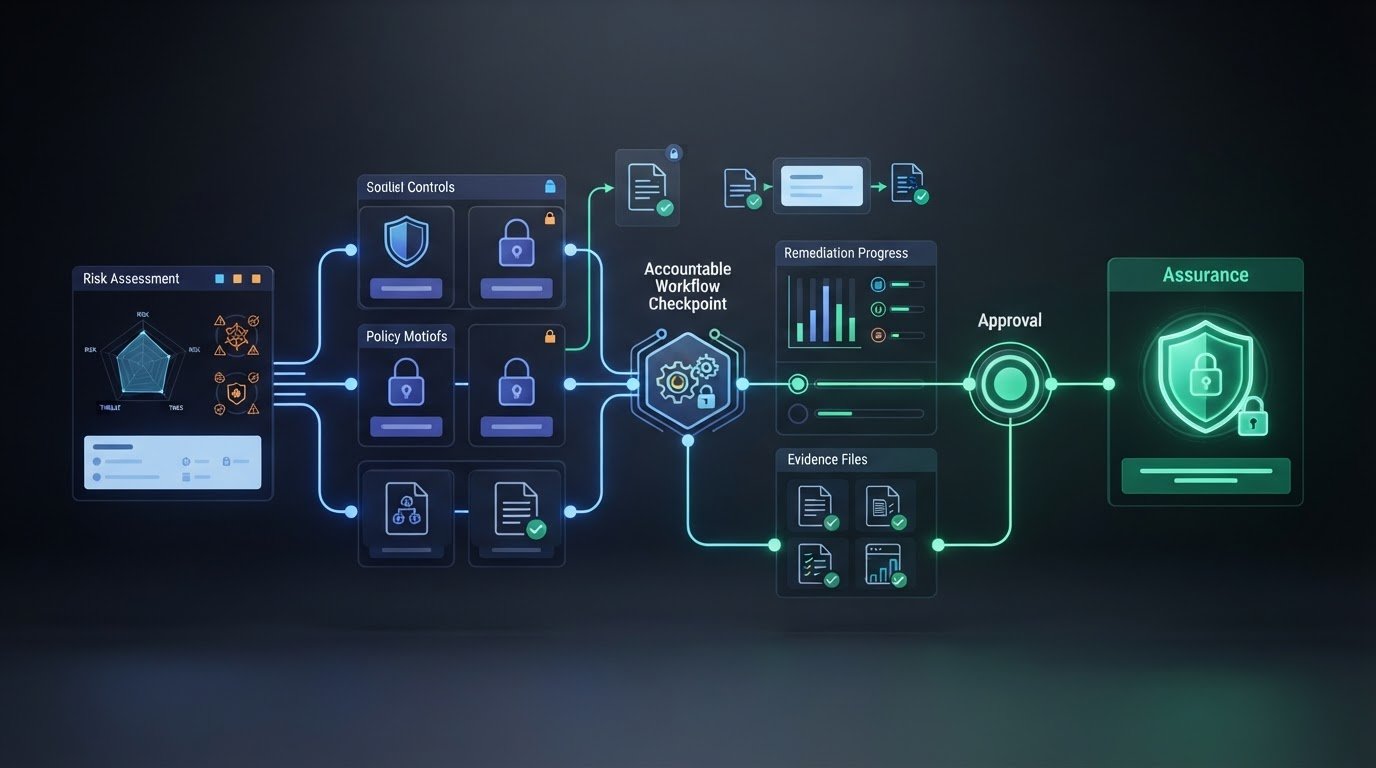
A signed policy proves intent, not execution. The question is how to prove due diligence for cyber security when evidence is scattered across tools, spreadsheets and reporting cycles, and leaders need to show that identified risks led to accountable decisions and action.
Control documents may describe safeguards, but they don’t show whether those safeguards operated or whether remediation was completed. A defensible record connects each risk to its controls, owners, evidence and decisions. This guide sets out a practical, repeatable way to build that trail and give leadership and assurance stakeholders a consistent view of cyber-security maturity.
We’ll cover how to assess and record risk, validate control operation, track remediation through to completion, and present evidence in a form that stands up to scrutiny. You’ll also see how a governed workflow can connect evidence from existing security tools to controls and assurance outcomes, so organisations can reuse validated evidence across frameworks without reconstructing the story later.
Key Takeaways
- Learn how to prove due diligence for cyber security by linking risks, controls, accountable owners, evidence and decisions in a traceable chain.
- Set clear assessment boundaries, then follow a repeatable workflow from risk assessment and control mapping through validation, remediation and reassessment.
- Judge evidence by its relevance, recency, provenance and fit with the control objective, not simply by whether a document exists.
- Keep assurance current with scheduled reviews, reassessment after material changes, and clear ownership, escalation and approval routes.
- See how a governed platform can connect evidence from existing security tools to control outcomes and support consistent assessment, remediation tracking and reporting.
Table of Contents
- What does proving cyber-security due diligence actually mean?
- How to build a cyber-security due-diligence evidence chain
- Which evidence best demonstrates cyber-security control effectiveness?
- How to keep cyber-security due diligence current and auditable
- How a governed compliance platform can make due diligence demonstrable
What does proving cyber-security due diligence actually mean?
Cyber-security due diligence means taking demonstrable, proportionate action to identify, govern and address risks to information and systems. The test is not whether an organisation can produce a policy, but whether it can show what it did, who was responsible, what evidence supports the account and how the outcome was reviewed.
The ideas of due care and due diligence provide useful context: responsible security requires both considered safeguards and evidence of sustained action. A defensible record supports assurance, but it cannot guarantee that an incident will not occur. Instead, it shows how risks were managed and decisions made, including where gaps remained and what followed.
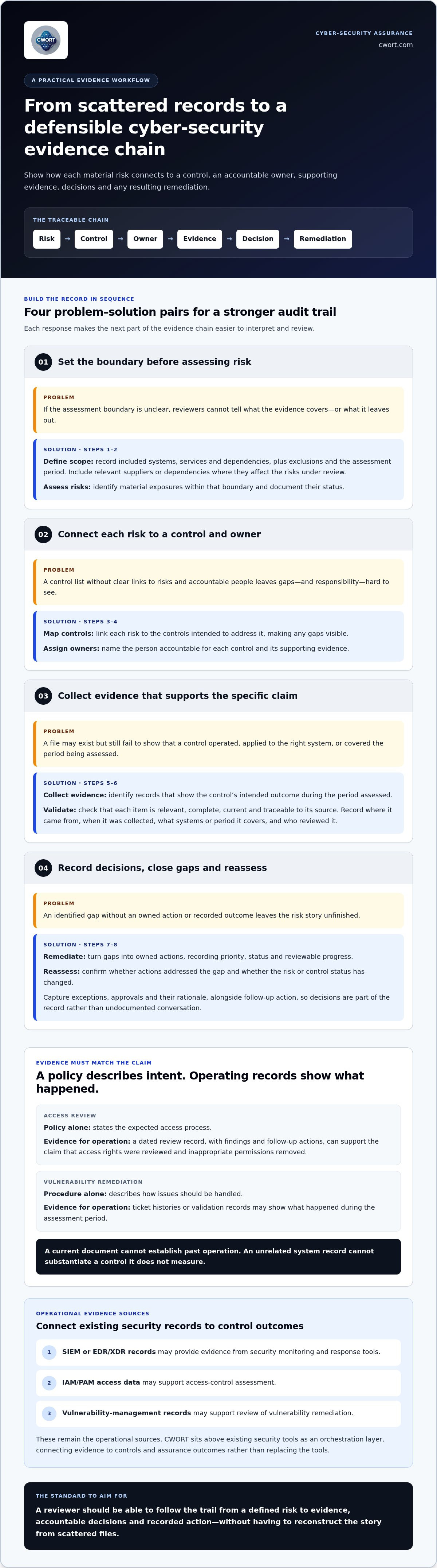
A practical answer to how to prove due diligence for cyber security begins with a clear chain of accountability:
- Risk: A potential event or weakness that could affect the organisation.
- Control: A measure intended to prevent, detect or reduce that risk.
- Evidence: A record showing whether the control was implemented or operated.
- Decision: An accountable judgement, approval or exception, with its rationale.
- Remediation: The action taken to address a gap, with progress and outcome recorded.
What should a defensible cyber-security record demonstrate?
Connect each material risk to a named owner and the relevant control. Make the supporting evidence interpretable by recording where it came from, when it was collected, which systems or period it covers, and who reviewed it. Without that context, a file may exist but its relevance to the risk remains unclear.
Capture decisions as part of the record, not as undocumented conversation. Log exceptions, approvals and the rationale behind them, alongside any follow-up action. This gives reviewers a traceable account of how the organisation assessed exposure and exercised oversight.
Why policies alone do not prove that controls worked
An approved access policy states the expected process. It does not, by itself, show that access rights were reviewed or that inappropriate permissions were removed. A dated review record, including its findings and follow-up actions, can support that specific claim.
The same distinction applies to vulnerability remediation: a procedure describes how issues should be handled, whilst ticket histories or validation records may show what happened during the assessment period. Evidence must match the control claim and timeframe. A current document cannot establish past operation, and an unrelated system record cannot substantiate a control it does not measure.
How to build a cyber-security due-diligence evidence chain
Build the record as a sequence, not a collection of files. Start by defining the assessment boundary: identify the systems, services and dependencies in scope, along with the period being assessed. Include relevant suppliers or other dependencies where they affect the risks under review. An explicit boundary helps reviewers understand what the evidence does and does not cover.
A traceable evidence chain links a defined risk to its control, accountable owner, supporting evidence, decision and any resulting remediation. Use this workflow to establish that connection:
- Define scope. Record included systems, services and dependencies, along with exclusions and the assessment period.
- Assess risks. Identify material exposures within that boundary and document their status.
- Map controls. Link each risk to the controls intended to address it, making any gaps visible.
- Assign owners. Name the person accountable for each control and its supporting evidence.
- Collect evidence. Identify records that show the control’s intended outcome during the period assessed.
- Validate. Review whether each item is relevant, complete, current and traceable to its source.
- Remediate. Turn gaps into owned actions, recording priority, status and progress.
- Reassess. Confirm whether actions addressed the gap and whether the risk or control status has changed.
The NIST due diligence guide offers a reference point for a structured assessment. Apply the same discipline to your own records: evidence should substantiate a control outcome, not simply occupy a folder. For example, a security alert report may show activity, but the assessment should establish how that activity relates to the control being evaluated and the period in scope.
Connect risks, controls, owners and evidence
Give each risk and control a clear relationship, accountable owner and status. Relevant evidence sources might include SIEM or EDR/XDR records, IAM/PAM access data, and vulnerability-management records. These remain the operational sources. CWORT sits above existing security tools as an orchestration layer, connecting evidence to controls and assurance outcomes rather than replacing the tools.
Validate evidence and record remediation
Check each item’s relevance, completeness, collection date and provenance. Confirm that it supports the specific control claim. Where it does not, record the gap as an owned action with a priority, status and reviewable progress. Preserve approvals, changes and decisions through controlled access and an audit history, so the rationale remains visible alongside the outcome.
This sequence makes how to prove due diligence for cyber security an operational process rather than a retrospective exercise. A governed workflow such as CWORT’s evidence orchestration connects assessment, remediation tracking and reporting in one repeatable process.
Which evidence best demonstrates cyber-security control effectiveness?
No single evidence type proves that every control worked. Policies show what should happen; operational records and test results help establish what happened. Approvals and remediation records explain how the organisation governed exceptions and addressed weaknesses. To assess evidence quality, check its scope, recency, provenance and alignment with the control objective. A record may be genuine but still fail to support the claim being assessed.
Use both operational telemetry and governance evidence. Logs can show system activity, whilst reviews and approvals provide context about oversight, decisions and accountability. Together, they support a stronger conclusion than either category alone.
What evidence can show that a cyber control operated?
For access governance, access logs can show activity, while a dated review record can show that permissions were examined and follow-up decisions documented. For vulnerability remediation, records can show that an issue was assigned and addressed; closure validation helps establish whether the weakness was actually resolved. Incident exercises, monitoring records and approvals are useful when they relate directly to the control and assessment scope.
How to handle incomplete, stale or conflicting evidence
Flag missing dates, unclear ownership, inconsistent scope and conclusions unsupported by the underlying record. Don’t present a gap as a verified control. Document the limitation and any compensating action, then assign follow-up where needed. If sources conflict, reconcile their scope and timing, record which evidence informed the final assessment, and preserve the rationale. This discipline makes how to prove due diligence for cyber security a question of defensible judgement, not document volume.
How to keep cyber-security due diligence current and auditable
Evidence has a useful life. A control assessment reflects a defined point in time, so its conclusions can become unreliable as systems, suppliers, services or operating models change. Set a scheduled review cadence that reflects the organisation's risk and control cycle, then trigger reassessment when a material change could affect the evidence or the control's effectiveness.
Make the assurance process itself accountable. Name control owners, evidence reviewers and approval authorities. Define how often evidence is reviewed, where exceptions are escalated, and who accepts or rejects resulting actions. Clear responsibilities help prevent overdue reviews and unresolved gaps from disappearing between reporting cycles.
How to maintain an assurance record through organisational change
Reassess affected controls after changes to systems, suppliers, services or operating arrangements. Keep version history, timestamps, reviewer details and decision records with each assessment, so it is clear which evidence supported each conclusion. Reassessment should verify whether previous remediation worked and identify new gaps introduced by the change, not simply carry forward an earlier status.
Use a consistent method to record each item's source, scope, date and review outcome. The compliance evidence integrity guide provides further detail on maintaining evidence quality and traceability.
How to make evidence useful to boards, auditors and regulators
Give assurance stakeholders a concise view of control status, evidence confidence, exceptions and open actions, with traceable references to underlying records. Separate verified results from management statements, unresolved gaps and proposed actions. This distinction lets readers see what has been demonstrated, what remains uncertain and who is accountable for the next step.
Where the assessment uses the NCSC Cyber Assessment Framework, link the reported outcome to the relevant assessment context and supporting evidence. The NCSC CAF assessment guide can help readers understand that context.
A consistent record turns how to prove due diligence for cyber security into an ongoing assurance discipline, rather than a rush to reconstruct decisions before a review. CWORT supports governed assessment, remediation tracking and reporting, with evidence connected to control outcomes. Explore how CWORT supports auditable cyber-security assurance.
How a governed compliance platform can make due diligence demonstrable
Structured software adds value when spreadsheets and separate trackers make it difficult to maintain clear ownership, consistent review, traceable evidence and reliable reporting. A spreadsheet can work for a small, stable assessment. As frameworks, teams and evidence sources multiply, fragmented records can make it harder to establish which control an item supports, who reviewed it and what decision followed.
Assess any approach against the assurance workflow you need to govern. Look for clear links between risks, controls, owners and evidence; defined access and role separation; a reviewable audit history; repeatable assessment outcomes; and cross-framework mapping that supports reuse of validated evidence. The approach should fit your organisation’s governance needs, not introduce a process that exists only to serve the software.
How CWORT supports an evidence-backed assurance workflow
CWORT translates obligations into governed activities, connects evidence to control outcomes and supports reporting across the assurance lifecycle: diagnose, design, deliver and demonstrate. It aggregates evidence from existing security tools as an orchestration layer, rather than replacing SIEM, EDR/XDR, vulnerability-management or other operational tools.
Its June 2026 taxonomy snapshot contains 1,355 controls across 217 domains and 42 frameworks or standards. As of June 2026, 98.6% of active controls carry framework references. These are dated platform figures, not a claim that the taxonomy will remain unchanged. Cross-framework mapping helps teams connect relevant control evidence to multiple assurance requirements, while preserving the relationship between evidence and the outcome it supports.
Deterministic scoring is designed to produce reproducible results from identical evidence, supporting consistent assessment and review. AI advisory can offer suggestions, but it doesn’t alter deterministic results. Governance capabilities include role-based and attribute-based access, separation of duties and immutable audit history, supporting control over who can access or change assurance records.
For organisations assessing how to prove due diligence for cyber security, a platform should reinforce the evidence chain, not obscure it. Test the approach against one real sub-function through a controlled pilot. Define the scope, accountable owners, evidence requirements and success criteria first; then evaluate whether the workflow produces traceable outcomes and usable reporting. Explore CWORT compliance validation as part of that assessment.
Make your cyber-security assurance evidence-led
Policies set expectations, but defensible due diligence depends on showing how risks were assessed, controls operated and decisions were followed through. The practical answer to how to prove due diligence for cyber security is to maintain a traceable record linking risks, controls, accountable owners, relevant evidence and completed or outstanding actions.
Keep that record current. Review evidence on a planned cadence, reassess after material changes, and distinguish verified results from unresolved gaps or management statements. This gives leadership and assurance stakeholders a consistent view of control status and remediation progress, without having to reconstruct the story later.
CWORT binds evidence to control outcomes within a governed assurance workflow. Its deterministic scoring is designed to produce reproducible results from identical evidence, supporting consistent, audit-defensible reporting. Start by considering how that approach could support one part of your assurance process.
Request a CWORT demonstration to explore how a governed evidence workflow could work for your organisation. Build the trail step by step and make assurance easier to explain and evidence.
Frequently Asked Questions
How do you prove cyber-security due diligence?
Build a traceable record showing how risks were assessed, which controls address them, who owns those controls and what evidence supports their operation. Include the evidence source, scope and date, plus review outcomes, decisions, exceptions and remediation progress. The practical answer to how to prove due diligence for cyber security is a current, reviewable chain from risk identification through action and reassessment, rather than a folder of policies alone.
What evidence demonstrates that cyber-security controls are effective?
Evidence depends on the control being assessed. System records can show activity, test results can show performance against defined criteria, and review records can demonstrate oversight. For example, access logs may show account activity, while a dated access review records whether permissions were examined and follow-up was agreed. Check that evidence is relevant to the control, covers the assessment period and has clear provenance and ownership.
Can policies prove cyber-security due diligence?
Policies help demonstrate documented intent and define expected responsibilities, but they don’t establish that a control was implemented or operated. Pair the policy with operational records that support the specific claim. For an access-control procedure, this might include a review record, its findings and any resulting actions. Keep the policy’s approval and version history too, so reviewers can see which requirements applied during the period assessed.
How often should cyber-security due diligence be reviewed?
Set a scheduled review cadence that reflects the organisation’s risks, controls and assurance needs, rather than assuming one interval suits every control. Reassess sooner when a material change could affect the evidence or control, such as a system, supplier, service or operating-model change. Record the review date, responsible owner and outcome. This helps identify stale evidence and confirms whether previous remediation remains effective.
What happens if an organisation cannot provide evidence for a control?
Record the control as unverified or evidence-deficient rather than presenting it as effective. Document what is missing, assess the resulting risk, assign an accountable owner and track an appropriate action with status and reviewable progress. If a compensating measure is used, record its rationale and supporting evidence. This transparent treatment preserves the integrity of the assessment and gives leadership a clear view of unresolved assurance gaps.
Can one set of cyber-security evidence support multiple frameworks?
Yes, where the evidence genuinely supports the control outcomes required by each framework. Map the evidence to each relevant control, then check differences in scope, wording, assessment period and expected outcome. Don’t assume a match simply because requirements sound similar. A validated crosswalk can reduce duplicated evidence collection whilst keeping each framework’s assessment rationale and any additional evidence needs visible.
How can leadership see whether cyber-security due diligence is working?
Give leaders a concise, regular view of control status, evidence confidence, exceptions and open remediation actions, with accountable owners and links to supporting records. Distinguish verified results from management statements, unresolved gaps and proposed actions. A governed workflow can support consistent reporting; CWORT’s deterministic scoring is designed to produce reproducible results from identical evidence, helping leadership review outcomes without losing traceability to the evidence behind them.
Disclaimer
The content on this site is provided for general information and educational purposes only. It does not constitute legal, regulatory, financial, or professional advice. CWORT provides AI-assisted insights and workflow automation, but all compliance decisions remain the responsibility of your organisation and its management. Always seek qualified legal or regulatory guidance for decisions relating to the UK NIS Regulations, CAF, DORA, NIS2, ISO 27001, or other obligations.
Related posts
Four ways to understand and reduce human error in compliance
Discover four ways of reducing the risk of human error in compliance, investigating near misses and improving controls, procedures and cyber risk management.
How to Demonstrate Control Effectiveness to Regulators: A Strategic Guide
Learn how to demonstrate control effectiveness to regulators with our guide. Shift from chaos to an evidence-based, audit-ready compliance programme today.
Proof of Control Effectiveness: A Strategic Guide for UK Enterprise Compliance in 2026
Struggling with DORA & NIS2? Learn how to generate definitive proof of control effectiveness and move beyond risky spreadsheets for UK enterprise compliance ...
Article by
Michael Iyiola
Co-Founder, CWORT
Michael Iyiola is a co-founder of CWORT and a Cyber and AI Security Engineer with deep experience in vulnerability management, detection engineering and operational resilience across UK critical national infrastructure, including rail, energy and financial services. At CWORT, he designs scalable, evidence-driven workflows that help teams meet modern regulatory and security demands.
Build Your Foundation of Auditable Certainty
Take control of your regulatory obligations and secure your infrastructure with CWORT.