Enforcing Segregation of Duties in IT Compliance: 2026

Michael Iyiola
Co-Founder, CWORT
Master how to enforce separation of duties in IT compliance. Move from manual tracking to automated enforcement for auditable certainty with DORA, NIS2 & ISO...

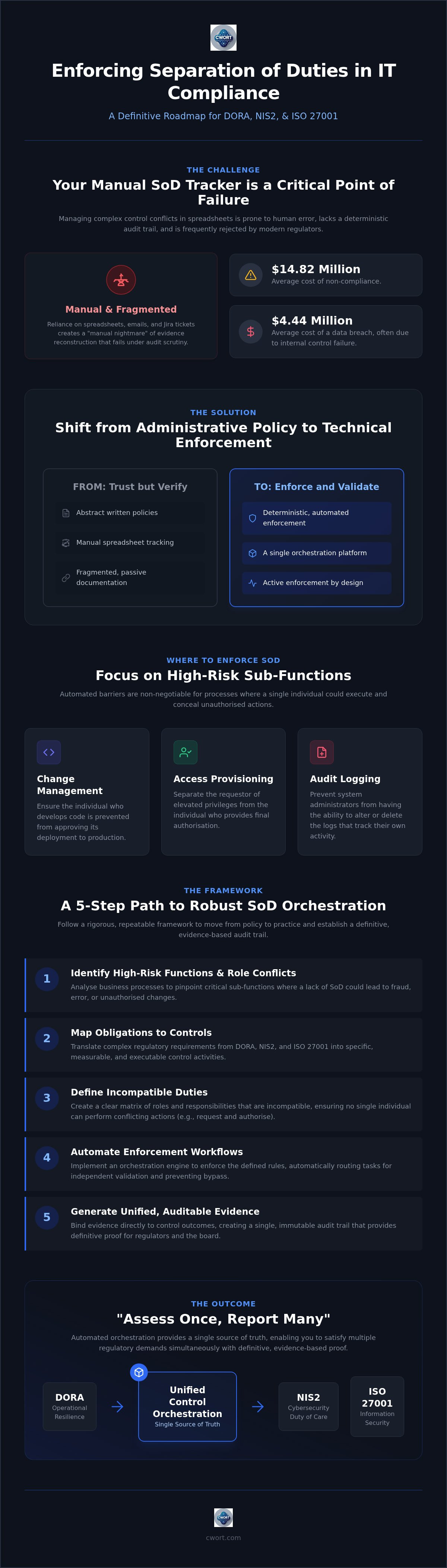
Your manual Segregation of Duties (SoD) tracker is likely the single greatest point of failure in your 2026 audit strategy. You already know that managing complex control conflicts in Excel is prone to human error and frequently rejected by regulators who demand more than just a Jira ticket as proof. Proving that the individual performing a control is not the same person validating it remains a fragmented, manual nightmare for most IT leadership teams. This guide provides a definitive roadmap on how to enforce separation of duties in IT compliance by moving from abstract policies to deterministic, automated enforcement.
You'll learn to satisfy the rigorous demands of DORA, NIS2, and ISO 27001 by binding evidence directly to control outcomes. We will move beyond the anxiety of potential failure to a state of auditable certainty, ensuring your reporting is board-level and regulator-ready without the need for manual evidence reconstruction. This article details the transition from fragmented administrative tracking to a single orchestrated system that provides definitive, evidence-based proof for every control execution.
Key Takeaways
- Replace manual, error-prone spreadsheets with a deterministic orchestration model that binds evidence directly to control outcomes for total audit certainty.
- Master how to enforce separation of duties in IT compliance by mapping complex regulatory obligations to specific, structured execution activities.
- Follow a rigorous 5-step framework to identify role conflicts and sensitive sub-functions, establishing a reproducible audit trail for UK regulators.
- Move from passive administrative tracking to active enforcement by design, ensuring that no individual can ever validate their own control performance.
- Utilise "assess once, report many" capabilities to satisfy DORA, NIS2, and ISO 27001 requirements simultaneously whilst providing definitive proof to the board.
Table of Contents
- Understanding the Critical Role of Separation of Duties (SoD) in Modern IT Compliance
- The Architecture of SoD Enforcement: Beyond Basic Access Controls
- Mapping SoD Requirements to DORA, NIS2, and ISO 27001
- A 5-Step Framework for Implementing Robust SoD Orchestration
- CWORT: Automating SoD Enforcement and Compliance Validation
Understanding the Critical Role of Separation of Duties (SoD) in Modern IT Compliance
The principle of separation of duties is no longer a mere administrative checkbox; it's a foundational requirement for enterprise cyber resilience. In the 2026 regulatory environment, the distinction between "segregation" and "separation" has become critical. Whilst segregation often refers to the broad organisational division of labour, separation in a modern IT context focuses on the granular, technical enforcement of workflow boundaries. Understanding how to enforce separation of duties in IT compliance requires moving beyond role descriptions and into the automated orchestration of technical sub-functions.
For UK enterprises, the grace period for DORA and NIS2 has concluded. DORA mandates strict operational resilience for financial entities, whilst NIS2 enforces a duty of care across 18 critical sectors. These frameworks view SoD as a primary defence against the "single point of failure" risk. Without it, a single compromised identity or a rogue administrator can bypass security controls, leading to catastrophic breaches. Statistics from 2025 show the average global cost of a data breach reached $4.44 million, a figure often exacerbated by internal control failures.
The Shift from Administrative Policy to Technical Enforcement
Written policies are historically fragile and easily ignored. In 2026, auditors reject manual spreadsheets because they lack a deterministic audit trail. You must transition from a "trust but verify" model to one of "enforce and validate." High-risk sub-functions require automated barriers where SoD is non-negotiable:
- Change Management: Ensuring the individual who develops code cannot approve its deployment to production.
- Access Provisioning: Separating the requestor of elevated privileges from the final authoriser.
- Audit Logging: Preventing system administrators from altering the logs that track their own activity.
Identifying these high-risk areas is the first step in learning how to enforce separation of duties in IT compliance through technical orchestration rather than passive documentation.
Consequences of SoD Failures in Regulated Industries
The price of control failure is exceptionally high. Beyond the average non-compliance cost of $14.82 million, organisations face severe reputational erosion and intensified regulatory scrutiny. SoD gaps create blind spots where unauthorised changes go undetected, directly undermining service continuity. When one individual controls the entire lifecycle of a sensitive process, they become a high-value target for external threat actors. Robust enforcement is the only way to guarantee that critical IT operations remain resilient against both external malice and internal human error.
The Architecture of SoD Enforcement: Beyond Basic Access Controls
Identity and Access Management (IAM) is a foundation, not a finish line. In 2026, relying solely on identity tools to manage SoD is a strategic error. These systems manage access rights, but they cannot govern the specific sequence of a control's execution or the validity of the evidence produced. To understand how to enforce separation of duties in IT compliance, you must look at the orchestration layer above your technical stack. Whilst Role-Based Access Control (RBAC) and Attribute-Based Access Control (ABAC) provide necessary guardrails, they don't provide the "who, what, and when" required by modern auditors. The NIST security controls framework (specifically control AC-5) serves as a global benchmark for this architecture, emphasizing that technical enforcement must prevent any single individual from possessing the capability to execute and conceal an unauthorised action.
IAM vs. Compliance Orchestration
There is a dangerous gap between "who can do it" and "who actually did it and who validated the result." IAM tools focus on the former, yet DORA and NIS2 auditors focus on the latter. Technical point-tools often fail to provide a holistic view of SoD compliance, creating silos where evidence is trapped and difficult to verify. This is where regulatory compliance workflow automation becomes essential. It bridges the divide by ensuring that the process itself enforces the boundary. It captures every interaction in an immutable audit trail, providing a level of defensible truth that manual trackers simply cannot match.
The Concept of Deterministic Validation
Audit readiness in 2026 relies on deterministic validation. This ensures that identical evidence always yields the same audit result, removing human subjectivity and the potential for bias. Implementing "blind validation" is a key tactic within this architecture. By obscuring the performer's identity from the validator, the system ensures that the control is assessed solely on its technical merits. This approach protects the integrity of the evidence and ensures that defensive content processing is applied at every stage of the enforcement workflow. If you are still relying on fragmented tools to manage these boundaries, you should book a platform walkthrough to see how orchestration simplifies the process.
By moving toward "Validated Execution," the system itself becomes the enforcer. This architecture eliminates the risk of self-validation by design. It ensures that the person performing a control is structurally prevented from being the one who approves it, satisfying both internal risk policies and external regulatory mandates with absolute certainty.
Mapping SoD Requirements to DORA, NIS2, and ISO 27001
By mid-2026, the regulatory landscape for UK enterprises has shifted from voluntary best practice to mandated technical rigor. Organisations must now demonstrate exactly how to enforce separation of duties in IT compliance across a overlapping web of requirements. ISO 27001:2022 Control 5.3 remains the foundational benchmark, requiring that conflicting duties and areas of responsibility be segregated to reduce opportunities for unauthorised or unintentional modification or misuse of organisational assets. However, modern audits demand more than just a list of roles; they require proof of deterministic orchestration. Following ISACA's guide to implementing SoD provides a solid methodology, yet the complexity of 2026 mandates requires a more integrated approach.
DORA and the ICT Risk Management Framework
The Digital Operational Resilience Act (DORA) places explicit accountability on management for ICT risk. Article 6 mandates that financial entities establish and maintain resilient ICT systems where functions are separated to minimise the risk of error or fraud. During DORA compliance validation audits, you'll be asked to prove that incident response and business continuity plans don't rely on a single individual. This ensures that the person identifying a system failure isn't the only one authorised to trigger recovery protocols, preventing "single point of failure" scenarios that could destabilise the broader financial market.
NIS2 and Critical National Infrastructure
For those in scope of the NIS2 Directive, which was transposed into law in August 2026, SoD is a vital component of "appropriate and proportionate" security. It is particularly critical for supply chain security, where you must ensure third-party access doesn't bypass internal control boundaries. When using NCSC CAF assessment software, you'll find that SoD is a key metric for maturity in OT and ICS environments. In these sectors, separating operational control from security monitoring is essential to prevent a single compromised account from shutting down national utilities or energy grids.
Strategic leadership teams now employ an "Assess Once, Report Many" strategy. By mapping a single, robust SoD control to multiple frameworks simultaneously, you eliminate redundant work. This is made possible by a central taxonomy of controls that carries framework references for DORA, NIS2, and ISO 27001. It transforms compliance from a series of fragmented tasks into a disciplined, reproducible workflow. Understanding how to enforce separation of duties in IT compliance through this unified lens is the only way to maintain resilience whilst managing the escalating volume of 2026 regulatory obligations.
A 5-Step Framework for Implementing Robust SoD Orchestration
Moving from abstract policy to defensible reality requires a systematic approach that manual spreadsheets simply can't provide. In the 2026 regulatory environment, understanding how to enforce separation of duties in IT compliance is no longer about checking boxes; it's about engineering workflows that prevent conflict by design. This framework shifts the focus from administrative tracking to deterministic execution, ensuring every sensitive action is validated by an independent party before completion.
Step 1 & 2: Defining the SoD Matrix
Start by identifying conflicting roles and sensitive sub-functions using an ISO 27001 control mapping tool. You must build a SoD Conflict Matrix that reflects your unique operating model, translating abstract duties into measurable activities within a digital workflow. For example, specify that the individual modifying firewall rules cannot be the same person reviewing the associated logs, creating a clear boundary within your technical operations.
Step 3 involves configuring your orchestration engine to enforce mandatory hand-offs between these defined roles. The system acts as a digital gatekeeper, ensuring that the person who initiates a sensitive action is structurally barred from validating it. This creates a forced workflow that guarantees compliance regardless of human intent. It moves your organisation away from reactive models toward proactive architectures where self-validation is technically impossible. By hard-coding these hand-offs into your operational processes, you eliminate the risk of accidental bypass or malicious internal activity.
Step 4 & 5: Evidence Binding and Reporting
Ensuring compliance evidence integrity is the final, critical stage of SoD enforcement. You must bind immutable evidence to every control outcome by automating the roll-up of data from your SIEM and IAM tools. This provides a clear, defensible answer to how to enforce separation of duties in IT compliance when under audit scrutiny. Finally, generate board-level maturity reports to provide definitive proof of your resilience posture without the need for manual reconstruction of audit trails.
To see this framework in action and eliminate the burden of manual evidence collection, request a platform demonstration. Transition your compliance function from a state of anxiety to one of auditable certainty today.
CWORT: Automating SoD Enforcement and Compliance Validation
CWORT eliminates the structural vulnerabilities inherent in manual spreadsheets and fragmented Jira workflows. It serves as the single orchestrated system that sits above your existing security stack to define, enforce, and validate boundaries. By utilising a taxonomy library of 1,355 controls mapped across 42 frameworks, including DORA and NIS2, CWORT provides a definitive answer on how to enforce separation of duties in IT compliance. The platform enforces SoD by design, ensuring that the system itself prevents any individual from validating their own control performance. This transition from administrative tracking to technical enforcement removes the possibility of internal collusion and human error, transforming compliance from a reactive burden into a pillar of strategic resilience.
With 98.6% of active controls carrying framework references, CWORT allows UK enterprises to "assess once and report many." This capability is vital in 2026, where the volume of regulatory obligations can easily overwhelm traditional compliance teams. By binding evidence directly to control outcomes, the platform ensures that your audit trail is both deterministic and reproducible. You no longer need to rely on the hope that processes were followed; you have the technical proof that they were enforced at every stage of the workflow.
Deterministic Proof for Senior Leadership
Senior leadership requires more than just a confirmation that policies exist; they demand definitive proof of their effectiveness. CWORT provides the Board with an explainable, real-time view of control maturity that is grounded in deterministic validation. This methodology ensures that identical evidence always yields the same audit result, providing absolute consistency across your global reporting. Whilst the platform includes an advanced AI advisory to assist in the configuration of complex workflows, it never alters the underlying deterministic audit results. This rigour significantly reduces the overall cost of compliance by eliminating manual hand-offs and the time-consuming reconstruction of evidence during an audit cycle. It replaces the anxiety of potential failure with the calm of auditable certainty.
Next Steps: From Gap Analysis to Audit Readiness
Transitioning to an automated model begins with a clear understanding of your current posture. You can conduct a comprehensive compliance gap analysis using the CWORT platform to identify exactly where your existing SoD controls fall short of 2026 requirements. We recommend piloting SoD orchestration on a critical sub-function, such as production change management or sensitive access provisioning, to demonstrate the efficiency of an end-to-end automated workflow. This phased approach allows you to build internal confidence whilst moving toward total audit readiness. By binding evidence to control outcomes in real-time, you ensure that your organisation is always prepared for regulatory scrutiny and board-level reporting.
Take the first step toward strategic resilience and Enforce Separation of Duties with CWORT today.
Achieving Auditable Certainty in 2026
The transition from manual SoD policies to automated, deterministic enforcement is no longer a strategic choice; it's a regulatory mandate. You've seen how fragmented trackers fail under the scrutiny of DORA and NIS2, and why technical orchestration is the only way to provide definitive proof to the board. Mastering how to enforce separation of duties in IT compliance requires a shift from passive administration to active, structural validation that prevents self-validation by design.
CWORT provides the deterministic, audit-defensible governance system needed to satisfy the most rigorous UK regulators, including Ofgem and the NCSC. With a 100% immutable audit history for every change, you can replace the anxiety of manual evidence reconstruction with the calm of total control. This is the path to professional maturity in a high-stakes environment where accountability is non-negotiable. You have the framework and the tools to eliminate operational blind spots and secure your resilience posture for the long term.
Secure your auditable proof of SoD with CWORT and lead your organisation into a new era of defensible truth.
Frequently Asked Questions
What is the primary objective of separation of duties in IT compliance?
The primary objective is to mitigate risk by ensuring no single individual has enough authority to execute and conceal an unauthorised action or error. It serves as a structural barrier against internal fraud and accidental system failures. By distributing sensitive tasks across different roles, organisations protect their operational integrity. This creates a resilient environment where every critical action requires independent validation, satisfying the core duty of care requirements found in frameworks like NIS2.
How does DORA specifically require separation of duties for financial firms?
DORA mandates the separation of ICT management and control functions under Article 6 to minimise risk and prevent conflicts of interest. Financial entities must ensure that the individuals responsible for operating ICT systems aren't the same ones tasked with monitoring or auditing them. This requirement extends to incident response and business continuity planning. Proving this separation requires a deterministic audit trail that shows independent validation occurred for every high-risk ICT change or access request.
Can small organisations enforce SoD without doubling their headcount?
Small organisations can successfully manage these requirements by utilising technical orchestration rather than increasing staff numbers. The secret to how to enforce separation of duties in IT compliance without doubling headcount lies in automating the workflow hand-offs. A centralised system can structurally prevent an individual from approving their own work, effectively enforcing the boundary. This allows lean teams to maintain high governance standards whilst focusing their limited resources on core technical delivery.
What is the difference between SoD and "Dual Control" in IT operations?
Separation of duties focuses on dividing a process into distinct stages performed by different people, whilst dual control requires two individuals to act simultaneously to complete a single task. For example, SoD ensures a developer cannot approve their own code deployment. Dual control might require two administrators to enter credentials to access a root vault. Both are essential components of a robust risk management strategy but serve different operational purposes within the control framework.
How do auditors verify that separation of duties is actually being enforced?
Auditors verify enforcement by examining immutable audit trails and the binding of evidence to specific control outcomes. They look for definitive proof that a mandatory hand-off occurred between the performer and the validator for every sensitive transaction. In 2026, simple policy documents are insufficient. Regulators like Ofgem and NCSC demand reproducible results where identical evidence always yields the same audit score, demonstrating that the control environment is both disciplined and transparent.
Why are spreadsheets considered inadequate for proving SoD compliance in 2026?
Spreadsheets are inadequate because they lack an immutable audit history and are susceptible to manual manipulation or human error. They provide a static, reactive view of compliance rather than proactive enforcement. In high-stakes environments, regulators reject manual trackers because they cannot prove that a process was actually followed at the time of execution. Without a deterministic link between the activity and the evidence, a spreadsheet remains an unverified claim rather than defensible proof.
How does compliance orchestration differ from traditional GRC software?
Compliance orchestration sits above your existing security tools to actively enforce and validate workflows, whereas traditional GRC software often serves as a passive repository for documentation. Orchestration aggregates live evidence from SIEM, IAM, and vulnerability tools to provide a real-time view of maturity. It moves beyond administrative tracking to ensure that every control is measurable and reproducible. This creates a single, explainable operating model that satisfies multiple frameworks through a unified assessment process.
What role does AI play in separation of duties and compliance validation?
AI serves an advisory role by providing suggestions and identifying potential gaps in your control matrix without altering deterministic results. It assists leadership in configuring complex workflows and mapping obligations to activities. However, for a system to be audit-defensible, the final scoring must remain reproducible and independent of AI bias. This ensures that the evidence always speaks for itself, maintaining the integrity of the audit trail whilst benefiting from intelligent guidance.
Disclaimer
The content on this site is provided for general information and educational purposes only. It does not constitute legal, regulatory, financial, or professional advice. CWORT provides AI-assisted insights and workflow automation, but all compliance decisions remain the responsibility of your organisation and its management. Always seek qualified legal or regulatory guidance for decisions relating to the UK NIS Regulations, CAF, DORA, NIS2, ISO 27001, or other obligations.
Related posts
Separation of Duties Compliance Software: Orchestrating Defensible Governance in 2026
Move beyond manual tracking. See how separation of duties compliance software orchestrates defensible governance and ensures you're ready for DORA & NIS2.
The Evolution of the Enterprise GRC Validation Tool: From Tracking to Orchestration in 2026
Stop chasing compliance ghosts in spreadsheets. Create a single source of truth for compliance with GRC orchestration to master NIS2, DORA, and UK audit dema...
Streamlining Regulatory Compliance Processes: From Manual Tracking to Orchestrated Validation
Stop wasting money on manual compliance. Learn about streamlining regulatory compliance processes to reduce personal liability under DORA & NIS2 and gain aud...
Article by
Michael Iyiola
Co-Founder, CWORT
Michael Iyiola is a co-founder of CWORT and a Cyber and AI Security Engineer with deep experience in vulnerability management, detection engineering and operational resilience across UK critical national infrastructure, including rail, energy and financial services. At CWORT, he designs scalable, evidence-driven workflows that help teams meet modern regulatory and security demands.
Build Your Foundation of Auditable Certainty
Take control of your regulatory obligations and secure your infrastructure with CWORT.