Establishing a Single Source of Truth for Compliance Evidence in 2026

Michael Iyiola
Co-Founder, CWORT
Is your evidence a liability? Establish a single source of truth for compliance evidence to meet DORA, NIS2 & ISO 27001 demands and automate board reports.

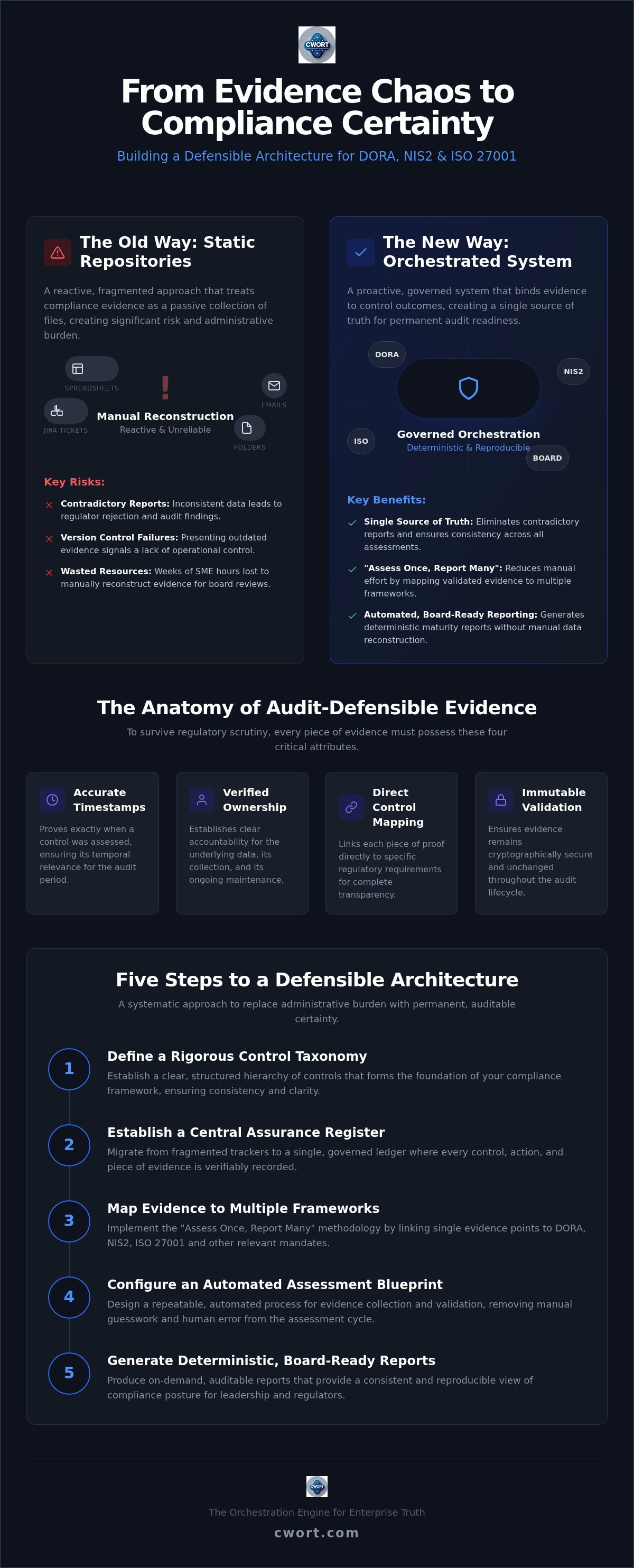
An evidence repository is not a strategy; it is a liability if it cannot produce a deterministic result under pressure. Most organisations still treat their single source of truth for compliance evidence as a passive collection of Jira tickets, emails, and SharePoint folders. You've likely felt the strain of this fragmentation during the weeks-long manual reconstruction of evidence for board reports or the discovery of version control failures during a regulatory assessment. It's a reactive cycle that consumes high-value resources whilst leaving the organisation vulnerable to avoidable audit findings.
It is time to replace this administrative burden with a rigorous, audit-defensible architecture designed for the 2026 regulatory landscape. You'll learn how to establish a reproducible evidence chain that satisfies the uncompromising requirements of DORA, NIS2, and ISO 27001:2022. We'll examine the shift from mere tracking to governed orchestration, where evidence is bound directly to control outcomes. This systematic approach eliminates manual guesswork and provides the automated, board-level reporting necessary to maintain a state of permanent, auditable certainty.
Key Takeaways
- Transition from passive data storage to active orchestration to ensure every piece of evidence is bound to a specific, validated control outcome.
- Eliminate contradictory reporting risks by establishing a single source of truth for compliance evidence that remains consistent across DORA, NIS2, and ISO 27001 assessments.
- Adopt the "Assess Once, Report Many" methodology to significantly reduce manual effort by mapping validated evidence to multiple regulatory frameworks simultaneously.
- Implement a five-step defensible architecture that moves from defining a rigorous control taxonomy to configuring an automated, repeatable assessment blueprint.
- Generate board-ready maturity reports through a deterministic system that preserves audit reproducibility without the need for weeks of manual data reconstruction.
Table of Contents
- Defining the Single Source of Truth for Compliance Evidence
- The Risks of Fragmented Evidence in High-Stakes Audits
- Comparing Static Repositories with Orchestrated Validation
- Five Steps to Implementing a Defensible Evidence Architecture
- CWORT: The Orchestration Engine for Enterprise Truth
Defining the Single Source of Truth for Compliance Evidence
In the context of 2026 regulatory scrutiny, a single source of truth for compliance evidence is no longer a passive repository. It's a governed, central environment designed to produce definitive proof of control effectiveness. Organisations often confuse raw data with compliance evidence, whilst failing to acknowledge the necessity of contextual binding. Raw data is the output of a SIEM or IAM tool; it's a collection of logs without context. Compliance evidence, however, is that data bound to a specific control outcome, validated against a requirement, and preserved within an immutable framework that survives auditor scrutiny.
To be audit-defensible, this source must be deterministic. This means that if an auditor looks at the same set of data points today or six months from now, the result remains identical and reproducible. An assurance evidence register serves as the foundation for this, replacing the fragmented tracking tools that once lived in disparate spreadsheets and email threads. It provides a structured ledger where every action is recorded, every control is mapped, and every piece of proof is verifiable. This creates a state of permanent readiness, shifting the focus from manual reconstruction to continuous validation.
Why 2026 Regulations Demand More Than Storage
Legislation like DORA and NIS2 has fundamentally shifted the compliance burden. It's no longer sufficient to point to a policy document and claim adherence. Regulators now demand proof of execution. This shift requires evidence to be fully explainable to senior leadership and external auditors alike. The era of "screenshots in a folder" is over; such manual methods lack the integrity, metadata, and lifecycle tracking required for modern cyber resilience. A valid source of truth must demonstrate not just that a control exists, but that it functioned correctly at a specific point in time, supported by a clear chain of custody.
The Anatomy of Audit-Ready Evidence
Audit-ready evidence requires specific metadata to survive scrutiny. Effective governance relies on binding this evidence to a robust ISO 27001 control mapping tool. This mapping ensures that proof gathered for one framework can be repurposed across others without losing its structural integrity. By maintaining an immutable audit trail, organisations secure their evidence against tampering, ensuring that the "truth" presented to the board is the same truth verified by the regulator. Every piece of evidence must include:
- Accurate timestamps: Proving exactly when the control was assessed to ensure temporal relevance.
- Verified ownership: Establishing accountability for the underlying data and its maintenance.
- Direct control mapping: Linking proof to specific regulatory requirements for total transparency.
- Immutable validation: Ensuring the evidence remains unchanged throughout the audit cycle and beyond.
The Risks of Fragmented Evidence in High-Stakes Audits
Fragmented data is a strategic liability. When evidence is scattered across Jira tickets, SharePoint folders, and personal emails, the organisation loses its ability to present a unified defensive posture. This creates a "Compliance Gap" where the same control might be reported differently to different regulators. Such inconsistencies lead to contradictory reports that auditors easily dismantle during a review. Without a single source of truth for compliance evidence, version control becomes a nightmare. Presenting an outdated policy or a stale evidence set during a live DORA or NIS2 audit signals a lack of operational control, often resulting in immediate audit findings.
The hidden cost of this fragmentation is measured in SME hours and operational friction. Organisations often lose weeks of productivity whilst subject matter experts manually reconstruct evidence chains for board reviews. This reactive process is not just inefficient; it's dangerous. When security, IT, and risk teams operate with different views of the same control, the result is a siloed truth. These silos obscure systemic weaknesses, making it impossible for leadership to identify where the operating model is failing until a regulator intervenes. Shifting to a deterministic system eliminates this manual reconstruction and ensures that every team works from the same auditable ledger.
Regulator Rejection: Why Manual Trackers Fail
Regulators like the NCSC and Ofgem are increasingly sceptical of Excel-based evidence trackers. Manual trackers lack the "separation of duties" required for modern governance; they allow the same individual to perform a task and validate its success without an independent audit trail. Fragmented systems also fail to provide a "capacity view". Regulators don't just want to see that a control worked once; they want proof that the organisation has the sustained capacity to maintain that control over time. If your evidence cannot demonstrate a continuous, governed lifecycle, it will likely face rejection during a formal assessment.
The Impact on Board-Level Confidence
Inconsistent data erodes board-level confidence and creates friction during maturity reporting. It frequently leads to "watermelon reporting", where high-level dashboards appear green whilst the underlying infrastructure is failing. This disconnect leaves senior leadership exposed to significant legal and reputational risks. Maintaining compliance evidence integrity is essential to protect the organisation and its officers from the fallout of inaccurate disclosures. To see how you can replace these manual failures with a reproducible evidence chain, you can request a demonstration of a governed orchestration engine.
Comparing Static Repositories with Orchestrated Validation
Static repositories are where compliance data goes to die. SharePoint folders and traditional GRC platforms serve as archives, but they lack the intelligence to validate whether a control is actually functioning. A deterministic single source of truth for compliance evidence must act as an orchestration layer that sits above your existing security stack. Whilst tools like SIEM, EDR, and IAM generate raw data, they don't understand regulatory intent. Orchestration bridges this gap by pulling evidence directly into a governed environment where it is bound to specific control outcomes.
This distinction is critical for the 2026 landscape. Storing a document is an administrative task; validating an operating model is a strategic one. By shifting from static storage to active orchestration, organisations move from a state of hopeful tracking to one of auditable certainty. This transition ensures that evidence is not just present, but also contextually accurate and ready for immediate regulatory inspection. It transforms compliance from a periodic hurdle into a continuous, defensible reality.
Moving Beyond GRC: The Orchestration Layer
Traditional GRC tools frequently become data graveyards because they lack a built-in execution engine. They rely on manual updates that are prone to human error and delay. Orchestration solves this by translating abstract obligations into structured, repeatable activities within a single source of truth for compliance evidence. It provides deterministic results, meaning the assurance produced is reproducible and defensible. This level of rigour is what separates a mature compliance programme from one that merely checks boxes and hopes for the best during an audit.
The Multi-Framework Cross-Walk Advantage
The ability to "Assess Once, Report Many" is the primary driver of operational efficiency. By leveraging a control taxonomy library containing 1,355 specific controls, organisations can map a single piece of evidence to 42 different frameworks simultaneously. This multi-framework cross-walk eliminates duplicate work across UK NIS, NIS2, and DORA. Automated evidence binding can reduce the total audit burden by 70%, allowing risk teams to focus on remediation rather than data entry. This architectural shift provides three distinct advantages:
- Deterministic proof: Eliminating the ambiguity of manual assessments through automated validation.
- Framework agility: Rapidly adapting to new regulations without the need for extensive re-mapping exercises.
- Operational transparency: Providing real-time visibility into control maturity for senior leadership and the board.
Five Steps to Implementing a Defensible Evidence Architecture
Building a robust single source of truth for compliance evidence requires a transition from manual oversight to systematic orchestration. This is not a mere storage project; it is the implementation of a deterministic architecture that binds every operational action to a specific regulatory requirement. By following a structured five-step methodology, organisations can eliminate the ambiguity that typically plagues high-stakes audits. Implementation is not an administrative exercise; it is the construction of a deterministic defence that protects both the organisation and its leadership.
- Step 1: Define the Control Taxonomy. Map every regulatory obligation to a specific domain within your library. Utilising a comprehensive library of 1,355 specific controls ensures that no requirement is overlooked whilst maintaining alignment with frameworks like DORA and NIS2.
- Step 2: Configure the Assessment Blueprint. Define the scope of each assessment and assign clear ownership. This ensures that accountability is established before the first data point is collected.
- Step 3: Orchestrate Data Capture. Automate the collection of proof from your existing security stack, including SIEM, EDR, and Asset Registers.
- Step 4: Bind Evidence to Outcomes. Contextualise raw data to prove it satisfies a specific control requirement. This step transforms data into defensible evidence.
- Step 5: Generate Auditor-Ready Outputs. Produce board-level heatmaps and evidence registers that provide immediate, auditable proof of maturity and resilience.
Step 1 & 2: Building the Foundation
Effective implementation begins with the "Bring Your Own Content" (BYOC) approach. This allows organisations to import existing maturity models whilst mapping them to global standards like ISO 27001 or the NCSC CAF. A critical component of this phase is ensuring a strict "separation of duties". By defining roles at the sub-function level, you prevent the person performing the task from being the sole validator of its success. This architectural discipline builds integrity into the system from the outset, providing a foundation that regulators can trust and SMEs can support without excessive manual burden.
Step 3 & 4: The Execution Phase
During execution, the system must integrate directly with operational tools to pull live evidence. This process must include rigorous "evidence protection" to ensure that proof remains immutable and cannot be altered after capture. Validation goes beyond mere presence; it must confirm both the "capability" (the tool's ability to perform the control) and the "capacity" (the organisation's ability to sustain it). This dual validation ensures that your single source of truth for compliance evidence represents a true reflection of operational resilience rather than a static snapshot in time.
Transitioning from fragmented spreadsheets to a governed architecture is the only way to secure board-level confidence in 2026. To see this deterministic system in action, you can request a demonstration of the CWORT platform and begin building your defensible evidence architecture today.
CWORT: The Orchestration Engine for Enterprise Truth
CWORT functions as more than a repository; it is a strategic orchestration engine that translates complex obligations into definitive execution. By establishing a single source of truth for compliance evidence, the platform enables organisations to move through a disciplined lifecycle: Diagnose, Design, Deliver, and Demonstrate. This end-to-end approach ensures that every control is not just tracked, but validated against a rigorous taxonomy of 1,355 controls. The result is a shift from administrative guesswork to a state of total, auditable assurance that satisfies the most demanding regulators.
Whilst the platform incorporates AI Advisory capabilities to improve operational efficiency, these tools remain strictly advisory. They never alter the deterministic results required for audit defensibility. This balance allows enterprises to achieve faster assessments and portfolio-level visibility without sacrificing the structural integrity of their evidence. Decisions are made based on concrete proof, providing a level of professional maturity that traditional GRC tools cannot replicate. This leads to faster assessments and defensible decisions that protect senior leadership from the risks of inaccurate reporting.
Deterministic Assurance for UK Enterprises
A central pillar of the CWORT platform is its commitment to deterministic assurance. In this system, identical evidence always yields the same result; there is no room for subjective interpretation or inconsistent scoring. This level of rigour is essential for UK enterprises, particularly those supporting critical national infrastructure where the stakes of failure are absolute. By automating the generation of board-ready maturity reports in real-time, CWORT provides leadership with a transparent, uncompromising view of the organisation's defensive posture. It ensures that the evidence presented to auditors is the same evidence used to drive internal resilience strategies.
Getting Started: From Pilot to Orchestration
Transitioning to a governed orchestration model does not require a total, immediate overhaul of your existing processes. The "Option B" approach allows organisations to build governed, reusable models that ensure durable compliance over time. We recommend starting with a pilot on a single sub-function to prove the end-to-end workflow and demonstrate the immediate reduction in manual effort. This targeted execution provides the proof of concept needed to scale the architecture across the entire enterprise with confidence. To begin this transition and secure your regulatory standing, you can book a working session to map CWORT to your programme and establish a definitive single source of truth for compliance evidence.
Transitioning to a Deterministic Compliance Architecture
The transition from manual tracking to governed orchestration is a strategic necessity for the 2026 regulatory environment. Fragmented data leads to contradictory reporting and erodes board-level confidence. By establishing a robust single source of truth for compliance evidence, you eliminate the anxiety of potential audit failure and replace it with the calm of auditable certainty. This architecture ensures every piece of proof is bound to a specific control outcome, providing a reproducible result that regulators can verify without delay.
CWORT provides the essential orchestration engine to achieve this state of permanent readiness. With 1,355 pre-configured controls and mapping for 42+ frameworks, the platform delivers deterministic, audit-defensible results that protect your organisation's integrity. It's time to secure your operating model and move beyond the limitations of static repositories. Orchestrate your compliance truth with CWORT and begin your journey toward total regulatory assurance. You have the capability to build a defensible future today.
Frequently Asked Questions
What is the difference between a single source of truth and a GRC tool?
A traditional GRC tool typically acts as a static database for tracking risks and policies, whereas an orchestrated single source of truth for compliance evidence is a dynamic execution engine. CWORT sits above your existing tools to validate control outcomes rather than just storing documents. It ensures that every piece of proof is contextually bound to a specific regulatory requirement, moving beyond the passive record-keeping common in legacy systems.
Can we use Jira or SharePoint as a single source of truth for compliance evidence?
Whilst Jira and SharePoint are useful for task management and document storage, they lack the governance required for a defensible evidence architecture. These tools don't provide immutable audit histories, separation of duties, or the ability to bind data directly to a control taxonomy. Relying on them often leads to version control failures and significant manual effort during audits, as they cannot produce the deterministic results that regulators now demand.
How does DORA require evidence to be managed for financial entities?
DORA mandates that financial entities demonstrate continuous operational resilience through rigorous evidence management. Regulators require proof of execution rather than just policy existence, necessitating a system that enforces separation of duties and provides a clear chain of custody. Your evidence must be explainable and reproducible, showing that controls for ICT risk management and third-party oversight are functioning effectively across the entire digital infrastructure at all times.
What does "assess once, report many" mean in practice for UK NIS and ISO 27001?
This approach allows you to perform a single assessment and automatically map the results across multiple standards. By using CWORT’s library of 1,355 controls, you eliminate duplicate work by binding one piece of evidence to several frameworks simultaneously. This significantly reduces the audit burden on SMEs, as the vast majority of active controls in the system carry direct framework references for immediate, multi-regulator cross-walk reporting.
How does an orchestrated evidence system improve board-level reporting?
Orchestrated systems improve board-level reporting by providing real-time visibility into control maturity through automated heatmaps and dashboards. This eliminates the need for SMEs to spend weeks manually reconstructing data before a meeting. Leadership receives a deterministic view of the organisation’s defensive posture, which replaces the ambiguity of inconsistent reports with a defensible ledger of truth. It allows the board to make investment decisions based on transparent, evidence-backed scoring.
Is evidence collected by CWORT considered audit-defensible by UK regulators?
Yes, evidence managed within CWORT is designed to be audit-defensible for regulators like the NCSC and Ofgem. The platform ensures that every data point is protected and linked to an immutable audit trail that tracks all changes. Because the system is deterministic, it provides a single source of truth for compliance evidence where identical proof always yields the same result. This level of rigour satisfies the highest standards of regulatory scrutiny during formal assessments.
Does CWORT replace our existing security tools like SIEM or EDR?
CWORT does not replace your existing SIEM, EDR, or IAM tools; it sits above them as an integration layer. It consumes the raw data generated by these point-tools and translates it into validated compliance evidence. By aggregating information from your entire security stack, CWORT provides a unified view of your operating model’s effectiveness. It turns technical logs into explainable proof that demonstrates regulatory adherence to auditors and senior leadership without disrupting your existing operations.
How does deterministic scoring ensure reproducibility during a regulatory audit?
Deterministic scoring ensures reproducibility by applying fixed rules where identical evidence always produces the same maturity score. This removes the human bias and inconsistency often found in manual assessments. During a regulatory audit, this means that any auditor can re-examine the evidence and reach the same conclusion as the original assessment. It provides a reliable, transparent methodology that stands up to questioning and ensures the long-term integrity of your compliance posture.
Disclaimer
The content on this site is provided for general information and educational purposes only. It does not constitute legal, regulatory, financial, or professional advice. CWORT provides AI-assisted insights and workflow automation, but all compliance decisions remain the responsibility of your organisation and its management. Always seek qualified legal or regulatory guidance for decisions relating to the UK NIS Regulations, CAF, DORA, NIS2, ISO 27001, or other obligations.
Related posts
Streamlining Regulatory Compliance Processes: From Manual Tracking to Orchestrated Validation
Stop wasting money on manual compliance. Learn about streamlining regulatory compliance processes to reduce personal liability under DORA & NIS2 and gain aud...
Separation of Duties Compliance Software: Orchestrating Defensible Governance in 2026
Move beyond manual tracking. See how separation of duties compliance software orchestrates defensible governance and ensures you're ready for DORA & NIS2.
GRC Platform vs Compliance Validation Tool: Choosing the Right Architecture for 2026
GRC platform vs compliance validation tool: Is your GRC ready for 2026? Learn how automated validation provides the defensible proof needed for DORA & NIS2.
Article by
Michael Iyiola
Co-Founder, CWORT
Michael Iyiola is a co-founder of CWORT and a Cyber and AI Security Engineer with deep experience in vulnerability management, detection engineering and operational resilience across UK critical national infrastructure, including rail, energy and financial services. At CWORT, he designs scalable, evidence-driven workflows that help teams meet modern regulatory and security demands.
Build Your Foundation of Auditable Certainty
Take control of your regulatory obligations and secure your infrastructure with CWORT.