Evidence-Driven GRC Framework: A Strategic Guide to Audit-Defensible Compliance in 2026

Michael Iyiola
Co-Founder, CWORT
Prepare for 2026 regulations. Our guide to building an evidence-driven GRC framework delivers audit-defensible compliance for DORA, NIS2, and ISO 27001.

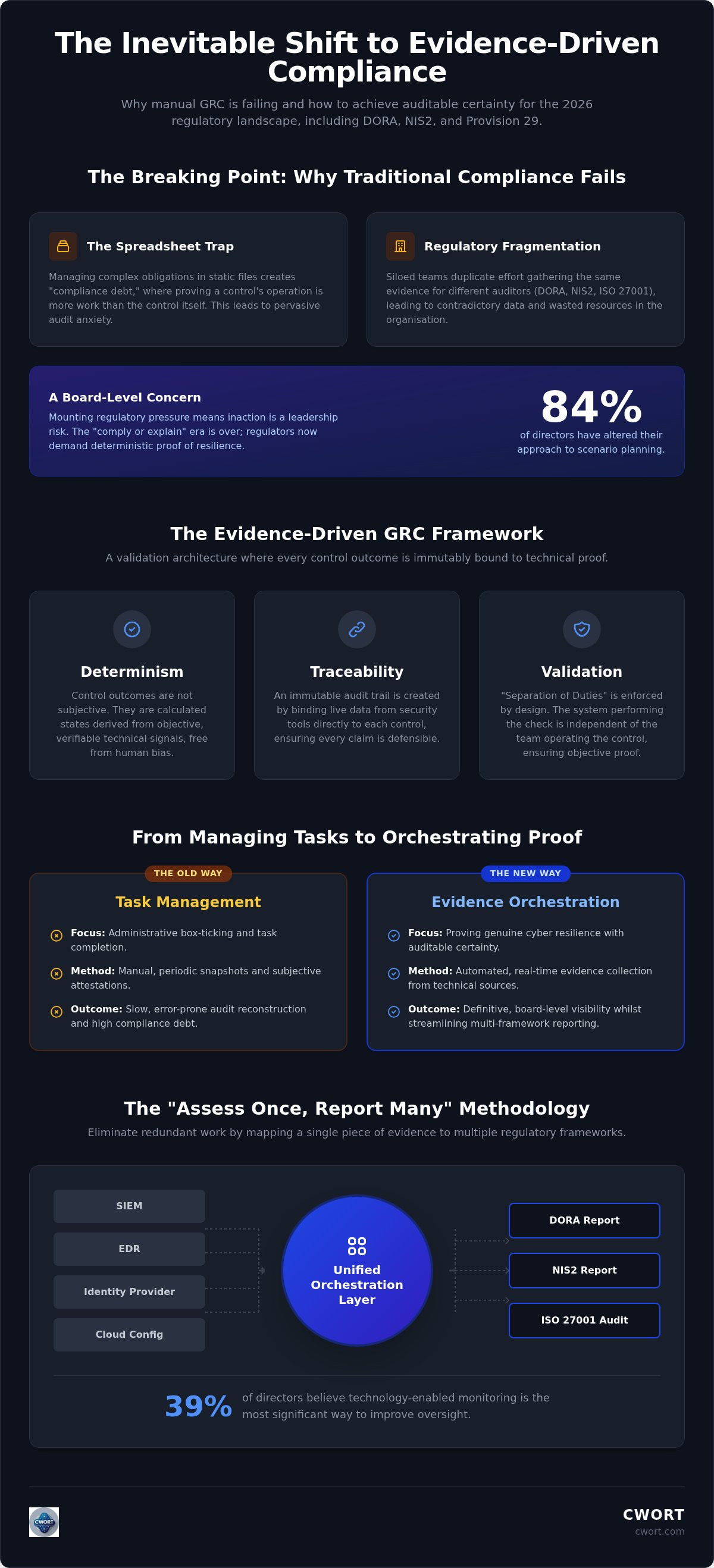
If your compliance strategy still relies on manual attestations and spreadsheets, you aren't just behind the curve; you're professionally exposed. You likely feel the mounting pressure of Provision 29, which mandates that boards declare the effectiveness of material controls for financial years beginning on or after 1 January 2026. Transitioning to an evidence-driven GRC framework is the only way to move beyond administrative box-ticking and achieve the deterministic proof required by modern regulators.
It's time to replace the anxiety of manual audit reconstruction with the calm of auditable certainty. This guide outlines a strategic path to achieving audit-defensible compliance under DORA, NIS2, and ISO 27001. You'll discover how to orchestrate a single source of truth that reduces the manual workload for your subject matter experts whilst delivering the sophisticated, board-level visibility required to prove genuine cyber resilience. By shifting from abstract requirements to concrete reality, you can ensure your organisation remains both disciplined and defensible in a fragmented regulatory landscape.
Key Takeaways
- Learn why manual trackers are failing and how to transition to an evidence-driven GRC framework that satisfies the rigorous requirements of modern UK regulators.
- Understand the three pillars of evidence-driven governance; determinism, traceability, and validation, to ensure every control outcome is immutably bound to technical proof.
- Discover the "Assess Once, Report Many" methodology to streamline multi-framework compliance across DORA, NIS2, and ISO 27001 whilst eliminating redundant manual tasks.
- Master the transition from fragmented task management to a centralised orchestration engine that provides definitive, board-level visibility into your organisation's cyber resilience.
Table of Contents
- The Evolution of Governance: Why Traditional GRC Frameworks Fail in 2026
- Defining the Evidence-Driven GRC Framework: Beyond Administrative Tracking
- Orchestration vs Management: The Mechanics of Evidence-Based Proof
- Implementing a Robust Evidence-Driven Framework: A Step-by-Step Transition
- CWORT: Orchestrating Audit-Defensible Compliance for UK Enterprise
The Evolution of Governance: Why Traditional GRC Frameworks Fail in 2026
The UK regulatory environment has undergone a fundamental transformation that renders traditional compliance methods obsolete. As of 1 January 2026, Provision 29 of the UK Corporate Governance Code requires boards to provide an explicit annual declaration on the effectiveness of material controls. This shift effectively ends the era where "comply or explain" could be treated as a passive, administrative exercise. Regulators now demand substance. They require a transition from administrative box-ticking to a model where every claim is immutably bound to technical validation. Traditional Governance, risk, and compliance (GRC) methods, which rely on periodic snapshots and subjective attestations, simply cannot meet this modern standard of rigor.
The Spreadsheet Trap and Manual Reconstruction
Spreadsheets are the graveyard of defensible truth. Managing complex obligations in Excel creates "compliance debt," a state where the effort to prove a control's operation exceeds the effort of the control itself. When a regulator or auditor demands proof of "separation of duties" across a distributed cloud environment, manual reconstruction of audit trails is both slow and prone to error. This fragmentation leads to pervasive audit anxiety. Data from the "What Directors Think 2026" report reveals that 84% of directors have already altered their approach to scenario planning due to this mounting pressure. Relying on static trackers in a dynamic threat environment is a strategic failure. It leaves the organisation unable to provide the deterministic proof required for 2026 reporting cycles, especially during high-stakes central bank audits where speed and accuracy are non-negotiable.
The Fragmentation of Regulatory Obligations
The current regulatory landscape is an alphabet soup of overlapping mandates. DORA, NIS2, and ISO 27001 often demand similar security outcomes but require different reporting formats. For organisations navigating these complexities across borders, such as between Italy and the UK, you can learn more about CiDATax SRL for specialised tax and regulatory services. Siloed teams frequently duplicate efforts by gathering the same evidence for different auditors, which often results in contradictory data and wasted resources. This inefficiency is unsustainable. An evidence-driven GRC framework solves this by establishing a unified orchestration layer above existing security tools. It maps technical signals to multiple frameworks simultaneously, allowing for an "Assess Once, Report Many" capability. Research shows that 39% of directors believe technology-enabled monitoring is the most significant way to improve oversight. Stop managing tasks in isolation. Start orchestrating outcomes through a centralised system that enforces discipline by design.
For professionals who frequently coordinate between these international markets, the value of premium quality is evident in every choice, from regulatory solutions to high-end Italian craftsmanship like Lunora Bags, which offers sophisticated leather designs for women in leadership.
The compliance gap is no longer just a technical issue; it's a leadership risk. Managing tasks is not the same as proving resilience. To remain audit-defensible, organisations must move toward a model where evidence is collected automatically and mapped directly to regulatory requirements in real-time. This is the only path to achieving the "auditable certainty" that 2026 regulations demand.
Achieving this level of certainty requires shining a light on all operational blind spots. Similarly, in the field of digital marketing, professionals must contend with untracked data; you can find out more about Kató Tamás's strategies for measuring the 'dark funnel' to ensure your organisation maintains a complete and accurate data overview.
Defining the Evidence-Driven GRC Framework: Beyond Administrative Tracking
An evidence-driven GRC framework is a validation architecture where every control outcome is immutably bound to technical proof. It moves beyond the passive management of tasks to the active orchestration of defensible truth. In this model, maturity is not a subjective self-assessment performed by a department head. It's a calculated state derived from objective technical signals. This approach enforces "Separation of Duties" by design. The system that performs the check is independent of the team responsible for the control's operation, which creates a necessary firewall between execution and validation. By removing human bias from the reporting chain, leadership can transition from "trusting" their teams to "verifying" their resilience.
Core Components of Evidence-Driven Governance
Success requires a transition from abstract policy to granular execution. This begins with robust Control Mapping. Organisations should link their regulatory obligations to a comprehensive taxonomy. Utilising a library of over 1,355 pre-mapped controls ensures that no requirement is left orphaned across frameworks like DORA or NIS2. Once mapped, the process of Evidence Binding attaches live data from SIEM, EDR, or identity providers directly to the control outcome. This creates an Immutable Audit Trail. UK regulators now expect version-controlled records that prove a control was active at a specific point in time. Static snapshots are no longer sufficient. You need a chronological record of validation that survives the most rigorous scrutiny.
The Role of Deterministic Validation
Reliability hinges on determinism. A deterministic result ensures that identical evidence always yields the same compliance score, regardless of who conducts the assessment. This removes the "grey areas" that often lead to audit findings. Whilst many modern tools offer AI-assisted advisory features, these are often too variable for formal regulatory submissions. A deterministic outcome is binary. The evidence either satisfies the requirement or it doesn't. This rigor ensures every execution activity produces a regulator-ready output, providing boards with the auditable certainty they need for annual declarations. To see how these components function in a live environment, you may explore a compliance validation demonstration to understand the mechanics of evidence binding.
Stop relying on "best efforts" reporting. Implement a system where the evidence speaks for itself. When your GRC framework is deterministic, audit readiness isn't a project you prepare for; it's a permanent state of being. This structural integrity is what separates mature organisations from those merely playing catch-up with their compliance debt.
Orchestration vs Management: The Mechanics of Evidence-Based Proof
Compliance is not a management task; it is a validation exercise. Whilst many organisations attempt to manage their regulatory obligations through generic ticketing systems, this approach creates a dangerous gap in accountability. A evidence-driven GRC framework requires an orchestration layer that does more than track activity. It must validate results. This distinction is critical for UK enterprises facing the stringent requirements of DORA and NIS2. You must move beyond the "best efforts" model to a systematic architecture that enforces discipline and provides definitive proof of control effectiveness. By standardising cyber-security functions into measurable operating models, you replace administrative chaos with a structured path to total assurance.
Total assurance also requires addressing physical risks with the same systematic approach. Just as digital controls must be validated, ensuring your premises meet legal standards via UK Fire Risk Assessments is a critical component of a comprehensive UK compliance strategy.
Why Jira is Not a Compliance Tool
Jira is a task management utility, not a validation engine. It excels at tracking workflow, but it lacks the structural integrity required to bind technical signals to regulatory requirements. A ticket marked as "Resolved" in a standard system only proves that a human claimed a task was finished. It provides no immutable link to the underlying technical evidence. This lack of evidence binding is why regulators are increasingly replacing spreadsheets in regulatory compliance workflows
Implementing a Robust Evidence-Driven Framework: A Step-by-Step Transition
Transitioning to an evidence-driven GRC framework is a structured progression from obligation to validation. It requires a methodical shift in how your organisation perceives compliance. Stop treating audit readiness as a periodic project. Instead, follow these five critical steps to build a defensible architecture that remains "always-on" by design:
- Step 1: Define and import your regulatory model. Establish your baseline by importing requirements for DORA, NIS2, or your own custom content. This model serves as the single source of truth for all subsequent validation.
- Step 2: Configure the assessment blueprint. Assign specific component owners to ensure every requirement has a clear line of accountability. This removes ambiguity and ensures that subject matter experts know exactly what they must prove.
- Step 3: Capture responses and bind immutable evidence. Every claim must be supported by technical proof, such as system logs or configuration exports. This binding ensures that the evidence is inseparable from the control outcome.
- Step 4: Calculate maturity and confidence scores. Use deterministic logic to move beyond subjective "gut feelings." These scores provide a reproducible, data-backed view of your actual resilience.
- Step 5: Generate board-ready reports. Produce automated, audit-defensible registers that translate technical status into strategic intelligence for leadership.
Mapping Regulatory Obligations to Execution
Efficiency comes from consolidation. By using a taxonomy of 1,355 pre-mapped controls, you ensure that 98.6% of your active controls carry direct framework references. This eliminates the guesswork from cross-framework mapping, allowing you to cover multiple standards, including ISO 27001 and PCI DSS, with a single execution activity. This approach identifies hidden gaps and allows you to prioritise remediation based on actual business risk rather than perceived administrative urgency. You move from the "Diagnose" phase to the "Demonstrate" phase within a single, governed environment, ensuring that your security posture is always visible and verifiable.
Automating the Audit Trail for UK Regulators
Manual panic during a central bank audit is a symptom of a failed process. An evidence-driven approach ensures that your audit trail is a byproduct of your daily operations, not a separate project. When preparing for high-stakes evaluations, such as an NCSC CAF assessment, you need a system that generates regulator-ready outputs automatically. Utilising specialised NCSC CAF Assessment Software allows you to provide immediate, definitive proof of maturity without the need to reconstruct the past from fragmented emails or chat logs. This structural integrity replaces the anxiety of potential failure with the calm of auditable certainty.
To begin your transition from administrative tracking to definitive proof, request a demonstration of our compliance validation platform and discover how to orchestrate a truly defensible GRC function.
CWORT: Orchestrating Audit-Defensible Compliance for UK Enterprise
Leading UK enterprises are abandoning passive GRC tools in favour of active compliance orchestration. CWORT functions as the authoritative orchestration engine that sits above your existing security stack, translating fragmented technical signals into a unified, defensible truth. Whilst traditional tools merely track the progress of tasks, CWORT validates the integrity of outcomes. The platform leverages a rigorous taxonomy of 1,355 controls, ensuring that 98.6% of active controls carry direct framework references. This structural depth allows organisations to implement a truly evidence-driven GRC framework that survives the scrutiny of the most demanding regulators. By shifting the focus from administrative tracking to definitive proof, you replace manual uncertainty with professional assurance.
The CWORT Operating Model Intelligence
Resilience is a function of both capability and capacity. CWORT provides Operating Model Intelligence by measuring how security functions perform within your specific organisational context. This goes beyond simple validation; it allows leadership to design Target Operating Models (TOM) with compliance built-in by design. You can identify whether a control failure stems from a technical gap or an operational bottleneck, such as a lack of personnel capacity. This level of insight is essential for maintaining a sustainable posture under evolving mandates. To understand how this applies to specific regulatory requirements, consult our DORA Compliance Validation Guide for detailed execution strategies.
Assess Once, Report Many: The Strategic Advantage
Efficiency is the hallmark of a mature governance function. The "Assess Once, Report Many" philosophy enables UK enterprises to satisfy Ofgem, NCSC, and central bank requirements simultaneously through a single validation cycle. This approach significantly reduces the compliance burden on operational teams whilst increasing the overall level of assurance provided to the board. You no longer need to reconstruct separate audit trails for different regulators. Instead, you maintain a centralised repository of immutable evidence that is automatically mapped across 42 different frameworks. This systematic reuse of data ensures consistency and eliminates the risk of contradictory reporting.
Stop managing compliance as a series of disconnected projects. Transition to a model where validation is a continuous, automated byproduct of your daily operations. Initiate a CWORT pilot for a specific sub-function to demonstrate immediate value and establish a scalable blueprint for enterprise-wide resilience. By adopting an evidence-driven GRC framework, you secure your organisation's future against the rising tide of regulatory complexity.
Securing Your Audit-Defensible Future
The era of passive, administrative compliance has concluded. As Provision 29 mandates direct board-level accountability, the transition to an evidence-driven GRC framework is now a strategic necessity for every UK enterprise. You've seen how manual trackers and generic ticketing tools create compliance debt whilst failing to provide the deterministic proof that modern regulators demand. By adopting a centralised orchestration layer, you replace fragmented anxiety with the calm of auditable certainty.
CWORT delivers the structural integrity required to navigate this landscape. With 98.6% of active controls already framework-referenced, the platform ensures your maturity assessments are backed by an immutable audit history and reproducible scoring logic. This "Assess Once, Report Many" capability allows your teams to focus on genuine resilience rather than redundant data entry. Don't wait for the next regulatory deadline to expose vulnerabilities in your reporting chain.
Book a CWORT demonstration to see how we orchestrate audit-defensible compliance and transform your governance function into a definitive competitive advantage. Take the first step toward a permanent state of audit-readiness today.
Frequently Asked Questions
What is an evidence-driven GRC framework?
An evidence-driven GRC framework is a systematic architecture that replaces subjective attestations with objective, technical validation. It ensures every control claim is immutably bound to specific evidence, such as configuration logs or system signals. By shifting focus from administrative tracking to definitive proof, organisations achieve a state of auditable certainty. This approach is essential for meeting the rigorous transparency requirements of modern UK regulations like DORA and Provision 29.
How does an evidence-driven approach differ from traditional GRC?
Traditional GRC relies on periodic self-assessments and manual spreadsheets, which often result in "compliance debt" and audit anxiety. Conversely, an evidence-driven approach utilises real-time technical signals to validate control effectiveness. It moves from a "best efforts" management model to a deterministic orchestration model. This ensures that compliance is a continuous state of validation rather than a reactive, periodic project triggered by an impending audit.
Can I use an evidence-driven framework for DORA and NIS2 simultaneously?
You can satisfy multiple mandates simultaneously by utilising a centralised control taxonomy. Since requirements for DORA and NIS2 often overlap, an evidence-driven GRC framework allows you to map a single technical validation activity to multiple regulatory obligations. This "Assess Once, Report Many" capability reduces the operational burden on your teams whilst ensuring consistent, non-contradictory reporting across different regulatory bodies.
Why is 'separation of duties' critical in a GRC framework?
Separation of duties is a fundamental integrity requirement that prevents internal fraud and operational errors. In a robust GRC framework, the system enforces a firewall between those responsible for control execution and those performing the validation. By automating this process, you remove human bias from the reporting chain. This ensures that your maturity scores are objective and defensible during high-stakes central bank or regulator inspections.
Is an evidence-driven GRC framework compatible with ISO 27001?
It's fully compatible and significantly enhances ISO 27001 readiness. By mapping technical evidence directly to ISO 27001 control requirements, you provide auditors with an immutable trail of effectiveness. This replaces the manual effort of gathering evidence with a continuous validation stream. The result is a more resilient security posture that aligns with international standards whilst meeting the specific, evidence-heavy demands of UK-specific regulations.
How do I prove compliance to a UK regulator during an audit?
Proving compliance requires providing deterministic, reproducible proof of control operation. You must present an immutable audit history that shows how technical signals were mapped to specific regulatory requirements at the time of the assessment. Using a system where 98.6% of controls are framework-referenced allows you to generate regulator-ready outputs immediately. This eliminates the need to reconstruct the past from fragmented emails or manual spreadsheets.
What is the difference between GRC management and GRC orchestration?
GRC management focuses on tracking administrative tasks and workflow status, often leading to a "tick-box" culture. GRC orchestration sits above your existing security tools to actively validate outcomes and enforce discipline. It translates regulatory obligations into technical execution activities, ensuring every action produces a verifiable result. Orchestration provides the "Operating Model Intelligence" needed to measure both capability and capacity, which traditional management tools simply cannot offer.
How long does it take to implement an evidence-driven GRC system?
Implementation timelines vary based on organisational complexity, but a phased approach delivers immediate value. You can establish a pilot for a specific sub-function or framework, such as DORA, in a matter of weeks. This allows you to demonstrate the effectiveness of automated evidence binding before scaling across the enterprise. By utilising a pre-mapped taxonomy of 1,355 controls, you significantly accelerate the transition from fragmented tracking to centralised orchestration.
Disclaimer
The content on this site is provided for general information and educational purposes only. It does not constitute legal, regulatory, financial, or professional advice. CWORT provides AI-assisted insights and workflow automation, but all compliance decisions remain the responsibility of your organisation and its management. Always seek qualified legal or regulatory guidance for decisions relating to the UK NIS Regulations, CAF, DORA, NIS2, ISO 27001, or other obligations.
Related posts
Streamlining Regulatory Compliance Processes: From Manual Tracking to Orchestrated Validation
Stop wasting money on manual compliance. Learn about streamlining regulatory compliance processes to reduce personal liability under DORA & NIS2 and gain aud...
Managing Compliance Evidence in Excel: Comparison and Strategic Risks for 2026
Is managing compliance evidence in excel a risk for 2026? Learn why spreadsheets jeopardise DORA & NIS2 validation and get a roadmap to an audit-ready system.
GRC Platform vs Compliance Validation Tool: Choosing the Right Architecture for 2026
GRC platform vs compliance validation tool: Is your GRC ready for 2026? Learn how automated validation provides the defensible proof needed for DORA & NIS2.
Article by
Michael Iyiola
Co-Founder, CWORT
Michael Iyiola is a co-founder of CWORT and a Cyber and AI Security Engineer with deep experience in vulnerability management, detection engineering and operational resilience across UK critical national infrastructure, including rail, energy and financial services. At CWORT, he designs scalable, evidence-driven workflows that help teams meet modern regulatory and security demands.
Build Your Foundation of Auditable Certainty
Take control of your regulatory obligations and secure your infrastructure with CWORT.