How future-proofing your compliance strategy informs decisions

Michael Iyiola
Co-Founder, CWORT
Future-proofing your compliance strategy helps you anticipate regulatory and technology risks, clarify accountability and use evidence to guide decisions.

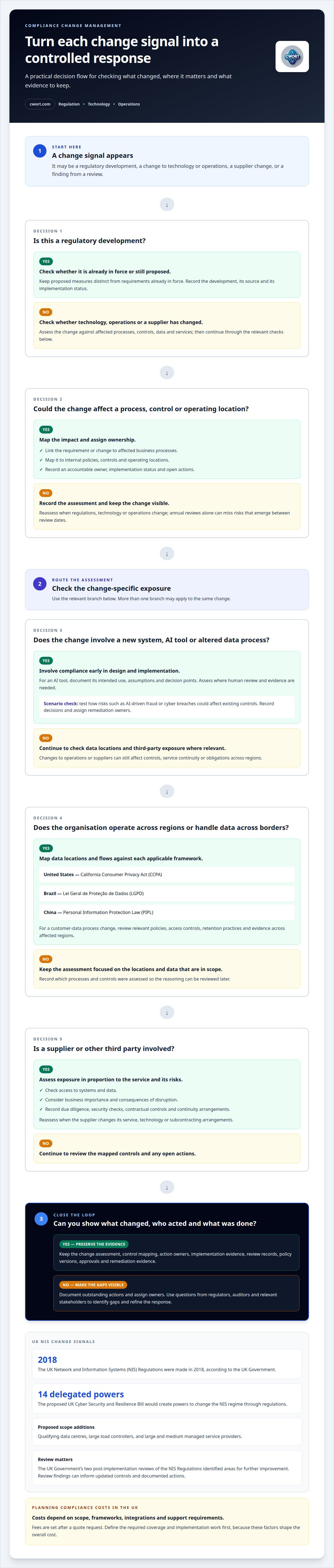
A compliance strategy built only for today’s obligations can leave tomorrow’s risks without clear ownership or oversight. Future-proofing your compliance strategy means making regulatory change, technology risk and accountability part of an ongoing governance process, not an occasional review. The UK Network and Information Systems (NIS) Regulations were made in 2018, according to the UK Government, illustrating why organisations need a way to assess requirements as they change.
Knowing which rules apply today is only part of the task. Leaders also need to understand which processes, controls and decisions may be affected, and how the organisation will evidence its response.
This article explains how to adapt compliance to regulatory and technological change, strengthen accountability, improve oversight and bring compliance into strategic decisions. You’ll see how to connect emerging risks with clear responsibilities, reliable evidence and practical reporting, so compliance can inform decisions rather than follow them.
Key Takeaways
- Connect regulatory updates to the business processes, controls and regions they affect, then assign clear actions and ownership.
- Make accountability practical with role-specific responsibilities, leadership support and a safe route for staff to raise concerns.
- Use decision-ready reporting and traceable evidence to show where risk is changing and how controls are working.
- Set a compliance vision that can adapt to emerging threats, using scenario analysis to test organisational resilience.
- Bring compliance into major decisions early, so risks inform choices such as new technology adoption and business ventures.
Table of Contents
- 1. Proactively addressing regulatory and technological change
- 2. Compliance culture and leadership accountability
- 3. Dashboards, reporting and audit trails
- 4. Defining a compliance vision and strategy
- 5. Involving compliance in strategic decisions
- CWORT: Bring Your Own Content Maturity Assessments
1. Proactively addressing regulatory and technological change
Future-proofing depends on translating regulatory change into specific control updates. Maintain a central change register recording each development, its source, affected business processes, accountable owner and implementation status. Map requirements to internal policies, controls and operating locations. This gives leaders a traceable view of what changed, where exposure sits and which actions remain open. Annual reviews alone can miss risks that emerge between review dates, so reassess when regulations, technology or operations change.
The UK NIS Regulations were made in 2018, according to the UK Government. The UK Cyber Security and Resilience Bill would create 14 delegated powers to change the NIS regime through regulations. The proposed Bill would also bring qualifying data centres, large load controllers, and large and medium managed service providers into scope. Treat these developments as change signals: identify potentially affected services, map relevant controls and document readiness actions. Keep proposed measures distinct from requirements already in force.
Global operations can create overlapping privacy obligations. Depending on where they operate and whose data they handle, organisations may need to consider the California Consumer Privacy Act (CCPA), Brazil’s Lei Geral de Proteção de Dados (LGPD) and China’s Personal Information Protection Law (PIPL). Map data locations and flows against each applicable framework. For example, a change to a customer-data process should prompt review of relevant policies, access controls, retention practices and evidence across affected regions.
Apply the same discipline to technology changes. Involve compliance teams early in design and implementation discussions, before a new system changes how data is collected, decisions are made or controls operate. For an AI tool, document its intended use, assumptions and decision points, then assess where human review and evidence are needed. Scenario planning can test how emerging risks, such as AI-driven fraud or cyber breaches, could affect existing controls. Record decisions and assign owners to remediation.
For suppliers and other third parties, assess their access to systems and data, the service’s business importance, and the consequences of disruption. Record due diligence, security checks, contractual controls and continuity arrangements against identified risks. Reassess when a supplier changes its service, technology or subcontracting arrangements. This connects supplier exposure to control actions instead of treating onboarding approval as permanent assurance.
Use structured reviews to engage regulators, auditors and relevant stakeholders. Share the change assessment, control mapping, action owners and implementation evidence; use questions raised during review to identify gaps and refine the response. Preserve review records, policy versions, approvals and remediation evidence for future changes. The UK Government’s two post-implementation reviews of the NIS Regulations identified areas for further improvement, illustrating why review findings should inform updated controls and documented actions.
In the UK, compliance software and managed compliance service costs depend on scope, frameworks, integrations and support requirements; fees are set after a quote request. Define the required coverage and implementation work first, because these factors shape the overall cost.
2. Compliance culture and leadership accountability
Make compliance visible in routine governance. Include control performance, overdue actions and reported concerns in management discussions. Ask owners to explain recurring failures, not just confirm that a task is complete. Boards and executive teams can then distinguish a one-off error from a process weakness that needs investment, clearer guidance or revised responsibilities. Record decisions and action owners so follow-up does not depend on memory.
Make training relevant to the decisions each role actually faces. Customer-facing employees need examples of appropriate information handling and escalation; technology leads need to understand how design choices affect control operation. Use scenarios, short exercises and team discussions to test whether people can apply policies under pressure. The Conference Board recommends that top business leadership engage with and support upskilling. Leaders can show that support by making time for learning and acting on the gaps it reveals.
Training should reflect each role’s real decisions. A customer-facing employee needs examples of appropriate information handling and escalation; a technology lead needs to understand how design choices affect control operation. Use scenarios, short exercises and team discussions to test whether people can apply policies under pressure. The Conference Board recommends that top business leadership engage with and support upskilling efforts. Leaders demonstrate that support by making time for learning and acting on the gaps it reveals.
- Set the standard. Leaders explain expected conduct and demonstrate it when delivery pressure conflicts with a control.
- Assign responsibility. Each material control has an accountable owner, a deputy and a defined escalation route.
- Make speaking up workable. Provide a formal issue-management process, protect staff from retaliation and communicate how concerns are handled.
- Close the loop. Track findings to resolution and share lessons with teams facing similar decisions.
A flexible culture adapts its guidance as work changes, without weakening accountability. When a team adopts new software or changes a customer journey, managers can review relevant procedures, identify training needs and update control responsibilities before the new process becomes routine. Increasing demands and a competitive landscape can make delivery targets feel urgent; leaders should make clear that escalation is responsible behaviour, not obstruction. Use staff feedback and recurring issue patterns to identify where policies are difficult to apply. Then revise guidance, explain the change and check whether teams can follow it. This cycle makes culture observable through decisions, records and corrective action, rather than relying on a statement of values alone.
3. Dashboards, reporting and audit trails
Build dashboards around decisions, not data volume. Give executives a view of material risks, unresolved control failures, remediation progress and emerging exposure. Give control owners the operational detail they need to act, such as assigned actions, evidence gaps and approval status. A dashboard showing a high-risk control with missing evidence, for example, should identify its owner and next action, not merely display a red status.
Connect risk information across business functions so leaders can see how organisation-wide exposure affects operational outcomes. A centralised view can bring together Business-Wide Risk Assessments, Customer Risk Assessments and risk appetite. This helps management identify how a broad risk affects a specific service or customer journey. Use current information to prioritise attention, but retain context: changing risk scores need an explanation and a responsible decision-maker.
Measure effectiveness through evidence that controls operate, not policy completion alone. Track whether required reviews happen, exceptions are resolved, findings recur and remediation closes identified gaps. Assess maturity by examining ownership, documented processes, evidence quality and management oversight. Compare teams or services to locate weak hand-offs. A completed training record, for instance, does not show whether staff applied the procedure correctly in a real process.
Audit trails make decisions defensible. Preserve control evidence alongside approvals, timestamps, policy versions and remediation records. If an AI tool informs a compliance decision, document its role, data sources, assumptions and how its output was reviewed. This lets reviewers reconstruct how an outcome was reached and identify changes that require renewed assessment. Keep evidence linked to the relevant control rather than scattered across email threads and disconnected files.
Review dashboard measures when changes to services, systems or regulations alter the risks being monitored. A measure that once supported meaningful oversight may become irrelevant after a process changes. Record why indicators were added, revised or retired. This history helps auditors understand how monitoring evolved and helps leaders distinguish genuine improvement from a change in measurement. Use the findings to direct resources towards controls that need attention.
- Define useful indicators. Assign each measure an owner, source, review cadence and escalation threshold.
- Separate signals from decisions. Record who assessed an alert, what evidence they considered and what action followed.
- Test data quality. Resolve duplicates, gaps and inconsistent formats before leaders rely on dashboard outputs.
Set a compliance vision that explains how governance will support organisational objectives. Define the outcomes leadership expects, the risks it will prioritise and the evidence needed to demonstrate control. A business expanding digital services, for example, might require privacy and cyber risks to be assessed before launch. Clear expectations help teams make consistent decisions instead of treating every new obligation as an isolated project.
4. Defining a compliance vision and strategy
Translate the vision into strategic priorities. Identify critical services, sensitive information, important suppliers and decisions with material customer or operational impact. Establish which risks fall within the organisation’s appetite and which require escalation. A new analytics capability, for example, may offer valuable insight, but its use should be assessed against data quality, privacy and decision-making risks. This gives investment discussions a consistent basis for weighing benefits against exposure.
Use scenario analysis to test whether the strategy can respond to emerging threats. Model an AI-driven fraud attempt or a cyber breach affecting a key service. Identify what the organisation would need to detect, who would decide on containment and how operations would continue. Compare the scenario’s demands with existing capabilities, then record gaps in technology, skills, governance or recovery planning. Repeat the exercise as services or threats change to keep priorities relevant.
Set an ethical AI framework before using AI for monitoring, due diligence or risk analysis. Define permitted uses, decision ownership and human review. Assess privacy implications and algorithmic bias, especially where outputs could affect customers or employees. Document the tool’s role and the rationale for relying on its output. These safeguards let teams test potential value while leadership retains oversight of consequential decisions.
- Purpose: state how compliance enables the organisation’s objectives.
- Scope: identify services, processes and information the strategy covers.
- Risk criteria: define how teams assess impact and escalate concerns.
- Evidence: specify what demonstrates that controls work in practice.
Assign an executive sponsor and connect strategic priorities to business planning. If a scenario exposes weak incident coordination, leadership can assign an owner, approve remediation and set criteria for closing the gap. Review the vision when the organisation changes services, enters a new market or adopts technology that alters its risk profile. A defined review process keeps strategy aligned with changing expectations without requiring every operational change to trigger a complete rewrite.
Bring compliance into decisions before commitments become difficult to reverse. For a merger or acquisition, assess how the proposed business could change exposure, control ownership and evidence requirements. Map its services, data flows and suppliers against the organisation’s risk framework. This helps decision-makers identify integration work and control gaps before agreeing how operations will combine. Compliance should inform the decision, not merely review it after completion.
5. Involving compliance in strategic decisions
Set a review point for major proposals, such as entering a market, launching a digital service or changing a critical supplier. The proposal owner provides its purpose, operating model and expected customer impact. Compliance identifies relevant obligations, affected controls and unresolved questions. A new online service, for example, may change how customer information is collected or decisions are made. Recording these effects lets leaders weigh the opportunity against operational and reputational exposure.
Scale the assessment to the decision’s reach. A minor process adjustment may need a focused control review; a major acquisition may require coordinated assessments across business units, technology and third parties. In either case, document assumptions, evidence and the decision rationale. If leaders accept residual risk, record who approved it, why it fits the organisation’s risk appetite and what monitoring will detect a change. This creates an auditable basis for revisiting the decision.
Evolving technology calls for clear oversight of AI-related decisions. A cross-functional AI ethics committee can bring together compliance, technology, risk and business perspectives. Give it a defined remit: review proposed uses, consider privacy and algorithmic bias, and monitor AI-based compliance tools. If a tool flags a transaction or customer for further review, for instance, assess its role in the decision and document how staff challenge or act on its output. Accountability stays with people, rather than being treated as an outcome of the tool itself.
- Define the trigger. Specify which proposals require compliance review, including new services and material technology changes.
- Set ownership. Name the proposal sponsor, compliance reviewer and executive decision-maker.
- Record conditions. Capture required controls, open issues and any conditions attached to approval.
- Reassess changes. Reopen the review when scope, data use, suppliers or customer outcomes change.
Integrate these reviews into existing investment and governance processes. Use a consistent framework to compare proposals, surface dependencies and assign actions before approval. After launch, compare intended controls with operational evidence and customer outcomes. If a new service creates unexpected risks, leaders can adjust its design, controls or monitoring. This makes compliance a decision input throughout the lifecycle, from proposal to implementation and subsequent review.
CWORT’s Bring Your Own Content Maturity Assessments help organisations evaluate compliance maturity against their own content. Use this approach when policies, controls or frameworks need structured assessment, or leaders need clearer evidence of gaps and priorities. CWORT connects assessment criteria, evidence, expert judgement and accountable approvals in a governed workflow, making conclusions traceable and reviewable.
To assess how structured compliance validation can support decision-making, request a compliance platform demonstration.
CWORT: Bring Your Own Content Maturity Assessments
Choose an upcoming decision with material operational or customer impact, then make its compliance assumptions visible before approval. Future-proofing your compliance strategy is not about predicting every change. It means ensuring decision-makers can identify uncertainty, understand its consequences and set conditions for proceeding. That discipline gives teams a practical way to respond as requirements or technology evolve.
Where specific regulatory frameworks are the priority, relevant options include DORA Compliance Readiness and Assessment, UK NIS Compliance Management, and NIS2 Readiness and Compliance Management. These offerings can help organisations structure readiness work around the requirements they need to address, rather than relying on disconnected tracking.
Contact CWORT to discuss how a maturity assessment could support your compliance priorities.
Make the next decision easier to defend
For the next proposal, record what could change the risk assessment, who owns the decision and what evidence would prompt a review. Set a point to revisit those assumptions after implementation, when operating experience can inform the next decision. This turns compliance from a final checkpoint into a continuing source of governance insight.
Future-proofing means preparing systems and decisions to remain effective as conditions change. For a UK organisation, that could mean designing a service review to consider new data flows, supplier dependencies and technology choices, rather than assessing only launch-day risks. A decision that works under current assumptions may create control gaps when the service, operating model or regulatory context changes.
Where structured validation would help connect obligations, controls and evidence, arrange a demonstration of CWORT’s compliance platform. Take the next decision forward with clearer accountability and a stronger basis for action.
Frequently Asked Questions
What is future-proofing and why is it so important?
Build change response into ordinary business planning. For example, require a focused impact assessment when a team proposes a new data use, supplier relationship or digital service. Record the decision, assumptions and unresolved dependencies, then revisit them if the proposal changes or moves into operation. This connects strategy and compliance without treating every development as a separate programme.
What practices should companies adopt to prepare for the future?
Future-proofing your compliance strategy means being ready to respond to changes in regulation, technology and business activity. It does not mean predicting every future requirement. Establish governance that identifies relevant change, assesses its effect on the organisation and adapts controls with evidence. A new service, for example, should prompt review of its processes, data use and responsibilities before approval.
What does future-proofing a compliance strategy mean?
Businesses with relevant network and information systems should monitor the UK Cyber Security and Resilience Bill. The proposed Bill would bring qualifying data centres, large load controllers, and large and medium managed service providers into the scope of the NIS Regulations. It also includes powers for future changes to the regime. Track the Bill’s progress and assess its potential relevance to your services without treating proposed measures as current requirements.
Which upcoming UK regulations should businesses prepare for?
Assign an owner to review relevant updates from regulators and government bodies, then record each item with its status and date identified. Triage it by asking which services, locations, customers or suppliers could be affected. A change concerning digital services, for example, may require input from technology, operations and customer teams. Document the decision, rationale and follow-up actions so later reviews can trace the response.
How can businesses monitor regulatory changes and assess their impact?
Define who can approve control changes and who must be consulted. Connect each significant business change to a review of its risks, dependencies and evidence needs. Assign actions to named owners, then give leadership a way to resolve competing priorities. A flexible programme also records why a control changed, so teams understand its purpose and can restore appropriate oversight if circumstances shift.
What are the key steps to build a flexible compliance programme?
Train people on the decisions they actually make, then test whether they can apply the guidance. A procurement exercise, for instance, can help staff practise identifying when a supplier change needs escalation. Give employees a clear way to raise concerns and explain how reports are handled. Managers should discuss lessons from incidents and near misses, turning practical experience into updated guidance rather than relying on an annual training record alone.
How should businesses train staff and maintain a culture of compliance?
Consequences depend on the applicable regime, the organisation’s conduct and the circumstances. Potential risks include regulatory scrutiny, required corrective action, service disruption, contractual disputes and damage to customer confidence. A fixed penalty cannot be assumed across all requirements. Organisations should establish which obligations apply, document how decisions were reached and address identified gaps promptly rather than relying on a generic estimate of possible sanctions.
What are the risks and penalties of failing to adapt to new compliance rules?
Consequences depend on the applicable regime, the organisation’s conduct and the circumstances. Potential risks include regulatory scrutiny, required corrective action, disruption to services, contractual disputes and damage to customer confidence. A fixed penalty cannot be assumed across all requirements. Organisations should establish which obligations apply, document how decisions were reached and address identified gaps promptly, rather than relying on a generic estimate of possible sanctions.
Disclaimer
The content on this site is provided for general information and educational purposes only. It does not constitute legal, regulatory, financial, or professional advice. CWORT provides AI-assisted insights and workflow automation, but all compliance decisions remain the responsibility of your organisation and its management. Always seek qualified legal or regulatory guidance for decisions relating to the UK NIS Regulations, CAF, DORA, NIS2, ISO 27001, or other obligations.
Related posts
Streamlining Regulatory Compliance Processes: From Manual Tracking to Orchestrated Validation
Stop wasting money on manual compliance. Learn about streamlining regulatory compliance processes to reduce personal liability under DORA & NIS2 and gain aud...
Real-Time Compliance Dashboards for Executive Decisions
See how real-time compliance dashboards for executives turn trusted data into clear risk signals, accountable actions and stronger regulatory oversight.
Four ways to understand and reduce human error in compliance
Discover four ways of reducing the risk of human error in compliance, investigating near misses and improving controls, procedures and cyber risk management.
Article by
Michael Iyiola
Co-Founder, CWORT
Michael Iyiola is a co-founder of CWORT and a Cyber and AI Security Engineer with deep experience in vulnerability management, detection engineering and operational resilience across UK critical national infrastructure, including rail, energy and financial services. At CWORT, he designs scalable, evidence-driven workflows that help teams meet modern regulatory and security demands.
Build Your Foundation of Auditable Certainty
Take control of your regulatory obligations and secure your infrastructure with CWORT.