How to Get Buy-In for a Compliance Platform by Showing the Costs of Non-Compliance

Michael Iyiola
Co-Founder, CWORT
Learn how to get buy-in for a compliance platform by demonstrating the real costs of non-compliance, control gaps, and clear operational risk to leaders.

The strongest case for a compliance platform starts with exposure, not software. To get buy-in for a compliance platform, connect compliance risks to business priorities: potential penalties, remediation effort, disruption and reputational impact. Then show how measurable indicators can make control gaps, ownership and evidence clearer to decision-makers.
Leaders are right to scrutinise the cost and implementation demands of a new platform. The case should explain both what the organisation could lose if compliance breaks down and how a structured approach can strengthen oversight and provide defensible evidence of progress.
This article explains how to make that case without vague warnings or unsupported savings claims. It covers the direct and indirect costs to assess, metrics that help demonstrate value, and credibility risks that can make compliance a board-level concern. It also shows how to frame the decision around business outcomes, so stakeholders can judge whether a platform addresses the organisation’s actual compliance challenges.
Key Takeaways
- Frame the case around operational exposure, credibility and the evidence leaders need to oversee compliance, not software features alone.
- Show how a structured platform can make control ownership, progress and evidence easier to track across compliance work.
- Build a business case around defined risks, current process costs and measurable performance indicators rather than assumed savings.
- Involve compliance, risk, technology, finance and senior decision-makers so the proposed platform addresses operational needs and has clear accountability.
- Compare the effort and cost of current processes with the platform’s contribution, then assess whether the evidence supports investment.
Table of Contents
- Compliance risks and business credibility
- What are the benefits of a compliance platform for UK organisations?
- How do you build a business case for investing in a compliance platform?
- Which stakeholders should be involved in selecting and approving a compliance platform?
- How can you quantify the cost savings and return on investment of compliance software
- CWORT: DORA Compliance Readiness and Assessment
Compliance risks and business credibility
Compliance failures create more than remediation work. They can expose weak oversight and undermine confidence in the organisation. A credible investment case connects specific risks to evidence, accountability and business impact.
Building the investment business case
A business case sets out the compliance exposure, current process and platform’s expected contribution. Leaders need a decision grounded in operational evidence, not general warnings. Document where spreadsheet tracking obscures ownership, delays evidence gathering or makes open actions hard to monitor. Then connect those gaps to relevant policies, business priorities and the controls that need oversight.
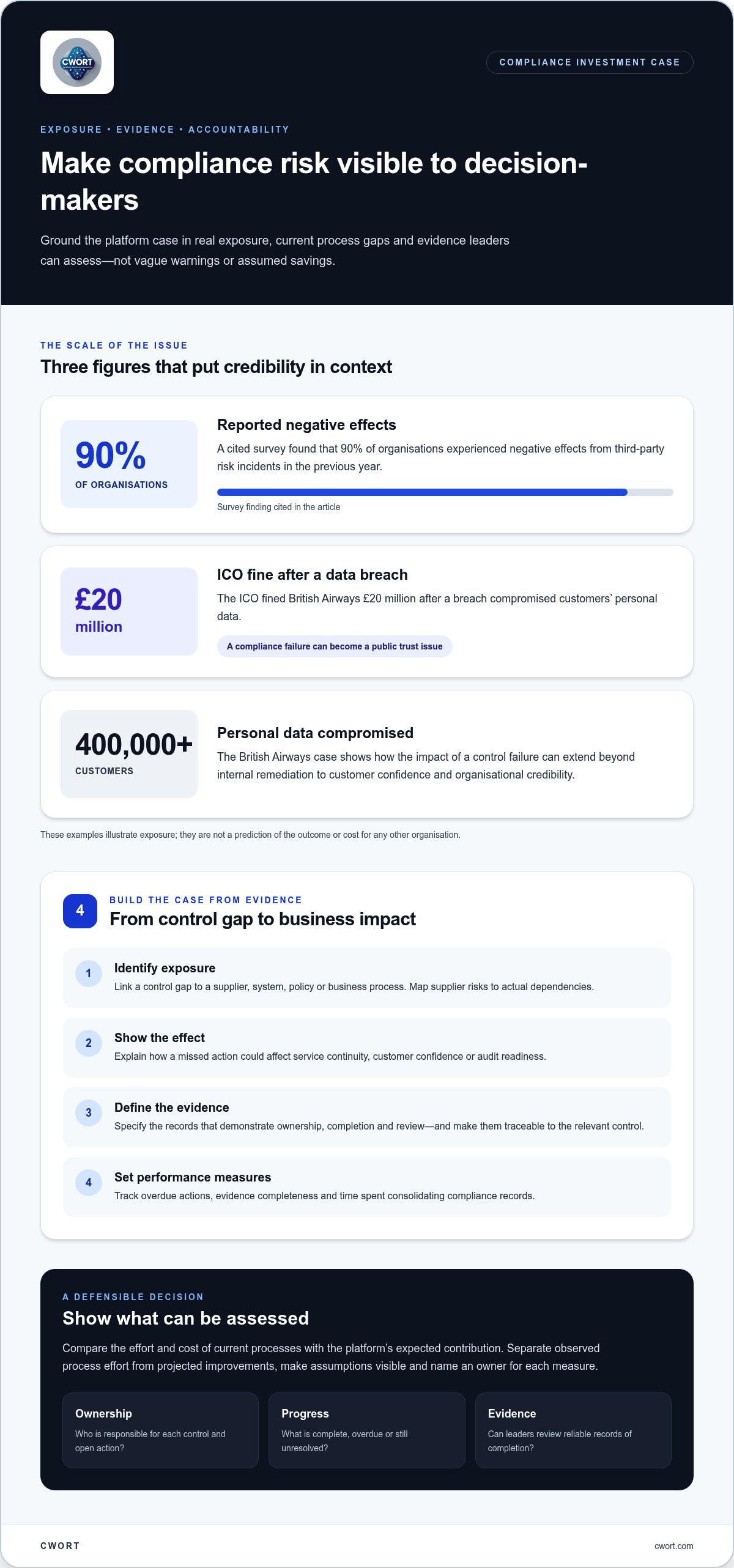
Put the consequences in business terms. A cited survey found that 90% of organisations experienced negative effects from third-party risk incidents in the previous year. For a UK organisation, supplier failures can affect service delivery, access to information and confidence in governance. Map the possible effects against the organisation’s actual suppliers and dependencies, rather than treating every external risk as equally material.
Use a specific example to show how non-compliance can damage credibility. The ICO fined British Airways £20 million after a breach compromised the personal data of over 400,000 customers. That case illustrates how a compliance failure can become a public trust issue, not simply an internal control weakness. The relevant question for a board is whether existing processes can identify gaps, assign actions and produce reliable evidence.
- Identify exposure: Link a control gap to a supplier, system, policy or business process.
- Show the effect: Explain how a missed action could affect service continuity, customer confidence or audit readiness.
- Define evidence: Specify which records would demonstrate ownership, completion and review.
- Set performance measures: Track overdue actions, evidence completeness and time spent consolidating compliance records.
These measures make the case for how to get buy-in for a compliance platform more concrete. They show what leaders can assess before and after implementation without promising unvalidated savings. Make assumptions visible: separate observed process effort from projected improvements, and name the owner of each measure.
Security, data protection and integration risks
Security, data protection and integration risks depend on how a platform stores information, manages access and exchanges records with other software. UK buyers should assess who can view, amend or export evidence, how retention and deletion are managed, and how incidents are handled. Weak permissions or inaccurate transfers can undermine control effectiveness and audit evidence.
What security, data protection and integration risks should UK buyers assess? Review access permissions, data handling, retention, incident processes and the accuracy of connected records. The European Union identifies adherence to GDPR guidelines as an example of regulatory compliance that may be monitored for vendors.
Test integrations against real workflows. If teams use Jira for actions and Excel for evidence, establish which record is authoritative and how changes remain traceable. Check how the system handles duplicate entries, failed transfers and changes in control ownership. An automated link is useful only if the resulting information remains accurate, transparent and reviewable.
Compare platform policies with internal security and data-handling requirements. Record the risks, assign an owner to each assessment and document the decision. This creates a defensible basis for approval, including when an integration or data flow needs further controls before adoption.
What are the benefits of a compliance platform for UK organisations?
A compliance platform can bring obligations, controls, owners and evidence into a more coherent operating model. For a UK organisation working across frameworks such as DORA, UK NIS or ISO 27001, that structure can make compliance work easier to coordinate and review.
A clearer view of controls and ownership
Start with one control record for each relevant obligation. Record its owner, required evidence, review status and open actions. If a control depends on a supplier review, for example, link the assessment and resulting actions to that control. Leaders can then see what is complete, what remains open and who is responsible, without reconciling separate spreadsheets.
This structure also reveals overlaps between frameworks. A single access-control process may support several requirements, but its evidence and review status must remain clear. Mapping related controls makes shared work visible and can reduce duplicated assessment effort. It also helps teams spot additional requirements that a shared control does not address.
More usable evidence and follow-through
Evidence is more useful when it stays connected to the control it supports. A platform can provide a defined way to associate records with control outcomes, helping reviewers trace the relationship between an obligation, an action and its supporting evidence. For example, an auditor reviewing a change-management control can locate the relevant approval record and see its status.
Traceability supports more disciplined remediation. Rather than leaving a gap in a report, assign an owner, capture the action and track its progress against the control. Teams can review overdue items and escalate unresolved issues through established governance. The benefit is not simply a longer action log; it is a clearer path from finding to accountable response.
- For compliance teams: organise obligations, evidence and actions around defined controls.
- For executives: review status and unresolved exposure without combining reports from different teams.
- For auditors: follow a documented trail from requirement to control and evidence.
- For operational owners: see assigned responsibilities and the records needed to demonstrate completion.
These benefits depend on accurate control mapping and active ownership. A platform cannot update outdated policies or establish by itself whether evidence proves a control works. Teams must validate content, maintain records and review exceptions. The system provides structure; people remain accountable for decisions and outcomes.
To assess whether this approach fits your organisation, map one priority framework and a live compliance process. Note where ownership, evidence or actions become difficult to trace, then explore a compliance platform against that workflow.
How do you build a business case for investing in a compliance platform?
Build the case around a defined compliance problem, then test whether a platform addresses it. Give decision-makers a clear line from the current process through operational exposure to measurable outcomes.
Begin with a specific process, such as preparing audit evidence or tracking remediation across teams. Record the tools involved, who does the work, where information is duplicated and which decisions are delayed. A concrete example, such as an action recorded in a spreadsheet but missing from a control review, gives the discussion a verifiable starting point.
Establish the current position
Describe the current workflow before comparing it with a proposed platform. Identify who creates each record, who approves it and how reviewers find supporting evidence. For example, trace a control from its policy requirement to an assigned owner, completed action and retained proof. This reveals the actual hand-offs and gaps the investment needs to address.
Next, connect process weaknesses to business consequences. A missed review may leave a control gap unresolved; fragmented records may make it harder to demonstrate oversight. Make the chain explicit: state the failure point, its likely operational effect and the evidence leaders would need. Separate observed issues from possible consequences so the case remains credible and does not present every risk as certain.
Define value in measurable terms
Set performance measures that relate directly to the identified problem. Examples include overdue actions, evidence completeness, time spent compiling audit records and controls without named owners. Define how each measure is calculated and who reports it. Do not present an assumed improvement as a realised saving.
For financial analysis, record the staff time and other internal resources used by the current process. Compare those costs with the platform’s implementation, operation and governance requirements. Managing Switching for Business in-house, for example, uses operational resources, requires specialist knowledge and can create compliance risk if steps are missed. Use this as an illustration of process costs, not proof that a platform automatically removes the risk.
Make the recommendation conditional on evidence from the organisation’s own workflow. Set out the problem, options considered, expected operational changes, dependencies and success measures. A pilot or controlled evaluation can test whether owners can complete actions and attach usable evidence. Define in advance what counts as success, what remains unresolved and who decides whether to proceed.
This structure makes the investment easier to scrutinise. Leaders can challenge assumptions, compare the current and proposed processes, and judge whether expected improvements to control and reporting justify the commitment. A defensible case is not the one with the largest projected benefit; it is the one whose reasoning and measures can be traced to real work.
Which stakeholders should be involved in selecting and approving a compliance platform?
Build a selection group around the people who own compliance outcomes, use the evidence and approve organisational change. Their roles differ: operational teams test whether the platform fits real work, while executives decide whether the investment supports business priorities.
Start with a named executive sponsor, such as the chief operating officer or chief risk officer. The sponsor connects the proposal to organisational objectives and resolves competing priorities. Compliance or risk leads should define framework coverage, control ownership and evidence needs. For example, they can assess whether a proposed workflow supports DORA obligations without treating every control as identical.
Include the teams responsible for operating and scrutinising the system:
- Information security: assess access controls, data handling and security risks, then document required safeguards.
- IT and architecture: map integrations with existing tools, such as identity systems or action-tracking software.
- Data protection: review personal-data flows, retention processes and access to sensitive records.
- Finance: test the investment assumptions, internal resource needs and ongoing cost model.
- Procurement: review commercial terms, supplier due diligence and the organisation’s purchasing process.
- Control owners and end users: walk through tasks such as uploading evidence, assigning remediation and closing actions.
- Internal audit: assess whether records provide a clear trail from requirement to evidence and review.
Use a real workflow to surface conflicts early. Ask a control owner to record an issue, assign an action and attach supporting evidence. Then ask compliance to review the record and IT to assess how connected systems exchange information. This exercise shows whether users understand their responsibilities and reviewers can access the evidence.
Separate recommendation from approval. The working group should document requirements, risks, dependencies and evaluation findings. The executive sponsor can then present the decision to the budget authority, such as a board committee or senior leadership team. Finance validates cost assumptions; security and data protection owners record their assessments; operational leads confirm the workflow is workable.
Make accountability explicit in the approval record. Name the executive sponsor, platform owner, control owners and decision-maker. Record mandatory requirements, risks requiring treatment and how success will be measured after adoption. Resolve disagreements between compliance, technology and business teams before approval, rather than leaving implementation teams to interpret requirements later.
A cross-functional group gives the decision a stronger operational basis. It also clarifies who will maintain the platform, review exceptions and report progress after selection.
How can you quantify the cost savings and return on investment of compliance software
Calculate return on investment (ROI) by comparing measurable benefits with the full cost of ownership. Start with the current process, then test which costs a compliance platform could realistically reduce. This gives finance and compliance teams a transparent method instead of relying on generic savings claims.
Build a baseline from actual work. Record the staff time spent collecting evidence, reconciling control records, following up actions and preparing audit packs. Use payroll costs to value that time in pounds, and identify external support or software expenditure directly attributable to the process. Keep each cost category separate so reviewers can challenge the assumptions.
Next, define the platform’s total cost of ownership. Include subscription charges, implementation, integration, training, internal administration and ongoing governance. Separate one-off expenditure from recurring costs. If an existing tool remains necessary, include its cost rather than assuming the new platform replaces it. Finance should validate the assumptions and confirm the comparison period.
Estimate benefits only where a process change can be measured. If evidence collection becomes more efficient, compare baseline hours with the hours recorded after adoption. If action tracking improves, measure changes in overdue actions or time spent preparing status reports. Treat released staff capacity as a resource benefit unless the organisation can demonstrate an actual reduction in expenditure.
- Time benefit: baseline hours minus post-adoption hours, valued using the relevant staff cost.
- Net benefit: measured benefits minus platform and operating costs.
- ROI: net benefit divided by total investment, expressed as a percentage.
Keep risk reduction separate from cash savings. A control gap could create operational, regulatory or reputational exposure, but avoiding it is not guaranteed income. Record the risk, its likelihood and potential business effect using the organisation’s established assessment method. Present this as a risk rationale, not a guaranteed financial return.
Use a pilot or defined evaluation to test assumptions against one framework or workflow. Compare the same measures before and after, such as evidence retrieval effort, action status and record completeness. Document the period, scope, data owner and calculation method. This makes the results reproducible and helps decision-makers distinguish observed outcomes from forecasts.
A persuasive answer to how to get buy-in for a compliance platform separates validated savings, capacity released and risk considerations. Present a conservative case alongside the assumptions that could change it. To assess a compliance workflow and its evidence requirements, request a compliance platform demonstration.
A UK cost estimate should include subscription fees and ongoing costs, such as internal administration and governance, alongside one-off implementation, integration and training expenses. Separate recurring fees from one-off costs, and include any existing software that will remain in use.
CWORT: DORA Compliance Readiness and Assessment
CWORT’s DORA Compliance Readiness and Assessment helps organisations structure their DORA compliance work. Use it to translate obligations into assigned activities, track control outcomes and connect evidence to requirements. The platform enforces separation of duties and brings compliance validation into an auditable process, helping teams replace fragmented tracking with clear execution.
The same approach can support organisations working on UK NIS Compliance Management, NIS2 Readiness and Compliance Management, or ISO 27001 Readiness and Control Mapping. These offerings are relevant when your investment case centres on framework readiness, control alignment and defensible evidence, rather than a general software purchase.
To explore how CWORT could support your compliance work, visit cwort.com.
Turn the case into a controlled next step
Approval is not the end of the decision. It is the point where leadership turns the agreed case into accountable execution, with clear ownership of next steps and a defined way to review progress. Keep the original measures visible as work begins, so decisions stay tied to operational evidence rather than assumptions.
If your priorities include framework readiness, CWORT offers DORA Compliance Readiness and Assessment, UK NIS Compliance Management, and NIS2 Readiness and Compliance Management. These offerings can help organisations address compliance work against those frameworks. A focused discussion can help you consider how the platform relates to your requirements and the outcomes in your business case.
For leaders considering how to get buy-in for a compliance platform, the next step is to bring the decision-makers and compliance owners together around the organisation’s specific needs. Contact CWORT to discuss your compliance requirements and explore a considered path towards stronger compliance validation.
Frequently Asked Questions
What are the costs of non-compliance?
Non-compliance can create financial and operational costs beyond regulatory penalties. Organisations may need to fund remediation, investigate control failures, restore affected services and respond to customer or supplier concerns. Exposure depends on the obligation, the nature of the failure and its effect on the business. To estimate it usefully, separate direct expenditure from disruption and reputational impact, then document the assumptions behind each category.
What does this look like in action?
A regulated organisation can use CWORT to structure a DORA programme. The platform translates obligations into controls and execution activities, assigns roles with separation of duties, and binds evidence to activity and control outcomes. A reviewer can trace an assigned activity to its supporting evidence and current status. CWORT also generates regulator-ready and audit-ready outputs, giving stakeholders a consistent view of compliance execution.
What are the steps for piloting and implementing a compliance platform?
Use a controlled pilot to test a real compliance workflow before broader implementation. Define its scope, choose relevant controls and evidence, and assign operational owners and reviewers. Configure roles and access, then run activities through completion. Review whether evidence is correctly linked, responsibilities are clear and outputs support oversight. Record defects and required changes, assign owners to resolve them, and use the findings to plan a phased rollout.
How do compliance platforms compare with spreadsheets, consultants and existing GRC software?
A compliance platform can organize obligations, controls, owners, evidence and actions in one structure. Spreadsheet tracking can obscure ownership, delay evidence gathering and make open actions difficult to monitor; the material does not establish a comparison with consultants or existing GRC software.
How can you address employee concerns and encourage adoption of a new compliance platform?
Involve the teams who will use the platform and assess it against a live compliance workflow and their operational needs. Show how it can make responsibilities, evidence and open actions easier to track, while keeping ownership and decisions clear.
Disclaimer
The content on this site is provided for general information and educational purposes only. It does not constitute legal, regulatory, financial, or professional advice. CWORT provides AI-assisted insights and workflow automation, but all compliance decisions remain the responsibility of your organisation and its management. Always seek qualified legal or regulatory guidance for decisions relating to the UK NIS Regulations, CAF, DORA, NIS2, ISO 27001, or other obligations.
Related posts
Real-Time Compliance Dashboards for Executive Decisions
See how real-time compliance dashboards for executives turn trusted data into clear risk signals, accountable actions and stronger regulatory oversight.
How to Demonstrate Control Effectiveness to Regulators: A Strategic Guide
Learn how to demonstrate control effectiveness to regulators with our guide. Shift from chaos to an evidence-based, audit-ready compliance programme today.
Board Level Cyber Resilience Reporting Software: Bridging the Gap from Technical Control to Governance Proof
Ditch risky spreadsheets. Discover board level cyber resilience reporting software that turns technical data into defensible, real-time proof for UK regulators.
Article by
Michael Iyiola
Co-Founder, CWORT
Michael Iyiola is a co-founder of CWORT and a Cyber and AI Security Engineer with deep experience in vulnerability management, detection engineering and operational resilience across UK critical national infrastructure, including rail, energy and financial services. At CWORT, he designs scalable, evidence-driven workflows that help teams meet modern regulatory and security demands.
Build Your Foundation of Auditable Certainty
Take control of your regulatory obligations and secure your infrastructure with CWORT.