How to Respond to a Regulatory Information Request

Michael Iyiola
Co-Founder, CWORT
Learn how to respond to a regulatory information request accurately. Discover our step-by-step guide to managing evidence, team workflows, and audit trails.

What if the hardest part of a regulatory information request isn’t finding the documents, but proving why each answer is accurate and who approved it? Knowing how to respond to a regulatory information request means more than gathering files. A rushed document dump can leave gaps in scope, evidence and accountability.
If the request’s authority, terminology or deadline is unclear, or supporting records sit across teams and systems, it’s reasonable to feel pressure. A controlled process can replace uncertainty with clear ownership and traceable decisions. Assess each response item, assign an owner, check it against reliable evidence and obtain the right approval before submission.
This guide explains how to confirm what’s being requested, coordinate contributors, validate evidence and preserve a record of decisions, approvals, submissions and follow-up. It also covers when to check regulator-specific instructions or seek appropriate legal review. The aim is a defensible response: accurate, timely and supported by an auditable trail, rather than reconstructed from scattered documents afterwards.
Key Takeaways
- Preserve the request, confirm its authority and scope, and assign a coordinator to manage the response.
- Map every request item to an owner, evidence source, status and reviewer.
- Choose a workflow that fits the request’s complexity, with clear ownership, version history and approval controls.
- Before submission, check every response against the request, confirm the deadline and format, and record accountable approval.
- Governed compliance operations and CWORT can help coordinate recurring response work and maintain links between evidence and control outcomes.
Table of Contents
- Responding to Requests: Start with Scope and Authority
- Build a traceable response: map every request item to evidence
- Choose a response workflow that fits the request’s complexity
- Review, approve and submit the response with defensible controls
- Make regulatory information requests repeatable with governed compliance operations
Responding to Requests: Start with Scope and Authority
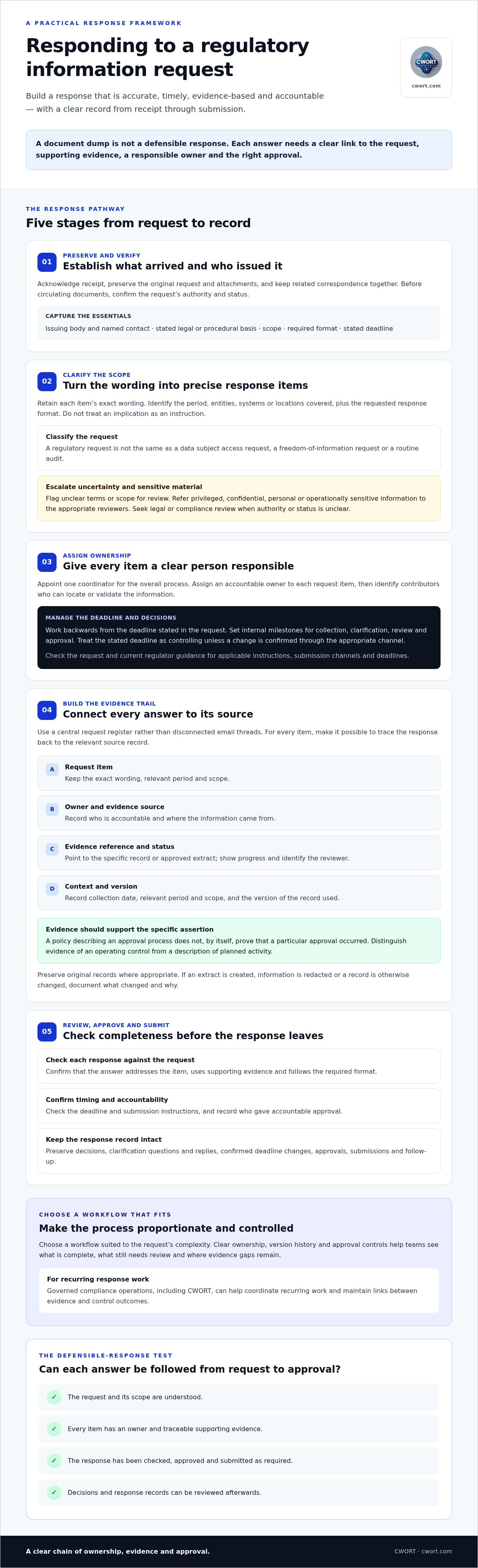
Acknowledge receipt, preserve the request and assign a coordinator. Before circulating documents, confirm who issued the request and what they’re asking for. Record the issuing body, named contact, stated legal or procedural basis, scope, required format and deadline. Keep the original request and attachments together with related correspondence so the record remains intact.
Classify the request before setting the response process. A regulator’s request within its remit is different from a data subject access request, a freedom-of-information request or a routine audit. Each may involve different owners, handling rules and response channels. If the request’s authority or status is unclear, ask the appropriate internal legal or compliance lead to review it. Regulatory compliance means adhering to applicable requirements, but not every request should be treated in the same way. See this overview of regulatory compliance.
What should the initial request review establish?
Translate the request into a precise list of items. Compare each item with the original wording, and don’t treat an implication as an instruction. For each item, identify the period, entities, systems or locations covered, along with the requested response format. If a term is unclear or the scope appears incomplete, flag it for review rather than letting teams make separate assumptions.
Check for information that may need careful handling, including privileged, confidential, personal or operationally sensitive material. Refer these issues to the appropriate reviewers before making decisions about collection or disclosure. The response coordinator manages the workflow, but doesn’t replace accountable organisational judgement or regulator-specific interpretation.
How should teams manage deadlines and accountability?
Work backwards from the deadline stated in the request. Set internal milestones for evidence collection, clarification, review and approval, leaving time to resolve gaps before submission. Treat the stated deadline as the controlling date unless a change is confirmed through the appropriate channel. Check the request and the regulator’s current guidance for applicable instructions, submission channels and deadlines.
Assign one accountable owner to each request item, then name contributors who can locate or validate the relevant information. This prevents a common failure: several teams assuming someone else owns the answer. Maintain a central log of request items, owners, contributors, status and key decisions. Record clarification questions and replies, any confirmed deadline changes, and who approved the final response. This creates a clear chain of accountability from receipt through submission.
That initial discipline makes the next stage more reliable: mapping each request item to traceable evidence instead of assembling documents without a clear link to what was asked.
Build a traceable response: map every request item to evidence
Once the scope is clear, build a request register that connects each question to the person responsible and the evidence supporting the answer. Avoid managing the process through disconnected email threads. They make it harder to see what’s complete, what’s under review and where gaps remain.
For each item, record the request wording, accountable owner, evidence source, status, evidence reference and reviewer. Add the collection date, relevant period and scope, as well as the version of the record used. This gives reviewers a route from the submitted answer back to its source, rather than asking them to rely on an unsupported summary.
- Item wording: retain the request’s exact language.
- Owner and source: identify who is accountable and where the record came from.
- Status and reviewer: show progress and who checked the response.
- Evidence reference: point to the specific record or approved extract.
Distinguish evidence of an operating control from a description of intended or planned activity. A policy describing an approval process doesn’t, by itself, show that a particular approval occurred. Match each assertion to evidence that supports it, and make clear when a response describes a plan rather than a completed action.
How do you collect evidence without losing context?
Ask source owners for records with enough context to establish what they show, which systems or entities they cover, and the relevant period. Preserve original records where appropriate. If you create an extract, redact information or otherwise transform a record, document what changed and why. For further guidance on provenance, see ensuring compliance evidence integrity.
Check relevance, not just resemblance. A document may concern the same topic but fail to support the specific assertion in the response. For example, a general access-control policy isn’t necessarily evidence that access was reviewed for the requested system and period.
How can teams validate answers consistently?
Have a second reviewer check each answer for completeness, accuracy, consistency with the request and a valid evidence reference. Record missing documents and conflicting information openly. Escalate unresolved points to the appropriate decision-maker rather than smoothing them over with confident wording.
Maintain version control for both the response and its evidence set, so reviewers can identify which material supports the version approved for submission. A governed workflow, such as the evidence and control tracking supported by CWORT, can help keep ownership and evidence links visible. Explore a governed evidence workflow as an option for coordinating response work.
Choose a response workflow that fits the request’s complexity
The right process depends on the request’s scope, sensitivity and number of people involved. A focused request with a clear evidence source may be managed through a controlled spreadsheet and email. A request spanning teams, systems or overlapping obligations needs stronger coordination. The aim isn’t to introduce tools for their own sake. It’s to maintain clear ownership, evidence traceability, separation of approval responsibilities, version history and reliable reporting.
Compare your options against those criteria:
- Email and spreadsheet: quick to establish and suitable for limited work, but status, evidence links and approvals depend on disciplined manual updates.
- Existing workflow tools: may help assign tasks and track progress, but check whether they preserve evidence references, approval history and a usable decision trail.
- Governed compliance platform: can provide structured ownership, controlled access and linked evidence across response items, subject to appropriate configuration and validation.
Scale governance to the risk and complexity. A lightweight process can still be defensible if access is controlled, owners are named, versions are managed and decisions are retained. As the number of request items, contributors or sensitive records grows, manual coordination becomes harder to oversee. For broader workflow design, see regulatory compliance workflow automation.
When can a manual tracker be sufficient?
A manual tracker may work for a request with limited scope, few contributors and known evidence sources. Name an owner for each item, restrict access to relevant people, identify the current version and retain key decisions alongside the tracker. Don’t rely on inbox searches as the audit trail. A manually maintained status can quickly become unreliable if updates, clarifications or approvals aren’t recorded consistently.
When does a governed workflow add value?
Consider a governed workflow when many items, distributed teams, sensitive evidence or overlapping obligations make coordination difficult. Assess whether the process supports distinct roles, appropriate approvals, evidence links and an auditable history. A platform such as CWORT can structure ownership and bind evidence to control outcomes, whilst remaining separate from regulator-specific interpretation and accountable decisions.
Where mappings have been confirmed, one validated evidence base may support more than one reporting need. That doesn’t mean every record is relevant to every request: check its scope, context and approval before reusing it. If you’re assessing how a governed process could fit your response work, review CWORT’s compliance workflow.
Review, approve and submit the response with defensible controls
Before submission, run a final check against the original request. Confirm that every item has an answer, the response follows the requested format and the deadline has been verified. Check that each answer is clear, responsive and consistent with its recorded evidence reference. An answer that sounds complete but relies on an unverified assumption needs further review.
What should the final quality review cover?
Use a reviewer who can challenge the response rather than simply repeat the preparer’s checks. Verify that supporting records substantiate the specific claims, and look for contradictions between answers or evidence sources. Confirm that any proposed redactions or disclosures have received appropriate specialist review. Resolve gaps and conflicting records before approval, or escalate them openly to the accountable decision-maker. Don’t present an assumption as a verified fact.
Separate preparation, review and approval responsibilities where appropriate. Record who completed each stage and who gave final sign-off. This creates a clear approval trail and helps demonstrate that the submitted response was considered, not simply assembled under deadline pressure. When deciding how to respond to a regulatory information request, check the issuing body’s instructions for the submission channel and any required format. Use the specified secure route, and retain evidence of transmission and receipt where available.
What should teams record after submission?
Preserve the exact submitted version in controlled storage, together with the evidence references used, approval history, transmission record and receipt. Keep subsequent correspondence with the same response record. If the regulator asks a follow-up question, create a linked work item, assign an owner and set internal milestones for gathering, reviewing and approving the additional information.
Keep the historical submission intact. If a later review identifies an error or improvement, document it as a separate decision or remediation action rather than silently editing the submitted record. This preserves the distinction between what was sent, what was known at the time and what changed afterwards.
A disciplined close-out makes the response auditable and gives teams a sound basis for handling future requests. If you’re looking to strengthen ownership, evidence links and approval history across response work, see how a governed compliance workflow could support your process.
Make regulatory information requests repeatable with governed compliance operations
A well-managed response shouldn’t depend on one person remembering where evidence sits or how a previous request was handled. Turn recurring themes into defined obligations, named owners, reusable evidence references and controlled workflows. Reuse can reduce repeated searching, but check each record against the specific request, scope and period.
A repeatable capability needs clear roles and standards: who prepares an answer, who reviews it, who approves it and when an issue must be escalated. Preserve the history of status changes, decisions and approved outputs so the organisation can trace how a response was assembled. If evidence exposes a control gap, connect it to an owned remediation action and track progress separately from the historical submission.
How can CWORT support a governed response workflow?
CWORT is a compliance validation platform that maps obligations to structured execution activities, assigns ownership and binds evidence to control outcomes. Its control-by-control evidence registers support status tracking, while role-based and attribute-based access controls, separation of duties and immutable audit history help maintain accountability. The platform sits above existing security tools, bringing relevant evidence into a unified view to support auditable reporting.
This can help teams coordinate response work across fragmented sources without manually reconstructing every evidence trail. CWORT supports the process, but doesn’t replace regulator-specific interpretation, legal review or accountable organisational decisions. Structured outputs should be treated as assurance support, not as a guarantee that a regulator will accept a response or that the organisation is compliant.
Teams considering how to respond to a regulatory information request consistently can review the CWORT compliance platform and assess whether its approach fits their ownership, evidence and approval needs. Validate reusable mappings before applying them to another obligation or request.
For a closer look at how structured execution and evidence tracking could support your process, request a CWORT platform demonstration.
How to respond to a regulatory information request consistently
A reliable response depends on more than meeting a deadline. Confirm the request’s scope, connect every answer to traceable evidence, and retain a clear record of review, approval and submission. These practices help teams respond to a regulatory information request with greater control whilst building a repeatable approach for future requests.
CWORT supports this work with control-by-control assurance evidence registers and status tracking, alongside access controls, separation of duties and immutable audit history. Its AI advisory provides suggestions only; it doesn’t alter deterministic results. The platform can help coordinate execution and evidence, but it doesn’t replace regulator-specific interpretation or accountable organisational decisions, nor does it guarantee acceptance or compliance.
If your team is assessing how to strengthen its response workflow, request a CWORT demonstration to explore how structured ownership and evidence tracking could fit your requirements. Start with a process that makes decisions visible and evidence easier to verify, then build on it with confidence.
Frequently Asked Questions
What is a regulatory information request?
A regulatory information request is a request from a regulator for information, records or explanations within its remit. Its authority, scope and possible consequences depend on the issuing body and circumstances. Check the request and the regulator’s current guidance to understand what applies. Don’t assume every request follows the same legal process or response timetable. If its authority or scope is unclear, refer the question to an appropriate internal legal or compliance lead.
How quickly should we respond to a regulatory information request?
Respond by the deadline stated in the request, after checking applicable regulator guidance or formal notices. To plan how to respond to a regulatory information request, set earlier internal milestones for evidence gathering, review and approval. If timing or scope is unclear, escalate promptly and seek clarification through the stated contact route. Continue working on clear items whilst awaiting a reply. Don’t treat a clarification request as an extension, and record a revised deadline only if the regulator confirms it.
Can we ask a regulator to clarify a request?
Yes. Ask a focused clarification question if the wording, scope, format or timing is unclear. Use the appropriate contact channel identified in the request or regulator guidance. Record what you asked, when you asked and the response received so the decision trail is clear. Continue gathering information for the parts you understand whilst waiting. A clarification request doesn’t change the deadline by itself; treat any revised date as confirmed only when the regulator says so.
What evidence should we provide in response to a regulator?
Provide evidence that directly supports each answer and matches the requested scope and period. Record its source, collection date, version and owner, then check that it’s complete and suitable for disclosure. For example, a general policy may not prove that a specific review took place during the period requested. Avoid sending unrelated material. Refer questions about privilege, confidentiality, personal data or sensitive information to the appropriate legal or specialist reviewer before disclosure.
Should legal or compliance review a regulatory response before submission?
Involve legal, compliance or other specialists when the request’s authority, interpretation, disclosure or sensitive information is uncertain. The appropriate review depends on the request and the organisation’s obligations. Assign an accountable approver and retain a record of the decision. A workflow can organise evidence, reviews and approvals, but it can’t replace professional judgement or legal advice. Check regulator-specific requirements against the actual request and official guidance before finalising the response.
How do we keep an audit trail of a regulatory response?
Maintain a central register showing request items, owners, evidence references, status, reviewers and decisions. Preserve the final approved response, submission and receipt records, and related regulator correspondence with suitable version history and access controls. Record gaps and follow-up actions as they arise, linking each to an owner. The record should let an authorised reviewer trace how each answer was prepared, supported by evidence, reviewed and approved, without relying on scattered email threads or individual recollection.
Disclaimer
The content on this site is provided for general information and educational purposes only. It does not constitute legal, regulatory, financial, or professional advice. CWORT provides AI-assisted insights and workflow automation, but all compliance decisions remain the responsibility of your organisation and its management. Always seek qualified legal or regulatory guidance for decisions relating to the UK NIS Regulations, CAF, DORA, NIS2, ISO 27001, or other obligations.
Related posts
Real-Time Compliance Dashboards for Executive Decisions
See how real-time compliance dashboards for executives turn trusted data into clear risk signals, accountable actions and stronger regulatory oversight.
How to Demonstrate Control Effectiveness to Regulators: A Strategic Guide
Learn how to demonstrate control effectiveness to regulators with our guide. Shift from chaos to an evidence-based, audit-ready compliance programme today.
DORA Technical Standards Compliance: Moving from Regulatory Theory to Validated Execution
Struggling with DORA technical standards compliance? Move beyond spreadsheets to a validated framework that provides real-time, auditable evidence for regula...
Article by
Michael Iyiola
Co-Founder, CWORT
Michael Iyiola is a co-founder of CWORT and a Cyber and AI Security Engineer with deep experience in vulnerability management, detection engineering and operational resilience across UK critical national infrastructure, including rail, energy and financial services. At CWORT, he designs scalable, evidence-driven workflows that help teams meet modern regulatory and security demands.
Build Your Foundation of Auditable Certainty
Take control of your regulatory obligations and secure your infrastructure with CWORT.