ICT Risk Management Reporting Software: A Strategic Guide to Regulatory Validation in 2026

Michael Iyiola
Co-Founder, CWORT
Ditch Excel for DORA. Our guide to ICT risk management reporting software shows you how to automate compliance for NIS2 & ISO 27001 and face 2026 audits with...

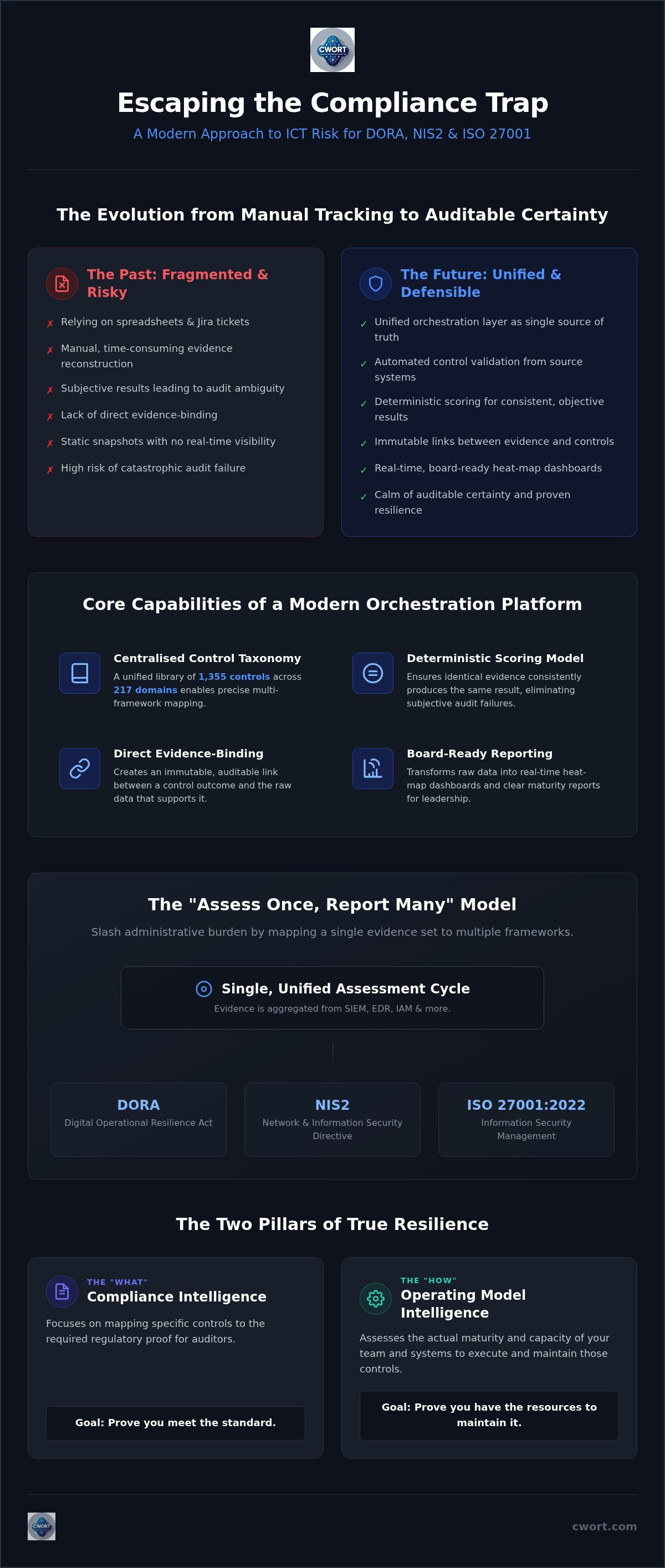
Spreadsheets are no longer a viable defence against a DORA auditor's scrutiny. If you're still relying on manual data entry or fragmented Jira tickets to prove compliance, you're operating on borrowed time. It's understandable why many leadership teams feel a sense of mounting anxiety as the 2026 regulatory deadlines for the EU AI Act and NIS2 approach. You've likely spent countless hours manually reconstructing evidence for the board, only to worry that a lack of separation of duties or a single broken link in Excel could lead to a catastrophic audit failure. Deploying a robust ICT risk management reporting software isn't just an IT upgrade; it's a strategic necessity for maintaining operational integrity.
This guide will show you how to move beyond administrative tracking and toward a deterministic system that delivers absolute, evidence-based proof. You'll discover how to consolidate fragmented data into a single source of truth that satisfies DORA, NIS2, and ISO 27001:2022 requirements simultaneously. We'll explore the transition from static snapshots to automated control validation and board-ready heat-map dashboards. By the end of this article, you'll have a clear roadmap for replacing regulatory anxiety with the calm of auditable certainty.
Key Takeaways
- Transition from fragmented tracking in Jira and Excel to a unified orchestration layer that provides a single, defensible source of truth for all regulatory evidence.
- Utilise a centralised taxonomy of 1,355 controls to "assess once and report many," satisfying the overlapping requirements of DORA, NIS2, and ISO 27001:2022 simultaneously.
- Adopt deterministic scoring models to ensure identical evidence consistently yields the same result, eliminating the subjectivity that often leads to audit failure.
- Deploy specialised ICT risk management reporting software to transform raw data into board-ready maturity reports and real-time heat-map dashboards.
- Implement a structured seven-step validation process to link organisational capability directly to capacity, ensuring your compliance posture is both visible and actionable.
Table of Contents
- Beyond the Spreadsheet: The Evolution of ICT Risk Management Reporting
- Core Capabilities of Modern ICT Risk Orchestration Platforms
- Ensuring Audit-Defensibility: Evidence Binding and Deterministic Scoring
- Strategic Implementation: Mapping ICT Risks to Regulatory Frameworks
- CWORT: Orchestrating Board-Ready Compliance and Operational Resilience
Beyond the Spreadsheet: The Evolution of ICT Risk Management Reporting
Modern IT risk management is no longer a passive exercise in documentation. It's an orchestrated validation process. In 2026, the regulatory landscape has shifted from "best effort" to "proven resilience." With DORA now fully applicable and NIS2 expanding its reach across the UK and EU, the stakes for financial and critical infrastructure organisations couldn't be higher. Relying on fragmented Jira tickets or cumbersome Excel sheets creates a dangerous compliance gap. These tools track tasks, not truth. They provide a snapshot of activity whilst failing to offer the deterministic proof that modern auditors demand. Determinism is the new standard. If two auditors look at the same evidence, the system must produce the same result every time.
Why Traditional GRC Tools Fail the Audit Test
Legacy Governance, Risk, and Compliance (GRC) systems often act as glorified filing cabinets. They lack direct evidence-binding, meaning there's no immutable link between a control outcome and the data that supports it. This leads to the "manual reconstruction" trap. When the board asks for a maturity report, teams spend weeks chasing SMEs and stitching together disparate logs. Static data is another fatal flaw. It fails to capture real-time operational capacity or maturity, leaving leadership blind to the actual resilience of the organisation. Without a live connection between evidence and reporting, your compliance posture is a work of fiction by the time it reaches the auditor's desk.
The Shift from Passive Tracking to Active Validation
Effective ICT risk management reporting software must function as an orchestration engine. Instead of merely recording that a control exists, it must translate abstract regulatory obligations into concrete, executable activities. This enables the "Assess Once, Report Many" model. By mapping a single evidence set to multiple frameworks like DORA, NIS2, and ISO 27001, organisations can slash their administrative burden. The CWORT philosophy centres on this unified view. It sits above point-tools like SIEM or EDR, orchestrating data to provide a definitive, audit-defensible reality. It moves the needle from "we think we're compliant" to "we can prove we're resilient." This transition ensures that every report is backed by immutable evidence, providing the certainty required for high-stakes governance.
Core Capabilities of Modern ICT Risk Orchestration Platforms
Modern orchestration platforms don't just store data; they enforce discipline. At the heart of a robust ICT risk management reporting software lies a centralised control taxonomy. CWORT maintains a library of 1,355 controls across 217 domains, ensuring that every technical requirement is accounted for. This granularity allows for precise multi-framework mapping. You can satisfy the specific demands of DORA, NIS2, and ISO 27001:2022 through a single assessment cycle. This approach aligns with global standards such as the NIST Risk Management Framework (RMF), which emphasises the necessity of a structured process to manage security and privacy risks.
Effective orchestration requires a seamless integration layer. The platform must aggregate evidence directly from your SIEM, EDR, and IAM tools. This automation eliminates the manual collection of logs, transforming raw telemetry into validated compliance proof. Leadership teams require more than just raw data. They need board-ready maturity reports featuring real-time heat-maps that highlight critical vulnerabilities before they escalate into audit failures. To see how these capabilities function in a live environment, you can explore a platform demonstration.
Operating Model Intelligence vs. Compliance Intelligence
True resilience requires two distinct but intersecting pillars. Compliance Intelligence focuses on the "what," mapping specific controls to regulatory proof for auditors. Operating Model Intelligence focuses on the "how," assessing the actual maturity and capacity of your team to execute those controls. Whilst compliance proves you meet the standard, operating model intelligence proves you have the resources to maintain it. Together, they provide a holistic view of cyber resilience that most traditional GRC tools simply cannot match.
The Role of AI in Regulatory Reporting
In a high-stakes audit environment, determinism is paramount. AI within the reporting workflow must remain advisory only. It should never alter a deterministic result or hide the underlying evidence. Use AI to assist in processing massive datasets or identifying patterns in evidence collection, but ensure it never compromises the audit trail. Every action must be recorded in an immutable history. This ensures that your reporting remains defensible and transparent, even when leveraging advanced automation. This disciplined approach prevents the "black box" problem often associated with automated compliance tools.
Ensuring Audit-Defensibility: Evidence Binding and Deterministic Scoring
Audit-defensibility is the ultimate benchmark of a high-performing ICT risk management reporting software. In 2026, regulators no longer accept anecdotal evidence or self-certified spreadsheets. Organisations must move beyond subjective assessments to a model of deterministic scoring. This means that identical evidence must always yield the identical result, regardless of which individual performs the assessment. This reproducibility ensures that your maturity scores are not just opinions but verifiable facts. By binding evidence directly to control outcomes, organisations create an unbreakable link between technical reality and regulatory reporting. This process is critical for satisfying the Digital Operational Resilience Act (DORA), which demands that financial entities maintain a rigorous and transparent risk management framework.
Enforcing Separation of Duties by Design
A common pitfall in compliance workflows is the lack of structural boundaries. To achieve meaningful DORA compliance validation, systems must enforce a strict Separation of Duties (SoD) by design. The software shouldn't just suggest SoD; it must prevent the same individual from both performing a control activity and validating its effectiveness. For UK enterprises, this is managed through sophisticated role-based and attribute-based access controls (RBAC/ABAC). These protocols ensure that every action is authorised and every validation is independent. This structural discipline eliminates the risk of internal collusion or accidental bias, providing auditors with the certainty that the reported maturity is accurate and untainted.
From Evidence Collection to Explainable Proof
Regulators like Ofgem and the NCSC require more than just raw data; they demand an explainable view of resilience. The Assurance Evidence Register serves as the single source of truth, housing all bound evidence in a centralised, immutable repository. Immutable audit trails are essential here. They protect evidence from tampering or accidental deletion, ensuring that the history of every control remains intact. This creates a state of reproducible truth. When senior leadership or regulators ask how a specific maturity level was achieved, your ICT risk management reporting software provides a clear, step-by-step path from the original telemetry to the final report. It transforms complex technical data into a narrative of disciplined execution that is both transparent and defensible.
Strategic Implementation: Mapping ICT Risks to Regulatory Frameworks
Strategic implementation of ICT risk management reporting software requires a shift from ad-hoc data collection to a structured, repeatable methodology. It starts with a clear understanding of the organisational risk profile. Instead of forcing a generic template, sophisticated platforms allow you to configure assessment blueprints tailored to specific business units or critical services. This flexibility is enhanced by "Bring Your Own Content" (BYOC) capabilities, enabling firms to integrate custom maturity models alongside standard regulatory requirements. This ensures that your reporting reflects the unique operational reality of your enterprise whilst maintaining strict alignment with external standards.
Step-by-Step Assessment Workflow
A disciplined 7-step process replaces the fragmented regulatory compliance workflow automation often found in legacy setups. First, define or import the model to establish the baseline. Second, configure the blueprint to align with specific organisational goals. Third, assign scope to ensure all relevant assets and departments are covered. Fourth, capture evidence through automated integrations or validated manual uploads. Fifth, calculate maturity using deterministic scoring models. Sixth, identify gaps between current performance and target requirements. Finally, track progress and reassess to ensure continuous resilience. This workflow ensures that remediation efforts are prioritised by business risk and the level of effort required, preventing "compliance fatigue" amongst technical teams.
Cross-Walking Frameworks: CAF, NIS2, and ISO 27001
The "Assess Once, Report Many" philosophy is the cornerstone of modern efficiency. By using a centralised taxonomy of 1,355 controls, organisations can map a single control outcome to multiple frameworks simultaneously. For instance, a validated encryption control can satisfy requirements for the NCSC CAF, NIS2, and ISO 27001:2022 without redundant testing. Utilising an ISO 27001 control mapping tool is particularly valuable for UK firms aiming to streamline their governance. With 98.6% of active controls in the library already carrying framework references, the administrative burden of cross-framework validation is virtually eliminated. This orchestration saves hundreds of manual hours every year, allowing your team to focus on security execution rather than administrative tracking. To see how this mapping functions in a live environment, you can request a platform demonstration.
CWORT: Orchestrating Board-Ready Compliance and Operational Resilience
CWORT sits at the apex of the compliance stack as the definitive strategic partner for UK enterprises. It's not a planning tool or a passive repository; it's a validation engine. By implementing a disciplined "Diagnose, Design, Deliver, Demonstrate" lifecycle, CWORT translates complex regulatory obligations into a governed digital environment. It replaces the inherent unreliability of Jira and Excel with a deterministic model where identical evidence consistently yields the same result. This ensures that your ICT risk management reporting software provides a single source of truth that is both immutable and audit-defensible.
Beyond simple tracking, CWORT links organisational capability to actual capacity. This "Operating Model Intelligence" allows leadership to verify that they have the resources required to maintain resilience. For organisations managing critical national infrastructure, CWORT provides specialised support for Operational Technology (OT) and Industrial Control Systems (ICS). This ensures full alignment with NIS2 and NCSC requirements, moving the organisation from a state of reactive anxiety to one of controlled certainty. It provides the structural integrity needed to survive high-stakes audits whilst maintaining operational momentum.
Designed for Senior Leadership and Audit Committees
Senior leadership teams and audit committees require clarity, not raw data. CWORT eliminates the need for manual reconstruction of compliance proof by providing "Board-ready" reporting outputs directly from the validation engine. Dynamic heat-map dashboards offer instant visibility into the organisation's risk posture, identifying critical gaps before they attract regulatory attention. These reports are built on rigorous standards, including NCSC CAF assessment software protocols, ensuring that the information presented to the board is both technically accurate and strategically relevant. This transparency builds trust with regulators and provides the board with the assurance they need to sign off on resilience statements.
Next Steps: From Gap Analysis to Audit Readiness
Achieving total assurance is a journey that starts with a single, structured step. We invite leadership teams to engage in a focused working session to map CWORT's orchestration capabilities to your existing programme. This allows you to identify immediate efficiency gains and plan a transition from fragmented tracking to a unified validation layer. To demonstrate the power of end-to-end orchestration, we offer targeted pilots on specific sub-functions. This approach proves the value of the platform in a live environment before a full-scale rollout. Don't leave your resilience to chance. Orchestrate your compliance validation with CWORT and secure your organisation's future in the 2026 regulatory landscape.
Securing Operational Resilience Through Deterministic Orchestration
Transitioning from fragmented tracking to a unified validation layer is no longer optional. It's a strategic necessity for UK organisations facing the 2026 regulatory deadlines. By adopting a system that enforces deterministic, reproducible scoring, you eliminate the subjectivity that leads to audit failure. This approach ensures that your ICT risk management reporting software provides a defensible source of truth that stands up to the most rigorous scrutiny from Ofgem or the NCSC. You've seen how evidence binding and framework cross-walking can replace manual reconstruction with automated, board-ready certainty.
CWORT offers a library of 1,355 controls mapped across 42 global frameworks, allowing you to assess once and report many. This orchestration layer transforms raw telemetry into definitive proof of both capability and capacity. It's time to replace the anxiety of potential regulatory failure with the calm of auditable truth. Orchestrate your ICT risk management and compliance validation with CWORT to secure your organisation's future. You have the opportunity to lead your enterprise into a new era of disciplined, evidence-based resilience.
Frequently Asked Questions
What is ICT risk management reporting software, and how does it differ from traditional GRC?
ICT risk management reporting software is an orchestration engine that translates regulatory obligations into technical activities. Unlike traditional GRC tools, which function as passive document repositories, this software actively enforces compliance workflows. It bridges the gap between high-level policy and granular execution. By automating the collection of evidence, it ensures that your risk posture reflects real-time operational reality rather than a static, outdated snapshot.
How does ICT risk software help with DORA and NIS2 compliance in the UK?
This software provides a structured framework for UK organisations to meet the strict timelines of DORA and NIS2. It aligns technical controls with the specific requirements of regulators like Ofgem and the NCSC. By using a centralised library of controls, firms can ensure they meet every regulatory mandate without duplicating effort. It transforms abstract legal requirements into a clear, executable roadmap for achieving and maintaining operational resilience.
Can ICT risk reporting software replace manual spreadsheets and Jira for audits?
It replaces manual tracking by providing a single, immutable source of truth for all audit evidence. Manual spreadsheets are prone to version control errors and broken links, whilst Jira tickets lack the structural context needed for a comprehensive audit. Modern ICT risk management reporting software centralises these activities into an Assurance Evidence Register. This eliminates the frantic manual reconstruction of data often seen during high-stakes regulatory inspections.
What is deterministic scoring in compliance reporting, and why is it important?
Deterministic scoring is a methodology where a specific set of evidence always produces the same maturity result. This removes human subjectivity from the assessment process, ensuring that scores are based on objective data rather than auditor bias. It's critical for audit defensibility because it allows organisations to prove that their reported resilience is reproducible. If an external auditor reviews the same data, they will reach the same conclusion.
How does evidence binding work in an ICT risk management platform?
Evidence binding creates a permanent, immutable link between raw telemetry and a specific control outcome. When data is ingested from tools like SIEM or EDR, the platform automatically attaches it to the relevant requirement. This ensures that every maturity score is backed by verifiable proof. It prevents the risk of orphaned data or missing documentation, providing a transparent trail that auditors can follow from the board report down to the original log.
What are the key features to look for in ICT risk management software for 2026?
Look for platforms that offer multi-framework mapping, real-time maturity dashboards, and robust support for both IT and OT environments. The software must provide deterministic scoring and enforce a strict separation of duties within the workflow. Integration capabilities with existing security stacks are essential to automate evidence collection. Finally, ensure the system can generate board-ready reports that clearly communicate risk levels and remediation priorities to non-technical stakeholders.
How does a compliance orchestration engine support "Assess Once, Report Many" workflows?
An orchestration engine uses a centralised taxonomy to map one technical activity to multiple regulatory domains. This "Assess Once, Report Many" model means that a single validated control, such as an encryption protocol, can satisfy ISO 27001, DORA, and NIS2 simultaneously. It significantly reduces the administrative burden on subject matter experts. This efficiency allows organisations to scale their compliance efforts without a corresponding increase in headcount or manual labour.
Is AI used in ICT risk reporting, and does it impact audit defensibility?
AI is utilised for data processing and identifying patterns, but it must remain advisory to preserve audit integrity. In a robust ICT risk management reporting software, AI never alters the deterministic outcome of a control assessment. It assists by suggesting evidence or highlighting gaps, whilst the final validation remains human-led. This approach ensures that the audit trail is transparent and defensible, preventing the risks associated with fully automated AI decision-making.
Disclaimer
The content on this site is provided for general information and educational purposes only. It does not constitute legal, regulatory, financial, or professional advice. CWORT provides AI-assisted insights and workflow automation, but all compliance decisions remain the responsibility of your organisation and its management. Always seek qualified legal or regulatory guidance for decisions relating to the UK NIS Regulations, CAF, DORA, NIS2, ISO 27001, or other obligations.
Related posts
Reducing Audit Preparation Time and Costs: A Strategic Guide for UK Enterprises
Tired of costly audit seasons? Our guide for UK enterprises shows you how to stop the manual scramble, reducing audit preparation time and costs with automat...
ISO 27001 Control Mapping Software: Orchestrating Evidence-Based Compliance in 2026
Ditch spreadsheets. Discover how ISO 27001 control mapping software orchestrates evidence-based compliance for a defensible, audit-ready posture in 2026.
Streamlining Regulatory Compliance Processes: From Manual Tracking to Orchestrated Validation
Stop wasting money on manual compliance. Learn about streamlining regulatory compliance processes to reduce personal liability under DORA & NIS2 and gain aud...
Article by
Michael Iyiola
Co-Founder, CWORT
Michael Iyiola is a co-founder of CWORT and a Cyber and AI Security Engineer with deep experience in vulnerability management, detection engineering and operational resilience across UK critical national infrastructure, including rail, energy and financial services. At CWORT, he designs scalable, evidence-driven workflows that help teams meet modern regulatory and security demands.
Build Your Foundation of Auditable Certainty
Take control of your regulatory obligations and secure your infrastructure with CWORT.